
Tagged: Greenland
Scandinavian America: A Chronology

.
Leif Erikson Statue at Minnesota State Capitol
.
982 Discovery of Greenland by Norwegian colonists from Iceland.
986-1003 Two Norwegians, Bjarni Herjolfsson and Leif Erikson, reach America, on separate voyages, the former from Iceland and the latter from Greenland. Colonization of “Vinland” fails, but research indicates that the Viking explorers may have penetrated the Americas as far west as Minnesota (see entry 1355). (For less known facts, see my essay Ingeborg, A Viking Girl on the Blue Lagoon here.)
999 According to the Sagas, Icelandic Viking Bjorn Asbrandsson spends thirty years in the Hvitramannaland or White Men’s Land near Vinland, as chief of a native tribe.
1013 Snoiri, son of Gudrid (wife of the Icelander Thorfinn Karlsefni), is the first white child born in North America.
1027 or 1029 According to the Sagas, Gudleif Gudlaugson, stranded in Vinland while sailing from Dublin, Ireland, to Iceland, was saved from skrælings’ hostility by a white man, later identified, from the items he gave Gudleif, as Bjarn the Breidavik-Champion, who had been exiled from Iceland thirty years before.
1064 Jonus, a Saxon bishop, reaches Vinland via Iceland as a Christian missionary. Vinlanders put him to death, which hints at paganism (Odinism) regaining ground in Vinland.
1121 Erik Gnupsson, bishop of Greenland, travels to Vinland and, according to Danish historian Claus C. Lyschander (†1624), sets up a colony there. According to C.C. Rafn (see 1837), he remained in Vinland, resigning from his former seat with a formal letter that reached Greenland in 1122.
1266 Three priests from the Gardar bishopric of Greenland sail to Barrow Strait and Wellington Channel in today’s Canada (Nunavut).
1279 The Holy See sends a cleric collect the dime in Greenland “and the surrounding islands and lands,” that is, Vinland. “In 1418 Greenland was still paying 2,600 pounds of walrus teeth annually for the dime and Peter’s pence” (Gabriel Gravier, Découverte de l’Amérique par les Normands au Xe siècle [The Discovery of America by the Normans in the 10th century], 1874). At this date (1418), the colony of Greenland was devastated; some, like Gravier, believe it was by Henry Sinclair’s float (see 1398), and by Scandinavian pirates called Victualie Brœdre. The colony had already declined by that time, due to climate change, Inuit raids, and the black plague of the 14th century; nevertheless, Gravier presents a list of Greenlandic bishops from 1121 to 1537 (with nominations in 1450, 1487, 1537, the seals of said bishops were found and archived).
1285 Brothers Adalbrand and Thorvald Helgason, both priests, fleeing from Norway find a land they call Fundu-Nyialand, which is Newfoundland in Canada.
1355 On the orders of the King of Norway, Paul Knudson travels to Greenland, where he finds the colony abandoned. Looking for the Greenlanders on the western side, or Vinland, he is believed by some to have journeyed deep into North America and left the Kensington Rune-Stone in Minnesota, in 1362.
1398 Henry Sinclair, earl of Orkney, is believed to have landed in Nova Scotia, Canada. He was a descendant of Seynt Cler or Clere, who accompanied William the Conqueror in England, where William became the first Norman king of the country. A monument to Sinclair’s landing was inaugured in 1996 in Halfway Cove, Guysborough, Nova Scotia.
1473 German corsairs Didrik Pining and Hans Pothorst, licensed by King Christian I of Denmark to sail to Greenland, may have reached Newfoundland and Labrador in Canada.
1488 Jean Cousin, a navigator from Dieppe in Normandy, that is, a descendant of the Normans established in this part of France under King Rollo in 911, is believed to have reached Brazil and come back. One of his captains was Martin Alonso Pinzon, who traveled with Columbus a few years later, in 1492.
1504 Binot Paulmier de Gonneville, from Honfleur in Normandy (see 1488), is the first European to reach the Southern parts of Brazil. He came back to France with the son of a Tupi chief, a certain Essemeric, who settled in Normandy as Paulmier’s heir. Essemeric’s descendants were exempted from the “droit d’aubaine” (feudal tax on foreigners) by Louis XIV in the seventeenth century.
1522 Corsair Jean Fleury, from Normandy (see 1488), attacks near the Azores three Spanish vessels transporting the treasure of the last Aztec emperor. The Aztec treasure landed in Normandy. This is the first known attack against Spanish vessels en route to Spain from the New World.
1630 Scandinavian settlers come with Dutch settlers in the bay of New Amsterdam.
1638 Fort Christina, first Swedish colony (New Sweden/Nya Sverige). (On New Sweden, see Amandus Johnson’s authoritative work The Swedish Settlements on the Delaware 1638-1664, 2 vol. 1911-14, 1927)
1638 The first log cabin in America is erected by Swedes.
1639 Jonas Bronck, a Scandinavian immigrant of disputed origin (Faroe Islands, or Denmark, or Sweden), married with a Dutch woman and settled in New Netherland, is the first to colonize the area that now bears his name, the Bronx in NYC, as does the Bronx River (Bronck’s river).
1655 After a battle at Fort Christina, during which the Dutch troops were led by Peter Stuyvesant, New Sweden becomes part of New Netherland. Later, in 1664, the Dutch New Amsterdam is conquered by an English fleet.
1681 William Penn buys the land for his colony of Pennsylvania from Swedish settlers.
1705 Thormodus Torfæus, royal historian of the Kingdom of Denmark-Norway, writes Historia Vinlandiæ Antiquæ (History of Ancient Vinland).
1721 Missionary Hans Egede, “the Apostle of Greenland,” founds the second Scandinavian settlement in Greenland, restoring Denmark’s broken relationship with this territory.
1728 Vitus Bering, Danish-born explorer leading a Russian fleet, enters the Strait that today bears his name, the Bering Strait between the Russian Far East and Alaska.
1739 Gustavus Vasa, or The Deliverer of His Country, a tragedy on the King of Sweden by Irish playwright Henry Brooke: “Brooke’s play found considerable favor in America during the latter part of the eighteenth’s century, and became a kind of battle-play of the American Revolution.” (Adolph B. Benson, “Was ‘Gustavus Wasa’ the First American Drama?”, Scandinavian Studies and Notes, Aug. 1921).
1749 Peter Kalm, of the Swedish Royal Academy of Sciences, is told by French explorer La Vérendrye about a stone discovered by the latter in what is today North Dakota. The stone was engraved with signs which some Jesuits found similar to the Tatarian script copied in one book of their library in Quebec. According to Hjalmar R. Holand, it could be a runic stone, as Tatarian script looks alike Scandinavian runes. Its whereabouts in France are unknown. (H.R. Holand, Norse Discoveries & Explorations in America 982-1362, 1940) “The Minnesota Historical Society has offered a $1000 reward for the stone’s rediscovery.” (Wkpd: Vérendrye Stone)
1769 Foundation in Philadelphia of a Society of Scandinavians, as a socio-cultural organization.
1776 John Morton, of Delaware, descendant of Swedish settlers, casts the deciding vote in favor of the Declaration of Independence.
1780 Swedish count Axel von Fersen is named general Rochambeau’s aide-de-camp in the French expeditionary corps fighting for American independence. He was awarded the Order of Cincinnatus by George Washington. (As Earl Marshal of Sweden, he was massacred by a mob in 1810 during the events that brought the Bernadotte dynasty of French and Napoleonian origin on the Swedish throne.)
1781-82 John Hanson, descendant of the earliest Swedish settlers, serves as the first “President of the U.S. in Congress Assembled,” before George Washington is elected President of a new U.S. government. Thus, he was chief executive of the nation during its first year.
1801-05 First Barbary War, in which the U.S. and Sweden together fought against the Barbary States of North Africa to stop piracy in the Mediterranean Sea. (There was a Second Barbary War, also known as the US-Algerian War, in 1815.)
1817 The Swedenborgian Church of North America (General Convention of the Church of the New Jerusalem) is established in Philadelphia.
1824 Finding in northwestern Greenland of the Kingittorsuaq Runestone, dated 1135 by one estimate. It is now located at the National Museum of Denmark in Copenhagen. Other runic artefacts from Greenland include the runestone from Brattahlid, the runestone from Gardar, the wooden stick from Hjerolfsnes churchyard, the (lost) Høne runestone, the Narsaq inscription.
1826-1910 Norway gave to America a larger proportion of her people than any other nation, except Ireland, during the great Atlantic migrations.
1837 Danish historian Carl Christian Rafn publishes Antiquitates americanæ, sive Scriptores septentrionales rerum antecolombianarum in America, opera et studio (American Antiquities, or the writings of Nordic authors on pre-Columbian matters in America: Their works and an examination of them), a collection of early sources on pre-Columbian Nordic travels and settlements.
1840 Swedish Immigration Law of 1768 restricting the right of emigration is repealed by the Parliament of Sweden as an answer to the problem of pauperism.
1843 Mr. Richter, of Otsego (State of New York), sees in the ruins of Aztalan, Wisconsin, an ancient, pre-Colombian Scandinavian site: in Mémoires de la Société royale des Antiquaires du Nord 1840-1843 pp. 8, 9 (quoted by G. Gravier, op. cit., p. 229. Aztalan written Uzteilan).
1844 A Dr. Schuck (Instituto Histórico Brasileiro?) hypothesizes that the pre-Colombian city of the Bahia province in Brazil was built by Normans from Greenland-Vinland: in Mémoires de la Société royale des Antiquaires du Nord 1840-1843 pp. 26-7, 1844 p. 180 (quoted by Gravier, op. cit., p. 235).
1846 Eric Jansson or Janson, leader of the Swedish pietistic sect known as the Jansonites, builds Bishop Hill Colony in Illinois, a communal society that was to last until 1870. Swedish-American naïve painter Olof Krans grew up in the colony.
1847 The first Scandinavian newspaper in the U.S., Skandinavia, is published in New York City.
1848 Creation of the first Bygdelag, or “District League,” Norwegian-American organization with social and cultural purposes.
1848 Danish pioneer Peter Lassen leads a party through the Sierra Nevada to northern California, blazing a new route past the mountain that now bears his name: Lassen Peak.
1850 Beginning of Danish Mormons’ emigration to Utah. (Danes are the major European component of the Mormons. See William Muller’s Homeward to Zion: The Mormon migration from Scandinavia, 1957.)
1850 Swedenborgians found a denominational liberal arts college, Urbana College in Urbana, Ohio, which became Urbana University in 1985.
1851 First Scandinavian political organization, the Swedish-American Republican Club of Illinois.
1852 Norwegian virtuoso violinist and composer Ole Bull buys land in Pennsylvania to start a utopian farming community, New Norway. It is a failure. The location is today Ole Bull State Park, in Stewardson Township.
1854 Scandinavians, as a group, begin to transfer their political allegiance from the Democratic to the Republican Party. The process was completed by 1860.
1856 Scandinavians largely oppose the American (Know-Nothing) Party in favor of immigration restriction and longer residence requirements for citizenship. (See entry 1886i for a shift in opinion.)
1857-1859 In his four-volume Histoire des nations civilisées du Mexique et de l’Amérique centrale durant les siècles antérieurs à Christophe Colomb (History of the civilized nations of Mexico and Central America in the centuries before Columbus), French Catholic priest Brasseur de Bourbourg, translator of the Popol Vuh, explains that the Toltecs of Mexico were “Thuletecs,” that is, Scandinavian Norsemen.
1862 Foundation of Gustavus Adolphus College in St. Peter, Minnesota, by Swedish immigrants. (Since 1965 the annual Nobel Conference takes place at Gustavus.)
1862 Norwegian-American colonel Hans Christian Heg forms the 15th Wisconsin Infantry Regiment of the Union during the American Civil War. The regiment was known as the “Scandinavian Regiment,” because its soldiers were almost all immigrants from Norway, Sweden, and Denmark. Heg’s statue by Paul Fjelde (born to Norwegian parents) stands at the Wisconsin State Capitol building in Madison.
1864-1867 The Great Famine in Sweden leads to an exodus to America.
1872 Icelander Jon Olafsson leads a movement for the exploration of Alaska as a settlement site for Icelanders. The resulting bill is not passed. Icelanders create a New Iceland colony near Lake Winnipeg, on land granted by the government of Canada; the colony is named Gimli after the paradise of Norse legends.
1872 Foundation of the first Laestadian congregation in America, at Cokato, Minnesota. Laestadianism, named after Swedish preacher Lars Levi Laestadius (1800-1861), is the largest Lutheran pietistic revival movement in the Nordic countries.
1874 America Not Discovered by Columbus, by Norwegian-American Asmus Bjørn Anderson, originator of Leif Erikson Day.
1874 Foundation of St. Olaf College in Northfield, Minnesota, by Norwegian-American immigrants.
1874 French historian Gabriel Gravier publishes Découverte de l’Amérique par les Normands au Xe siècle (Discovery of America by the Normans in the tenth century AD), in which he contends that the “Normans” of Greenland-Vinland found their way into the whole American continent. He explains that the tumuli of the Mississippi valley (Cahokia) and Florida, those of Guatemala (Rabinal), and the Aztec pyramids are based on the model of Scandinavian tumuli.
1874 Norwegian-born Oliver Olson founds in Chicago the one-man Olson Rug Company, with a concept, the “Olson fluff rug,” “a hand-weaved product made from older, repurposed fabric.” The company will become a major manufacturer of rugs and carpets. Walter Olson, Oliver’s son and successor, built the Olson Park and Waterfall, a popular landmark in Chicago (closed in 1971).
1877 Swedenborgians found in Bryn Athyn, Pennsylvania, the Academy of the New Church, now Bryn Athyn College.
1877 Foundation of the Norwegian-American Historical Museum (now Vesterheim Norwegian-American Museum) in Decorah, Iowa. Decorah is nicknamed the “Norwegian capital” of the state.
1880 French historian Eugène Beauvois publishes La Norambègue : Découverte d’une quatrième colonie précolombienne dans le Nouveau Monde (Norumbega: Discovery of a fourth pre-Columbian [Viking] colony in the New World), in which among other things he derives the Gougou myth of Souriquois Micmac Indians described by Champlain from the Scandinavian troll-woman or ogress Gýgr (or Gýgur).
1883 The first prima donna of the New York Metropolitan Opera is a Swedish woman: Christina Nilsson.
1883 Swedish immigrant Frank Ofeldt patents the “naphta launch,” the world’s first successful motorboat. See The Naphta Revolution: The Untold Story of an Invention That Changed the World, 2002, by Graeme Ferguson.
1884 Foundation of Dana College in Blair, Nebraska, by Danish immigrants (1884-2010).
1884 The Co-operative Commonwealth in Its Outlines: An Exposition of Modern Socialism, a milestone of Socialist thinking in America, by Danish-born Laurence Gronlund.
1886 Many Scandinavians join nativist associations in opposition to the emigration of new people from Southern and Eastern Europe.
1886 Due to agrarian distress in the Midwest, thousands of Scandinavians leave the Republican Party and join the Farmers’ Alliance, which will later become part of the Populist Party.
1887 The first statue of Leif Erikson in America, “Leif the Discoverer” by Anne Whitley, is unveiled on the Commonwealth Avenue Mall in Boston, MA.
1887 Foundation in California of The Buddhist Ray, first Buddhist journal in the U.S., by Swedish-born Herman Vetterling, a Buddhist convert. Vetterling’s best-known work is Swedenborg the Buddhist, or The Higher Swedenborgianism: Its Secrets and Thibetan Origin, 1887 (under pseudonym Philangi Dasa).
1888 Publication of the Norwegian-American newspaper Normanden is started in Grand Forks, North Dakota; headed by writer Hans Andersen Foss, it expresses the Populist sympathies of the Scandinavian farmers (1888-1993). (More on H. A. Foss: see Prohibitions-Mystik here.)
1889 American scientist (chemistry) Eben Norton Horsford has the Norumbega Tower erected in Weston, MA, to mark the location of Fort Norumbega, an alleged pre-Columbian Norse settlement (see at 1880). See also his book The Discovery of the Ancient City of Norumbega, 1890.
1889 Commercialization by Westinghouse of the first automatic storage water heater, developed by Norwegian-born engineer Edwin Ruud. In 1897 Ruud founds his own company, Ruud, now Rheem (keeping the name Ruud as a brand).
1890 Jacob A. Riis, probably the best-known Danish-American intellectual, publishes How the Other Half Lives, an influential appeal to social conscience. He later published, among other things, his memoirs under the title The Making of an American, 1901.
1890 Scandinavians in the Midwest are instrumental in getting Farmers’ Alliance’s candidates elected to the House of Representatives.
1890 Publication of Svensk-amerikanska poeter i ord och bild (Swedish-American Poets in Words and Pictures; an anthology) by Ernst Skarstedt, Svenska folkets tidnings förlag, Minneapolis, MN. (For my French translations of a few of these poems, and a poem in the original text by Herman Stockenström, see here.) (Swedish-American historian Emory Lindquist, president of Bethany College and Wichita State University, wrote Skarstedt’s biography, An Immigrant’s American Odyssey: A Biography of Ernst Skarstedt [1970].)
1891 In reply to a questionnaire sent to governors of states by the Immigration Restriction League, 12 state governments express a desire for immigrants of Scandinavian background (for these are perceived as “hard-working, God-fearing, and non-radical”).
1894 Swedish immigrants Alfred Stromberg and Androv Carlson found telecommunications company Stromberg-Carlson in Chicago, “one of five companies that controlled the national supply of telephone equipment until after WWII” (Wkpd).
1894 “Give me Swedes, snuff and whiskey, and I’ll build a railroad through hell.” (James J. Hill, of the Great Northern Railroad)
1894 The John Ericsson Republican League of Illinois is founded. “Its mission was to exert a Scandinavian-American influence on American politics and advance Scandinavian-Americans for political office. … (The league was named after) Captain John Ericsson, Swedish-American engineer and inventor best known for his creation of the Union ironclad warship U.S.S. Monitor, which defeated the Confederate ironclad warship U.S.S. Merrimac in a naval battle on March 9, 1862. This battle was instrumental in securing a Union victory in the Civil War.” (augustana.edu)
1894 Many Scandinavian-Americans join the American Protective Association, a nativist anti-Catholic organization.
1894 Numerous victories of the Populist Party, especially in Scandinavian populated states: North and South Dakota, Minnesota, Wisconsin.
1895 Creation of the Sons of Norway, the largest Norwegian secular organization in America.
1897 In Yukon Charley Anderson becomes “Lucky Swede”: “A Swede named Charley Anderson had been at work on Miller Creek the year of the strike, and arrived in Dawson with a few hundred dollars. Two miners, who had staked No. 29 Eldorado, decided that he was the proper man upon whom to “unload.” He was too canny to approach sober, so at a considerable expense they got him drunk. Even then it was hard work, but they kept him befuddled for several days, and finally, inveigled him into buying No. 29 for $750. When Anderson sobered up, he wept at his folly, and pleaded to have his money back. But the men who had duped him were hard-hearted. They laughed at him, and kicked themselves for not having tapped him for a couple of hundred more. Nothing remained for Anderson but to work the worthless ground. This he did, and out of it he took over three-quarters of a million of dollars.” (Jack London, The Gold Hunters of the North, in Revolution and Other Essays)
1898 Finding of the Kensington Stone, a slab of Runic inscriptions, dated 1362, in Minnesota.
1898 Archaeologist Cornelia Horsford’s Dwellings of the Saga Time in Iceland, Greenland, and Vineland. Cornelia is the daughter of Eben Norton Horsford (see 1889).
1898 Danish engineer Valdemar Poulsen patents the “telegraphone,” the first magnetic wire recorder, in the US. “It might be of interest to mention that the Poulsen patent on the steel recorder is the only patent ever issued in the United States by virtue of a special Act of Congress.” (P. L. Jensen, The Great Voice, 1975)
1899 Thorstein Veblen’s Theory of the Leisure Class.
1899 Swedish-born Carl Swanson becomes a partner with John O. Hjerpe (or, Americanized, Jerpe; a Swedish name) in a wholesale company that will become the food production company Swanson. In 1953 the company, under Carl’s two sons, Gilbert Carl and W. Clarke, launches “TV dinners,” which commercial success introduces frozen meals in American homes nationally.
1900 Minneapolis is the Scandinavian capital of America, the center of Swedish and Norwegian newspapers, churches, and seminaries.
1901 Charles Walgreen, born to Swedish immigrants (Wahlgren), starts a pharmacy in Chicago. Today, Walgreens Boots Alliance is the 26th largest U.S. company.
1902 Swedish-born Justice P. Seeburg, born Sjöberg, founds the J.P. Seeburg Piano Company in Chicago, manufacturing orchestrions and automatic pianos. In 1949 the company, managed by his son Noel, introduces a jukebox mechanism that nearly puts all other manufacturers out of business, then incurring, and losing, a lawsuit under the anti-trust law in the nineteen-fifties.
1902 Chicago-based Ottilie Liljencrantz writes her first Viking romance, The Thrall of Leif the Lucky, based on the journeys of Leif Erikson to Greenland and America.
1903 Norwegian-born newspaperman and writer, friend of Ole Rolvaag’s, Waldemar Ager becomes editor of Eau Claire, Wisconsin newspaper Reform (a position he kept till his death in 1941). Among other things, Ager was a prominent supporter of Prohibition. His books include On the way to the Melting Pot (1917). (Einar Haugen [see 1972i] wrote Ager’s biography: Immigrant Idealist: A Literary Biography of Waldemar Ager, Norwegian American, 1989.)
1903 Swedish-born Charles Borg and Marshall Beck found Borg & Beck, designing and selling car parts. In 1909 they invent the first practical sliding clutch. Merging with other manufacturers in 1928, they form the Borg-Warner group, of which, among other activities, the Norge Appliance Company provides appliances for the nationwide laundromat chain Norge, well-known in the nineteen-fifties. (Norge is the Norwegian name of Norway.)
1904 Swedish-born engineer Ernst Alexanderson patents the “Alexanderson alternator,” an early radio transmitter: it was one of the first devices capable of generating the radio waves needed for transmission of amplitude modulated signals by radio and was used to transmit transoceanic messages by Morse code.
1905 Alexander Pierce Anderson, born to Swedish immigrants, patents the process for making puffed rice cereals and starts the Anderson Puffed Rice Company. Quaker Oats Co., partnering with Anderson, advertised the cereal as “Dr. Anderson’s Gift,” “the Eighth Wonder of the World,” and “Food Shot From Guns.”
1905 Norwegian-born labor leader Olaf Tveitmoe founds the Asiatic Exclusion League, a political organization advocating immigration restrictions to bolster domestic wages.
1906 Danish-born Soren Sorensen “Sam” Adams founds The Cachoo Sneezing Powder Company, later S.S. Adams Co., undisputed leader in practical joke and magic trick manufacturing.
1907 Norwegian-born Ole Evinrude invents the first outboard motor with commercial application.
1907 The Swedish-American Art Association is founded in Chicago. Founding members include painters Arvid Nyholm, Henry Reuterdahl, Gerda Ahlm, and its first president was sculptor Carl Johann Nilsson.
1908 Swedish-born Vera Swanston Howard embarks on translating Selma Lagerlöf’s works in English, which she will be doing for some twenty years. She also translated some of Strindberg’s works. In this same year 1908 she has a novel of her own, När Maja-Lisa kom hem från Amerika (When Maja-Lisa comes back from America), published in Stockholm by the Nationalförening mot emigrationen (see 1912).
1909 The Federal Telegraph Company, initially known as the Poulsen Wireless Telephone and Telegraph Company, named after Valdemar Poulsen (see 1898iii), licenses the Poulsen arc converter transmitter for use in the US. Use of arc transmitters largely ceased in the 1920s, supplanted by Alexanderson alternators (see 1904).
1909 Swedish-born painter Carl Oscar Borg is a founding member of the California Art Club.
1910 Even as late as 1910, Scandinavian immigrants are less inclined to settle in cities than other immigrant arrivals.
1910 Establishment of the Scandinavian Socialist Federation, a national organization which united local Swedish, Norwegian, and Danish language Socialist clubs scattered around the United States.
1910 The Kensington Rune-Stone: An Address, by scholar George Tobias Flom, of Norwegian ancestry, in which he claims the stone is a forgery. In 1909 Flom had published a History of Norwegian Immigration to the United States: From the Earliest Beginnings Down to the Year 1848.
1910 Vincent Bendix, born to Swedish immigrants, founder in 1907 of the Bendix Corporation in Chicago to manufacture his automobiles, the Bendix Buggies, patents the “Bendix drive,” “still used on most automobiles today.” In 1929 he founds Bendix Aviation Corp. and in 1942 Bendix Helicopters, Inc. In 1936, Bendix Corp. licensed its name to Bendix Home Appliances, which in 1937 marketed the first domestic automatic washing machine.
1910 John P. Groset, born Johan Pedersen Grøseth in Norway, patents the first automatic ice cream cone machine.
1911 Swedish-born David Sundstrand invents an adding machine that is the very first to use the now ubiquitous “3×3 above zero” key arrangement. In 1926 he creates with his brother Oscar the Sundstrand Machine Tool Company, later Sundstrand Corporation, later (1999) Hamilton Sundstrand, manufacturing industrial and aerospace products.
1911 The Danish-American Colony Company, established in 1910, founds Solvang in California, today known as the Danish Capital of America. The city hosts the Elverhøj Museum of History and Art and the Hans Christian Andersen Museum.
1911 Emanuel Swedenborg och hans inflytande i Amerika (Swedenborg and his influence in America), Minneapolis, by Swedish-American Axel Lundeberg, a minister of the Swedenborgian faith in Minneapolis.
1912 Swedish sociologist Adrian Molin, a prominent member of the National Society Against Emigration (Nationalförening mot emigrationen) and editor of its publication Hem i Sverige (Home in Sweden), after a travel to North America publishes Hur svensk-amerikanerna bo (How Swedish-Americans Live).
1912 Cliff Sterret, of Scandinavian background, launches at the New York Evening Journal the cartoon Polly and Her Pals, of great repute and influence in the genre.
1914 Swedish-born Eric Wickman starts the activity that will become the largest bus services company in the world from the thirties to the nineties, Greyhound Lines.
1914-1915 Icelandic-American Vilhjalmur Stefansson became a world-famous explorer of the Arctic; he showed how, by using local resources, explorers could spend years north of the Arctic circle.
1915 Swedish-born glass engineer Alexander Samuelson patents the characteristic bottle that Coca-Cola will use from 1916 on.
1915 Scandinavian-Americans form the backbone of the Farmers’ Non-Partisan League.
1916 Fry cook Walter Anderson, born to Swedish immigrants, invents the hamburger bun, in Wichita, Kansas. In 1921, he co-founds White Castle, the world’s first fast food hamburger chain. – Among other claimants to the title of hamburger inventor is Danish immigrant Louis Lassen, from New Haven, CT (1900).
1917 U.S. purchases the Danish West Indies (Virgin Islands), where live 3,200 Danes, who acquire American citizenship in 1927.
1917 Danish-born Peter L. Jensen co-founds with Edwin S. Pridham the Magnavox company to sell their moving-coil loudspeaker. Magnavox became a major American brand of consumer electronics, manufacturing in 1972 the first home video game console, Odyssey. Jensen’s autobiography, The Great Voice, was published in 1975 by his daughter.
1917 Swedish-born Gideon Sundbäck patents the zipper or zip fastener.
1917 Norwegian-American Henry Oyen writes novel Gaston Olaf, made into a film the same year by director Francis Ford as The Avenging Trail with actor Harold Lockwood.
1918-1935 Comic strip in Norwegian Han Ola og han Per by Peter J. Rosendahl in newspaper Decorah-Posten, Decorah, Iowa.
1918 Norwegian-born senator for Minnesota and former governor of the state Knute Nelson is member of the Overman Committee, which concludes in June 1919 that Communism in Russia is “a reign of terror unparalleled in the history of modern civilization.” Knute Nelson Monument by Norwegian-American sculptor John Karl Daniels stands at the Minnesota State Capitol since 1928.
1919 Inauguration of Bryn Athyn Cathedral, episcopal seat of the Swedenborgian General Church of the New Jerusalem.
1919 Andrew Volstead, a Norwegian-American Congressman from Minnesota, writes the Prohibition Law.
1919 After Flom described the Kensington Stone as a forgery (see 1910iii), the Wisconsin Magazine of History publishes a paper by Norwegian-born historian Hjalmar Holand reaffirming that the Stone is genuine. Holand publishes a second paper in the same magazine in 1920. Norwegian-American scholar Laurence M. Larson discusses Holand’s views in the June 1921 issue of Scandinavian Studies and Notes (“The Kensington Rune Stone”), tending to align with Flom’s conclusions (“Until some competent scholar, one who knows runes and Northern dialects, shall decide otherwise, this conclusion is likely to stand”; nota bene: “Larson was a member of the committee before which Prof. Blom argued his report, and he coincided with the decision reached”), yet stressing the relevance of some of Holand’s points. Holand further expatiated on his findings, in Scandinavian Studies and Notes issues of 1921 and 1922 (“Five Objections Against the Kensington Rune Stone”).
1919 Laurence M. Larson (see previous entry) publishes “The Church in North America (Greenland) in the Middle Ages,” in Scandinavian Notes and Studies (Oct. 1919).
1921 The Swedish-Lutheran Church in America resolves to conduct all services in English (at that time, 85% of preaching was still in Swedish).
1921 At the Second International Conference on Eugenics (New York), Dr Jon Alfred Mjøen from Norway introduces the resolution creating the committee which ultimately organized the American Eugenics Society. Mjøen was editor of journal Den Nordiske Race (The Nordic Race).
1921 John Augustus Larson, born to Swedish parents and the first American police officer with an academic doctorate, invents the polygraph (called “lie detector” by the press: Larson referred to it as a “cardio-pneumo psychogram”). He later opposed the usage made of it by some law enforcement.
1921 Christian Nelson, an immigrant from Denmark and owner of an ice cream parlor in Iowa, invents the Eskimo pie.
1922 Howard Hanson, born in Nebraska to Swedish immigrant parents, composes his Nordic Symphony (No. 1).
1923 The Hobo: The Sociology of the Homeless Man by Nels Anderson (Chicago School of Sociology).
1924 Certain Factors Affecting Telegraph Speed, scientific paper by Swedish-born electronic engineer Harry Nyquist that laid the ground for the information theory developed by Claude Shannon. Terms named for H. Nyquist: Nyquist rate, Nyquist frequency, Nyquist filter, Nyquist plot, Nyquist ISI criterion, Nyquist stability criterion, Johnson-Nyquist noise, Nyquist-Shannon sampling theorem.
1924 Chikabohéme: 13. Noveller (The Boheme of “Chikago”: 13 Short Stories) by Ossian Elgström (Stockholm).
1924 Swedish-born physicist Carl Wickland publishes Thirty Years Among the Dead, a Swedenborgian account of his psychotherapies based on spiritualism en vogue at the time.
1924 Norwegian Nils Waltersen Aasen, inventor prior to WWI of the hand grenade and land mine, moves to the U.S. where he establishes the Aasen Corporation of America, focused on military innovations.
1925 Ole Edvart Rølvaag’s Giants in the Earth (Verdens Grøde).
1925 Cosmic Evolution: Outlines of Cosmic Idealism, by Swedish-born philosopher John Elof Boodin, whose work “preserved the tradition of philosophical idealism within the framework of contemporary science” (Wkpd).
1925 Servel (later Servel Electrolux) buys American rights to the Swedish 1922 patent for a continuous absorption refrigerator and starts to focus on the gas refrigeration market. In the following years, it advertises its refrigerators for their silence: “Servel Electrolux serves you in silence” (1936 with a poster showing two sleeping children), “Mandy’s giving us another chance since we changed to silence” (1941 with the words “to silence” underlined), “This time I know our refrigerator will be PERMANENTLY SILENT because it’s a Servel Electrolux – it freezes with NO MOVING PARTS.” (Year?) Back to the future! Servel Electrolux was the only manufacturer of gas refrigerators in the U.S. for 30 years (1927-1956). The consumer’s gilded age of the nineteen-fifties, based on the individual house fully equipped with household appliances, rested largely on this Swedish-American venture.
1925 It is estimated that by 1925 the Swedish immigrant farmers had cleared or farmed over 12,000,000 acres of land in the U.S.
1926 Foundation of the American Swedish Historical Museum in Philadelphia, Pennsylvania, by Swedish-American historian Amandus Johnson (see 1638i). Johnson “chose Philadelphia as the location because of its connection to the New Sweden Colony” (American Swedish Historical Museum: Our History).
1926 Sweden and the American Revolution by Swedish-born scholar Adolph B. Benson. Benson also published in 1938 Swedes in America, 1638-1938, with Naboth Hedin.
1926 Swedish film director Victor Sjöström, working in Hollywood from 1924 to 1937, makes The Scarlet Letter, from Hawthorne’s novel, with Lilian Gish and Swedish actor Lars Hanson.
1926 Danish film director Benjamin Christensen, maker of the famous 1922 film Häxan (Witchcraft Through the Ages) starts a three-year American career with film Devil’s Circus starring Norma Shearer.
1926-1930 Swedish engineer Alvar Lenning leads Electrolux U.S. refrigeration laboratory. Lenning is the designer of “Assitent,” the stand mixer kitchen appliance commercialized by Electrolux in 1940 that became the company’s bestseller (see 1925iii on the importance of Electrolux for the American consumer’s gilded age).
1927 Charles Lindbergh, son of Swedish immigrants, makes his famous pioneer flight New York-Paris non-stop.
1927 Philo Farnsworth, a Mormon from Utah of Danish ancestry and a farm boy, patents the first electronic television system. He is nicknamed “the father of television.”
1927 Frank W. Ofeldt, grandson of Frank Ofeldt (see 1883ii), patents the first steam pressure washer, “high-pressure Jenny.”
1929 The Leif Erikson Memorial Association is organized to promote the establishment of a Leif Erikson Day.
1929 Lake Shore Park in Duluth, Minnesota, is renamed Leif Erikson Park, and the Norwegian-made replica of Leif’s ship was long placed on display in the park (the ship had sailed from Norway in 1927).
1930 Cartoonist Floyd Gottfredson, born in a Mormon family of Utah with Danish roots, starts working on the Mickey Mouse comic strip for Disney. His work will be the defining factor for the world-renowned character until his retirement in 1975.
1931 Agent Eliot Ness, born to Norwegian immigrants, and his team of “Untouchables” manage to have infamous mobster Al Capone convicted (for “federal income tax invasion”). Prosecution was overseen by assistant U.S. attorney general Gustav Aaron Youngquist, born in Sweden.
1931 Icelandic scholar Sigurdur Nordal’s first of eight lectures (1931-32) for the Charles Eliot Norton Professorship at Harvard University, on “The Spirit of Icelandic Literature.” Nordal is known for his influential views on the Icelandic Sagas.
1931 Swedish operatic tenor of international repute Gustav Harald Lindau, aka Aroldo Lindi, settles in America (San Carlo Opera company, Chicago).
1931 Swedish-American illustrator Haddon Sundblom designs his famous Coca Cola Santa Claus (based on his own earlier versions, starting in the 1920s); drawing Santa with a red suit for the first time, “he is credited as having created the modern image of Santa Claus” (Wkpd) (together with Swedish illustrator Jenny Nyström for the jultomte or nisse associated with Santa in the modern imagery).
1932 Einar Lund’s novel Solveig Murphy (the title says it all).
1934 Swedish-born Carl Friden founds the Friden Calculating Machine Company in San Leandro, California. “Friden introduced the first fully transistorized desktop electronic calculator, the model EC-130 in June 1963” (Wkpd).
1934 Viking Mettles by Swedish-American journalist and poet Johan G.R. Banér, from Ironwood, Michigan. The book is a collection of poems interspersed with historical considerations on the pre-Colombian mines in Michigan, especially L’Isle Royale. According to Banér, these mines were of Viking origin. Although current historiography imparts a much greater antiquity to said activities, it should be noted that Michigan is about the only place in North America where pre-Colombian mines have been found, the reason for which remains unclear if one assumes that pre-Colombian Indians in North America were familiar with mining.
1935 Norwegian-born Torkild Rieber becomes Texaco’s chairman. He was forced to resign in 1940 over oil supply to Germany’s Third Reich.
1936 Physicist Carl David Anderson, born to Swedish parents, receives the Nobel Prize with Victor Hess for the discovery of the positron.
1936 Swedish-born Gustaf Tenggren is appointed artistic director of Disney Studios (his contributions include Snow White and the Seven Dwarfs, Fantasia, Bambi, and Pinocchio).
1936 Painter Christian von Schneidau, born to Swedish immigrants and famous for his portraits, founds the Scandinavian-American Art Society of the West, in California.
1936 Take All To Nebraska, Danish-American novelist Sophus Keith Winther’s first part of his Grimsen Trilogy (1936, 1937, 1938) about Danish immigrants who never attain freedom from landlord or mortgage-holder.
1936 Demise of Icelandic-American poet Kristjan Niels Julius (1860-1936), buried at Thingvalla Lutheran Church, North Dakota. The church was destroyed by an accidental fire in 2003 but there remains a memorial to K.N. Julius.
1936 Former representative for Minnesota Ernest Lundeen, of Swedish ancestry, is elected Senator from Minnesota as Minnesota Farmer-Labor Party (FL) candidate, a position he held until his accidental death in 1940. He is said to have been sympathetic to Germany’s Third Reich, of which his collaboration with author George Sylvester Viereck would be evidence.
1936 In his White Indians of Darien, Charles Oglesby Marsh, who accompanied a number of Cuna or Tule Indians from Panama to the U.S. and introduced them to some scholars, writes: “Finally the linguists came to me and reported, ‘The anthropologists can tell you what they please, Marsh, but some ancient Norse people certainly taught the Tule people their language.’ They found that the Tule language had a Sanskrit or Aryan structure, not mongoloid, and they discovered over sixty words identical with early Norse.” (More details are lacking in the book, and the quoted linguists are not named.)
1937 Western Electric manufactures the Model 302 telephone, obviously inspired by the Ericsson (Swedish company) DBH 1001 from 1931, which was the first combined telephone set with a housing and handset made from Bakelite.
1937 Jac Jacobsen, founder of the Norwegian company Luxo ASA, invents the Luxo L-1 balanced-arm lamp. It became the inspiration for the 1986 animated short film Luxo Jr. by Pixar Animation Studios and figures on the Pixar logo.
1937 Journalist Ferdinand Lundberg publishes his America’s 60 Families about American plutocracy.
1938 Kierkegaard by Walter Lowrie, first English biography of the Danish philosopher. Lowrie worked closely with Swedish-born scholar David Ferdinand Swenson on English translations of Kierkegaard’s works.
1938 Full Recovery or Stagnation by Harvard professor Alvin Hansen, the “American Keynes.” He introduced Keynesian economics in the states and “played a role in the formation of the Social Security System in 1935 and the Full Employment Act of 1946 that established the Council of Economic Advisors” (Nielsen & Petersen).
1938 Åland-born comic writer and artist Paul Gustavson creates The Human Bomb for Quality Comics. In 1939 he creates The Angel for the first publication of Timely Comics.
1939 Norwegian-born Jacob Thorkelson, a Republican, is elected U.S. Congressman for Montana’s first congressional district, a position he held until 1941. He was dubbed “the mouthpiece of the Nazi movement in Congress.” Among other texts, he published A Norwegian Angle (U.S. Government Printing Office, 1940).
1939 Swedish actress Ingrid Bergman starts her ten-year American career. She has been called the “ideal of American womanhood” (Pendergast, 2000). She ranks 4th greatest female star on the American Film Institute’s list (just before Greta Garbo, another Swede, 5th, and Marilyn Monroe, born Norma Jean Mortenson, of Norwegian ancestry through her father, 6th).
1939 Norwegian-born Ole Bardahl founds the Bardahl Oil Company, the leading brand of motor oils and oil additives in the U.S.
1940 The Bay Ridge area of Brooklyn (NYC), sometimes called a suburb of Oslo, in 1940 has the largest concentration of Norwegians outside Norway (almost 55,000 persons). Eighth Avenue in Brooklyn was nicknamed Lapskaus Boulevard in the days of “Little Norway.” (See Andreas Nilsen Rygg, Norwegians in New York 1825-1925, 1941.)
1940 Mount Eisen, in the Sierra Nevada in California, is named after Swedish-born polymath Gustav Eisen (1847-1940), honorary member of the California Academy of Sciences.
1940 Danish-born illustrator of fairy tales (Andersen, Grimm, Perrault…) Kay Nielsen is art director on Disney animated film Fantasia.
1940 The Viking and The Red Man: The Old Norse Origin of the Algonquin Language, by Reider Thorbjorn Sherwin. The book receives a scathing review in the Aug. 1940 issue of Scandinavian Studies and Notes. (The same journal had published in its Nov. 1930 issue a paper by Martin Severin Peterson titled “Some Scandinavian Elements in a Micmac Swan Maiden Story,” the conclusion of which reads: “While the possibility of ever establishing conclusively the line of travel taken by primitive, unwritten stories is remote, it seems to me, in this case, in view of the fact that the Indian stories draw from two foreign sources, and in the case of the Norse, from a Swan Maiden literature embedded in Scandinavian mythology, that the journey of the Swan Maidens was from the east, via the arctic circle, to the west.”)
1941 The carving of Mount Rushmore National Memorial is officially ended. It was achieved by sculptor Gutzon Borglum, born in Idaho to Danish Mormon polygamist parents, and his son Lincoln.
1941 First biennial Svensk Hyllningsfest (Swedish Honoring Festival) in Lindsborg, Kansas.
1942 Chester Carlson, the son of Swedish immigrants, patents xerography (photocopier).
1942 With German-American entrepreneur Hans Knoll, Danish-born designer Jens Risom founds the Hans Knoll Furniture Company, influential on modern design. Risom launched his own company, Jens Risom Design, in 1946.
1942 Some Early English and American Strindberg Criticism by Swedish-American literary scholar and translator Alrik Gustafson.
1942 In his book on the Newport Tower (Newport, Rhode Island), historian Philip Ainsworth Means concludes that it is of pre-Colombian, presumably Scandinavian origin. (P.A. Means, Newport Tower, 1942) The same is quoted by Hjalmar R. Holand in the latter’s 1940 book (see 1749 and 1960) thus: “Coming thus from a scholar who has made such a thorough study of the inscription [of the Kensington Stone, which, according to Means, is genuine] the following tentative statement, from a new book on a related subject which will soon be issued by Mr. Means [which must be Means’s book on the Newport tower] is of great interest … ‘A manuscript of the fourteenth century in Paris makes it look very probable that Vinland was then a secret colony of the King of Norway.’” The idea that the Newport Tower was of Scandinavian origin is already in Gabriel Gravier’s 1874 book Découverte de l’Amérique par les Normands au Xe siècle (Discovery of America by the Normans in the tenth century AD), Gravier taking it from Rafn (see at 1837).
1942 Danish immigrant William Knudsen, president of General Motors, is appointed by President F.D. Roosevelt to mobilize American industry for war production in WWII. “Míster Knudsen, director eminente de la General Motors y asociado principal de la Opel en Alemania, fue designado Director General de la Defensa: en los Estados Unidos, no en Alemania.” (Juan José Arévalo, Fábula del tiburón y las sardinas)
1943 The Chinese Exclusion Repeal Act of 1943, or Magnuson Act, named after U.S. Representative Warren Magnuson, adopted son of second-generation Scandinavian immigrants, is passed. It repealed the Chinese Exclusion Act of 1882, allowing for an annual quota of 105 Chinese immigrants, at the same time maintaining the ban against the ownership of property and businesses by ethnic Chinese.
1944 The library building completed in 1942 at St. Olaf College is named Rolvaag Memorial Library after Ole E. Rolvaag (see 1925).
1944 Swedish-born Thorsten Sellin, a pioneer of scientific criminology, helps draft the U.S. Uniform Criminal Statistics Act. Among his writings, The Protective Code: A Swedish Proposal (1957).
1947 Finn Ronne, a Norwegian-American, establishes that Antarctica is one continent.
1947 Grass Roots History by historian Theodore C. Blegen, on the methodology of doing historical research through the “literature of the unlettered.” Blegen, superintendent of the Minnesota Historical Society, had published in 1936 a book of Norwegian Emigrant Songs and Ballads (with English translations by Martin B. Ruud).
1947 Red Star Over Hollywood by Swedish-born former Communist Oliver Carlson turned anti-Communist writer and witness before the House Committee on Un-American Activities (HCUA).
1948 The Kensington Stone is placed in the Smithsonian Institution.
1949 The Leif Erikson Memorial by Norwegian-American sculptor John Karl Daniels is unveiled on the grounds of Minnesota State Capitol.
1949 Lilian Swenson, widow of David F. Swenson (see 1938i), establishes the David F. Swenson-Kierkegaard Memorial Fund, to grant annual fellowships for the study of Danish philosopher Kierkegaard.
1950 Cartoonist Charles Monroe “Sparky” Schulz from Minneapolis, of German and, via his mother, Norwegian descent, starts the comic strip Peanuts, featuring Charlie Brown and Snoopy.
1950 Danish illustrator Kurt Ard settles in California. Influenced by Norman Rockwell, he was one of the most popular magazine illustrators of his time. He returned to Denmark in 1953.
1951 Chemist Glenn Theodore Seaborg, of Swedish ancestry, receives with Edwin McMillan the Nobel Prize for the discovery and isolation of ten transuranic elements, including seaborgium, which was named in his honor.
1951 John Erik Jonsson, born to Swedish immigrants, as vice-president and treasurer of Geophysical Service Inc. co-founds Texas Instruments in Dallas, and is its first president, until 1958, then chairman of the board until 1966. He was mayor of Dallas from 1964 to 1971.
1951 Danish-born illustrator Paul Detlefsen publishes his first calendar, The Good Old Days. “His art was lithographed into calendars, reproductions, playing cards, jigsaw puzzles, mats for tables, and even four-foot-wide wall murals. … In 1969, UPI (United Press International) estimated that 80% of all Americans had seen his work.” (Wkpd)
1953 Earl Warren, son of Norwegian immigrant Matt Varren from Stavanger and his wife Crystal from Sweden, is appointed Chief Justice of the Supreme Court.
1954 Premiere of Prayers of Kierkegaard cantata by American composer Samuel Barber, with texts from the Danish philosopher.
1955 Bendix Corporation (see 1910) launches the Bendix G-15 computer, “sometimes described as the first personal computer, because it has the Intercom interpretive system. The title is disputed by other machines, such as the LGP-30 [Librascope company] (shipped in late 1956), and the DEC LINC [DEC: see 1957] (March 1962) and PDP-8 [DEC] (March 1965), while some maintain that only microcomputers, such as those which appeared in the 1970s, can be called personal computers.” (Wkpd)
1955 Jim Henson creates the puppet television show The Muppets. (I have no specific information about Henson’s, born in Mississippi, background, except that his name sounds or may sound Scandinavian and above all in 2003 he was inducted in the Scandinavian-American Hall of Fame in Minot, ND.)
1956 Release of IBM 350 disk storage unit, the first disk drive, conceived by the team led by Reinhold Johnson, born to Swedish immigrants. For his works and patents, Johnson is nicknamed “the father of the hard disk drive.”
1956 The “tulip chair” by Finnish-American architect and designer Eero Saarinen (for the Knoll company, see 1942ii).
1957 Ken Olsen, of Norwegian and Swedish stock, and Harlan Anderson (Scandinavian name) found the Digital Equipment Corporation (DEC), which became the second world’s largest computer company from the 60s to the 90s.
1960 Norwegians Helge and Anne Stinne Ingstad find remains of a Viking village at L’Anse aux Meadows on the island of Newfoundland, Canada. That the Norsemen limited their colonization to Newfoundland is unlikely. For compelling arguments that Newfoundland is the inhospitable “Helluland” of the Vinland sagas, which therefore is not the inhospitable Baffin Island as generally assumed, and that the foresty “Markland” is Nova Scotia, and “Vinland” is further south, see Hjalmar R. Holand, Norse Discoveries & Explorations in America 982-1362, 1940. In light of these facts, the Norsemen established a settlement on the most inhospitable part of America according to their very lore; therefore, it is to be presumed that they attempted to settle on more hospitable tracts too. Besides, the conflation of L’Anse aux Meadows with Vinland is unfounded as the latter’s name comes from vines, which according to the saga the Vikings found in abundance, and: “The northern limit of grapes along the Atlantic seaboard is 47°. [L’Anse aux Meadows lies above 51°!] The vine is scarce along the coast of Nova Scotia, New Brunswick, Maine and New Hampshire. It is only when we reach the shores of Massachusetts that we find it growing abundantly.” (H.R. Holand, op. cit., p. 45)
1961 Samsonite starts to manage the Danish Lego brand in the United States (licensing agreement), until 1972, when the Danish company buys out the rights. There are three Legoland amusement parks in the U.S., and the Lego group operates 121 Lego Brand stores in the country.
1962 NASA begins to use Swedish company Hasselblad cameras on space flights. “There are 11 Hasselblad cameras currently sitting on the lunar surface, where only the film magazines were brought back to Earth” (Wkpd).
1962 Swedish company Tetra Pak introduces its aseptic container on the U.S. market. The iconic Tetra Brik, although commercialized in Europe since 1969, will not enter the U.S. before 1981, through its subsidiary Brik Pak.
1963 Dane Thomas Dam’s “troll doll” is named Toy of the Year by the U.S. Toy Association. The same will occur a second time in 1991. Dam lost the U.S. copyrights for the doll in 1965 by case law; these rights were restored to his relatives in 2003.
1964 October 9 becomes Leif Erikson Day in the United States of America. Several states already had Leif Erikson Days, the first of which being Wisconsin since 1929, then Minnesota since 1931, later South Dakota, Illinois, Colorado, Washington, and California. “Because the exact date of Leif’s arrival to the Americas is unknown, the October 9 date was chosen in commemoration of the Restauration’s arrival to New York Harbor, carrying some of the first Norwegian immigrants to the United States.” (Wkpd)
1965 The Logic of Collective Action by economist Mancur Olson, of a Norwegian migrant family, talking of “the power of small, cohesive, and well-organized groups” tends to correct James Madison’s views on the innocuity of minority factions.
1965 “Big Ole,” 8.5m-tall statue of a Viking, is built as an attraction for the New York World’s Fair. On the Viking’s shield reads “Alexandria, Birthplace of America,” in reference to the Kensington Stone of 1362 found in Minnesota. Today, Big Ole stands near the Kensington Runestone Museum in Alexandria, MN.
1968 Norwegian-born Lars Onsager receives the Nobel Prize in Chemistry “for the discovery of the reciprocal relations bearing his name, which are fundamental for the thermodynamics of irreversible processes.”
1970 Agronomist Norman Borlaug, of Norwegian descent, nicknamed “the father of the Green Revolution,” receives the Nobel Peace Prize for his research and worldwide initiatives on agricultural production.
1970 Computer engineer Gene Amdahl, born to Norwegian and Swedish parents, founds Amdahl Corporation in California. Amdahl had been the chief architect of the IBM System/360. Amdahl Company developed mainframe computers, such as the 470V/6 in 1975.
1970 Swedish film director Bo Widerberg’s film Joe Hill, about Swedish-American song writer and labor activist Joseph Hillström. (The film makes use of the song Joe Hill, which Joan Baez had sung at Woodstock festival in 1969.)
1971 Polyarchy: Participation and Opposition by influential political scientist Robert Dahl, of Norwegian descent.
1971 “The NASA Psychic”: Swedish-born engineer Olof Jonsson performs a long-distance telepathy experiment during the Apollo 14 mission in 1971. Four psychics on earth were chosen to receive telepathic signals from astronaut Edgar Mitchell in space.
1972 The Ecology of Language: Language Science and National Development, foundational work of ecolinguistics, by Einar Haugen, born to Norwegian immigrants. Einar Haugen is also known for his work on The Norwegian Language in America: A Study in Bilingual Behavior, 1953.
1972 A Religious History of the American People, by Swedish-American scholar Sydney E. Ahlstrom.
1972 William Rehnquist, whose paternal grandparents immigrated from Sweden, becomes Justice of the Supreme Court of the United States. He became the Court’s Chief Justice in 1986, a position he held until his death in 2005.
1972 Swante M. Swenson (1816-1896), the first Swede in Texas (1850) and founder of the SMS Ranches or Swenson Ranches, one of the largest landowners in Texas, is inducted in the Hall of Great Westerners of the National Cowboy and Western Heritage Museum in Oklahoma City.
1973 Establishment of the Laestadian Lutheran Church (LLC) under the name Association of American Laestadian Congregations (current name dates back from 1994), separating from other Laestadian congregations (see 1872ii).
1975 Painter Arnold Friberg, born to a Swedish father and a Norwegian mother, exhibits his painting The Prayer at Valley Forge (depicting George Washington). A member of the Church of Jesus Christ of Latter-Day Saints, Friberg also painted scenes from the Book of Mormon in neoclassical style.
1976 Kierkegaard scholars Howard and Edna Hong donate their research collection to St. Olaf College–founding moment of the Hong Kierkegaard Library.
1978 Ibsen scholar Rolf Fjelde, of Norwegian ancestry, is elected founding president of the Ibsen Society of America.
1980 Foundation of the Nordic Heritage Museum, now National Nordic Museum, in Seattle, WA.
1981 Chaosium releases Call of Cthulhu, the roleplaying game based on Howard P. Lovecraft’s universe, by Sandy Petersen, born Carl Sanford Joslyn Petersen (who posted on X “I’m of Danish descent”). [A methodological note on the present work: Obvious Scandinavian names such as Petersen hint at Scandinavian origins via the paternal line. However, I am not including people if I do not have evidence of Scandinavian provenance other than the name.]
1984 Den lange plovfure (The long plough furrow), published in Denmark, by Danish-American writer Enok Mortensen “is the last novel by an immigrant who participated in the major wave of Danish immigration” (Nielsen & Petersen). Mortensen had immigrated to U.S., in Solvang, CA, in 1927.
1984 Walter Mondale, whose surname comes from Mundal, a valley and town in the Fjærland region of Norway, is the Democratic Party’s nominee against incumbent President Donald Reagan. One wag joked about his “Norwegian charisma,” and this racist stereotyping is still quoted by scholars and journalists as a witty oxymoron.
1988 Reaganomics by Finnish-American economic advisor of President Ronald Reagan, William A. Niskanen. Niskanen chaired the Cato Institute, a libertarian think-tank, from 1985 to 2008.
1991 Swedish-born George Kellgren, after designing firearms for Swedish (Husqvarna) and U.S. companies, founds Kel-Tec CNC Industries Inc., or KelTec, a firearms manufacturing company, in Florida. The company follows in the footsteps of older U.S. firearms manufacturers such as Iver Johnson & Co. founded by Norwegian-born I. Johnson in 1883, and Mossberg founded by Swedish-born Oscar Frederick Mossberg in 1919.
1992 Danish-born painter Olaf Wieghorst (†1988) is inducted in the Hall of Great Westerners of the National Cowboy and Western Heritage Museum in Oklahoma City.
1994 Opening of the Danish Immigrant Museum in Danish Village (enclave of Danish ethnicity) Elk Horn, Iowa. In 2013 the museum was renamed Museum of Danish America. It has a Genealogy Center.
1994 In Plain Sight: Old World Records in Ancient America, by Gloria Farley, in which she claims the Heavener Runestone in Oklahoma is a genuine runic artefact of Norse origin. According to her, the stone dates back to 600-900 AD, that is, before the events described in the Vinland sagas. Most researchers think the stone was made by Scandinavian immigrants in the nineteenth century.
1995 There is also a Danish Heritage Museum in Danevang, Texas. Danevang was proclaimed Danish Capital of Texas by the state legislature in 1995.
1995 Artificial Intelligence: A Modern Approach, by computer scientists Peter Norvig, born of a Danish father, and Stuart J. Russell: the most popular textbook in the field to this day.
Twit25 Grøxit
Twitter Anthology Oct-Nov 2019 FR-EN
*
Demander la levée d’interdiction d’une organisation classée terroriste n’est pas un délit selon la Cour européenne des droits de l’homme : « Appeler à la levée de l’interdiction du PKK relevait de sa liberté d’expression » (Aydin c/ Allemagne, 27.1.2011).
[Mais « celle-ci [Aysel Aydin, la requérante] était néanmoins passée outre l’interdiction [du PKK en tant qu’organisation terroriste] en signant la déclaration [de soutien au PKK], en participant à la campagne [pour la levée de l’interdiction du PKK] et en faisant des dons à une section du parti » et a donc été, selon la Cour, légitimement condamnée par la justice allemande. Qui peut bien comprendre cette jurisprudence à dormir debout ? Appeler à la levée de l’interdiction du PKK relève de la liberté d’expression mais se servir de cette liberté d’expression en signant une déclaration appelant à la levée de l’interdiction du PKK est condamnable ! Cela n’a aucun sens.]
*
De l’avis de toutes les parties au conflit en Syrie, les mouvements kurdes alliés aux Occidentaux sont liés au PKK qui est interdit aux États-Unis et dans l’UE comme organisation terroriste. Je demande au nom des droits de l’homme la condamnation de ces États alliés à une organisation terroriste. De deux choses l’une, ou bien l’organisation est terroriste et ces États, dont la France, soutiennent le terrorisme, ou bien elle ne l’est pas et ces États répriment les libertés fondamentales de leurs populations en les empêchant de soutenir une organisation qui ne devrait pas être interdite.
*
Ubalanced Democracy
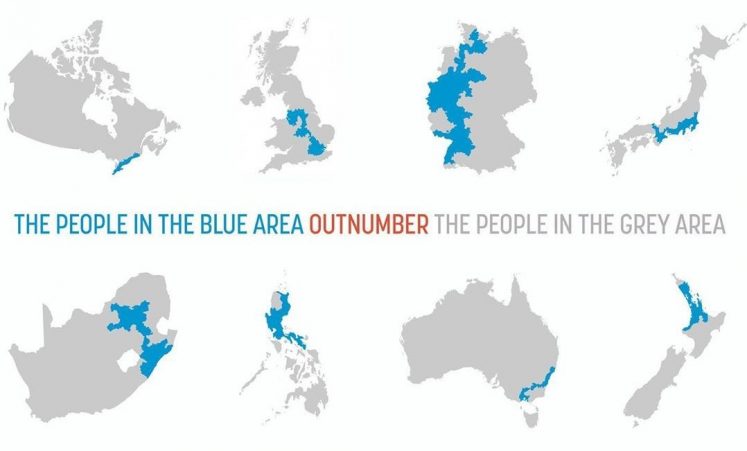
“The people in the blue area outnumber the people in the grey area.” [I didn’t find the source for this map, the anonymous tweeb who posted it said no word about it.]
Thence you can infer that a person’s vote in the blue area weighs much lower than a person’s vote in the grey area in national elections, except in single-district systems (with one district covering the whole country).
Take Australia, with a tiny blue speck on her South-Eastern coast. They’ve got federal elections for two Houses of Parliament. Besides this, I know nothing of their electoral system but if it isn’t a single-district system I can imagine two alternatives. 1/ Each district sends in an equal number of representatives: then Australia is dead as a democracy. 2/ Each district sends in a different number of MPs according to demographics, but then, given the concentration of the population as evidenced by the map, a fair number would be something like 100 MPs for the blue speck and 1 MP for each other district and I’m sure the actual figures don’t show such discrepancies as would reflect the true demographic ones. So constituents in the tiny blue speck remain at a disadvantage, they are second-class citizens as far as the ballot is concerned.
As an aside (so to speak), the ballot-disadvantaged blue speck concentrates the proletariat of the country (as demographic concentration follows industrial/economic concentration).
*
Pentagon “likely” to send tanks and armored units to eastern Syria to protect the oil fields.
The spin on Syria’s oil fields is about making the thing look rational (“the economy”). Yet the oil you pay with a costly military occupation is more expensive than the oil you get through deals, usually.
ii
Timing (of about ten days)
-Trump announces US withdrawal from Syria
-After outcry, Trump cancels withdrawal “because of the oil fields”
-ISIS leader Baghdadi is killed by US soldiers in Syria
🎲 🎲
*
« Les mots tuent. » Donc il faut les condamner à perpétuité ?
*
La démocratie a-t-elle encore un avenir ? Un débat @LeMondeFestival (Le Monde)
Quand un journal du capital demande si la démocratie a un avenir, on sent que le capital n’y croit plus trop.
La démocratie en France, avec la concurrence de la Chine ? Vous voyez des travailleurs français voter pour la semaine de 80 heures ? (Ce chiffre est donné par la FIDH, qui estime entre 60 et 80 heures la durée hebdomadaire réelle du travail en Chine, où la durée légale est de 44 heures.)
*
Does the U.S. not having an official language give U.S. citizens the right to address a state or federal administration in any language and the right to a reply in the language used in the address? And why not?
*
Au pays de la justice aveugle
Quand la chancellerie (le ministère de la justice) adresse une note aux juges d’instruction pour faire pression sur eux en vue de booster les intentions de vote pour le parti gouvernemental aux élections, cela veut dire que les juges d’instruction ont ce pouvoir ? Expliquez-le-moi, s’il vous plaît, c’est pour comprendre la justice de mon pays.
Si cette note a été conçue comme un moyen de pression, cela veut dire que les juges d’instruction ont le pouvoir d’influer sur les résultats des élections municipales. J’aimerais comprendre par quel mécanisme. Est-ce par le biais du traitement judiciaire des « affaires » ?
ii
Pourquoi le gouvernement dit-il aux juges d’instruction que la carte judiciaire dépendra des résultats électoraux, et non, en même temps, aux directeurs de bureaux de poste que la carte des bureaux de poste dépendra des résultats électoraux ? Les juges ont un pouvoir électoral ? Où est-ce écrit ?
Et le fait que les juges sont, comme cela ressort de l’existence de ce courrier de la chancellerie, en mesure d’influencer des résultats électoraux, en quoi est-ce démocratique ?
iii
Il est à présent indubitable que la France n’a pas de Constitution, au sens de l’article 16 de la Déclaration des droits de l’homme et du citoyen (DDHC) : « Toute société dans laquelle la garantie des droits n’est pas assurée, ni la séparation des pouvoirs déterminée, n’a point de Constitution. »
En effet, non seulement on savait déjà que le parquet (les procureurs) permet au gouvernement français de conduire une « politique pénale » au-delà de son pouvoir propre qui est par essence légiférant (il a l’initiative des lois) et réglementaire, mais on apprend à présent aussi que les juges du siège eux-mêmes sont dans la dépendance, puisque la note de la chancellerie, dont le fond est confirmé par un magistrat (« De tels calculs ont toujours existé, mais personne n’était assez bête pour les consigner noir sur blanc », Le Canard enchaîné du 30.10.2019), montre qu’ils exercent la justice en fonction des intérêts électoraux (et sans doute d’autres intérêts encore) du gouvernement en place.
Dès lors que la France n’a pas de Constitution, puisque aucun des deux versants de l’autorité judiciaire, parquet et siège, n’est indépendant de l’exécutif, tout acte répressif des autorités est une violence illégitime.
Le magistrat anonyme cité par le Canard enchaîné souligne la bêtise de l’administration et/ou du gouvernement, mais on peut y voir plutôt le cynisme de ceux qui n’hésitent plus à « consigner noir sur blanc » des pratiques inavouables, parce que les juges ne les ont jamais dénoncées. Puisque les juges n’ont jamais dénoncé comme un scandale ces « calculs » foulant aux pieds leur indépendance, n’est-il pas permis aux gouvernants de penser que révéler ces pratiques au grand jour ne saurait avoir la moindre conséquence ? Les moutons ne mordent pas.
*
Sant Bhindranwale
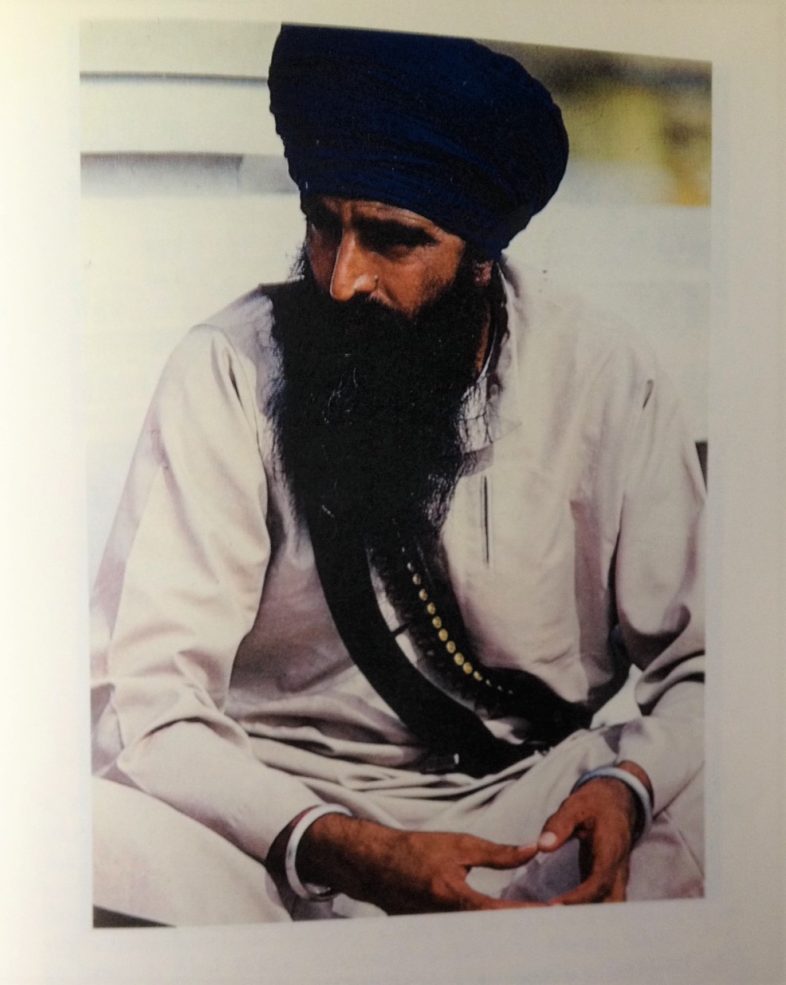
Jarnail Singh Bhindranwale aka Sant Bhindranwale (picture from Les Sikhs, 1989, by Michel Delahoutre)
[This posting of a portrait of Sant Bhindranwale from a French book on Sikhs and Sikhism gives me the opportunity to post a few earlier tweets that I have so far left out of my tweet anthology on this blog.]
Bhindranwale never demanded Khalistan: Subramanian Swamy (HT Punjab, 29 Apr, 2018)
[This piece of news raised my attention because I was Swamy’s student at Harvard Summer School 2004 and besides the name ‘Subramanian’ appeared in a collection of Bhindranwale’s speeches that I was reading at the time of learning the news, so I wanted to know if the Subramanian named by Bhindranwale was Subramanian Swamy. The tweets read as follows:]
In Struggle for Justice: Speeches and Conversations of Sant Jarnail Singh Khalsa Bhindranwale, Sikh Educational & Religious Foundation, Dublin, Ohio, 1999), Bhindranwale names a few times a Subramanian “who is a prominent representative of a party,” and calls him a “jackal” (p.133). Could it be Subramanian Swamy? Bhindranwale’s Speech of May 14, 1983 (excerpt):
Subramanian said this. He said: “When the Emergency was declared, I grew a beard, put a turban, and changed my name to Singh.” I asked him why. He said: “To hide [from oppression].” I replied: “Sikhism is Kalgidhar Ji’s jungle. In it there are tigers and leopards. Jackals also hide in it. If a jackal like yourself also found an excuse [to join it] in order to hide, it is not our fault.” He said: “I accept defeat.” (End of quotation; brackets are from the transcripts and not mine) Who is that Subramanian “who is a prominent representative of a [political] party”?
[I got no answer. I hope such quotation and my suggestion that the politician told of by Bhindranwale was Subramanian Swamy was not found offensive by Swamy’s supporters if they happened to read these tweets of mine. I have already talked of Subramanian Swamy on this blog (here), where I recall his intellectual (he’s an economist of international repute) and political achievements and stress my disapproval of his dismissal from his position at the Harvard Summer School faculty. Given what has been happening in Kashmir lately, I add that he may also be considered one of the intellectual warrants of the Indian authorities’ action there.
As to Subramanian’s demand that the files relative to Operation Blue Star be declassified (Hindustan Times, Oct 1, 2018), it is a praiseworthy initiative to help shed more light on this sensitive issue. On June 7, 2019, he tweeted the following: ‘‘Operation Bluestar was a Soviet Union conspiracy to make us [India] more dependent on USSR for our defence against Pak. This way Soviets could pincer attack being then in Afghanistan. It was TDK [Sonia Gandhi, according to a webpage, swamy39abbreviations, which explains the abbreviations used by Subramanian on Twitter] who kept pressing Indira to attack Sant Bhindranwale. So did Surjeet of CPM [sic for CPI(M), Communist Party of India, then led by Harkishan Singh Surjeet].’’
As to his statement according to which, as quoted by Hindustan Times, ‘‘Bhindranwale never demanded Khalistan,’’ it is confirmed by Bhindranwale’s speeches, although Bhindranwale laid down conditions for the Sikhs not demanding Khalistan, for instance:
We do not seek [Khalistan], but if it is given us we shall not refuse. If they keep us with them, among them, we shall not accept living as second class citizens. We shall live as first class citizens and work as equal partners. Whatever concessions are available to others, [for example] the convenience that Pawan Kumar has – of keeping two hundred and thirty grenades, [should as well be available to] any person with ‘Singh’ in his name. (July 30, 1983, p. 211, brackets are from the transcripts and not mine) There are many other similar utterances. Bhindranwale’s demand was one of equal rights for Sikhs under the Constitution of India, a perfectly legitimate demand were it not that India’s government said the Sikhs already had equal rights and their requests were therefore unconstitutional. The example taken in this quote by Bhindranwale is admittedly odd, referring to an obscure case of which he speaks at length; another example is therefore in order:
I have been asked many times by our newspaper friends about my opinion regarding Khalistan. I have but one answer for all of them: I do not oppose it nor do I support it as yet. In all tape-recordings this has been my statement: I neither oppose it nor support it. It is the business of the Center [transcriber’s note: Government of India] and not mine. The Center should tell us if it wishes to keep these turbaned people with it or not. … If they wish to stay with us, they should give us our share. We have given ninety heads, all the rest of them have given ten [transcriber’s note: Reference is to the 93 Sikhs having been hanged to death by the British during India’s struggle for freedom]. (Dec 31, 1983, pp. 327-8]
*
Icy Green 2: From Grøxit to Greenland Deal
[For Icy Green 1, see here]
The problem for pensioners from abroad who want to settle down in Greenland is that the Danish currency makes it so expensive. Solution: #GreenlandDeal #GreenlandPurchase
ii
Stark numbers of Greenlanders are found among Denmark’s homeless population: Aalborg 27%, Odense 15%, Copenhagen 12%. (Source : dr.dk, Nov 3, 2019)
iii
#Grøxit/#Groexit: In 1979 Greenland became autonomous inside the Kingdom of Denmark and in 1982 it voted to leave Europe (& Grøxit became effective in 1985).
*
Chasse aux sorcières
Est justifiée l’hospitalisation sous contrainte de celle qui parle de sorcellerie et maintient que son « visage change tous les jours ». Cour d’appel de Rennes, 25 avril 2012
Est justifiée l’hospitalisation sous contrainte de celle qui soutient qu’elle a vu le diable et qu’elle discute régulièrement avec sa cousine et sa mère qui sont pourtant décédées. Cour d’appel de Versailles, 13 septembre 2013
Est justifiée l’hospitalisation sous contrainte de celui qui : – déclare être Jesus, – puis finalement être l’antéchrist, – assure qu’il est télépathe, – certifie qu’il devine les pensées – et maintient que ces éléments ne sont pas pathologiques. CA Aix-en-Provence, 5/4/19
Ces jurisprudences « Halloween » montrent que la justice française en est encore à la chasse aux sorcières. Si les personnes internées d’office ne sont pas dangereuses, le but de leur internement est de leur faire renoncer à des idées mystiques qu’aucune démonstration rationnelle ne peut infirmer. C’est du lavage du cerveau. Ces personnes sont victimes, d’un côté, d’une bien-pensance religieuse qui, tout en ayant elle-même des idées mystiques dans le cadre de ses dogmes, condamne des formes externes de mysticisme, et, de l’autre, d’un dogmatisme matérialiste réduisant la pensée à l’empirisme.
Au cas où il irait de soi que, dans les tweets « Est justifiée l’hospitalisation sous contrainte de la personne qui… », la personne, sans être dangereuse, est incapable de pourvoir à ses besoins, il faut se demander si c’est en raison de licenciements causés par ses idées.
C’est ma conviction que certaines personnes hospitalisées sous contrainte en France gagneraient autant que tous les juges de France réunis si elles étaient citoyens américains. #PaulaWhite (conseillère spirituelle du Président Donald Trump)
Veuillez noter [dans une vidéo réunissant quelques passages choisis des prédications de Paula White], après les hurlements, le «speaking in tongues» de Paula, le « parler en langues », ou glossolalie pour le terme technique. N’essayez pas devant un préfet ou un juge français => hospitalisation sous contrainte.
Sans ces tweets [du compte Curiosités juridiques], je n’aurais pas la notion que la France prive de liberté des individus inoffensifs et capables de pourvoir à leurs besoins, à cause de leurs idées mystiques. Cela vient compléter le dossier contre la France antipays des droits de l’homme.
« Prive de liberté » et soumet à des traitements inhumains et dégradants : médicamentation forcée=« camisole chimique » et demain peut-être le retour des électrochocs, qui ont déjà fait leur retour aux États-Unis. (En attendant le retour de la lobotomie ?)
ii
Est justifiée l’hospitalisation sous contrainte de celle qui parle de sorcellerie et maintient que son « visage change tous les jours ».
Cette femme est hospitalisée sous contrainte car elle croit que son « visage change tous les jours ». Or c’est scientifiquement vrai : le facial symmetry index est corrélé à des taux hormonaux qui varient au cours du cycle menstruel. C’est donc parce que cette femme est plus sensible que la moyenne à ces variations faciales, qui peuvent l’inquiéter et qu’elle aura peut-être tendance, dès lors, à exagérer, qu’elle se trouve internée et soumise à la camisole chimique. En France.
[Ces conclusions sont fondées sur les éléments apportés par les tweets. Je me fie à la compétence des juristes du compte Twitter en question pour présenter les éléments les plus saillants de ces jurisprudences, c’est-à-dire les éléments principaux du jugement, sans laisser d’importantes considérations de côté. Car il va de soi que, si une hospitalisation sous contrainte est justifiée par le fait de parler de sorcellerie, d’affirmer que son visage change tous les jours et d’avoir tenté d’assassiner son conjoint, le fait de laisser de côté ce dernier élément serait trahir le sens de la décision et non en rendre compte.]
*
Après la Marche du 10 novembre [contre l’islamophobie], les islamophobes veulent interdire le mot Allah dans l’espace public (car ce serait islamiste). Ils préparent une loi : il ne sera permis de dire Allah que chez soi, les fenêtres fermées, après 22 heures et jusqu’à 6 heures du matin. #islamophobie 🤡
*
Le sexe socialiste – et si c’était mieux ? La chercheuse américaine Kristen Ghodsee revisite la société est-allemande. (Mediapart)
La RDA n’était pas un régime socialiste mais une exploitation bureaucratique du prolétariat (cf. Cornelius Castoriadis). Dans cette société bureaucratique, la classe bureaucratique avait davantage de moyens à sa disposition que la classe capitaliste dans une société capitaliste pour concentrer entre ses mains les richesses créées par le prolétariat, et c’est ce qu’elle a fait. À la fin de la Guerre froide, quand des touristes russes et d’autres pays de l’Est commencèrent à venir en Europe occidentale, tout le monde fut frappé par leur morgue et vulgarité. On disait alors que c’étaient des nouveaux riches. Mais c’était la classe bureaucratique reconvertie au capitalisme. Cette morgue, cette vulgarité des nouveaux touristes d’au-delà du rideau de fer effondré, était celle des esclavagistes bureaucratiques des économies « socialistes », et elles donnent une idée de l’enfer que cette classe a fait vivre aux travailleurs de ces pays.
De fait, qu’était la « planification socialiste » de ces économies ? C’était le moyen de la classe bureaucratique de maintenir l’immense majorité au minimum vital, là où dans le bloc atlantiste les travailleurs arrachaient malgré tout quelques avancées (précaires).
Aujourd’hui, quand une telle classe bureaucratique bien établie, en Chine (13e plan quinquennal 2016-2020), joue le marché mondial, la classe capitaliste dans le monde entier sent sa propre faiblesse, son inorganisation, son « anarchie »…
*
Quand la sociologue Monique Pinçon-Charlot parle des grands bourgeois qu’elle a connus [interview par Thinkerview mise en ligne sur YouTube le 4 juin 2019], trente ans après elle est encore tout émoustillée. Tout le monde ne peut pas être Jack London, socialiste, premier écrivain américain millionnaire, qui les a fréquentés aussi et en a dit tout ce qu’il faut savoir : des buses.
*
L’interdiction de la diffamation religieuse par la loi française
Le parti LFI n’aime pas le mot islamophobie car, selon JLM, « il ne faut pas donner l’impression qu’il est interdit de critiquer une religion ». Peut-on avoir un exemple de critique qui ne soit ni injure ni provocation à la haine ni diffamation envers un « groupe de personnes à raison de leur religion » ? – S’il n’est « pas interdit de critiquer une religion », comme le croit JLM, alors il n’est pas non plus interdit de critiquer une race, un sexe, une orientation sexuelle et toutes les autres catégories qui figurent avec la religion dans la loi de 1881.
Non seulement il semble difficile de critiquer une religion sans risque de poursuites judiciaires mais il existe aussi un contentieux des films « blasphématoires » : TGI Paris 22.9.88, 1e civ. 29.10.90 cf. J.-M. Denquin, Sur les conflits de liberté, 1981. Une jurisprudence dite « équilibrée ». Ma source (B. Beignier) dit en outre qu’un décret du 27 mars 1992 interdit « l’utilisation de moyens susceptibles de choquer les sentiments religieux » dans la publicité. Il semble donc bien que le droit aujourd’hui se « libéralise » en faveur de l’islamophobie et d’elle seule. C’est une attaque contre l’islam.
Ce dévoiement de l’application du droit se traduit d’abord par le fait que les intervenants du débat public feignent d’ignorer la loi, à savoir que les dispositions sur les délits de presse (de parole) couvrent les religions, toutes les religions, dont bien sûr l’islam. #Le10contrelislamophobie
JLM n’aime pas le mot islamophobie mais a-t-il un problème avec le mot homophobie ? Non ? Or religion et orientation sexuelle sont protégées identiquement dans notre droit : « groupe de personnes à raison de leur ethnie, nation, race ou religion, de leur sexe ou orientation sexuelle etc. ». La loi est claire. On peut parler pénalement d’islamophobie comme on peut parler de racisme et d’homophobie. Ces débats, sur le fait que l’islamophobie ne serait pas condamnable en France, sont mascarade et mépris de la loi. Sacré Méluche, ça fait un quart de siècle qu’il siège dans l’une ou l’autre assemblée, vote ces lois liberticides les unes après les autres (comme tous les autres parlementaires, d’ailleurs) mais voilà, « il ne faut pas donner l’impression qu’il est interdit de critiquer une religion »…
ii
Les propos du ministre de l’éducation : « Le voile n’est pas conforme à nos valeurs » (quelles valeurs, quand un ministre s’exprime, sinon les valeurs républicaines ?) sont une sérieuse mise en cause du voile et de la religion qui (c’est selon) le prescrit ou l’encourage.
Selon le résumé gouvernemental de la politique du gouvernement, « le voile n’est pas souhaitable mais pas interdit. » Sauf que, pour le ministre, le voile n’est pas souhaitable car « pas conforme à nos valeurs ». Quelles valeurs, quand un ministre s’exprime, sinon les valeurs de la République ? Ne pas être conforme aux valeurs de la République, c’est ce qu’il peut y avoir de pire ; ce serait, si de telles catégories existaient, un délit non seulement selon la loi mais selon la norme la plus haute, la Constitution, selon laquelle la « forme républicaine » est intangible. Par conséquent, si le voile islamique n’est pas conforme à nos valeurs républicaines, non seulement le voile pas souhaitable mais il n’est pas non plus constitutionnel, donc il ne peut même pas être légal, une loi ne peut pas l’autoriser car elle serait inconstitutionnelle ! « Pas souhaitable car ‘pas conforme à nos valeurs’ (ministre), donc inconstitutionnel, mais pas interdit. » 👌
« Non conforme à nos valeurs » signifie non conforme à nos valeurs républicaines qui s’incarnent dans des principes à valeur constitutionnelle (PVC), donc, n’étant pas conforme aux PVC, pas conforme à la Constitution, pas constitutionnel. « Mais pas interdit. » 👌
« Le voile (islamique) n’est pas conforme à nos valeurs (républicaines). » => Diffamation au sens de l’article 32 de la loi de 1881 envers un groupe de personnes à raison de leur appartenance à une religion = « diffamation religieuse ». [Avec lien vers un article d’avocat, « Diffamation publique et religion » (x).]
iii
Si « le voile n’est pas conforme à nos valeurs », on voit mal comment il peut être légal ou plutôt, même, constitutionnel, puisque nos valeurs s’incarnent dans des principes à valeur constitutionnelle.
On serait au Danemark, par exemple, une telle déclaration ministérielle (« le voile n’est pas etc. ») n’aurait pas grande importance mais notre loi sur les associations, pour ne citer que celle-là, interdit les associations dont l’idéologie ou les motivations ne sont pas conformes à nos valeurs… Malaise.
iv
Un ancien secrétaire général de la Commission nationale consultative des droits de l’homme (CNCDH) publie en 2019 un article intitulé La diffamation religieuse n’est un délit ni en France ni à l’ONU [Le copyright est daté de 2019]. L’article 32 de la loi de 1881 parle pourtant de « groupes de personnes à raison de leur religion », mais l’ancien secrétaire général de la CNDCH écrit :
« En droit français la liberté d’expression et d’opinion, principe fondamental des droits de l’homme, admet deux limitations lorsqu’il s’agit de religion : La diffamation à l’égard d’une personne, sanctionnée d’une peine d’emprisonnement d’un an et/ou d’une amende de 45 000 euros, et/ou l’injure condamnée par une peine de six mois d’emprisonnement et/ou de 22 500 euros d’amende ; La provocation à la discrimination, à la haine et à la violence à l’égard d’une personne ou d’un groupe de personnes à raison de leur appartenance à une religion déterminée, sanctionnée par une peine d’un an de prison et/ou d’une amende de 45 000 euros. »
Cet ex-secrétaire général de la CNCDH publie en ligne la contre-vérité « La diffamation religieuse n’est pas un délit en France ». Or c’est si bien un délit qu’il a fallu faire une exception aux principes : « L’offre de preuve est impossible en matière de diffamation raciale. » (courdecassation.fr : lien) Cette citation parle certes de diffamation raciale mais l’article 32 (comme les articles 33 et 24) met dans le même sac race et religion comme catégories des « groupes de personnes à raison de… », ce qui signifie, la diffamation raciale existant, que la diffamation religieuse existe tout autant.
Oui, l’article 32 met dans le même sac race et religion car il parle (comme les articles 33 et 24) de « groupe de personnes à raison de leur origine ou de leur appartenance ou de leur non-appartenance à une ethnie, une nation, une race ou une religion [je souligne] déterminée ».
Il suffit de googler « diffamation religieuse » pour avoir de la jurisprudence : « Constitue le délit de diffamation publique envers un groupe de personnes un article qui, après dénonciation des pratiques d’égorgement de moutons auxquelles donne lieu la fête de l’Aïd etc. » (tiré de l’article « Diffamation publique et religion » cité plus haut).
Les trois articles pertinents sont l’article 24 (provocation à la discrimination, à la haine etc.), l’article 32 (diffamation) et l’article 33 (injure). Pour chacun, la religion est incluse comme facteur aggravant au même titre que la race. Et au même titre que d’autres catégories, dont la nationalité. Donc, insulter quelqu’un parce qu’il est, par exemple, de nationalité comorienne, c’est un an d’emprisonnement et 45.000 euros d’amende. Comme quand on dit devant caméras : « Le kwassa-kwassa pêche peu, il amène du Comorien », ce qui revient à déshumaniser ces personnes « à raison de » leur nationalité : « C’est pas du poisson, c’est du Comorien. » Qui a entendu le « premier magistrat » s’excuser pour ces paroles ? Pendant ce temps, des citoyens français (vulgus pecum) prennent cher au pénal pour des plaisanteries plus drôles que ça, même après s’être excusés.
Quand il parle des Comoriens comme d’une marchandise indésirable (« amène du Comorien »), les hauts fonctionnaires qui l’entourent – on le voit sur la vidéo – rient. Les médias ont parlé de « rire gêné » mais peut-être que ce sont les caméras qui les gênaient car ils auraient voulu se rouler par terre.
*
J’ai vécu quand j’étais adolescent avec environ 1.000 euros par mois. … Je sais ce que c’est de boucler une fin de mois difficile. (Premier magistrat)
Un adolescent qui vit avec 1.000 euros par mois, on est loin de la précarité. (Hilare)
Qui plus est, 1.000 euros il y a 20-25 ans, c’était bien plus qu’aujourd’hui : #inflation
Certes, l’euro n’existait pas il y a vingt-cinq ans, quand il était adolescent, mais s’il convertit ses revenus en francs de l’époque en euros, il faut savoir s’il tient compte de l’inflation ou non. Bref, qu’il donne son véritable salaire en francs de l’époque pour que nous puissions juger. A priori, ces 1.000 euros ne tiennent pas compte de l’inflation car c’est tout de même un calcul un peu savant et il aurait dit quelque chose comme « Après avoir posé la question à l’INSEE, je gagnais etc. ». Il a donc sans doute simplement converti ses francs de l’époque en euros, et il gagnait par conséquent bien plus que 1.000 euros d’aujourd’hui.
*
Situation chaotique à l’université Lille 2. 200 étudiants ont saccagé l’amphithéâtre, déchiré le livre de Hollande, qui a dû être évacué en urgence. (La Plume libre)
En déchirant des exemplaires du livre de François Hollande, il est évident que les étudiants ont commis un très grave attentat contre la culture.
*
Midway
A few remarks about #MidwayMovie by Roland Emmerich. [Midway, 2019]
1-Contrary to my (admittedly scant) reading on the topic but also Clint Eastwood’s Letters from Iwo Jima, here the Japanese forces are described as superior to the U.S.’s on all counts (numbers and military technology). It seems extremely unlikely. Kamikazes were started when the Japanese realized that their fighter aircrafts were no match for the U.S.’s, whose technological advance was unbridgeable. Moreover Japanese industrial capacity was small compared to that of the United States.
Considering Japan’s alleged numerical and technological superiority in WW2 according to the movie, the message is it’s the brilliant guy in slippers at the cipher bureau won the war… Wait till we face the numerical and tech match of China.
2-Doolittle’s indiscriminate air bombing of Tokyo was a war crime. Strange that this character is later heard saying, about the Japanese in China: “What are their targets? There are only civilians here!” Was his own excuse for the Tokyo raid that his planes might have (by chance) hit military targets?
3- About officers’ humaneness with their boys, French philosopher Alain (Émile Chartier), who fought in WWI, has something to say, and it’s that there is no such humaneness. When a high-ranking officer with no knowledge whatsoever of current field conditions orders men to attack the enemy through a muddy field where they will be bogged down, you shut up and die and the brass gets off scot-free. So I start seeing with respect the custom of Japanese officers, as described in Midway, to harakiri (seppuku) after a dramatic failure, and I can only wish to serve under Nippon-like officers in the next war rather than under the kind of officers described by Alain from his own experience.
*
“There is no reason to fear low-skilled migration.” Nobel prize-winning economist Esther Duflo says “the effect of low-skilled migration on low-skilled wages is zero”. (Channel 4 News)
Supply-demand models are BS? She must explain how her paradoxical (no matter how politically correct) conclusions fit in the science. When supply grows, the equilibrium price (wages) must decrease: this is the science. Say it isn’t science once for all.
‘‘For example when Cubans came to Miami in big waves, when Castro gave them the green light for a short period, you had a huge wave of Cuban migrants, and David Card, a labour economist at Berkeley, studied this episode and looked at what happened to the wages of the low-skilled people in Miami, compared to other similar cities. Nothing.’’ (Duflo)
Does the Miami study include illegal work (black market)?
‘‘Opposite, in the 1960s, there was already a lot of protests against migrants and so finally Kennedy decided to send back home all the temporary migrants that were working on farms in California. What happened to wages? Nothing. … When the migrants got sent home, the farmers mechanized.’’ (Duflo)
The removal of migrant workers from California had no effect on wages because employers then mechanized. But then the obvious conclusion is that migrants were an obstacle to mechanization, i.e. to productivity gains, and that’s an even stronger motive to oppose immigration!
*
#Schoolshooting is one of the many problems with school. Evaëlle, 11, Thibault, 12, committed suicide because of school bullying. The evils of school are many.
*
Of French Religious Libel Law
You [Attorney D. Niose] wrote “One of the many problems with the concept of protecting religion from defamation is that ideas (including religious ideas) cannot be defamed – only people can be defamed.”
In France one incurs 1 year imprisonment & 45.000€ fine for defaming a religious group (article 32 of 1881 Law). Don’t let the name ‘‘1881 Law’’ mislead you: This is no dusty relic from a bygone authoritarian age, it’s only that every new speech restriction is incorporated into that old law of 1881, and although the law looks old on the face of its name the repression is very much alive.
As to your quote. If a group, meaning here not a group of people in the street but a community, i.e., for a religious group, a community cemented by faith, can be defamed, then your definition of libel is void as far as French law is concerned. France shows the way toward repression.
*
Dans le futur, après la chute, des chercheurs s’interrogeront sur ce qui est arrivé à la France quand des intellectuels se sont mis à dire publiquement leur haine à la fois du féminisme, des musulmans, de l’écologisme et du peuple. En somme de l’égalité. (Edwy Plenel)
Ils se demanderont aussi pourquoi, alors que chaque nouvelle majorité politique aggravait solennellement (et rituellement) la législation contre les « contenus haineux », le procureur ne se saisissait pas des contenus haineux répandus par ces mêmes intellectuels médiatiques.
*
Valeurs Actuelles, le journal choisi par le Président de la République pour une interview exclusive, se félicite (tweet du 15 novembre) des records d’audience sur Cnews d’une personne condamnée en justice pour ses propos haineux. Bon barrage à tous.
*
Le contentieux administratif des blessures causées par les forces de l’ordre
Il faut saisir le juge administratif d’une demande d’indemnisation sur la base d’une responsabilité de l’État pour blessures.
i/ Responsabilité sans faute
Le requérant n’a pas besoin de prouver une faute des forces de l’ordre si : 1/ celles-ci ont fait usage, au cours de l’opération ayant causé les blessures, d’armes dangereuses (Les GLI-F4 sont considérées comme des armes de guerre : « Les grenades GLI-F4 sont classifiées en tant qu’armes de guerre dans le Code de la sécurité intérieure » Wkpd) et 2/ la victime est une personne tierce à l’opération.
Les grands arrêts de principe du Conseil d’État sur la question : Responsabilité de l’État engagée sans faute à prouver : – en cas d’usage d’armes dangereuses : arrêt Consorts Lecomte, CE 24 juin 1949 ; & – la victime est une personne non visée par l’opération, Dame Aubergé, CE 27 juillet 1951.
(Dans le cas d’une opération de maintien de l’ordre au cours d’une manifestation, il semble évident qu’un journaliste est « tiers à l’opération ». Mais je considère, comme je l’ai déjà écrit sur ce blog, que poser en principe qu’un manifestant ne pourrait revendiquer la qualité de « tiers à l’opération » en cas de blessures lors d’une opération de maintien de l’ordre dans une manifestation, serait problématique, car cela viderait de son sens la notion de « personne tierce » dans la mesure où les personnes visées par une opération de police sont normalement individuellement déterminées et où sont donc « tierces » toutes celles qui ne sont pas ces individus-là ; si tout manifestant était visé par principe dans le cadre d’une opération de maintien de l’ordre en manifestation, le critère précédent ne s’appliquerait plus, le groupe de manifestants se substituant aux personnes.)
ii/ Responsabilité en raison d’une faute commise par un agent
Dans le cas du dernier éborgné en date, Manu (qui a perdu son œil lors de l’Acte 53 des Gilets Jaunes), il est évident, puisqu’il existe une vidéo de l’impact, qu’un expert pourra dire si la grenade lacrymogène a été tirée par son arme propre, le fusil destiné à tirer ce genre de grenade, ou si elle a été lancée à la main, au lance-pierre ou à l’arbalète. (Cela devrait même être possible d’après l’examen des blessures.)
La vitesse et la trajectoire horizontale excluent l’hypothèse d’un jet à la main : le projectile sort du canon d’une arme. Sur un plateau télé, un policier rappelle qu’en cas de tir d’une grenade lacrymogène au fusil la trajectoire doit être parabolique. Si le juge constate à la vidéo que le projectile sort du canon d’une arme, il constatera par conséquent en même temps que le tir enfreignait les consignes d’utilisation de l’arme. Si le tir a enfreint les consignes d’utilisation, il y a faute, et la responsabilité de l’État est donc engagée pour blessures devant le juge administratif en raison d’une faute de l’agent (faute de service ou bien faute personnelle non dépourvue de tout lien avec le service).
À moins qu’un manifestant ait arraché son fusil des mains d’un agent et s’en soit servi… Aucun signalement n’ayant été fait en ce sens, le tir tendu, si le juge administratif constate que c’est un tir d’arme, est la faute d’un agent de l’État. La responsabilité de l’État est par conséquent engagée.
iii/ Saisir le juge administratif et pas seulement la juridiction pénale
a)
Les poursuites pénales doivent identifier un individu responsable mais pas les poursuites en responsabilité de l’État devant le tribunal administratif puisque l’État peut être reconnu responsable même sans faute d’un agent. Si la « faute de service » ou la « responsabilité sans faute » peut être retenue, je ne vois pas le juge exiger de connaître le tireur.
Je constate que les victimes des manifestations de Gilets Jaunes se tournent vers des avocats de droit privé : ces derniers ne savent rien ou presque du droit administratif et semblent en tout cas ignorer les possibilités d’action en responsabilité de l’État.
« Les affaires de Flash-Ball devant la juridiction administrative ne sont pas légion. La voie devant le juge pénal étant systématiquement empruntée, les requérants ont rarement actionné le juge administratif. » (Article Dalloz 17.7.2018 La responsabilité de l’État pour l’utilisation d’un Flash-Ball x)
Or la cour administrative d’appel (CAA) a condamné le 5 juillet 2018 l’État à la suite d’un tir de flash-ball (LBD) d’un policier qui avait blessé un mineur à l’œil au cours d’une manifestation. Cette jurisprudence doit selon moi s’appliquer aussi aux GLI-F4 et autres. L’article rappelle la jurisprudence relative aux grenades lacrymogènes mais l’arrêt (un arrêt technique) date des années cinquante. Le LBD serait une « arme dangereuse » (selon la CAA de Nantes) mais pas les GLI-F4 apparues en 2011 et contenant de la TNT ? Impossible.
b)
Quand les avocats de droit administratif parlent des Gilets Jaunes, ce n’est pas pour dire à ceux-ci qu’ils peuvent se faire indemniser par le juge administratif la perte d’un œil mais pour dire aux commerçants qu’ils peuvent se faire indemniser une vitrine…
« Responsabilité sans faute de l’État [vis-à-vis notamment des commerçants dont les commerces ont subi des dégradations] du fait des attroupements ou rassemblements. »
« Sans faute », cela veut dire, en gros, une indemnisation automatique en cas de recours. Ça, c’est pour la vitrine. Pour l’oeil d’un Gilet Jaune, ce n’est pas encore gagné…
Vu que les commerçant souscrivent des assurances tous risques, pour peu qu’ils fassent un recours devant le juge administratif pour vitrine brisée après un acte Gilets Jaunes, l’assurance privée plus l’indemnisation judiciaire, cela peut même être une aubaine. Qu’est-ce qui l’empêche ?
c)
Quand comprendrez-vous que face aux provocs des giléjones, on est dans la légitime défense et que ça devient compliqué ?
Votre point de vue peut se défendre mais le procureur qui vient de requérir contre un agent des forces de l’ordre trois mois de prison avec sursis pour avoir jeté un pavé dans une manifestation de Gilets Jaunes ne paraît pas avoir vu de la légitime défense dans ce geste.
*
Pardon de ne pas avoir les mêmes évidences immédiates que ceux qui vont chaque jour sur les médias mainstream, mais on voit bien que ce n’est pas sur ces médias que les gens apprennent à défendre leurs droits.
*
Facebook is said to be too lax as to speech police. Lately, a famed clown said they would have let Hitler do his propaganda on the platform. Yet the Weimar Republic had repressive hate speech laws, and a few Nazis were tried for hate speech, before takeover. And the evidence points to the likelihood that the next party in power in France will be the Islamophobic RN (there are already clear Islamophobic trends in the current government), despite harsh hate speech legislation that includes religious libel laws.
*
Rares les artistes qui ont osé défendre les Gilets Jaunes.
Les artistes qui défendent les Gilets Jaunes grillent leurs chances de tourner dans des spots de pub bien payés (pour des pâtes, du savon, des balayettes…).
J’aurais voulu être un artiste
pour aider à vendre des croquettes pour chien 🎶
« Ces succulentes croquettes, je les ai goûtées : ce sont les meilleures ! »
*
La publicité, cette chose qui n’existe dans aucune théorie économique.
 florent boucharel rAd-Free