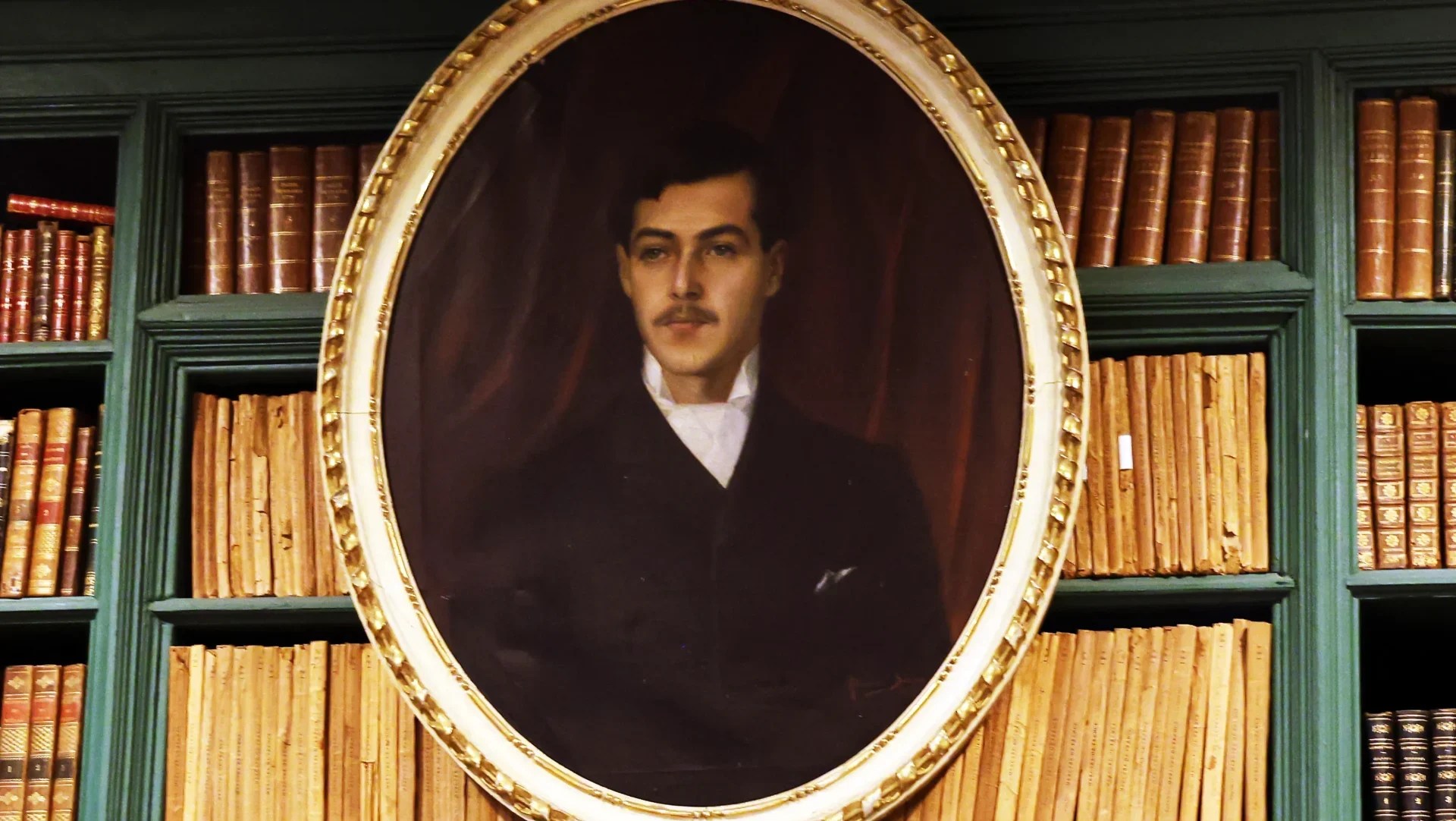
Le maître du burg : Cent poèmes (dizains et douzains)

I/ Le maître du burg
II/ Histoires
III/ Absinthes
IV/ Célimène

.

1

Quand une porte grince au milieu de la nuit
Et que vous êtes seul dans le noir d’une chambre,
Sous une couverture, inquiet de ce bruit,
Et le chêne dehors craque au vent de décembre,
Qu’il n’est dans le manoir antique, féodal
Personne autre que vous, un souffle glacial
En s’engouffrant soudain par une entrebâillure
Vous apprend que l’on ouvre un huis, déverrouillé.
Et le portail au fond du parc, vieux et rouillé,
A gémi sur ses gonds dans le grès qui l’emmure.

*

2

Quelle est cette sylphide errante sous la lune,
Dans le parc, lumineuse et blanche ? Je descends,
Je sors la retrouver. Ma présence importune
L’éloigne, elle franchit les moellons imposants
Du mur d’enceinte et va se perdre sous les chênes.
Je la suis, la forêt m’aspire, yeuses, frênes,
Érables, châtaigniers, entravent mon chemin.
J’entre dans le marais que flanque un vaste rouvre.
C’était une noyée, et l’onde me recouvre ;
Je meurs en lui tendant une impuissante main.

.

I
LE MAÎTRE DU BURG

.

(i)

.

3

En cet amour blessé, dans cette solitude,
Je crois vivre en seigneur de château féodal,
Loin du monde et du bruit, loin de la multitude ;
Et, la nuit, noir écrin de ce burg sépulcral,
Enténébré j’attends un fantôme de femme.
Quand le chandelier fume et que s’éteint la flamme,
Dans un profond silence empreint de gravité,
Elle apparaît enfin, vapeur mélancolique,
Un flottement qui danse à pas lents, phosphorique,
Pour que je pleure encore en voyant sa beauté.

*

4

Dans mon château, la nuit, je crois te voir flotter
Devant mon lit, vapeur franchissant les murailles,
Et, ne sachant pourquoi tu me reviens hanter,
Sans le moindre soupir, me glaçant les entrailles,
Je suis tétanisé par ton vol transparent.
Pourquoi de jours défunts ce phosphore affleurant
Vient-il me rappeler l’inégalable joie ?
J’ai fermé sur le parc et les bois mes rideaux,
Car du soleil je fuis les importuns flambeaux.
Tu brilles dans le noir afin que je te voie.

*

5

Quand la bûche crépite et s’effondre dans l’âtre,
Je me tourne, pensant que l’huis vient de s’ouvrir
Et que j’entends ton pas ; mon cœur se met à battre
Plus vite un court instant, puis je pousse un soupir.
Le vent des combles souffle, et ce bruit m’ensorcelle :
Ne serait-ce ta voix, dans la nuit, qui m’appelle ?
En moi vit le passé. Quand courent les souris,
Apparaît dans le noir, droite comme une flamme,
Ton image, lucide et subtile, à mon âme,
Et tu pleures parfois, et parfois tu souris.

*

6

Dans cette solitude où ton fantôme est tout,
Dans les sombres couloirs, dans la bibliothèque,
Dans l’escalier couvert de son tapis, surtout
Dans la chambre gothique et byzantine, ou grecque,
J’aime que chaque nuit tu viennes pour flâner,
Flotter de-ci de-là, doucement chantonner,
Passer tes doigts fumeux sur la tranche d’un livre,
En faisant comme si tu ne me voyais pas.
Je regarde, accablé, tes lucides appas,
Puis tu redisparais où je ne peux te suivre.

*

7

Maintenant que revient ton fantôme à minuit,
Dans le manoir obscur de ma déliquescence,
Devant cette vapeur de mon passé, qui luit,
Perçant l’obscurité de sa phosphorescence,
Je sais que j’aurais dû – puisque à tout tu suffis –
T’aimer plus tendrement, mieux que je ne le fis.
Mais je payai tes vœux du seul amour frivole
Que mon cœur trop léger pouvait tirer de moi.
Maintenant – ô si tard ! – que me revient la foi,
Je revois ton fantôme et, contrit, me désole.

*

8

Je ne vis que pour être ami de ton fantôme,
Pellucide vapeur qui viens en ce manoir
Où je finis mes jours et flânes sans me voir,
Mais dont le flottement m’apaise comme un baume.
Tu traverses les murs, pour toi n’ont point de rets
Les tentures, les bois des meubles, les objets.
Et dans ma solitude opiniâtre et sombre,
Ta présence muette et transparente m’est
Cette clarté que j’aime et contemple dans l’ombre.
Je vis pour la lueur que ce beau double émet.

*

9

Son fantôme volant devant les boiseries,
Dans la nuit que cinglaient l’orage et les éclairs,
Franchissant les rideaux et les tapisseries,
Fit resurgir en moi tous les tourments soufferts
En ce funèbre amour de passion fatale.
Luisance de vapeur limpide et liliale,
Elle avait tous les traits que j’avais encensés,
Et je crus, dans le vent qui balançait les branches,
L’entendre murmurer ; ses belles mains si blanches,
Blanches, la voir les tendre à mes baisers glacés.

*

10

Quand je lève les yeux d’un livre, sous la lampe
Dans le salon obscur, parfois je vois flotter
Devant moi son fantôme, admirant une estampe
Ou flânant indécise et sans me regarder,
Traverser les fauteuils, les meubles de la pièce,
Un mur, puis revenir ; et, touché de tristesse,
Je repose le livre et l’observe longtemps.
Ce que fut notre amour, son double diaphane
Me le rappelle ainsi, clarté de cymophane.
Cette présence reste avec moi hors du temps.

*

11

Dans le sombre manoir où je vis en reclus,
Du monde séparé, ma porte reste close.
Un double hante ici, de temps qui ne sont plus
Évoquant les transports à mon âme morose.
C’est une blanche aura de femme, un diamant
Étincelant, la nuit, en un cercle fumant.
Elle passe en halo les pourpres palissandres,
Disparaît et revient, mais jamais ne me voit,
Et c’est elle qui vit, plus que moi, sous ce toit.
Elle est le feu qui reste après que tout est cendres.

*

12

Grille du fond du parc, il est temps que tu t’ouvres,
Roule donc sur tes gonds et me laisse passer.
Dans la forêt profonde où je veux m’enfoncer,
Le vent fait murmurer la frondaison des rouvres.
Et si je dois me perdre en ce vaste désert,
Si la nuit couvre enfin mon chemin rouge et vert,
J’écouterai le chant du hibou, note lente
Et gelée, envahir l’obscurité. – Portail,
À l’oriel m’attend la forme étincelante 
D’un fantôme, dessin de gothique vitrail.

*

13

Solitaire, je suis le maître de ce burg,
Que ton fantôme hante, apaisant ma folie.
Je ne descends jamais de la colline au bourg,
Je reste avec ton double et ma mélancolie.
C’est un microcéphale, Ignace, qui me sert.
Rien ne vient déranger la paix de ce désert.
Et, la nuit, le silence irisé de ton spectre
Me visite, ornement gemmé, paranormal,
Mystère d’un passé d’amour monumental
Qui sur mon cœur tendu se pose ainsi qu’un plectre.

.

(ii)

.

14

Hélas ! en ce manoir antique et sépulcral
Où je veux terminer mon absurde existence,
Ton fantôme n’est pas, non, la seule présence
À me hanter : il vient un tourmenteur fatal
Qui me veut, acharné, bourreler pour mes fautes,
Le poltergeist. La nuit, depuis les chambres hautes,
Quand ton cristal fumant à mes yeux est caché,
Il martèle les murs, les carreaux, ou le vide,
Et je suis, en ces lieux à jamais retranché,
Grès qui d’un égouttis sans fin percé trépide.

*

15
Le pendu

Il est en ce manoir une chambre interdite,
Où l’un de mes aïeux fut retrouvé pendu.
Le récit de sa vie est aujourd’hui perdu,
Et son nom oublié, car son âme est maudite.
C’est la cause, à coup sûr, des faits surnaturels
Dont je suis assiégé, des heurts incorporels
Qu’inflige à mon ouïe, éprouvée à toute heure,
Un glaçant poltergeist dans le burg ancestral.
Bourreau de ma poussière, adversaire fatal,
Pour me sauver de toi faut-il donc que je meure ?

*

16

Un aïeul corrompu fit de ce burg austère
Jadis un rendez-vous d’hérétiques damnés.
Le monde ne sait rien de ces faits, griffonnés
Sur un vieux manuscrit ne faisant point mystère
Des crimes de la secte, et que je découvris
Dans un secret de mur au dos de faux lambris.
Mon aïeul exerçait la sacrificature
Du culte que décrit l’effrayant parchemin,
Où des vierges mouraient, atones, sans vêture,
Sur un autel fumant, souillé de sang humain.

*

17

Comment, en vivant seul avec le simple Ignace,
Ne suis-je pas souvent dans mon burg attaqué,
Connaissant les instincts de toute populace,
Se demande sans doute un quidam intrigué.
C’est très simple, ce burg est piégé, mille trappes
Y guettent les intrus : puits sans fond, lourdes chapes
De plomb, pals dérobés, vierges de Nuremberg,
Murs électrifiés, fenêtres-guillotines
(En un sens littéral), caustiques gélatines…
Mon manoir est plus sûr que le fameux Spielberg !

*

18
Ambre

Comme l’ambre écoulé fige dans son limon
Translucide la forme atteinte d’une proie
Pour toute éternité, je voulus comme joie
Couler en un bloc pur ton apparition,
L’aspect de ton fantôme en chryséléphantine 
Statuaire, et j’avais certaine gélatine
Qu’en électrifiant par le dû procédé
Je supposais pouvoir y garder ton passage !
Fallait-il que je fusse obsédé, possédé,
Pour couver en mon sein ce délire sauvage.

*

19
Ambre II

Quand, la nuit, retiré dans la paix de ma chambre,
Je n’entends point les coups du poltergeist frappeur,
Je sais que j’attendrai, dans l’obscurité, l’ambre
De ton double éthéré ; je n’aurai point de peur,
C’est l’unique soulas de mon cœur solitaire.
Si, léger, retentit un chant d’orgue de verre,
De ton opalescence écloront des zargons,
Et je croirai te voir ainsi que gélatine,
Quasi matérielle, et chryséléphantine,
En luisant, des lambris faisant des sang-dragons.

*

20
Ambre bleu

Tout comme l’ambre bleu dans la jungle birmane
Ébranle nos concepts des insectes au temps
Du Crétacé, je veux, châtelain monomane,
Dans une gélatine aux cristaux résistants
Figer ton apparence éthérique, ô fantôme !
Afin que cette image, aurale et monochrome,
Démontre ma hantise à la postérité.
J’élève donc un mur fait de cette substance ;
Tu le traverseras et, plein de ta présence,
Que m’enclose tes traits de l’électricité !

*

21

Il faut, pour te figer dans de la gélatine,
Que l’électricité soit bleue, entièrement 
– Pour cela j’ai besoin d’un tore en diamant –,
Que l’exposition soit chryséléphantine
– Cela requiert l’effet de lampes art déco,
Que mon burg féodal devienne rococo –
Et que l’encens s’élève au son de la cithare.
Que, bourgeois gentilhomme et grand mamamouchi,
J’étale les splendeurs d’une pompe barbare
De janissaire albain ou d’esclave affranchi.

*

22

Nos concepts ébranlés, s’agissant des insectes
Au Crétacé, depuis qu’est connu l’ambre bleu,
Ce bouleversement, senti jusqu’en ce lieu,
Où j’avais pourfendu des doctrines suspectes,
C’est vrai, m’abasourdit ; et si le poltergeist,
Tant je suis sidéré par le nouveau zeitgeist,
Me laisse indifférent avec ses coups fébriles,
Ton beau fantôme, hélas, sans cesser de voler,
Toujours majestueux devant mes yeux flébiles,
Ne peut plus, je le crains, guère me consoler.

*

23
Ylang-ylang

En ce château réduit à la sphère privée,
Quand j’eusse dû servir des intérêts plus hauts,
Défendre avec chaleur de nobles idéaux,
À quel « verpestergeist » ma valeur énervée
Oppose-t-elle en vain des flots d’ylang-ylang ?
Chaque pas qu’ici-bas je fais est un zugzwang,
Je ne crois plus du tout aux causes naturelles.
Le simple Ignace dit qu’un rat mort dans les murs
Empuantit mon lit, ma chambre, mes dentelles,
Mais je sais que ce sont des fantômes impurs.

*

24
Zugzwang

Il faut donc que s’achève ici, dans cette enceinte,
Un temps prochain, ma vie absurde et sans repos,
Et traverser du Styx fuligineux les eaux.
Je quitterai sans peine un sombre labyrinthe
Où chacun de mes pas fut contraint, un zugzwang.
Mes jours n’ont pas été fleuris d’ylang-ylang,
Tu fus le plus heureux de nous deux, brave Ignace.
Qu’importe les émois du cœur, qu’en reste-t-il ?
Tu ne sus jamais bien démêler ta tignasse,
Cela n’affectait point ton entrain puéril.

*

25
Morgenstern

Un aïeul – c’est, croit-on, celui qui s’est pendu –
Disait que notre burg se tient sur une faille,
Un abîme sans fond, en château suspendu
Au-dessus de l’Enfer, qui sous les douves bâille ;
Et que notre blason à la guivre ou wyvern
Évoque un Belphégor qu’un pesant morgenstern
Au salon d’apparat, exposé dessus l’âtre,
Servit à repousser dans le gouffre de feu.
Devant finir mes jours solitaire en ce lieu,
Je sais que vit en moi le démon à combattre.

*

26
Teutonique

L’ancêtre chevalier Teutonique et ministre
En Livonie, au burg majeur de l’Ordenstaat,
Revenu sur sa terre en suivant son fiat
Remeubla ce castel, dans la forêt sinistre
Et noire, où son passé d’homme d’État prudent
Occupait son loisir vide et sans accident.
Les pins de Tannenberg obsédaient sa retraite,
L’ambre de Marienburg, ses immuables nuits ;
Ses oraisons souffraient des bataillons détruits,
Ses lais à Dorothée† aussi, de la défaite.

Dorothée de Montau, patronne de l’Ordenstaat.

*

27
Alfinger

Un autre aïeul, parti de ce même castel
Pour avec Alfinger trouver – dans quelles sylves ? –
L’Eldorado chanté par l’Espagnol en silves,
Revint pauvre, ennemi des hommes et du Ciel,
Avec un perroquet vert, bleu, vermillon, jaune,
Qui parlait notre langue, Arlequin d’une faune
Inconnue à nos gens, et qui le consola,
Avant que de mourir de heimweh exotique
En oiseau malheureux car né patriotique,
D’avoir un jour conquis le Venezuela.

*

28
Rouvres

Une nuit que, ton double absent, j’étais morose,
Et je n’entendais pas non plus de coups frappés,
Je marchais dans ma chambre hermétiquement close.
Les objets, d’un éclat de lune étaient drapés.
Vers la fenêtre mû, soudain étincelante,
Je vis un vol plongeant de soucoupe volante
Qui sur le boulingrin se posa sans un bruit.
J’en vis sortir alors je ne sais quelles drudes,
Quels alfes les servant, pour en ces solitudes
Se donner un ballet, sous les rouvres conduit.

*

29
Doppelgänger

Que ton doppelgänger hante toujours ce Schloß,
C’est tout ce que je veux pour cette vie absurde.
J’aurais dû gazouiller comme le merle – ou turde –
Mais je fus, dirait-on, le pesant albatros
Chanté par le poète, aux ailes inutiles.
Ton double est mon seul bien, dans ses vapeurs subtiles.
Sur un mur du salon funéraire, alangui,
Attendant ton aura d’éther je vois un pholque,
Immobile squelette, indifférent yogi.
Que vienne ton fantôme, aérien glutwolke.

*

30
Ce Schloß

Ce Schloß, que serait-il sans ton doppelgänger ?
Tu vas et viens, je veux, bien sûr, dire ton double,
Et sans toi je ne sais si me battrait un cœur,
Car ton double lui seul me remue et me trouble.
Certes, cela n’est plus Londres au temps du Blitz
En moi, non, c’est plutôt un bien-être de spitz
Casanier qui reçoit son maître une pantoufle
À la gueule, pourtant j’entends mon cœur qui bat.
Laissons aux poltergeists le goût pour le sabbat ;
Tu m’es tout, n’étant pas même un soupir, un souffle.

*

31
Mordaxt

Qu’en serait-il de moi, dans ce Schloß ténébreux,
Si tu n’y flottais point, blanche caryatide ?
Détachant de sa planche un mordaxt monstrueux,
J’en ferais l’instrument, je crois, de mon suicide.
Mais je suis grâce à Dieu l’heureux minnesänger,
Le céladon chantant de ton doppelgänger.
Lorsque, la hache en main, vers mon sort je titube,
Tu viens, claire vapeur : je pose ce jouet
D’un musculeux aïeul et rime un triolet.
Une nuit, tu viendras sous l’aspect d’un succube.

*

32
Téléphone

Une nuit, un quidam, surpris par la tempête,
À la porte frappa, manteau dégoulinant.
Par Ignace conduit au salon, frissonnant
Mélancoliquement, en foulant la carpette
Il s’assit prêt du feu qui ronchiait dans l’âtre
Et rendit des couleurs à sa mine grisâtre.
Comme enfin je parlai, ce faciès se troubla.
Il expliqua son fait, d’une manière atone.
On eût dit qu’il se vit aux mains de Dracula,
Quand je dis qu’en ces murs n’était le téléphone.

*

33
Le Frigidaire

J’achetai pour mon Schloß, un jour, un Frigidaire.
Malheur ! qu’avais-je fait ; le monstre, en ces vieux murs
Faits pour ensevelir des pensements obscurs,
Bourdonnait, pantelait ainsi qu’un dromadaire,
Ou bien qu’une momie en train de s’éveiller.
Les pierres en tremblaient jusqu’à mon oreiller,
Je ne pouvais dormir dans ce bruit mécanique,
Dont la brutalité me semblait sardonique.
Ah ! si le poltergeist, ainsi, n’existait pas,
Je l’aurais inventé par cet achat funeste.
Meure l’ingénieur d’un tel objet dantesque,
À bas cet ennemi de la pensée, à bas !

*

34
Le Frigidaire II

Funèbre sarcophage entré dans cette enceinte,
Mon Schloß, où ta présence inquiète les rats,
Quelle sombre momie enveloppent tes bras,
Car le burg tout entier résonne de sa plainte,
Ces soupirs de tombeau souterrains et glacés ?
Quel ingénieur fou, de rêves insensés,
Pensa que l’on voudrait de tes râles profonds,
De tes gargouillements hideux en nos demeures ?
Depuis ton arrivée ici, tu me morfonds ;
Et si tu n’es pas mort, je voudrais que tu meures.

.

II
HISTOIRES

.

Süzel

.

35
Berlin-Stamboul

Berlin jusqu’à Stamboul, par Vienne, Belgrade
Et Sofia – Sagesse ! Un train gardant l’Elsaß
(Où n’est point « familier » comme ici le mot « schlaß »).
Nos zouaves, couleur d’azur et marmelade,
N’avaient pas, à la fin de Sedan, supporté
Devant l’Arc de Triomphe un Siegeszug botté ;
Il fallait revancher Süzel et Cäcilie
De Colmar. Le Kaiser est l’hôte du Sérail,
Bajazet lui décerne un croissant en émail ;
Et c’est la guerre sainte. Où donc est l’Italie ?

*

36
Süzel

Depuis Colmar Süzel se rendit à Berlin
Pour monter dans le train jusqu’à Constantinople,
Désirant pour ses kutts du rouge d’Andrinople
Et voulant comparer le voile zinzolin
Des belles du sérail à sa coiffe opulente.
Vienne, Budapest, Belgrade étincelante
De bulbes mordorés, flèches de Sofia,
Le Bosphore baignant le pin stambouliote :
Süzel vit ces beautés et s’en émerveilla,
Tandis que Lucien la vengeait dans la crotte.

*

37
Süzel sur le Bosphore

Süzel a pris le train de Berlin à Stamboul,
En kutt de vermillon et schlupfkap anthracite.
Les cyprès sur la mer où chante le boulboul,
Le zéphyr embaumé des limons d’Aphrodite,
À son cœur haut-rhénan aux élans colombins
Parlent le doux langage ami des chérubins.
Un officier feldgrau, hochant du pickelhaube,
Accompagne ses pas aux jardins tulipiers
Sur le Bosphore bleu… Ah Süzel ! quand dès l’aube
Sans pitié les Berthas pilonnent nos bourbiers.

*

38
Idylle

Elle ouvre ses volets sur le Bosphore à l’aube
Et remet son pimpant bonnet à nœud, Süzel ;
Sa chanson éjouit la chambre, au Grand-Hôtel.
Fou d’elle, un officier sangle son pickelhaube.
Sur le pont d’un voilier ils sont au paradis,
Où s’inclinent pour eux d’affables effendis.
Il lui montre les pins, leurs deux formes penchées,
Et lui touche la main, ô célestes débuts
De fatidique amour, Süzel ! Et les tranchées
S’effondrent sur nos lits quand pleuvent les obus.

*

39
Magnolias

Süzel, l’exquisité du gewürztraminer
Est moins ronde, opulente et douce que ta bouche,
Et le ravissement d’un doigt de kirschwasser,
Moins profond que celui de ta main que je touche…
Vois ces pins parasols et ces magnolias
Au bord de l’eau, jardins embaumés et villas
Derrière la dentelle à jours de la feuillée,
Et les citronniers verts et dorés des coteaux.
Le Bosphore éclatant, constellé de bateaux,
Accueille notre amour sous sa vigne émaillée.

*

40
Narguilé

Ainsi, ce jour finit, et la vie est changée.
Süzel m’aime. Un bonheur aussi grand que le mien
N’est-il point de ce monde et du temps l’apogée ?
Et c’est donc pour moi seul que parut tout le bien ?
Ô nuit ! quel immortel en ton sein dormirait,
Venant de se connaître ? Un homme le pourrait,
Mais cette extase-là n’est pas de cette terre.
Je veux au narguilé, devant le clapotis
De l’eau contre le quai, les remous amortis,
Repasser chaque instant de ce jour de lumière.

*

41
Narguilé II

Chaque instant de ce jour fut une vie entière,
Et je les revis tous, un par un, chacun d’eux,
Dans l’immobilité d’un orant en prière,
Jusqu’au bout de la nuit. Je suis un homme heureux.
Elle m’aime ! Le monde avait tant d’ambroisie ?
C’est l’Olympe chanté par notre poésie ?
Tout est si différent, pourtant rien n’a changé.
Chaque instant de ce jour suffirait à mon âme…
– Commandant ! – Lieutenant ? – Au fort on m’a chargé
D’annoncer le départ, nous changeons de programme.

*

42
Gaza 1917

Je vous écris, Süzel, depuis la Palestine,
Où nous avons gagné l’affaire de Gaza.
Freiherr von Kressenstein sans peine s’imposa
Face aux Anglais, avec la troupe levantine.
Vous êtes, ai-je appris, retournée à Colmar,
Où les bombardements français, selon Siegmar,
Font d’importants dégâts. Surtout, soyez prudente.
Et faites-moi savoir si votre père et vous
Viendrez à Schloß Altheim où vous attend ma tante.
J’espère vous revoir très bientôt, à genoux.

.

Vaisseau spatial

.

43
Vaisseau spatial « Leif Erikson »

C’est un jouet, parmi d’autres dans une chambre
Sur la table, la chaise, au tapis, sur le lit,
Un vaisseau spatial portant un nom sicambre.
Il va, son odyssée en secret s’accomplit.
Quelques navigateurs se trouvent à son bord ;
Sans doute pour manger vont-ils au smorgasbord,
À moins que les héros se passent de substance.
Les novas, les trous noirs, les périlleux vortex
Seront tous archivés par de puissants télex,
Dans cette chambre en haut d’un escalier, l’enfance.

*

44
Vaisseau spatial « Leif Erikson » II

C’était un pavillon de banlieue : un jardin
Au milieu d’un lacis de jardins, de ramures,
De lanternes, de fleurs, quartier ni citadin
Ni rustique, au loisir consacré d’âmes pures,
Au pur loisir, divin, poétique, élevé,
Des âmes en repos du labeur achevé.
Ni bazars ni bureaux ni champs pour les machines :
C’était la simple idée, auguste, de l’heur, tel
Que je veux, adorant, fumiger cet autel
De tout le rêve accru parmi ses églantines.

*

45
Tubes de Geissler

Je vis dans une nauf en tubes de Geissler,
Un vaisseau spatial sur un chemin d’étoiles.
Quand un astre lointain se démet d’un éclair,
Une aurore de pôle agite ses longs voiles.
Et c’est un pavillon, fenêtre sur jardin.
Cet arbre dans la nuit parle au ciel, et soudain
Je vois qu’il appelait d’étranges créatures
Mystérieuses qui, dans le plus grand secret,
Se déploient à mes yeux. Ô quel est mon regret
De ce silence ami d’insignes aventures !

.

Idylle

.

46
Swensen’s

Suzy, d’extraction dano-norvégienne,
S’est laissé convier à l’ice cream parlor
Swensen’s, où le néon rougit les vagues d’or
Et le visage pur de la « collégienne ».
Carl est son cavalier, germano-suédois, 
Et la boîte à musique, un Wurlitzer, je crois.
L’alacrité du cœur imbibe leurs haleines ;
Comme si les sodas étaient drogués, ma foi…
Et c’était au milieu des grandes, vastes plaines,
Où souffle un vent gelé loin, très loin devant soi.

*

47
Swanson’s

Un soir, à Chikago, mais plutôt la banlieue,
De long en large allait, sur la moquette Olson,
Carl attendant Suzy : il fit bien une lieue
Marchant de la télé, sigle Stromberg-Carlson,
Au meuble radio Bendix, quand la sonnette
Enfin tonitrua : « Fais choir la bobinette ! »
Elle entra, lui tendant quelques provisions
En sac de papier Kraft, et c’étaient des volailles
Aux petits pois de chez Swanson : ces victuailles,
Ces surgelés, des deux étaient trouvés fort bons.

*

48
Sur la Lune

Plus tard, Carl et Suzy vécurent en Floride,
Carl étant concepteur à Cap Canaveral.
C’est lui qui dessina le support de la bride
Du bras articulé de l’axe pivotal
De l’appareil photo des missions lunaires.
Ils coulaient donc des jours exaltants, balnéaires,
Sous les palmes, les pins, les fleurs de mimosa,
Dans une course intense avec les Soviétiques.
Qui ne s’étonna point, un peu, quand la NASA,
Son exploit fait, perdit les bandes magnétiques ?

.

Saudades

.

49
Don Tiague

Don Tiague vivait, ayant quitté Lisbonne,
Au milieu des Bouddhas et de leurs talapoins,
Conseillant l’Empereur siamois comme on donne
Des ordres à l’enfant qui grandit sous nos soins.
C’est lui qui guerroyait contre les clans sauvages
Dans les vastes forêts, les Birmans lotophages
Aux peaux d’alligator, sur le dos d’éléphants,
Les pirates malais de Bornéo l’ogresse…
Sous son harnois niellé le souvenir l’oppresse :
Done Ulrique à Sintra, promenant les infants.

*

50
La grotte

Don Tiague forçant la pagode hantée,
Un brandon à la main descendit au caveau
Où son pas retentit sous la voûte effritée.
L’ombre des rats fuyait la lueur du flambeau. –
Les bonzes plaçaient là, naguère, leurs momies,
Mais par l’intrusion de forces ennemies,
Occultes, ce tombeau de vénérables saints
Était devenu l’antre, aranéen d’étoffes,
De morts-vivants damnés, grouillant de rhinolophes.
Les Bouddhas fienteux luisaient sous ces essaims.

*

51
Foï-tong

Nul ne doit ignorer dans la Gaule bourrue
Que si l’art culinaire au Siam est si haut,
C’est que le Portugais y servit la morue,
Dont le nom lusophone et juste est cabillaud,
Révolutionnant le curry jaune et rouge,
Tandis qu’il défendait le trône de sa vouge.
Ainsi, le chu-chi-pla vient d’un conquistador.
De même les desserts succulents ont pour reine
Maria Guyomar de Pinha, souveraine,
Créant les foï-tong, en français « cheveux d’or ».

*

52
François Xavier

Dans la forêt de Dieu mélodieux boulboul,
À Goa, Portugal ultramarin, tu fondes
La mission que porte un éléphant tamoul
Au pêcheur habitant le bord des vertes ondes.
Ayant charmé, conquis les Fo du Sri Lanka,
Tu vas répandre ailé la foi dans Malacca,
Avant de t’essorer, acolyte d’Ignace,
Pour l’archipel neigeux du zazen : au Japon,
Où de tes résultats, spirituel ippon,
Les persécutions n’ont pu noyer la trace.

.

Les singes de Sodome et le fongus panspermiste

.

53
Orgies égyptiaques

Les fils de Râ cachaient dans leurs temples sacrés,
Tout au fond des naos, d’étranges créatures,
Des monstres qu’ils vêtaient de longs manteaux dorés,
Se livrant avec eux à d’infâmes luxures.
C’étaient des nains bossus et des hommes-poissons
Pêchés dans les marais, et, pris dans les buissons,
Les bosquets du Nil blanc et forêts de Nubie,
Les verdoyants déserts de l’humide Libye,
Des singes nus ailés, au stupre sidérant.
Les matrones couraient se faire, aux temps d’orgie,
Monter par ces babouins de tératologie.
Ces rites ont passé jusqu’à Louis-le-Grand.

*

54
Singes

Célimène, mon cœur ! ce pays est pourri.
Les singes au pouvoir, s’ils découvraient vos courbes,
Voudraient me dépouiller d’un objet si chéri,
Tant ils sont vicieux, concupiscents et fourbes.
Ils voudront caresser de leurs longs doigts velus
Vos appas rebondis et doux, ces crépelus
Anthropoïdes nains ! Après tant d’onanisme,
Ils ne peuvent jamais émouvoir votre cœur,
Ils pensent que la force en amour est vainqueur,
Ils veulent polluer votre exquis organisme !

*

55
Fongus

Les singes au pouvoir, rongés par un fongus
Parasite venu de très loin dans l’espace
(Panspermie), introduit en eux via l’anus,
Nous paraissent vivants mais sont une carcasse
Délabrée éructant les mots du champignon
Ou de la moisissure attaquant le fignon,
Les intestins, le sang, le chyle et la cervelle
Qui les contrôle. Il fait applaudir ce navrant
Spectacle monstrueux de tout Louis-le-Grand,
Gymnase devenu formidable poubelle.

*

56
Fongus II

Par l’anus des babouins au pouvoir est entré
Un fongus de l’espace affamé qui les ronge !
Nous sommes subvertis par l’intestin chancré
Des politiciens, et notre pays plonge
Dans le chaos, aux chants de rampants bacheliers
Ignorant le danger pour leurs boyaux culiers
De se joindre au cartel à cause de leurs mères,
Dont les aïeules sont les prêtresses d’Isis
Qui servaient aux plaisirs des mânes d’Anubis,
Égayaient les babouins de leurs amples derrières.

*

57
Fongus III

Ce fongus xénomorphe entré par le fignon
Fait en quatre ou cinq jours de son hôte un zombie 
Soumis aux idéaux moussus du champignon,
Accusant d’anarchisme et de xénophobie
La population à longueur de discours,
Bavant, vitupérant, au ra plat des tambours.
Le ministre babouin parasité s’exclame,
Vomissant des vapeurs de spores, du limon
Sulfurique, sa peau pareille au goémon ;
On ne comprend plus rien, Louis-le-Grand acclame.

*

58
La grande chauve-souris

Quand les babouins rongés par le fongus vireux,
Les crocs dégoulinants et le mufle morose,
Sont enfin devenus suffisamment nombreux,
Ils ouvrent dans les monts glacés la faille close
Que nos pères avaient condamnée à toujours…
Et cherchant dans les plis, les sinueux détours
De la baume hantée un être qu’ils ignorent,
Ils réveillent au fond des méandres pourris
Leur idole vivante, une chauve-souris 
Géante, maléfique, et prostrés ils l’adorent.

.

III
ABSINTHES

.

59
Mon dégoût

Comprenez-vous pourquoi je n’ai que du dégoût 
Pour ce pays de vice et de grandes écoles
Et de Louis-le-Grand qui s’étale partout,
Quand je lève les yeux, en blanches auréoles ?
Je croyais exister, en fait je ne suis rien ;
C’était l’illusion d’un fat béotien,
D’un palmier du pompeux décor de quelque scène,
Qui se voit personnage au milieu des acteurs,
Admirant son sommet touffu dans les hauteurs.
Comprenez-vous pourquoi j’éprouve de la haine ?

*

60
Ma haine

Ta beauté me console un peu des agoutis.
Quand l’agouti ne fait que passer dans la rue,
Anonyme et chagrin de n’avoir œil qui tue,
Je bâille indifférent, ces gestes sont petits.
Mais lorsque le mulot pavanant sur la scène 
Est de Louis-le-Grand, alors j’ai de la haine.
Je vois autour de lui tout un réseau de fils,
Électriques ou non, en toile d’araignée,
Un complot ourdissant des écrits sots et vils,
Des rituels poisseux, dont l’âme est indignée.

*

61

Réponds-moi sans les mots : avec ta nudité.
Car j’ai beaucoup souffert de nos grandes écoles
Et, bien avant cela, de la sublimité
De Janson-de-Sailly, Condorcet, et de folles,
Sachant que je n’étais d’aucun préau connu,
Qui disaient que leur corps, quand j’en étais ému,
Pour me faire enrager, a les traits de la vache.
Que si j’aimais ces traits, c’est donc que j’étais bas ;
Et, de toute façon, pour discuter ébats
Louis-le-Grand faillait à mon humour potache.

*

62
Inventaire à la Louis-le-Grand

C’est tout de même assez drôle, même hilarant.
Nos écrivains ont beau, verbe haut, face blême,
Avoir quasiment tous purgé Louis-le-Grand,
C’est Prévert, qui n’a pas fait d’études, qu’on aime
Chez les Français… Pourquoi, pourquoi me dire alors
Que mes vers, désuets, me laissent en dehors
Du grand courant où tout est balayé, surnage,
Puisque vous n’êtes pas davantage goûtés,
Quasiment, dans le fond que moi, vous qui sortez
Du noble incubateur, par la plèbe sauvage ?

*

63
Rituel

Français, tes écrivains chantent si bien Paris !
De Toulouse ils n’ont cure, or il te faut les lire,
À Narbonne, à Rouen, à Montluçon, à Ris,
Les lire et déclamer : « C’est cela que j’admire »,
Pour espérer avoir ton baccalauréat.
Sublime rituel, cher vaillant lauréat !
Cependant, n’étant point passé par Henri-Quatre,
À toi cela ne sert de rien, ce qui s’apprend ;
Parce que tu n’a pas purgé Louis-le-Grand,
Même à Paris tu sens le mouton, comme un pâtre.

*

64
Louis-le-Grand précède l’essence

« La province est si plate et morne, philistine »,
Chantent nos écrivains après Louis-le-Grand,
« Que mon dégoût pourrait en faire une tartine,
Un gros livre de tout ce néant écœurant.
Car je n’ai pas choisi de voir le jour à Dole,
Je décidai de naître à mon gré : dans l’école.
Et cela conduit loin, au moins jusqu’au Marais.
C’est toujours à Paris que naissent les génies.
Au-delà du périph s’ouvrent les colonies.
Qu’au Flore avec bonheur de miettes je mourrais ! »

*

65
Pisciculture

Il raconte sa vie amusante au lycée
Comme s’il s’agissait d’une boîte lambda,
Celle de ses lecteurs, et sa vie est censée
Refléter notre vie à nous autres. Juda !
Oui, l’établissement de ce hideux potache
Est depuis deux cents ans et plus – c’est ce qu’il cache –
Le seul accès possible au statut d’écrivain,
Dans ce pays rongé par l’entre-soi fétide.
Et de l’extrême gauche à l’extrême insipide,
C’est dans un même trou que croît cet alevin.

*

66
Négritude

Ils disent t’admirer, poète Aimé Senghor,
Pour ce que tu nommas un jour ta négritude.
C’est ce qu’ils disent tous, en le répétant. Or
Tu n’existerais pas, nonobstant l’amplitude
Diffuse de ton vers et son bruit effarant,
Si tu n’avais écrit depuis Louis-le-Grand,
Où tu ne fus pas plus tropical, exotique,
Pour eux, que vos amis de Limoges, de Tours
Ou de Montbéliard, les sonores tambours
De ces patois locaux au timbre drolatique.

*

67
Au ciel

Comme, à Louis-le-Grand, je plaignais la misère !
Mes professeurs aimaient ce délicat sanglot
Et me disaient : Ton chant, plus haut que la grammaire,
Au cocotier t’aura grâce à nous le beau lot.
En ce gymnase altier frappe ton vers occulte,
La France veut l’ouïr et te vouer un culte.
Écris, ne pense pas au sens des mots, peu sûr.
Qu’importe le flacon pourvu qu’on ait la presse !
Je sentais leur encens vaincre ma sécheresse,
Un choix de chérubins m’acclamait dans l’azur.

*

68
Lycée Bacchanale

Un des rares bijoux de l’immense banlieue
Où passer quelques ans peut n’être point perdu :
Pour cela les parents doivent faire la queue
Au cadastre et payer le tribut foncier dû.
Alors les rejetons s’en donnent à cœur joie,
Le bocard de Mme Alibaba festoie
Avec ces bons à rien ; c’est le chemin tracé
Vers les salons pompeux, la carrière publique,
Le sommet de l’affiche. Et surtout, règle unique :
Pas un mot de travers ou tout est exposé.

*

69
Académie

Nos lettres sont aux mains de cervelles malades,
Exégètes cherchant des vices nauséeux
Dans les alexandrins des hautes Franciades,
Ou ceux de leurs appuis ou leurs vices de gueux.
Je dénonce le bran puant dont nous conchie
Ce diplômé troupeau roulé de l’anarchie
Que dirige un bocard, depuis Louis-le-Grand.
Car cet aréopage, huileuse salmonelle,
De boucs efféminés, la gueule solennelle,
Veut nous voir avec lui noyé dans le courant.

*

70
Académie II

Ce n’est pas une aca / démi(e), c’est un asile.
Le psychiatre en chef est nommé par décret 
Avec six contreseings, plus un avis secret
De Mme Giton, secret mais inutile.
Ce haut fonctionnaire est d’une loyauté
Exemplaire au cartel de la lubricité.
Quiconque a plané haut parmi nos gens de lettres
Doit être convaincu de perversion ;
Libres, notre pensum est d’abaisser les maîtres,
Notre hommage doit être une dérision.

*

71

Je marche dans la rue et tout est décadent.
L’illégalité suinte au grand jour, la police
Me voit froncer les yeux de dégoût : imprudent,
Je lui deviens suspect, à cette bienfaitrice !
Des femmes mendiant devant la tour Eiffel
Avec des enfançons : système industriel
Dans la tradition purulente de crimes
D’abjects robachicos de Babel en ferment,
Qui n’attend qu’un peu plus de notre abaissement
Pour arracher des yeux, mutiler ses victimes.

*

72

Dans mon château, je couds et recouds de la chair
Des fosses exhumée, arrachée à la tombe.
Je veux en ciselant ces tissus par le fer –
À l’amant que je suis ce noble office incombe –
Recréer le contour, le faciès de Philis.
Et quand j’aurai sculpté parfaitement ce lys,
Je sais comment son cœur battra par galvanisme.
Elle ouvrira les yeux, mon chef-d’œuvre inouï,
Et du néant tirée, enfin me disant oui,
Une Philis vivra sous mon déterminisme.

*

73

J’aime – mais c’est forcé ! – le plus français qui soit.
Il est beau comme un chou frisé de maraîchère,
Fait toujours ce qu’il veut et jamais ce qu’il doit,
Me pince le fessier en badinant : « Ma chère ».
Si romantique, un jour il m’apporte des fleurs :
« C’est sur notes de frais », dit-il. Saines valeurs !
Il est fin connaisseur de vins et de vignobles,
Dans le plus grand secret boit du coca-cola.
Je ne sais qu’ajouter, tant de vertus si nobles…
– Que « c’est plutôt Robert que Redford » ? – C’est cela.

*

74
Jours bénis

Jours bénis où, courant au marché de ma ville,
J’allais des choux frisés voir les ballons feuillus !
Quel meilleur aliment pour se faire du chyle,
Cette soupe vaut mieux que les cafés bouillus.
C’était tôt le matin, la ronde maraîchère, 
Dont l’aspect à lui seul parlait de bonne chère,
Plongeait ses beaux bras nus dans les choux bien frisés,
Et moi, pendant ce temps, je palpais des bananes,
En regardant comment elle arrangeait les fanes
Des choux dont on eût dit qu’ils étaient irisés.

*

75
La maraîchère

Elle avait des choux-fleurs charnus, étincelants
Comme l’ivoire antique, et gros, la maraîchère.
Mais je ne croyais pas qu’il fût hors des lys blancs
De trésor et passai… Son image si chère
Aujourd’hui m’apparaît en des nimbes dorés :
Je pleure les gratins que j’eusse dévorés,
Chaque heure, chaque instant d’une vie abattue.
Le lys a par la foule été cent fois souillé
Et me glace, trognon à jamais effeuillé.
Le souvenir cuisant de beaux choux-fleurs me tue.

*

76
La laveuse de carreaux

Je m’en souviens encore… En haut de la bastille
Elle allait se jucher, pour laver les carreaux,
Avec un air mutin de la vieille Castille,
Ou d’une Andalousie alme d’azulejos.
Et moi, la revoyant sur cette citadelle
À frotter les carreaux, voilà je m’épris d’elle.
La mansarde où mon sort de poète déchut
Me vit souvent attendre, écrivant quelques lignes,
La brune Asuncion, pour lui faire des signes.
Me souriant un jour, dans le vide elle chut.

*

77
Au bout de la nuit

Dansez, belle Ingeborg, pour mes yeux dansez nue
Sous des voiles légers, vaporeux, transparents.
Au comble du bonheur enfin, mon âme émue
Ne veut plus revenir jamais de vos torrents.
À la fin de la nuit je peux mourir bien aise,
Oui, lever cette coupe où l’orage s’apaise,
Entrer dans un sommeil éternel, oublier
La blessure infligée à l’esprit par le monde,
Comme tombe la pluie en fils bleutés sur l’onde,
M’évaporer de voir votre jambe plier.

*

78
Soupirs

Mes soupirs s’entendaient au moins jusqu’à la Seine,
Mais les clochards, sans doute, assis sous le balcon
Couvraient ce chant avec leur bavardage obscène
Et vous n’entendiez point ma voix sur l’Hélicon.
Ce chant dont vos appas étaient la cause insigne,
Dont je désespérais de pouvoir être digne !
Et si vous l’entendiez, pourquoi n’avoir rien dit ?
Pourquoi m’avoir laissé bouillir dans mon vinaigre ?
Peut-être pensiez-vous : « Mais si c’était un nègre
Dont la négroïtude à jamais me perdît » ?

*

79
Au pied de l’alcôve

Quand la nuit les clochards beuglaient, leur campement
Sous votre alcôve avait des odeurs de vinasse
Et leurs propos devaient vous sonner rudement.
Car la police fut inutile et bonasse.
Las ! vous n’aviez rien fait pour mériter cela,
Et personne à vos maux ne mettait le holà.
Or si j’avais eu vent de cet ignoble trouble,
J’eusse coupé la gorge à ces rebuts humains
Et fait, dans leurs boyaux plongeant, rouges, les mains,
Avec votre bonheur ému le mien : coup double.

*

80
Au pied de l’alcôve II

Un soir, avant d’aller chercher vos somnifères 
Et vos boules Quies en espérant dormir
Malgré le campement de clochards et d’ulcères
Aidés par la police et l’armée (à vomir),
Dans la rue où graillait cette orde métastase
Vous auriez entendu le silence… en extase.
Et depuis le balcon, vous prouvant ces douceurs,
Vous m’auriez vu couvert de sang, parmi les membres
Dispersés, les boyaux ; et de toutes les chambres,
Des femmes en peignoir qui me jettent des fleurs.

.

IV
CÉLIMÈNE

.

81

Madame, entendez-moi, j’aime plus que ma vie
Vos cheveux blonds, vos yeux d’azur, vos belles mains,
Le sourire céleste et profond qui convie
L’âme à l’évasion des occultes chemins 
Dans la forêt où, seul, je vous parle et soupire.
Que ferez-vous, sachant le cas, de votre empire
Sur mes jours, sans beauté loin de vous, loin du rêve ?
N’avez-vous point d’orgueil de mon amour pour vous ?
Et comment de mon sort essuierai-je les coups
Si dans mon cœur se fige et se glace la sève ?

*

82

Madame, j’ai pour vous un amour si brutal 
Que j’étouffe en pensant qu’un autre homme vous plaise
Et, quand votre statue est sur son piédestal,
Qu’autre Pygmalion sur la bouche vous baise.
J’enrage de savoir sur vous des yeux posés
Et ne sais quels tourments aux égards méprisés
Par vos appas pourraient apaiser ma colère.
J’ignore le moyen pour vous de me complaire
Assez dans cette rage hostile à tout venant,
Pour que je ne sois point fumant de jalousie
Quand vous ne distillez en moi douce ambroisie
Par de longs regards d’ange heureux m’illuminant.

*

83

Madame, je tuerais mon rival devant vous
Si vous imaginiez m’éprouver de la sorte.
Ne vous délassez point ainsi car mon courroux
D’un innocent irait se poster à la porte.
Si vous n’avez pitié de moi, jaloux méchant,
Faites pour le moins grâce au céladon touchant
Qu’il vous amuserait de placer sur ma route.
N’ayez de son trépas, Célimène, aucun doute :
Mon gant le giflerait sous un prétexte vain
Et mon estoc ensuite ouvrirait sa poitrine.
Soyez sage, brodez quelque idylle ou marine
Ou quelque bergerade avec nymphe et sylvain.

*

84

Madame, je tuerais devant vous mon rival
S’il vous prenait le goût de faire la coquette.
Un caprice peut être et frivole et fatal,
Veuillez ne point pousser trop loin votre conquête,
Si vous ne souffrez pas que soit versé le sang,
Quand me défend l’honneur de ravaler mon rang.
Agréez ce conseil d’un ami très fidèle 
Et vous épargnerez à quelque parentèle
Le deuil, causé par vous, d’un pauvre malheureux.
Je ne puis vous laisser prétendre que vos charmes
Ont, m’étant réservés, d’autres suites qu’alarmes
Pour ceux qui se verront consumer dans leurs feux.

*

85

Loin de vous, cette vie est une mort cruelle.
Je ne sais, inquiet, si vous pensez à moi
Ou m’avez oublié, si vous demeurez celle
Qui régnait sur mes jours, qui me donnait ma loi,
Ou si pour vous mon cœur n’est plus qu’une ombre vague
Quand vous n’entendez plus son battement, la vague
Qui sans cesse venait sur le sable courir
D’un littoral heureux, avec un long soupir.
Loin de vous je n’ai plus d’espérance et de joie,
Je n’ai plus de soleil et n’ai plus d’horizon,
Il n’est plus dans mon île une belle saison,
Je ne vois plus vos yeux, pour qu’à l’amour je croie.

*

86

Loin de vous, cette mort qu’est la vie, à quoi bon
La vanter, lui prêter des beautés admirables ?
Leopardi l’a vu, la seule illusion
Qui nous rende les jours en ces ombres passables,
C’est l’amour, et mon cœur loin de vous s’est fané.
Célimène, pourquoi faut-il que je sois né ?
Notre amour, tout mon bien, vous l’immolez au monde,
Ô vous sacrifiez sa vérité profonde,
Sans pitié pour celui qui vous devait son port.
Que ne me versiez-vous du poison dans un verre,
En partant ? c’eût été clémence humanitaire.
Vous avez votre vie et moi, donc, j’ai ma mort.

*

87

Vous m’aviez dit, ce jour entre tous le plus beau,
Si beau ! que vous m’aimiez. Puis vous êtes partie,
Le jour où s’est ouvert devant moi le tombeau
Et sur mon cœur tombé la dalle appesantie.
Qu’ai-je donc entendu ? Ce propos mensonger
À qui n’était pour vous, ainsi, qu’un étranger,
Perfide, oserez-vous le déclarer sincère ?
Si c’était un serment, vous ne le tenez guère.
Était-ce une promesse, elle vous engageait.
Mais vous avez bientôt trahi cette parole
– Et me voilà perdu, sans chemin, sans boussole –,
Comme si cet amour, de vous rien n’exigeait.

*

88

Vous m’avez déclaré votre amour, ce fut beau,
Mais un jour je fus seul, car vous étiez partie.
Je regardais autour de moi, dans le tombeau
Où vous m’aviez laissé : fermé, pas de sortie.
Je n’osai point le croire, et j’attendis longtemps
Une clé, le retour avec vous du printemps,
Mais quand il devint clair que s’était envolée
Ma sylphide, je sus que ma prison gelée
Enfermait dans ses murs la fin de tout espoir.
Perçant, désabusé, le secret de mon être,
Qu’il aurait mieux valu pour moi ne jamais naître,
Puis-je vous accuser de me le faire voir ?

*

89

Je ne sais même plus si vous me l’avez dit,
Que vous m’aimiez, tout passe et de mon cœur ne reste
Que des cendres au vent, le désespoir grandit 
Seul en mes jours sans joie, en ce vide funeste.
Tout passe… non, vos yeux sont restés ma prison.
Puisque je ne suis plus nef à votre horizon
Et je n’ai point de port en vos tendres caresses,
Je vous tends un bouquet de toutes les tristesses,
Et dans mon sein n’est plus qu’un abîme sans fond.
Ô je vous aime tant, mais vous êtes partie !
Dans le jardin désert ne pousse que l’ortie
Déchirant un autan qui tourne, tourne en rond.

*

90

Célimène, pourquoi faut-il que je sois né,
Quand, après m’avoir dit que vous m’aimiez – ô joie ! –,
Vous partez, me laissant hagard, abandonné,
Ne me relevant plus du jet qui me foudroie ?
C’est comme si, m’ouvrant pyxide avec trésor
Pour éblouir mes yeux de diamants et d’or,
On s’évanouissait tel un mirage ensuite
Sans que j’eusse fermé les deux mains assez vite.
Où vous trouver ? Je suis si loin d’être Sherlock.
Direz-vous, quand j’irai m’affliger aux corneilles,
Que me jouaient un tour bien fâcheux mes oreilles ?
Qu’êtes-vous donc, pour fuir avec le chant du coq ?

*

91

Ces mots… c’était un rêve, et vous êtes partie
Sans m’avoir adressé que les propos banals
Qu’on tient à ceux qui sont très loin de notre vie,
À moi pour qui vos yeux si beaux furent fatals.
C’était un rêve et si l’on veut vous faire un blâme 
De mes discours, que tant soit maudite mon âme
Que chacun des enfers ait une éternité
Pour elle dans ses puits de tourments et de soufre.
Qu’on m’arrache la langue, au plus sinistre gouffre,
Cent fois par jour avec un coutelas denté.

*

92

Resplendissez, Madame ! Au banquet, je vous vois,
D’un châle étincelant les épaules couvertes,
Votre gorge à l’éclat de rutilant pavois
Ceinte de diamants et d’émeraudes vertes,
Avancer telle un cygne, en fendant la touffeur,
Sous les lustres versant leur cascadante fleur
Sur le rayonnement de vos cheveux si flaves
Et le poudroiement chaud de sourires suaves.
J’entends les chuchotis dans votre tourbillon :
« Quel homme est le secret de cette nitescence ? »
Quel enviable amour imprime son essence
En ce cœur débordant au féerique sillon ?

*

93

Telle un cygne fendant les eaux, miroir de lune,
Je vous vois dans la presse ébahie avancer,
Des pendants scintillants d’oreille peu commune
Sur un ondoyant lit de platine danser,
Tandis qu’une rivière étincelante et pure
Par ses bleus diamants dont votre col s’azure
Semble sur votre gorge un torrent d’oasis.
Et la tête me tourne, avec ce teint de lys
Et ce pas gracieux, ce port et cette ligne,
Quand vos doigts annelés d’opales arlequin
Passent sur vos cheveux d’or ou le casaquin.
Je meurs de vous aimer, tel est mon chant du cygne.

*

94

Quand la verte émeraude éclabousse ta gorge,
Je me sens enlevé vers un lieu tropical.
Tes cheveux, ces guérets dorés, ondoyants d’orge
De nos pays, soudain deviennent un métal 
Précieux qu’Espagnol je prends à des caciques,
Aux dieux sanguinolents d’hallucinants Mexiques.
Mais aussi, je le vois ! que roulent ces ruisseaux
De perles qui sinuent en miroitantes eaux
Par d’agrestes vallons, de tremblantes collines.
Tu révèles tes doigts annelés de grenat –
Fallait-il que ton cœur, aimant m’abandonnât ? –
Et de diamants purs, d’ambre, de tourmalines.

*

95

Les yeux de Célimène ont ravagé mon âme,
Dévasté mon esprit, démoli ma raison,
Anéanti ce moi du brasier de leur flamme,
Rasé l’être pensant, ah quelle fauchaison !
Quel cyclone barbare, ah l’inouï déluge !
Le cataclysme énorme ! il n’est aucun refuge
Contre ces yeux, pitié pour mon cœur fulminé !
Est-ce pour ce chaos fatal que je suis né ?
Pour devenir un tas de décombres lyrique ?
Pour couler jusqu’au fond du gouffre glacial ?
Le pouvoir de ces yeux ! De quel nerf spécial
Sort un tel foudroiement de puissance électrique ?

*

96

Célimène a chassé ma raison, je suis fou.
Il ne faut pour cela qu’un regard, quelle vie !
Pourrai-je me soigner d’un tel coup de bambou,
Plus grave qu’un catarrhe ou qu’une synovie ?
On veut un jour enfin prétendre au doctorat,
Le lendemain on est fait, refait comme un rat ;
Un jour de Feuerbach et Foucault l’on pérore
Et puis le lendemain on jure qu’on l’adore
À Célimène, blonde, ô blonde comme blés.
On a beau d’Althusser et de Marx tout connaître,
En soupirant l’on dit qu’on vient juste de naître.
Et c’est que d’un regard nos sens sont endiablés.

*

97

Célimène, je veux m’immoler pour vos yeux.
Quelle existence vide et funèbre, en l’absence
Des supernels plaisirs et dons prodigieux
Dont chaque jour comblait mon cœur votre puissance.
Daignez faire de moi le docile instrument
De votre volonté souveraine : comment
Puis-je servir ? Veuillez me signifier l’ordre
Qu’au péril de ma vie accomplisse mon bras.
Je serai votre chien, défierai les ingrats
Et quiconque vous nuit : signalez-moi qui mordre !

*

98

Vos lèvres, Célimène, ont, je le sens, un baume
Pour mon esprit en feu, qui vous peint et repeint
À chaque instant de veille et de rêve, au royaume
Céleste où, vous aimant, épris mon cœur atteint…
S’il n’est à mon amour, aussi, rien de plus tendre,
Que n’avez-vous conçu qu’il importait d’attendre
Le jour où nous devions vous et moi nous trouver ?
Et lorsque ce jour vient, ainsi qu’une évidence,
Que c’est là ma moitié, don de la Providence,
Quelle part m’avez-vous bien voulu réserver ?

*

99

Si j’avais, Célimène, au bon endroit poussé,
Fait de Louis-le-Grand la course magnifique,
Je n’aurais point failli, non, point tergiversé,
En observant l’éclat de ton œil séraphique,
À te tambouriner sensiblement mes feux ;
Et, sûre de ton choix, tu me rendrais heureux,
Car tu m’aurais connu pour un sujet d’élite.
Tel que tu me voyais, tu ne pouvais savoir
Si je n’avais l’esprit, voire un fond de sang noir.
Et si je suis un clown, c’est sans aucun mérite.

*

100

Célimène, ton nom presse et passe ma bouche,
Quand je m’épanche ému dans la fraîcheur des bois.
Je vais seul en ce monde, avec un air farouche.
Je vais seul mais je t’aime, ô plus que tu ne crois.
Si haute, et moi si bas, n’étant l’ancien élève
D’aucun Louis-le-Grand où l’auguste s’élève,
Se fait un nom connu, peut devenir quelqu’un.
Point de Louis par qui le prestige déferle,
D’un pourceau la vertu sans sésame est la perle.
Et si je suis un clown, c’est sans mérite aucun.

Scandinavian America: A Chronology

.

Leif Erikson Statue at Minnesota State Capitol

.

982 Discovery of Greenland by Norwegian colonists from Iceland.

986-1003 Two Norwegians, Bjarni Herjolfsson and Leif Erikson, reach America, on separate voyages, the former from Iceland and the latter from Greenland. Colonization of “Vinland” fails, but research indicates that the Viking explorers may have penetrated the Americas as far west as Minnesota (see entry 1355). (For less known facts, see my essay Ingeborg, A Viking Girl on the Blue Lagoon here.)

999 According to the Sagas, Icelandic Viking Bjorn Asbrandsson spends thirty years in the Hvitramannaland or White Men’s Land near Vinland, as chief of a native tribe.

1013 Snoiri, son of Gudrid (wife of the Icelander Thorfinn Karlsefni), is the first white child born in North America.

1027 or 1029 According to the Sagas, Gudleif Gudlaugson, stranded in Vinland while sailing from Dublin, Ireland, to Iceland, was saved from skrælings’ hostility by a white man, later identified, from the items he gave Gudleif, as Bjarn the Breidavik-Champion, who had been exiled from Iceland thirty years before.

1064 Jonus, a Saxon bishop, reaches Vinland via Iceland as a Christian missionary. Vinlanders put him to death, which hints at paganism (Odinism) regaining ground in Vinland.

1121 Erik Gnupsson, bishop of Greenland, travels to Vinland and, according to Danish historian Claus C. Lyschander (†1624), sets up a colony there. According to C.C. Rafn (see 1837), he remained in Vinland, resigning from his former seat with a formal letter that reached Greenland in 1122.

1266 Three priests from the Gardar bishopric of Greenland sail to Barrow Strait and Wellington Channel in today’s Canada (Nunavut).

1279 The Holy See sends a cleric collect the dime in Greenland “and the surrounding islands and lands,” that is, Vinland. “In 1418 Greenland was still paying 2,600 pounds of walrus teeth annually for the dime and Peter’s pence” (Gabriel Gravier, Découverte de l’Amérique par les Normands au Xe siècle [The Discovery of America by the Normans in the 10th century], 1874). At this date (1418), the colony of Greenland was devastated; some, like Gravier, believe it was by Henry Sinclair’s float (see 1398), and by Scandinavian pirates called Victualie Brœdre. The colony had already declined by that time, due to climate change, Inuit raids, and the black plague of the 14th century; nevertheless, Gravier presents a list of Greenlandic bishops from 1121 to 1537 (with nominations in 1450, 1487, 1537, the seals of said bishops were found and archived).

1285 Brothers Adalbrand and Thorvald Helgason, both priests, fleeing from Norway find a land they call Fundu-Nyialand, which is Newfoundland in Canada.

1355 On the orders of the King of Norway, Paul Knudson travels to Greenland, where he finds the colony abandoned. Looking for the Greenlanders on the western side, or Vinland, he is believed by some to have journeyed deep into North America and left the Kensington Rune-Stone in Minnesota, in 1362.

1398 Henry Sinclair, earl of Orkney, is believed to have landed in Nova Scotia, Canada. He was a descendant of Seynt Cler or Clere, who accompanied William the Conqueror in England, where William became the first Norman king of the country. A monument to Sinclair’s landing was inaugured in 1996 in Halfway Cove, Guysborough, Nova Scotia.

1473 German corsairs Didrik Pining and Hans Pothorst, licensed by King Christian I of Denmark to sail to Greenland, may have reached Newfoundland and Labrador in Canada.

1488 Jean Cousin, a navigator from Dieppe in Normandy, that is, a descendant of the Normans established in this part of France under King Rollo in 911, is believed to have reached Brazil and come back. One of his captains was Martin Alonso Pinzon, who traveled with Columbus a few years later, in 1492.

1504 Binot Paulmier de Gonneville, from Honfleur in Normandy (see 1488), is the first European to reach the Southern parts of Brazil. He came back to France with the son of a Tupi chief, a certain Essemeric, who settled in Normandy as Paulmier’s heir. Essemeric’s descendants were exempted from the “droit d’aubaine” (feudal tax on foreigners) by Louis XIV in the seventeenth century.

1522 Corsair Jean Fleury, from Normandy (see 1488), attacks near the Azores three Spanish vessels transporting the treasure of the last Aztec emperor. The Aztec treasure landed in Normandy. This is the first known attack against Spanish vessels en route to Spain from the New World.

1630 Scandinavian settlers come with Dutch settlers in the bay of New Amsterdam.

1638 Fort Christina, first Swedish colony (New Sweden/Nya Sverige). (On New Sweden, see Amandus Johnson’s authoritative work The Swedish Settlements on the Delaware 1638-1664, 2 vol. 1911-14, 1927)

1638 The first log cabin in America is erected by Swedes.

1639 Jonas Bronck, a Scandinavian immigrant of disputed origin (Faroe Islands, or Denmark, or Sweden), married with a Dutch woman and settled in New Netherland, is the first to colonize the area that now bears his name, the Bronx in NYC, as does the Bronx River (Bronck’s river).

1655 After a battle at Fort Christina, during which the Dutch troops were led by Peter Stuyvesant, New Sweden becomes part of New Netherland. Later, in 1664, the Dutch New Amsterdam is conquered by an English fleet.

1681 William Penn buys the land for his colony of Pennsylvania from Swedish settlers.

1705 Thormodus Torfæus, royal historian of the Kingdom of Denmark-Norway, writes Historia Vinlandiæ Antiquæ (History of Ancient Vinland).

1721 Missionary Hans Egede, “the Apostle of Greenland,” founds the second Scandinavian settlement in Greenland, restoring Denmark’s broken relationship with this territory.

1728 Vitus Bering, Danish-born explorer leading a Russian fleet, enters the Strait that today bears his name, the Bering Strait between the Russian Far East and Alaska.

1739 Gustavus Vasa, or The Deliverer of His Country, a tragedy on the King of Sweden by Irish playwright Henry Brooke: “Brooke’s play found considerable favor in America during the latter part of the eighteenth’s century, and became a kind of battle-play of the American Revolution.” (Adolph B. Benson, “Was ‘Gustavus Wasa’ the First American Drama?”, Scandinavian Studies and Notes, Aug. 1921).

1749 Peter Kalm, of the Swedish Royal Academy of Sciences, is told by French explorer La Vérendrye about a stone discovered by the latter in what is today North Dakota. The stone was engraved with signs which some Jesuits found similar to the Tatarian script copied in one book of their library in Quebec. According to Hjalmar R. Holand, it could be a runic stone, as Tatarian script looks alike Scandinavian runes. Its whereabouts in France are unknown. (H.R. Holand, Norse Discoveries & Explorations in America 982-1362, 1940) “The Minnesota Historical Society has offered a $1000 reward for the stone’s rediscovery.” (Wkpd: Vérendrye Stone)

1769 Foundation in Philadelphia of a Society of Scandinavians, as a socio-cultural organization.

1776 John Morton, of Delaware, descendant of Swedish settlers, casts the deciding vote in favor of the Declaration of Independence.

1780 Swedish count Axel von Fersen is named general Rochambeau’s aide-de-camp in the French expeditionary corps fighting for American independence. He was awarded the Order of Cincinnatus by George Washington. (As Earl Marshal of Sweden, he was massacred by a mob in 1810 during the events that brought the Bernadotte dynasty of French and Napoleonian origin on the Swedish throne.)

1781-82 John Hanson, descendant of the earliest Swedish settlers, serves as the first “President of the U.S. in Congress Assembled,” before George Washington is elected President of a new U.S. government. Thus, he was chief executive of the nation during its first year.

1801-05 First Barbary War, in which the U.S. and Sweden together fought against the Barbary States of North Africa to stop piracy in the Mediterranean Sea. (There was a Second Barbary War, also known as the US-Algerian War, in 1815.)

1817 The Swedenborgian Church of North America (General Convention of the Church of the New Jerusalem) is established in Philadelphia.

1826-1910 Norway gave to America a larger proportion of her people than any other nation, except Ireland, during the great Atlantic migrations.

1837 Danish historian Carl Christian Rafn publishes Antiquitates americanæ, sive Scriptores septentrionales rerum antecolombianarum in America, opera et studio (American Antiquities, or the writings of Nordic authors on pre-Columbian matters in America: Their works and an examination of them), a collection of early sources on pre-Columbian Nordic travels and settlements.

1840 Swedish Immigration Law of 1768 restricting the right of emigration is repealed by the Parliament of Sweden as an answer to the problem of pauperism.

1843 Mr. Richter, of Otsego (State of New York), sees in the ruins of Aztalan, Wisconsin, an ancient, pre-Colombian Scandinavian site: in Mémoires de la Société royale des Antiquaires du Nord 1840-1843 pp. 8, 9 (quoted by G. Gravier, op. cit., p. 229. Aztalan written Uzteilan).

1844 A Dr. Schuck (Instituto Histórico Brasileiro?) hypothesizes that the pre-Colombian city of the Bahia province in Brazil was built by Normans from Greenland-Vinland: in Mémoires de la Société royale des Antiquaires du Nord 1840-1843 pp. 26-7, 1844 p. 180 (quoted by Gravier, op. cit., p. 235).

1846 Eric Jansson or Janson, leader of the Swedish pietistic sect known as the Jansonites, builds Bishop Hill Colony in Illinois, a communal society that was to last until 1870. Swedish-American naïve painter Olof Krans grew up in the colony.

1847 The first Scandinavian newspaper in the U.S., Skandinavia, is published in New York City.

1848 Creation of the first Bygdelag, or “District League,” Norwegian-American organization with social and cultural purposes.

1848 Danish pioneer Peter Lassen leads a party through the Sierra Nevada to northern California, blazing a new route past the mountain that now bears his name: Lassen Peak.

1850 Beginning of Danish Mormons’ emigration to Utah. (Danes are the major European component of the Mormons. See William Muller’s Homeward to Zion: The Mormon migration from Scandinavia, 1957.)

1850 Swedenborgians found a denominational liberal arts college, Urbana College in Urbana, Ohio, which became Urbana University in 1985.

1851 First Scandinavian political organization, the Swedish-American Republican Club of Illinois.

1852 Norwegian virtuoso violinist and composer Ole Bull buys land in Pennsylvania to start a utopian farming community, New Norway. It is a failure. The location is today Ole Bull State Park, in Stewardson Township.

1854 Scandinavians, as a group, begin to transfer their political allegiance from the Democratic to the Republican Party. The process was completed by 1860.

1856 Scandinavians largely oppose the American (Know-Nothing) Party in favor of immigration restriction and longer residence requirements for citizenship. (See entry 1886i for a shift in opinion.)

1857-1859 In his four-volume Histoire des nations civilisées du Mexique et de l’Amérique centrale durant les siècles antérieurs à Christophe Colomb (History of the civilized nations of Mexico and Central America in the centuries before Columbus), French Catholic priest Brasseur de Bourbourg, translator of the Popol Vuh, explains that the Toltecs of Mexico were “Thuletecs,” that is, Scandinavian Norsemen.

1862 Foundation of Gustavus Adolphus College in St. Peter, Minnesota, by Swedish immigrants. (Since 1965 the annual Nobel Conference takes place at Gustavus.)

1862 Norwegian-American colonel Hans Christian Heg forms the 15th Wisconsin Infantry Regiment of the Union during the American Civil War. The regiment was known as the “Scandinavian Regiment,” because its soldiers were almost all immigrants from Norway, Sweden, and Denmark. Heg’s statue by Paul Fjelde (born to Norwegian parents) stands at the Wisconsin State Capitol building in Madison.

1864-1867 The Great Famine in Sweden leads to an exodus to America.

1872 Icelander Jon Olafsson leads a movement for the exploration of Alaska as a settlement site for Icelanders. The resulting bill is not passed. Icelanders create a New Iceland colony near Lake Winnipeg, on land granted by the government of Canada; the colony is named Gimli after the paradise of Norse legends.

1872 Foundation of the first Laestadian congregation in America, at Cokato, Minnesota. Laestadianism, named after Swedish preacher Lars Levi Laestadius (1800-1861), is the largest Lutheran pietistic revival movement in the Nordic countries.

1874 America Not Discovered by Columbus, by Norwegian-American Asmus Bjørn Anderson, originator of Leif Erikson Day.

1874 Foundation of St. Olaf College in Northfield, Minnesota, by Norwegian-American immigrants.

1874 French historian Gabriel Gravier publishes Découverte de l’Amérique par les Normands au Xe siècle (Discovery of America by the Normans in the tenth century AD), in which he contends that the “Normans” of Greenland-Vinland found their way into the whole American continent. He explains that the tumuli of the Mississippi valley (Cahokia) and Florida, those of Guatemala (Rabinal), and the Aztec pyramids are based on the model of Scandinavian tumuli.

1874 Norwegian-born Oliver Olson founds in Chicago the one-man Olson Rug Company, with a concept, the “Olson fluff rug,” “a hand-weaved product made from older, repurposed fabric.” The company will become a major manufacturer of rugs and carpets. Walter Olson, Oliver’s son and successor, built the Olson Park and Waterfall, a popular landmark in Chicago (closed in 1971).

1877 Swedenborgians found in Bryn Athyn, Pennsylvania, the Academy of the New Church, now Bryn Athyn College.

1877 Foundation of the Norwegian-American Historical Museum (now Vesterheim Norwegian-American Museum) in Decorah, Iowa. Decorah is nicknamed the “Norwegian capital” of the state.

1880 French historian Eugène Beauvois publishes La Norambègue : Découverte d’une quatrième colonie précolombienne dans le Nouveau Monde (Norumbega: Discovery of a fourth pre-Columbian [Viking] colony in the New World), in which among other things he derives the Gougou myth of Souriquois Micmac Indians described by Champlain from the Scandinavian troll-woman or ogress Gýgr (or Gýgur).

1883 The first prima donna of the New York Metropolitan Opera is a Swedish woman: Christina Nilsson.

1883 Swedish immigrant Frank Ofeldt patents the “naphta launch,” the world’s first successful motorboat. See The Naphta Revolution: The Untold Story of an Invention That Changed the World, 2002, by Graeme Ferguson.

1884 Foundation of Dana College in Blair, Nebraska, by Danish immigrants (1884-2010).

1884 The Co-operative Commonwealth in Its Outlines: An Exposition of Modern Socialism, a milestone of Socialist thinking in America, by Danish-born Laurence Gronlund.

1886 Many Scandinavians join nativist associations in opposition to the emigration of new people from Southern and Eastern Europe.

1886 Due to agrarian distress in the Midwest, thousands of Scandinavians leave the Republican Party and join the Farmers’ Alliance, which will later become part of the Populist Party.

1887 The first statue of Leif Erikson in America, “Leif the Discoverer” by Anne Whitley, is unveiled on the Commonwealth Avenue Mall in Boston, MA.

1887 Foundation in California of The Buddhist Ray, first Buddhist journal in the U.S., by Swedish-born Herman Vetterling, a Buddhist convert. Vetterling’s best-known work is Swedenborg the Buddhist, or The Higher Swedenborgianism: Its Secrets and Thibetan Origin, 1887 (under pseudonym Philangi Dasa).

1888 Publication of the Norwegian-American newspaper Normanden is started in Grand Forks, North Dakota; headed by writer Hans Andersen Foss, it expresses the Populist sympathies of the Scandinavian farmers (1888-1993). (More on H. A. Foss: see Prohibitions-Mystik here.)

1889 American scientist (chemistry) Eben Norton Horsford has the Norumbega Tower erected in Weston, MA, to mark the location of Fort Norumbega, an alleged pre-Columbian Norse settlement (see at 1880). See also his book The Discovery of the Ancient City of Norumbega, 1890.

1889 Commercialization by Westinghouse of the first automatic storage water heater, developed by Norwegian-born engineer Edwin Ruud. In 1897 Ruud founds his own company, Ruud, now Rheem (keeping the name Ruud as a brand).

1890 Jacob A. Riis, probably the best-known Danish-American intellectual, publishes How the Other Half Lives, an influential appeal to social conscience. He later published, among other things, his memoirs under the title The Making of an American, 1901.

1890 Scandinavians in the Midwest are instrumental in getting Farmers’ Alliance’s candidates elected to the House of Representatives.

1890 Publication of Svensk-amerikanska poeter i ord och bild (Swedish-American Poets in Words and Pictures; an anthology) by Ernst Skarstedt, Svenska folkets tidnings förlag, Minneapolis, MN. (For my French translations of a few of these poems, and a poem in the original text by Herman Stockenström, see here.) (Swedish-American historian Emory Lindquist, president of Bethany College and Wichita State University, wrote Skarstedt’s biography, An Immigrant’s American Odyssey: A Biography of Ernst Skarstedt [1970].)

1891 In reply to a questionnaire sent to governors of states by the Immigration Restriction League, 12 state governments express a desire for immigrants of Scandinavian background (for these are perceived as “hard-working, God-fearing, and non-radical”).

1894 Swedish immigrants Alfred Stromberg and Androv Carlson found telecommunications company Stromberg-Carlson in Chicago, “one of five companies that controlled the national supply of telephone equipment until after WWII” (Wkpd).

1894 “Give me Swedes, snuff and whiskey, and I’ll build a railroad through hell.” (James J. Hill, of the Great Northern Railroad)

1894 The John Ericsson Republican League of Illinois is founded. “Its mission was to exert a Scandinavian-American influence on American politics and advance Scandinavian-Americans for political office. … (The league was named after) Captain John Ericsson, Swedish-American engineer and inventor best known for his creation of the Union ironclad warship U.S.S. Monitor, which defeated the Confederate ironclad warship U.S.S. Merrimac in a naval battle on March 9, 1862. This battle was instrumental in securing a Union victory in the Civil War.” (augustana.edu)

1894 Many Scandinavian-Americans join the American Protective Association, a nativist anti-Catholic organization.

1894 Numerous victories of the Populist Party, especially in Scandinavian populated states: North and South Dakota, Minnesota, Wisconsin.

1895 Creation of the Sons of Norway, the largest Norwegian secular organization in America.

1897 In Yukon Charley Anderson becomes “Lucky Swede”: “A Swede named Charley Anderson had been at work on Miller Creek the year of the strike, and arrived in Dawson with a few hundred dollars. Two miners, who had staked No. 29 Eldorado, decided that he was the proper man upon whom to “unload.” He was too canny to approach sober, so at a considerable expense they got him drunk. Even then it was hard work, but they kept him befuddled for several days, and finally, inveigled him into buying No. 29 for $750. When Anderson sobered up, he wept at his folly, and pleaded to have his money back. But the men who had duped him were hard-hearted. They laughed at him, and kicked themselves for not having tapped him for a couple of hundred more. Nothing remained for Anderson but to work the worthless ground. This he did, and out of it he took over three-quarters of a million of dollars.” (Jack London, The Gold Hunters of the North, in Revolution and Other Essays)

1898 Finding of the Kensington Stone, a slab of Runic inscriptions, dated 1362, in Minnesota.

1898 Archaeologist Cornelia Horsford’s Dwellings of the Saga Time in Iceland, Greenland, and Vineland. Cornelia is the daughter of Eben Norton Horsford (see 1889).

1899 Thorstein Veblen’s Theory of the Leisure Class.

1899 Swedish-born Carl Swanson becomes a partner with John O. Hjerpe (or, Americanized, Jerpe; a Swedish name) in a wholesale company that will become the food production company Swanson. In 1953 the company, under Carl’s two sons, Gilbert Carl and W. Clarke, launches “TV dinners,” which commercial success introduces frozen meals in American homes nationally.

1900 Minneapolis is the Scandinavian capital of America, the center of Swedish and Norwegian newspapers, churches, and seminaries.

1901 Charles Walgreen, born to Swedish immigrants (Wahlgren), starts a pharmacy in Chicago. Today, Walgreens Boots Alliance is the 26th largest U.S. company.

1902 Swedish-born Justice P. Seeburg, born Sjöberg, founds the J.P. Seeburg Piano Company in Chicago, manufacturing orchestrions and automatic pianos. In 1949 the company, managed by his son Noel, introduces a jukebox mechanism that nearly puts all other manufacturers out of business, then incurring, and losing, a lawsuit under the anti-trust law in the nineteen-fifties.

1902 Chicago-based Ottilie Liljencrantz writes her first Viking romance, The Thrall of Leif the Lucky, based on the journeys of Leif Erikson to Greenland and America.

1903 Norwegian-born newspaperman and writer, friend of Ole Rolvaag’s, Waldemar Ager becomes editor of Eau Claire, Wisconsin newspaper Reform (a position he kept till his death in 1941). Among other things, Ager was a prominent supporter of Prohibition. His books include On the way to the Melting Pot (1917). (Einar Haugen [see 1972i] wrote Ager’s biography: Immigrant Idealist: A Literary Biography of Waldemar Ager, Norwegian American, 1989.)

1903 Swedish-born Charles Borg and Marshall Beck found Borg & Beck, designing and selling car parts. In 1909 they invent the first practical sliding clutch. Merging with other manufacturers in 1928, they form the Borg-Warner group, of which, among other activities, the Norge Appliance Company provides appliances for the nationwide laundromat chain Norge, well-known in the nineteen-fifties. (Norge is the Norwegian name of Norway.)

1904 Swedish-born engineer Ernst Alexanderson patents the “Alexanderson alternator,” an early radio transmitter: it was one of the first devices capable of generating the radio waves needed for transmission of amplitude modulated signals by radio and was used to transmit transoceanic messages by Morse code.

1905 Alexander Pierce Anderson, born to Swedish immigrants, patents the process for making puffed rice cereals and starts the Anderson Puffed Rice Company. Quaker Oats Co., partnering with Anderson, advertised the cereal as “Dr. Anderson’s Gift,” “the Eighth Wonder of the World,” and “Food Shot From Guns.”

1905 Norwegian-born labor leader Olaf Tveitmoe founds the Asiatic Exclusion League, a political organization advocating immigration restrictions to bolster domestic wages.

1906 Danish-born Soren Sorensen “Sam” Adams founds The Cachoo Sneezing Powder Company, later S.S. Adams Co., undisputed leader in practical joke and magic trick manufacturing.

1907 Norwegian-born Ole Evinrude invents the first outboard motor with commercial application.

1907 The Swedish-American Art Association is founded in Chicago. Founding members include painters Arvid Nyholm, Henry Reuterdahl, Gerda Ahlm, and its first president was sculptor Carl Johann Nilsson.

1908 Swedish-born Vera Swanston Howard embarks on translating Selma Lagerlöf’s works in English, which she will be doing for some twenty years. She also translated some of Strindberg’s works. In this same year 1908 she has a novel of her own, När Maja-Lisa kom hem från Amerika (When Maja-Lisa comes back from America), published in Stockholm by the Nationalförening mot emigrationen (see 1912).

1909 Swedish-born painter Carl Oscar Borg is a founding member of the California Art Club.

1910 Even as late as 1910, Scandinavian immigrants are less inclined to settle in cities than other immigrant arrivals.

1910 Establishment of the Scandinavian Socialist Federation, a national organization which united local Swedish, Norwegian, and Danish language Socialist clubs scattered around the United States.

1910 The Kensington Rune-Stone: An Address, by scholar George Tobias Flom, of Norwegian ancestry, in which he claims the stone is a forgery. In 1909 Flom had published a History of Norwegian Immigration to the United States: From the Earliest Beginnings Down to the Year 1848.

1910 Vincent Bendix, born to Swedish immigrants, founder in 1907 of the Bendix Corporation in Chicago to manufacture his automobiles, the Bendix Buggies, patents the “Bendix drive,” “still used on most automobiles today.” In 1929 he founds Bendix Aviation Corp. and in 1942 Bendix Helicopters, Inc. In 1936, Bendix Corp. licensed its name to Bendix Home Appliances, which in 1937 marketed the first domestic automatic washing machine.

1910 John P. Groset, born Johan Pedersen Grøseth in Norway, patents the first automatic ice cream cone machine.

1911 Swedish-born David Sundstrand invents an adding machine that is the very first to use the now ubiquitous “3×3 above zero” key arrangement. In 1926 he creates with his brother Oscar the Sundstrand Machine Tool Company, later Sundstrand Corporation, later (1999) Hamilton Sundstrand, manufacturing industrial and aerospace products.

1911 The Danish-American Colony Company, established in 1910, founds Solvang in California, today known as the Danish Capital of America. The city hosts the Elverhøj Museum of History and Art and the Hans Christian Andersen Museum.

1911 Emanuel Swedenborg och hans inflytande i Amerika (Swedenborg and his influence in America), Minneapolis, by Swedish-American Axel Lundeberg, a minister of the Swedenborgian faith in Minneapolis.

1912 Swedish sociologist Adrian Molin, a prominent member of the National Society Against Emigration (Nationalförening mot emigrationen) and editor of its publication Hem i Sverige (Home in Sweden), after a travel to North America publishes Hur svensk-amerikanerna bo (How Swedish-Americans Live).

1912 Cliff Sterret, of Scandinavian background, launches at the New York Evening Journal the cartoon Polly and Her Pals, of great repute and influence in the genre.

1914 Swedish-born Eric Wickman starts the activity that will become the largest bus services company in the world from the thirties to the nineties, Greyhound Lines.

1914-1915 Icelandic-American Vilhjalmur Stefansson became a world-famous explorer of the Arctic; he showed how, by using local resources, explorers could spend years north of the Arctic circle.

1915 Swedish-born glass engineer Alexander Samuelson patents the characteristic bottle that Coca-Cola will use from 1916 on.

1915 Scandinavian-Americans form the backbone of the Farmers’ Non-Partisan League.

1916 Fry cook Walter Anderson, born to Swedish immigrants, invents the hamburger bun, in Wichita, Kansas. In 1921, he will co-found White Castle, the world’s first fast food hamburger chain. Among other claimants to the title of hamburger inventor is Danish immigrant Louis Lassen, from New Haven, CT (1900).

1917 U.S. purchases the Danish West Indies (Virgin Islands), where live 3,200 Danes, who acquire American citizenship in 1927.

1917 Danish-born Peter L. Jensen co-founds with Edwin S. Pridham the Magnavox company to sell their moving-coil loudspeaker. Magnavox became a major American brand of consumer electronics, manufacturing in 1972 the first home video game console, Odyssey.

1917 Swedish-born Gideon Sundbäck patents the zipper or zip fastener.

1917 Norwegian-American Henry Oyen writes novel Gaston Olaf, made into a film the same year by director Francis Ford as The Avenging Trail with actor Harold Lockwood.

1918-1935 Comic strip in Norwegian Han Ola og han Per by Peter J. Rosendahl in newspaper Decorah-Posten, Decorah, Iowa.

1918 Norwegian-born senator for Minnesota and former governor of the state Knute Nelson is member of the Overman Committee, which concludes in June 1919 that Communism in Russia is “a reign of terror unparalleled in the history of modern civilization.” Knute Nelson Monument by Norwegian-American sculptor John Karl Daniels stands at the Minnesota State Capitol since 1928.

1919 Inauguration of Bryn Athyn Cathedral, episcopal seat of the Swedenborgian General Church of the New Jerusalem.

1919 Andrew Volstead, a Norwegian-American Congressman from Minnesota, writes the Prohibition Law.

1919 After Flom described the Kensington Stone as a forgery (see 1910iii), the Wisconsin Magazine of History publishes a paper by Norwegian-born historian Hjalmar Holand reaffirming that the Stone is genuine. Holand publishes a second paper in the same magazine in 1920. Norwegian-American scholar Laurence M. Larson discusses Holand’s views in the June 1921 issue of Scandinavian Studies and Notes (“The Kensington Rune Stone”), tending to align with Flom’s conclusions (“Until some competent scholar, one who knows runes and Northern dialects, shall decide otherwise, this conclusion is likely to stand”; nota bene: “Larson was a member of the committee before which Prof. Blom argued his report, and he coincided with the decision reached”), yet stressing the relevance of some of Holand’s points. Holand further expatiated on his findings, in Scandinavian Studies and Notes issues of 1921 and 1922 (“Five Objections Against the Kensington Rune Stone”).

1919 Laurence M. Larson (see previous entry) publishes “The Church in North America (Greenland) in the Middle Ages,” in Scandinavian Notes and Studies (Oct. 1919).

1921 The Swedish-Lutheran Church in America resolves to conduct all services in English (at that time, 85% of preaching was still in Swedish).

1921 At the Second International Conference on Eugenics (New York), Dr Jon Alfred Mjøen from Norway introduces the resolution creating the committee which ultimately organized the American Eugenics Society. Mjøen was editor of journal Den Nordiske Race (The Nordic Race).

1921 John Augustus Larson, born to Swedish parents and the first American police officer with an academic doctorate, invents the polygraph (called “lie detector” by the press: Larson referred to it as a “cardio-pneumo psychogram”). He later opposed the usage made of it by some law enforcement.

1921 Christian Nelson, an immigrant from Denmark and owner of an ice cream parlor in Iowa, invents the Eskimo pie.

1922 Howard Hanson, born in Nebraska to Swedish immigrant parents, composes his Nordic Symphony (No. 1).

1923 The Hobo: The Sociology of the Homeless Man by Nels Anderson (Chicago School of Sociology).

1924 Certain Factors Affecting Telegraph Speed, scientific paper by Swedish-born electronic engineer Harry Nyquist that laid the ground for the information theory developed by Claude Shannon. Terms named for H. Nyquist: Nyquist rate, Nyquist frequency, Nyquist filter, Nyquist plot, Nyquist ISI criterion, Nyquist stability criterion, Johnson-Nyquist noise, Nyquist-Shannon sampling theorem.

1924 Chikabohéme: 13. Noveller (The Boheme of “Chikago”: 13 Short Stories) by Ossian Elgström (Stockholm).

1924 Swedish-born physicist Carl Wickland publishes Thirty Years Among the Dead, a Swedenborgian account of his psychotherapies based on spiritualism en vogue at the time.

1924 Norwegian Nils Waltersen Aasen, inventor prior to WWI of the hand grenade and land mine, moves to the U.S. where he establishes the Aasen Corporation of America, focused on military innovations.

1925 Ole Edvart Rølvaag’s Giants in the Earth (Verdens Grøde).

1925 Cosmic Evolution: Outlines of Cosmic Idealism, by Swedish-born philosopher John Elof Boodin, whose work “preserved the tradition of philosophical idealism within the framework of contemporary science” (Wkpd).

1925 Servel (later Servel Electrolux) buys American rights to the Swedish 1922 patent for a continuous absorption refrigerator and starts to focus on the gas refrigeration market. In the following years, it advertises its refrigerators for their silence: “Servel Electrolux serves you in silence” (1936 with a poster showing two sleeping children), “Mandy’s giving us another chance since we changed to silence” (1941 with the words “to silence” underlined), “This time I know our refrigerator will be PERMANENTLY SILENT because it’s a Servel Electrolux – it freezes with NO MOVING PARTS.” (Year?) Back to the future! Servel Electrolux was the only manufacturer of gas refrigerators in the U.S. for 30 years (1927-1956). The consumer’s gilded age of the nineteen-fifties, based on the individual house fully equipped with household appliances, rested largely on this Swedish-American venture.

1925 It is estimated that by 1925 the Swedish immigrant farmers had cleared or farmed over 12,000,000 acres of land in the U.S.

1926 Foundation of the American Swedish Historical Museum in Philadelphia, Pennsylvania, by Swedish-American historian Amandus Johnson (see 1638i). Johnson “chose Philadelphia as the location because of its connection to the New Sweden Colony” (American Swedish Historical Museum: Our History).

1926 Sweden and the American Revolution by Swedish-born scholar Adolph B. Benson. Benson also published in 1938 Swedes in America, 1638-1938, with Naboth Hedin.

1926 Swedish film director Victor Sjöström, working in Hollywood from 1924 to 1937, makes The Scarlet Letter, from Hawthorne’s novel, with Lilian Gish and Swedish actor Lars Hanson.

1926 Danish film director Benjamin Christensen, maker of the famous 1922 film Häxan (Witchcraft Through the Ages) starts a three-year American career with film Devil’s Circus starring Norma Shearer.

1926-1930 Swedish engineer Alvar Lenning leads Electrolux U.S. refrigeration laboratory. Lenning is the designer of “Assitent,” the stand mixer kitchen appliance commercialized by Electrolux in 1940 that became the company’s bestseller (see 1925iii on the importance of Electrolux for the American consumer’s gilded age).

1927 Charles Lindbergh, son of Swedish immigrants, makes his famous pioneer flight New York-Paris non-stop.

1927 Philo Farnsworth, a Mormon from Utah of Danish ancestry and a farm boy, patents the first electronic television system. He is nicknamed “the father of television.”

1927 Frank W. Ofeldt, grandson of Frank Ofeldt (see 1883ii), patents the first steam pressure washer, “high-pressure Jenny.”

1929 The Leif Erikson Memorial Association is organized to promote the establishment of a Leif Erikson Day.

1929 Lake Shore Park in Duluth, Minnesota, is renamed Leif Erikson Park, and the Norwegian-made replica of Leif’s ship was long placed on display in the park (the ship had sailed from Norway in 1927).

1930 Cartoonist Floyd Gottfredson, born in a Mormon family of Utah with Danish roots, starts working on the Mickey Mouse comic strip for Disney. His work will be the defining factor for the world-renowned character until his retirement in 1975.

1931 Agent Eliot Ness, born to Norwegian immigrants, and his team of “Untouchables” manage to have infamous mobster Al Capone convicted (for “federal income tax invasion”). Prosecution was overseen by assistant U.S. attorney general Gustav Aaron Youngquist, born in Sweden.

1931 Icelandic scholar Sigurdur Nordal’s first of eight lectures (1931-32) for the Charles Eliot Norton Professorship at Harvard University, on “The Spirit of Icelandic Literature.” Nordal is known for his influential views on the Icelandic Sagas.

1931 Swedish operatic tenor of international repute Gustav Harald Lindau, aka Aroldo Lindi, settles in America (San Carlo Opera company, Chicago).

1931 Swedish-American illustrator Haddon Sundblom designs his famous Coca Cola Santa Claus (based on his own earlier versions, starting in the 1920s); drawing Santa with a red suit for the first time, “he is credited as having created the modern image of Santa Claus” (Wkpd) (together with Swedish illustrator Jenny Nyström for the jultomte or nisse associated with Santa in the modern imagery).

1932 Einar Lund’s novel Solveig Murphy (the title says it all).

1934 Swedish-born Carl Friden founds the Friden Calculating Machine Company in San Leandro, California. “Friden introduced the first fully transistorized desktop electronic calculator, the model EC-130 in June 1963” (Wkpd).

1934 Viking Mettles by Swedish-American journalist and poet Johan G.R. Banér, from Ironwood, Michigan. The book is a collection of poems interspersed with historical considerations on the pre-Colombian mines in Michigan, especially L’Isle Royale. According to Banér, these mines were of Viking origin. Although current historiography imparts a much greater antiquity to said activities, it should be noted that Michigan is about the only place in North America where pre-Colombian mines have been found, the reason for which remains unclear if one assumes that pre-Colombian Indians in North America were familiar with mining.

1935 Norwegian-born Torkild Rieber becomes Texaco’s chairman. He was forced to resign in 1940 over oil supply to Germany’s Third Reich.

1936 Physicist Carl David Anderson, born to Swedish parents, receives the Nobel Prize with Victor Hess for the discovery of the positron.

1936 Swedish-born Gustaf Tenggren is appointed artistic director of Disney Studios (his contributions include Snow White and the Seven Dwarfs, Fantasia, Bambi, and Pinocchio).

1936 Painter Christian von Schneidau, born to Swedish immigrants and famous for his portraits, founds the Scandinavian-American Art Society of the West, in California.

1936 Take All To Nebraska, Danish-American novelist Sophus Keith Winther’s first part of his Grimsen Trilogy (1936, 1937, 1938) about Danish immigrants who never attain freedom from landlord or mortgage-holder.

1936 Demise of Icelandic-American poet Kristjan Niels Julius (1860-1936), buried at Thingvalla Lutheran Church, North Dakota. The church was destroyed by an accidental fire in 2003 but there remains a memorial to K.N. Julius.

1936 Former representative for Minnesota Ernest Lundeen, of Swedish ancestry, is elected Senator from Minnesota as Minnesota Farmer-Labor Party (FL) candidate, a position he held until his accidental death in 1940. He is said to have been sympathetic to Germany’s Third Reich, of which his collaboration with author George Sylvester Viereck would be evidence.

1936 In his White Indians of Darien, Charles Oglesby Marsh, who accompanied a number of Cuna or Tule Indians from Panama to the U.S. and introduced them to some scholars, writes: “Finally the linguists came to me and reported, ‘The anthropologists can tell you what they please, Marsh, but some ancient Norse people certainly taught the Tule people their language.’ They found that the Tule language had a Sanskrit or Aryan structure, not mongoloid, and they discovered over sixty words identical with early Norse.” (More details are lacking in the book, and the quoted linguists are not named.)

1937 Western Electric manufactures the Model 302 telephone, obviously inspired by the Ericsson (Swedish company) DBH 1001 from 1931, which was the first combined telephone set with a housing and handset made from Bakelite.

1937 Jac Jacobsen, founder of the Norwegian company Luxo ASA, invents the Luxo L-1 balanced-arm lamp. It became the inspiration for the 1986 animated short film Luxo Jr. by Pixar Animation Studios and figures on the Pixar logo.

1937 Journalist Ferdinand Lundberg publishes his America’s 60 Families about American plutocracy.

1938 Kierkegaard by Walter Lowrie, first English biography of the Danish philosopher. Lowrie worked closely with Swedish-born scholar David Ferdinand Swenson on English translations of Kierkegaard’s works.

1938 Full Recovery or Stagnation by Harvard professor Alvin Hansen, the “American Keynes.” He introduced Keynesian economics in the states and “played a role in the formation of the Social Security System in 1935 and the Full Employment Act of 1946 that established the Council of Economic Advisors” (Nielsen & Petersen).

1938 Åland-born comic writer and artist Paul Gustavson creates The Human Bomb for Quality Comics. In 1939 he creates The Angel for the first publication of Timely Comics.

1939 Norwegian-born Jacob Thorkelson, a Republican, is elected U.S. Congressman for Montana’s first congressional district, a position he held until 1941. He was dubbed “the mouthpiece of the Nazi movement in Congress.” Among other texts, he published A Norwegian Angle (U.S. Government Printing Office, 1940).

1939 Swedish actress Ingrid Bergman starts her ten-year American career. She has been called the “ideal of American womanhood” (Pendergast, 2000). She ranks 4th greatest female star on the American Film Institute’s list (just before Greta Garbo, another Swede, 5th, and Marilyn Monroe, born Norma Jean Mortenson, of Norwegian ancestry through her father, 6th).

1939 Norwegian-born Ole Bardahl founds the Bardahl Oil Company, the leading brand of motor oils and oil additives in the U.S.

1940 The Bay Ridge area of Brooklyn (NYC), sometimes called a suburb of Oslo, in 1940 has the largest concentration of Norwegians outside Norway (almost 55,000 persons). Eighth Avenue in Brooklyn was nicknamed Lapskaus Boulevard in the days of “Little Norway.” (See Andreas Nilsen Rygg, Norwegians in New York 1825-1925, 1941.)

1940 Mount Eisen, in the Sierra Nevada in California, is named after Swedish-born polymath Gustav Eisen (1847-1940), honorary member of the California Academy of Sciences.

1940 Danish-born illustrator of fairy tales (Andersen, Grimm, Perrault…) Kay Nielsen is art director on Disney animated film Fantasia.

1940 The Viking and The Red Man: The Old Norse Origin of the Algonquin Language, by Reider Thorbjorn Sherwin. The book receives a scathing review in the Aug. 1940 issue of Scandinavian Studies and Notes. (The same journal had published in its Nov. 1930 issue a paper by Martin Severin Peterson titled “Some Scandinavian Elements in a Micmac Swan Maiden Story,” the conclusion of which reads: “While the possibility of ever establishing conclusively the line of travel taken by primitive, unwritten stories is remote, it seems to me, in this case, in view of the fact that the Indian stories draw from two foreign sources, and in the case of the Norse, from a Swan Maiden literature embedded in Scandinavian mythology, that the journey of the Swan Maidens was from the east, via the arctic circle, to the west.”)

1941 The carving of Mount Rushmore National Memorial is officially ended. It was achieved by sculptor Gutzon Borglum, born in Idaho to Danish Mormon polygamist parents, and his son Lincoln.

1941 First biennial Svensk Hyllningsfest (Swedish Honoring Festival) in Lindsborg, Kansas.

1942 Chester Carlson, the son of Swedish immigrants, patents xerography (photocopier).

1942 Some Early English and American Strindberg Criticism by Swedish-American literary scholar and translator Alrik Gustafson.

1942 In his book on the Newport Tower (Newport, Rhode Island), historian Philip Ainsworth Means concludes that it is of pre-Colombian, presumably Scandinavian origin. (P.A. Means, Newport Tower, 1942) The same is quoted by Hjalmar R. Holand in the latter’s 1940 book (see 1749 and 1960) thus: “Coming thus from a scholar who has made such a thorough study of the inscription [of the Kensington Stone, which, according to Means, is genuine] the following tentative statement, from a new book on a related subject which will soon be issued by Mr. Means [which must be Means’s book on the Newport tower] is of great interest … ‘A manuscript of the fourteenth century in Paris makes it look very probable that Vinland was then a secret colony of the King of Norway.’” The idea that the Newport Tower was of Scandinavian origin is already in Gabriel Gravier’s 1874 book Découverte de l’Amérique par les Normands au Xe siècle (Discovery of America by the Normans in the tenth century AD), Gravier taking it from Rafn (see at 1837).

1942 Danish immigrant William Knudsen, president of General Motors, is appointed by President F.D. Roosevelt to mobilize American industry for war production in WWII. “Míster Knudsen, director eminente de la General Motors y asociado principal de la Opel en Alemania, fue designado Director General de la Defensa: en los Estados Unidos, no en Alemania.” (Juan José Arévalo, Fábula del tiburón y las sardinas)

1943 The Chinese Exclusion Repeal Act of 1943, or Magnuson Act, named after U.S. Representative Warren Magnuson, adopted son of second-generation Scandinavian immigrants, is passed. It repealed the Chinese Exclusion Act of 1882, allowing for an annual quota of 105 Chinese immigrants, at the same time maintaining the ban against the ownership of property and businesses by ethnic Chinese.

1944 The library building completed in 1942 at St. Olaf College is named Rolvaag Memorial Library after Ole E. Rolvaag (see 1925).

1944 Swedish-born Thorsten Sellin, a pioneer of scientific criminology, helps draft the U.S. Uniform Criminal Statistics Act. Among his writings, The Protective Code: A Swedish Proposal (1957).

1947 Finn Ronne, a Norwegian-American, establishes that Antarctica is one continent.

1947 Grass Roots History by historian Theodore C. Blegen, on the methodology of doing historical research through the “literature of the unlettered.” Blegen, superintendent of the Minnesota Historical Society, had published in 1936 a book of Norwegian Emigrant Songs and Ballads (with English translations by Martin B. Ruud).

1947 Red Star Over Hollywood by Swedish-born former Communist Oliver Carlson turned anti-Communist writer and witness before the House Committee on Un-American Activities (HCUA).

1948 The Kensington Stone is placed in the Smithsonian Institution.

1949 The Leif Erikson Memorial by Norwegian-American sculptor John Karl Daniels is unveiled on the grounds of Minnesota State Capitol.

1949 Lilian Swenson, widow of David F. Swenson (see 1938i), establishes the David F. Swenson-Kierkegaard Memorial Fund, to grant annual fellowships for the study of Danish philosopher Kierkegaard.

1950 Cartoonist Charles Monroe “Sparky” Schulz from Minneapolis, of German and, via his mother, Norwegian descent, starts the comic strip Peanuts, featuring Charlie Brown and Snoopy.

1950 Danish illustrator Kurt Ard settles in California. Influenced by Norman Rockwell, he was one of the most popular magazine illustrators of his time. He returned to Denmark in 1953.

1951 Chemist Glenn Theodore Seaborg, of Swedish ancestry, receives with Edwin McMillan the Nobel Prize for the discovery and isolation of ten transuranic elements, including seaborgium, which was named in his honor.

1951 Danish-born illustrator Paul Detlefsen publishes his first calendar, The Good Old Days. “His art was lithographed into calendars, reproductions, playing cards, jigsaw puzzles, mats for tables, and even four-foot-wide wall murals. … In 1969, UPI (United Press International) estimated that 80% of all Americans had seen his work.” (Wkpd)

1953 Earl Warren, son of Norwegian immigrant Matt Varren from Stavanger and his wife Crystal from Sweden, is appointed Chief Justice of the Supreme Court.

1954 Premiere of Prayers of Kierkegaard cantata by American composer Samuel Barber, with texts from the Danish philosopher.

1955 Jim Henson creates the puppet television show The Muppets. (I have no specific information about Henson’s, born in Mississippi, background, except that his name sounds Scandinavian and above all in 2003 he was inducted in the Scandinavian-American Hall of Fame in Minot, ND.)

1956 Release of IBM 350 disk storage unit, the first disk drive, conceived by the team led by Reinhold Johnson, born to Swedish immigrants. For his works and patents, Johnson is nicknamed “the father of the hard disk drive.”

1955 Bendix Corporation (see 1910) launches the Bendix G-15 computer, “sometimes described as the first personal computer, because it has the Intercom interpretive system. The title is disputed by other machines, such as the LGP-30 [Librascope company] (shipped in late 1956), and the DEC LINC [DEC: see 1957] (March 1962) and PDP-8 [DEC] (March 1965), while some maintain that only microcomputers, such as those which appeared in the 1970s, can be called personal computers.” (Wkpd)

1957 Ken Olsen, of Norwegian and Swedish stock, and Harlan Anderson (Scandinavian name) found the Digital Equipment Corporation (DEC), which became the second world’s largest computer company from the 60s to the 90s.

1960 Norwegians Helge and Anne Stinne Ingstad find remains of a Viking village at L’Anse aux Meadows on the island of Newfoundland, Canada. That the Norsemen limited their colonization to Newfoundland is unlikely. For compelling arguments that Newfoundland is the inhospitable “Helluland” of the Vinland sagas, which therefore is not the inhospitable Baffin Island as generally assumed, and that the foresty “Markland” is Nova Scotia, and “Vinland” is further south, see Hjalmar R. Holand, Norse Discoveries & Explorations in America 982-1362, 1940. In light of these facts, the Norsemen established a settlement on the most inhospitable part of America according to their very lore; therefore, it is to be presumed that they attempted to settle on more hospitable tracts too. Besides, the conflation of L’Anse aux Meadows with Vinland is unfounded as the latter’s name comes from vines, which according to the saga the Vikings found in abundance, and: “The northern limit of grapes along the Atlantic seaboard is 47°. [L’Anse aux Meadows lies above 51°!] The vine is scarce along the coast of Nova Scotia, New Brunswick, Maine and New Hampshire. It is only when we reach the shores of Massachusetts that we find it growing abundantly.” (H.R. Holand, op. cit., p. 45)

1961 Samsonite starts to manage the Danish Lego brand in the United States (licensing agreement), until 1972, when the Danish company buys out the rights. There are three Legoland amusement parks in the U.S., and the Lego group operates 121 Lego Brand stores in the country.

1962 NASA begins to use Swedish company Hasselblad cameras on space flights. “There are 11 Hasselblad cameras currently sitting on the lunar surface, where only the film magazines were brought back to Earth” (Wkpd).

1962 Swedish company Tetra Pak introduces its aseptic container on the U.S. market. The iconic Tetra Brik, although commercialized in Europe since 1969, will not enter the U.S. before 1981, through its subsidiary Brik Pak.

1963 Dane Thomas Dam’s “troll doll” is named Toy of the Year by the U.S. Toy Association. The same will occur a second time in 1991. Dam lost the U.S. copyrights for the doll in 1965 by case law; these rights were restored to his relatives in 2003.

1964 October 9 becomes Leif Erikson Day in the United States of America. Several states already had Leif Erikson Days, the first of which being Wisconsin since 1929, then Minnesota since 1931, later South Dakota, Illinois, Colorado, Washington, and California. “Because the exact date of Leif’s arrival to the Americas is unknown, the October 9 date was chosen in commemoration of the Restauration’s arrival to New York Harbor, carrying some of the first Norwegian immigrants to the United States.” (Wkpd)

1965 The Logic of Collective Action by economist Mancur Olson, of a Norwegian migrant family, talking of “the power of small, cohesive, and well-organized groups” tends to correct James Madison’s views on the innocuity of minority factions.

1965 “Big Ole,” 8.5m-tall statue of a Viking, is built as an attraction for the New York World’s Fair. On the Viking’s shield reads “Alexandria, Birthplace of America,” in reference to the Kensington Stone of 1362 found in Minnesota. Today, Big Ole stands near the Kensington Runestone Museum in Alexandria, MN.

1968 Norwegian-born Lars Onsager receives the Nobel Prize in Chemistry “for the discovery of the reciprocal relations bearing his name, which are fundamental for the thermodynamics of irreversible processes.”

1970 Agronomist Norman Borlaug, of Norwegian descent, nicknamed “the father of the Green Revolution,” receives the Nobel Peace Prize for his research and worldwide initiatives on agricultural production.

1970 Computer engineer Gene Amdahl, born to Norwegian and Swedish parents, founds Amdahl Corporation in California. Amdahl had been the chief architect of the IBM System/360. Amdahl Company developed mainframe computers, such as the 470V/6 in 1975.

1970 Swedish film director Bo Widerberg’s film Joe Hill, about Swedish-American song writer and labor activist Joseph Hillström. (The film makes use of the song Joe Hill, which Joan Baez had sung at Woodstock festival in 1969.)

1971 Polyarchy: Participation and Opposition by influential political scientist Robert Dahl, of Norwegian descent.

1971 “The NASA Psychic”: Swedish-born engineer Olof Jonsson performs a long-distance telepathy experiment during the Apollo 14 mission in 1971. Four psychics on earth were chosen to receive telepathic signals from astronaut Edgar Mitchell in space.

1972 The Ecology of Language: Language Science and National Development, foundational work of ecolinguistics, by Einar Haugen, born to Norwegian immigrants. Einar Haugen is also known for his work on The Norwegian Language in America: A Study in Bilingual Behavior, 1953.

1972 A Religious History of the American People, by Swedish-American scholar Sydney E. Ahlstrom.

1972 William Rehnquist, whose paternal grandparents immigrated from Sweden, becomes Justice of the Supreme Court of the United States. He became the Court’s Chief Justice in 1986, a position he held until his death in 2005.

1972 Swante M. Swenson (1816-1896), the first Swede in Texas (1850) and founder of the SMS Ranches or Swenson Ranches, one of the largest landowners in Texas, is inducted in the Hall of Great Westerners of the National Cowboy and Western Heritage Museum in Oklahoma City.

1973 Establishment of the Laestadian Lutheran Church (LLC) under the name Association of American Laestadian Congregations (current name dates back from 1994), separating from other Laestadian congregations (see 1872ii).

1975 Painter Arnold Friberg, born to a Swedish father and a Norwegian mother, exhibits his painting The Prayer at Valley Forge (depicting George Washington). A member of the Church of Jesus Christ of Latter-Day Saints, Friberg also painted scenes from the Book of Mormon in neoclassical style.

1976 Kierkegaard scholars Howard and Edna Hong donate their research collection to St. Olaf College–founding moment of the Hong Kierkegaard Library.

1978 Ibsen scholar Rolf Fjelde, of Norwegian ancestry, is elected founding president of the Ibsen Society of America.

1980 Foundation of the Nordic Heritage Museum, now National Nordic Museum, in Seattle, WA.

1984 Den lange plovfure (The long plough furrow), published in Denmark, by Danish-American writer Enok Mortensen “is the last novel by an immigrant who participated in the major wave of Danish immigration” (Nielsen & Petersen). Mortensen had immigrated to U.S., in Solvang, CA, in 1927.

1984 Walter Mondale, whose surname comes from Mundal, a valley and town in the Fjærland region of Norway, is the Democratic Party’s nominee against incumbent President Donald Reagan. One wag joked about his “Norwegian charisma,” and this racist stereotyping is still quoted by scholars and journalists as a witty oxymoron.

1988 Reaganomics by Finnish-American economic advisor of President Ronald Reagan, William A. Niskanen. Niskanen chaired the Cato Institute, a libertarian think-tank, from 1985 to 2008.

1991 Swedish-born George Kellgren, after designing firearms for Swedish (Husqvarna) and U.S. companies, founds Kel-Tec CNC Industries Inc., or KelTec, a firearms manufacturing company, in Florida. The company follows in the footsteps of older U.S. firearms manufacturers such as Iver Johnson & Co. founded by Norwegian-born I. Johnson in 1883, and Mossberg founded by Swedish-born Oscar Frederick Mossberg in 1919.

1992 Danish-born painter Olaf Wieghorst (†1988) is inducted in the Hall of Great Westerners of the National Cowboy and Western Heritage Museum in Oklahoma City.

1994 Opening of the Danish Immigrant Museum in Danish Village (enclave of Danish ethnicity) Elk Horn, Iowa. In 2013 the museum was renamed Museum of Danish America. It has a Genealogy Center.

1995 There is also a Danish Heritage Museum in Danevang, Texas. Danevang was proclaimed Danish Capital of Texas by the state legislature in 1995.

1995 Artificial Intelligence: A Modern Approach, by computer scientists Peter Norvig, born of a Danish father, and Stuart J. Russell: the most popular textbook in the field to this day.