
Tagged: William James
Subliminal XII: Transmarginal Advertising
Back to our Subliminal Junk series! (Go to Index for previous issues.)
For an explanation of the title “Transmarginal Advertising,” go to Complements, after Cases 88-95 below.
……………Case 88 Tyrannosaurus Toyota
An advert from the Italian weekly L’Espresso (October 1st, 2015).
Is it possible to miss the ferocious look of the car, with its headlights designed as brutish eyes and the bumper as the mouth of a furious animal ready to attack? It seems possible, yes, because who would admit, even to themselves, that they buy a car that looks frightful – a car that takes one back to some fantasy prehistoric times when cavemen rode dinosaurs to raid on their enemies and exterminate them to the last man?
Here you get an illustration to some scholarly conclusions I find thus expressed: “It is well-known that staring eyes can elicit fear in humans and other nonhuman species (Eibl-Eibesfeldt 1989; Aiken 1998) because such patterns are associated with ambushing predators and aggressive conspecifics (Coss 2003). Eyespots are exploited by certain organisms to ward off potential predators and sometimes they are even present in art, architecture, and design (Joye 2007). For example, some car brands seem to tap into these arousing effects by designing vehicles whose headlights are similar to frowning and threatening ‘eyes,’ which can give them a conspicuously aggressive look (Coss 2003; Joye 2007). Recent research by Aggarwal and McGill (2007) indeed confirms that car fronts are perceived as face-like and can express different types of emotions.” (“Evolutionary Store Atmospherics” – Designing with Evolution in Mind, Yannick Joye, Karolien Poels, and Kim Willems, in Evolutionary Psychology in the Business Sciences, G. Saad ed., 2011) The “seem” in the next to last sentence (“some car brands seem to tap”) is superfluous: They do tap into these effects.
In the last sentence the authors cite some research that tends to show people are conscious of their perception of car fronts as being face-like. No doubt you can, in a psychology lab, draw the attention of people on the fact, but I suggest the perception is not conscious during purchase decision, for a man who would acknowledge he is buying a car because of its threatening and aggressive look would by the same token admit to himself either that he needs to compensate for some deficiencies in his life or that he is a public danger. Besides, if the same man is conscious of the ferocious look of his car, then certainly he can reflect that others will be conscious of it too and that they may make inferences from his choice of such a car to the kind of man he is, namely a man in need of compensation for deficiencies or an outright antisocial person, or both. Therefore, I think the ferocious aspect of the car as pictured in the advert remains largely subliminal. If perceived at conscious level, it will be explained away as unintentional, when in reality it is his sick mind manufacturers and advertisers are tapping.

Case 88

88-2
……………Case 89 El Corte Inglès SEX
Cases 89 to 92 are taken from the Spanish magazine ¡Hola! (September 30, 2015).
El Corte Inglès is a local store chain. On this ad you only see a model leaning against the frame of what seems to be a huge mirror. Or maybe it’s just an empty frame because no reflection is to be seen; instead, it’s the same whitish, empty wall inside and outside the frame. And the model is leaning against it. The copy, in Spanish, says “Inspiras otoño,” or “inspire autumn.” The local store chain advertises its autumn fashion collection.
Yet this is not all. The back of the model’s left hand is in contact with some gilded pattern of the frame. This adornment is an erect penis, of which I have outlined the testes, the shaft, and the glans (picture 89-3). What would make you overlook that it is an erect penis is not only the downward direction of the penis but also the somewhat warped proportions of the shaft and glans. No matter how realistic the curvature of the shaft, it tapers at the junction with the glans, which makes the latter look extremely big. The model is caressing it with the back of her hand. Moreover, the index finger is pointing to the model’s mouth, which may be telling you she is intent on putting the penis in her mouth.

Case 89

89-2

89-3
…………….Case 90 Jo Malone (London) SEX
The copy says that the combination of mimosa and cardamom is “sensual, warm and enveloping.” Fine. Now, strangely, part of the tablecloth is hooked to, I don’t know for sure, either a branch of mimosa or the model’s ankle just behind it (more likely the branch, however). This, in my opinion, is completely crazy. How could the advertisers overlook such a blunder? Couldn’t they just disentangle the tablecloth from the plant or the model’s ankle bracelet before taking the picture? How much were these incompetent fools paid for the shot?
Yet, when you look more carefully at the tablecloth, you see that the fold it is making due to its entanglement with the mimosa looks like an erect penis. It’s not that they needed the hooking to make the fold, because most of the picture seems to have been airbrushed and they could have airbrushed any type of fold they wanted, but they needed a dissonant element to draw your subconscious attention to the subliminal sexual depiction. From the tip of the penis, sperm, drawn as white irregular blots, is spurting (sluggishly). This ejaculation happens on the same spot where the copy’s word “sensual” is written.
Further on the right of the penis, you can see a spectral face on the cloth. The model herself has something eerie about her. She may be described, except for the closed mouth, as been completely thoughtless and emotionless, as if zombified.

Case 90

90-2

90-3
…………….Case 91 Travelkids SEX
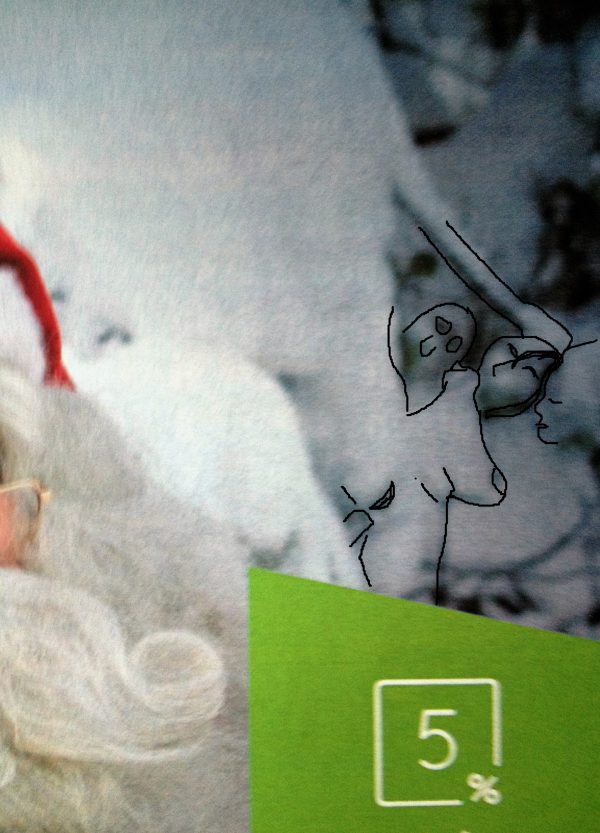
Travelkids organizes travels and sojourns “for the family.” Yet, in case you would find it a bit trite, they suggest you may find more excitement than just that. I am not talking about the meeting with Santa Claus, which is the copy line, but of the subliminal embed in the background. A woman is laid with two men. One man is lying beneath her; you can see his face, looking at you, between her right thigh and her right breast. The other man’s face is against her face. I have also outlined what seem to be a stretched arm and a hand resting on the woman’s head, hinting at the possible presence of a third man. The man beneath the woman is penetrating her in the anus (picture 91-3). The vaginal slit may be stuffed with a penis too, if you look carefully, but I have not outlined this because I’m not so sure there.

Case 91

91-2
91-3
…………….Case 92 Rabat (Barcelona Madrid Valencia) SEX
The bust shows almost only naked parts, uncovered skin. The pattern of the few centimeters of dress that you can see looks like spermatozoa.
Under the model’s eyes, in the shady area, have been embedded a couple of SEXes which I leave to you to spot.
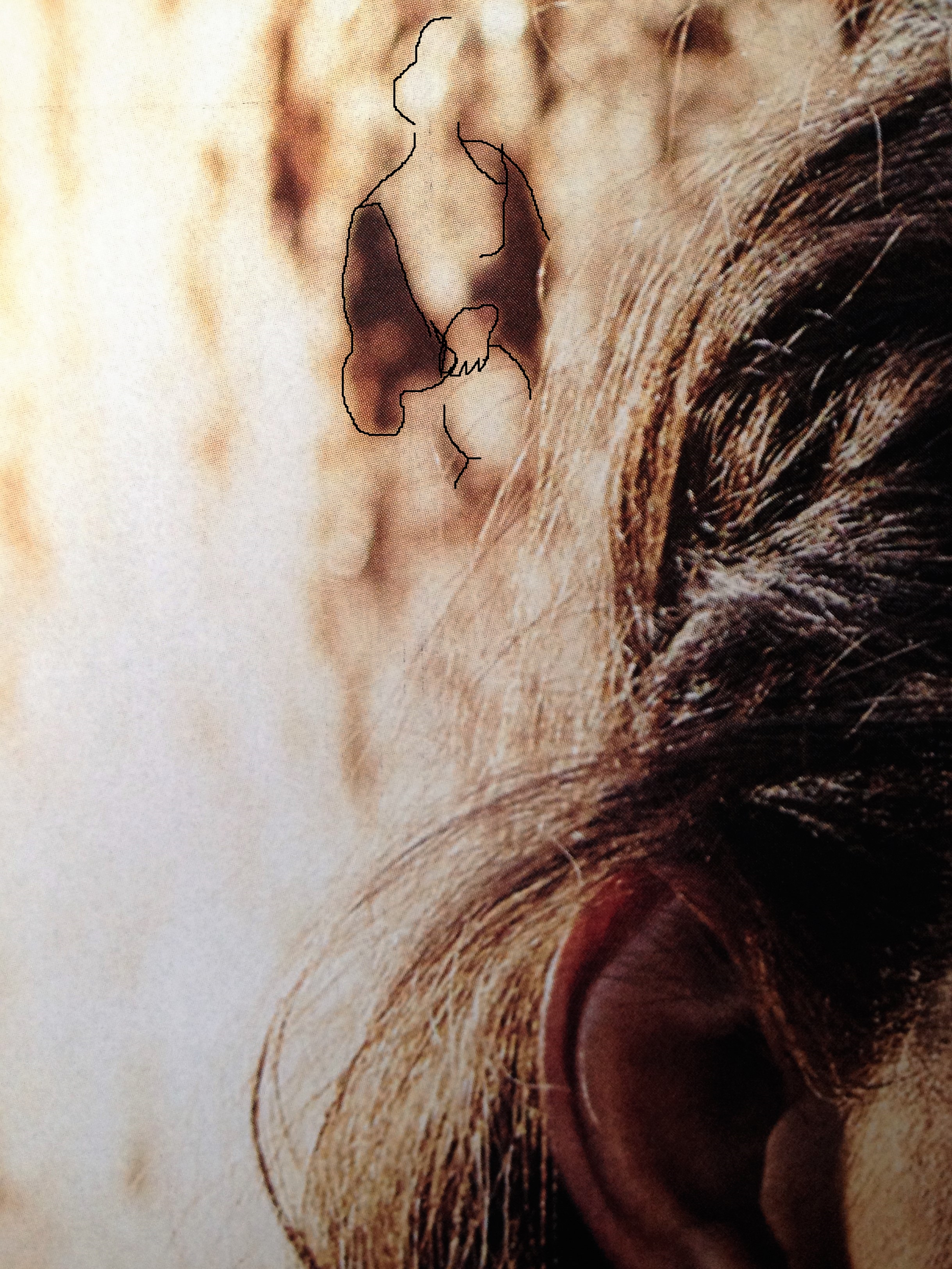
What I have concentrated on is the subliminal presence, in the background, of a woman wearing only a dark shirt or blouse wide open on her naked breast. The blouse has fallen down her shoulders, slightly, so the shoulders too are largely uncovered. Her left hand is on her vagina. The inclination of the head hints at a moment of abandon. That subliminal woman is masturbating.

Case 92

92-2
…………….Case 93 Gucci SEX
Cases 93 to 95 are from Cosmopolitan UK Edition, October 2015.
On the left page of this two-page advert for perfume, you can see, beside the name of the brand and the copy (“Underneath it all she wears Gucci Bamboo” – this by itself is eroticism, isn’t it?), a Japanese-like ink print, complete with birds in bamboo trees and grass by a river. The river stream and grass stand for a moist, oozing vaginal slit with pubic hair.
The model on the right page, wearing a risqué evening dress, is looking at you intensely. You too are on the picture, mind you, because albeit you may think the shadow on the wall is hers, whose shadow is it that is on her? There is only one shadow and that’s the shadow of a man with erect penis (outlined on picture 93-2). This is whom the woman is looking at.

Case 93

93-2
…………….Case 94 Pantene SEX
Are words necessary? I don’t know how to tell you, but there’s not even a façade of propriety in your world. You talk like a person of worth and dignity, and yet that’s the kind of stuff your guests will find in your living room, on the sofa or under the coffee table – depictions of fellatio.
Please take a look at what I wrote on Case 72 (here), where I already discussed the “blow dry” copy. The present advert confirms that I am right. For, yes, it’s a fellatio that you’re seeing just now. And it’s a fellatio that was intended, with that hairdryer and that wide-open mouth. Had it not been intended, there would have been some guy in the staff telling the others: “Shouldn’t we do something to make the picture look less like a fellatio?” And someone would have replied: “Oh yes, it’s true some people will think of a fellatio! Let’s do something about it.” No, they wanted it that way.

Case 94
……………Case 95 Fiat SEX
A female hand is about to apply lipstick to a car rear light. Because, as the copy goes, the rear light is as glossy as lipstick. On the other hand, the stick is about to penetrate the dark space between the red glossy “lining” of the rear light. Another sexual representation.
Why do women put on lipstick in the first place? According to evolutionary psychologists, it’s a way to simulate sexual arousal, since her lips tend to redden and shine when a woman is aroused; such a state of arousal being in its turn sexually arousing for men, lipstick makes women more attractive. It’s like swollen genitals during estrus among certain primate species. Among species with visible estrus, a female can take no rest at these periods because all males want to copulate with her, and even if she’s monopolized by one dominant male he won’t stop copulating with her, in case she would be inseminated by another male despite his vigilance (and he wants to counter the other male’s semen with his own: this is called sperm competition, see my Science of Sex series).
In echo with Case 88 (Tyrannosaurus Toyota), even though the ad is obviously aimed at women, its copy intends to be alluring to aggressiveness: “The Icon Reloaded. Change the Fiat 500? That’s crazy talk. So we set out to subtly style-up the little beauty. Take a look at the red hot halo-style rear lights with body coloured inserts. Just one of many ferociously fashionable (author’s emphasis) touches that make the new Fiat 500 even glossier. Shine baby, shine.” Being fashionable is not enough, one must be “ferociously” fashionable. Many a psychologist (even among evolutionary psychologists) will tell you women are not aggressive… They don’t live in the same world as us, seemingly. Women are aggressive and when they mean business they know how to use men as weapons.
“Icon” can apply both to the car and the customer, that is, the female ad viewer. If the latter needs “reloading,” and that can mean something very organic such as vagina-loading (this is consistent with the whole seduction line of the ad), she may reach out for the car.

Case 95
…………….Complements
Have I the right to make use of all these adverts without asking permission? I have read several scholarly books dealing (more or less competently) with advertising, and they all thank the companies for their kind permission to let them use their material.
On one occasion, when Kentucky Fried Chicken faced a viral campaign on the Web because of a racist ad, first they hinted ominously at unpermitted use of their advert by the people who launched the campaign. Then they pulled the ad like good boys.
Still, I find it would be strange that the companies that otherwise pay for an advertisement to be made for one of their products and also pay for that advert to appear in various media, object to another medium showing the same material without asking money for it. To be sure, I take the liberty of making comments on that material, which the other media never do (they take the money and shut up – that’s what they call informing the public). This is why I add here the following excerpt from Eric McLuhan’s introduction to the 2014 edition of Marshall McLuhan’s book Culture Is Our Business (1970):
Many have wondered at the lack of acknowledged permissions for using the ads in both books [The Mechanical Bride and Culture Is Our Business]. The reason is that permissions were unnecessary: the ads were available for free. Editors at Vanguard had found a curious legal fiction. Advertisers were being given huge tax breaks on the grounds that they were engaged in a sort of educational enterprise, “educating the public” about products so that it might better make informed choices. The upshot is that anyone can make use of the (government-supported) ads for free providing they were not being used as ads, but as educational materials, for educative purposes. Needless to say, the agencies were reluctant to let these matters become known to the public.
And, on behalf of advertisers, thank you for the tax breaks.
Whether this legal provision applies to my case or not, I haven’t the slightest clue (under which jurisdiction lies this blog is unknown to me), but I guess that if multinationals want to crush me or anyone, they have the means. But I, on my side, have nothing to lose. (They perhaps have the means to buy me, as an alternative, who knows?)
I’ve got nothing to lose and besides I’m not alone; there is at least one living dead with me, namely Aldous Huxley, whose Brave New World Revisited (1958), written some 25 years after Brave New World, I urge you to read, especially, regarding the present topic, its chapter IX “Subconscious Persuasion,” which I quote:
Poetzl was one of the portents which, when writing Brave New World, I somehow overlooked. There is no reference in my fable to subliminal projection. It is a mistake of omission which, if I were to rewrite the book today, I should most certainly correct.
Last but not least, a quote from William James on his views about the “transmarginal field of consciousness,” in The Varieties of Religious Experience (1902):
Such rapid abolition of ancient impulses and propensities [by religious conversion] reminds us so strongly of what has been observed as the result of hypnotic suggestion that it is difficult not to believe that subliminal influences play the decisive part in these abrupt changes of heart, just as they do in hypnotism. Suggestive therapeutics abound in records of cure, after a few sittings, of inveterate bad habits with which the patient, left to ordinary moral and physical influences, had struggled in vain. Both drunkenness and sexual vice have been cured in this way, action through the subliminal seeming thus in many individuals to have the prerogative of inducing relatively stable change (author’s emphasis). If the grace of God miraculously operates, it probably operates through the subliminal door, then.
and
Incursions from beyond the transmarginal region have a peculiar power to increase conviction.”
And the money-grubbers would deem it below their dignity to make use of such a powerful tool at their disposal?
July 2016
XXIX The Science of Sex II
Dr Robin Baker’s Science of Sex II
In his reply to my essay on what I called his Sex Wars trilogy (Dr Robin Baker’s Science of Sex: A Discussion, XXVIII, here), Robin Baker pointed out three blunders I made, and for the rest invited me to read the book he authored with Mark Bellis, Human Sperm Competition. Copulation, Masturbation and Infidelity (1995), which presents the results of their research in a more systematic and detailed fashion. I then ordered the book and read it. The present essay is intended as a sequel to XXVIII; it acknowledges that my non-specialist objections on particular points of Baker’s theory have found satisfactory answers in Human Sperm Competition, and further expatiates on a few inferences I draw from the theory.

As a sequel, the present essay perhaps should not be read before taking cognizance of the content of the original essay (here). A brief introduction on human sperm competition can also be found here (XXVII).
The abbreviations for the book titles have been maintained from the former essay. Further on Human Sperm Competition will be found abbreviated as HSC. I am using the first hardback edition by Chapman & Hall, 1995.
Before I tell how my objections and doubts have been satisfied, one word on the blunders Baker pointed out in his reply (a reply I have posted as a comment to XXVIII). They are three: one on method, two on content.
On the method, I had made some quotes from the collective work Sperm Competition in Humans (SCH) without naming the authors of the passages quoted. I have since then corrected the slip in the text itself, acknowledging the fact in a further comment.
Another blunder I made, this time regarding the content of Baker’s books, was that I construed the expression ‘clear eyes’ as meaning ‘fair eyes’. Hence my questions on this point lacked an actual ground, because they were based on a semantic misunderstanding. Baker made it clear in his reply.
The second blunder on content concerns some figures on the extent of human sperm competition. Baker answered with an extensive quote from HSC showing that my remarks, here again, were groundless. I shall deal with this point more at length, explaining the nature of my blunder, under the head “Conception Via Sperm Warfare: The Figures.”
I shall now proceed with exposing how my objections have been answered, under the same heads, or subtitles, used in XXVIII.
Female Orgasm
Under this head I did not exactly make an objection; it was rather a request for more information. I requested, namely, a confirmation that via copulatory orgasm, as an operation by which the outcome of sperm competition can be slanted, women really manage to discriminate between sperm from different men, and how. I think I now understand the mechanism better.
As I understand things, female copulatory orgasms discriminate between different sperm as long as these are not mixed in one and the same seminal pool. It means that copulatory orgasms are of no avail when two successive copulations by two different men occur before a flowback (expulsion of sperm from the female’s genital tract) has resulted from the first insemination. Quoth: “The overall pattern is more or less as predicted by the ‘upsuck’ hypothesis, female orgasm in some way assisting uptake of sperm from the seminal pool before the remainder of the sperm are ejected in the flowback.” (HSC, 236, box 10.5). & “Orgasm facilitates the passage of sperm from the seminal pool to the cervical mucus. It could do this in one or all of several ways: (1) dipping the cervix further into the seminal pool; (2) promoting greater mixing of cervical mucus and seminal fluid; (3) lengthening and/or increasing the number of seminal projections into the cervical mucus; and/or (4) lengthening the time that the cervix is dipped in the seminal pool.” (HSC, p. 237). Thus, the mechanism of female copulatory orgasm in any case exerts itself on a given seminal pool, and would not be able to discriminate among the content of that pool if composed of various sperm.
As a result, the example I took in XXVII of an orgy is an instance where a woman would be least likely to slant the result of insemination, if male participants inseminate her by turns without interruption, because orgasm upsuck would then apply to a multifarious seminal pool in which the favorite male’s semen is mixed with other males’ sperm. Admittedly, such configuration is relatively rare (even in the context of an orgy, flowbacks may occur between several inseminations, if the participants make breaks; quoth: “Median time to emergence of the flowback after male ejaculation is 30 minutes with a range of 5-120 min” [HSC, 45]) and copulatory orgasms remain useful in the majority of cases of sperm competition, the woman favoring the sperm contained in a homogeneous seminal pool although she may at the moment of orgasm shelter sperm from another insemination in her cervical crypts and/or oviducts (these latter sperm being not impacted by orgasm).
If this is so, it raises a question: What sperm does the penis, in its function of sperm-removal tool, actually remove? Is it only ‘flowback sperm’, so-called, forming a seminal pool in the upper vagina and due to be ejected very soon? Quoth: “Backward and forward thrusting of the penis during copulation, combined with the shape of the penis in a distended vagina should successfully remove a major part of any soft copulatory plug or liquid seminal pool.” (HSC, 171). It thus seems that the answer to the question is yes. However, “The greater the suction, the greater the chance of removing cervical mucus with perhaps older sperm from the cervix itself.” (HSC, 170, box 6.13). I stressed the word ‘perhaps’ because it makes a big difference whether the penis can remove sperm already stored in the cervix or not; for if it cannot, it then applies to present seminal pools merely, that is, in the context present-day customs, it never serves most of times. In the absence of a seminal pool, if we keep assuming that the penis can’t remove sperm stored in the cervix, it can still remove sperm, but it is flushed-out sperm mixed with leucocytes that invalidate them and cells and debris from the female (HSC, 40, box 3.5), that is, sperm unlikely to perform fecundation anyway – sperm that is being removed by the female tract itself (after flowback), without the help of a ‘piston penis’.
As we saw from quote HSC, 45, in general flowbacks occur fairly quickly after intercourse. The probability that another intercourse occurs before flowback should in normal circumstances be deemed small as a consequence, and if ‘flowback sperm’ merely is exposed to the action of the piston penis, it makes the latter’s usefulness rather low. This way open to men to slant sperm competition seems fairly inadequate, whereas the corresponding way open to women, their copulatory orgasms, is effective in most cases and can be foiled by very specific contrivances only (above mentioned), which anyway imply a degree of sperm competition.
The picture I have just outlined, based on my understanding of the facts, is that of a radical asymmetry between women and men in regard of their respective physiological endowments for slanting sperm competition. HSC has provided me with a confirmation that female copulatory orgasm can discriminate among different sperm, in the limits above presented, and with the insight that the limits of the piston penis’ usefulness are important. Of course, we should not disregard the fact that Baker & Bellis consider that the penis can ‘perhaps’ remove sperm from the cervix as well, but they give no clue as to how that would happen.
Oral Sex
My objection, under this head, was that the passive gender in an act of oral sex (men in the case of fellatio, women in that of cunnilingus) should have evolved a dislike for the practice, and that, not only have they not, but according to a study by Eysenck et al. it is the active gender that generally expresses a dislike (men say they dislike cunnilingus, women say they dislike fellatio). As Baker, in his trilogy, presents oral sex as a way to collect information (on health and faithfulness), I could have replied to my own objection myself: since it is about exchange of information, if one partner is eager to get information the other may as well be willing to provide it. Which is what Baker & Bellis say: “The main feature of overt orgasms is that the climaxing individual is giving their partner information. … If the transference of this range of information is sufficiently advantageous to both male and female, it could be enough evolutionarily to maintain the observed behaviour. The main topic of theoretical interest then becomes the optimum ratio of cryptic to overt orgasms for male and female performers and observers.” (HSC, 115).
For the man, giving information is a straightforward transparency operation, but Baker & Bellis hint at another set of motivations for the woman: “As far as the climaxing female is concerned, the interplay of cryptic and overt orgasms is a major part of her strategy to confuse the male over levels of sperm retention. Allowing the male to observe a non-copulatory orgasm could be an important element in this strategy.” (HSC, 115).
As to Eysenck et al.’s study, the fact that primates and other mammals practice oral sex (HSC, 101) may cast some doubt on the validity of its results. Otherwise, it could be that the dislike is true generally and that oral sex is performed because of its strategic importance albeit not accompanied by pleasure, but such a view would run contrary to the notion that evolutionary useful acts are predicted to be pleasurable to their performers.
Ejaculates
Under the present head, I expressed some doubt on the likelihood of an energetic trade-off model, based on the testes’ huge sperm productivity. It turns out the trade-off considered by Baker is not necessarily that which I thought of: “Such restraint over the number of sperm ejaculated when the risk of sperm competition is low implies that males suffer some disadvantage if they ejaculate too many sperm on any given occasion. Two main disadvantages have been suggested: (1) that the sperm and other constituents in an ejaculate are costly to produce (Dewsbury, 1982); and (2) that, in the absence of sperm competition, the more sperm a male ejaculates, the lower his chances of fertilizing the egg(s) of the current female (Baker & Bellis, 1993).” (HSC, 24). So, the idea of an energetic trade-off is credited to Dewsbury, whereas Baker & Bellis, quoting their own research, hint at another phenomenon, namely that too many sperm may act as a chemical weapon against the woman’s eggs.
My objection taking sperm productivity into account (for the figures, see XXVIII) could still hold against Dewsbury’s model, but it is limited to sperm and I have nothing to say about the productivity of ‘other constituents’ of an ejaculate, i.e. the seminal fluid, which may be much more costly to produce and spend than sperm themselves.
Baker & Bellis do not formally reject Dewsbury’s model and in at least one occasion they seem, on the contrary, to rely on it: “The disadvantage of small testes should be that their possessors produce fewer sperm per day and thus, all else being equal, must either: (1) ejaculate less often and, on average, inseminate older sperm; or (2) ejaculate as often and, on average, inseminate fewer sperm.” (HSC, 111). Such calculations are based on a cost analysis of sperm production and seem to imply the validity of Dewsbury’s energetic trade-off as regard sperm themselves.
Furthermore, the idea that sperm competition itself has being selecting big testes for their capacity to produce more sperm and thus give their owner an advantage in sperm competition, fits the energetic model. There is, seemingly, no way to escape the model, no matter how the figures of sperm production make the very idea of a trade-off along energetic lines puzzling.
Accordingly, Baker & Bellis’s careful conclusion is not surprising: “At present, we cannot determine the relative importance of this factor [optimizing sperm numbers according to levels of sperm competition] and any constraint on sperm numbers due to the cost of producing ejaculates (Dewsbury, 1982). Inevitably, ejaculate cost must have been a factor in the evolution of species-specific rates of sperm production. It is possible, however, that at least for mammals ejaculate cost could be less important than the factors discussed here in influencing restraint over the number of sperm inseminated on any given occasion.” (HSC, 227).
Conception Via Sperm Warfare: The Figures
Baker has replied to my remarks under this head by quoting extensively the relevant passage from HSC (see his reply in comment on XXVIII). To put in a nutshell, I had lost sight of one important possibility, which Baker & Bellis put thus forth: “a female may be paired to one male, conceive by another (via infidelity, and perhaps sperm competition)” (HSC, 200, box 8.4). When writing that part of my essay, I fancied that no woman would conceive via infidelity without sperm competition, because I overlooked the possibility of breakdowns in routine sex. Given that “On average, human pairs engage in IPC [intrapair copulation] at median intervals of about every three days” (HSC, 206), and that Baker & Bellis retain a life expectancy of sperm inside the female tract of 5 days (they present this figure as a conservative estimate), in the normal course of events no female infidelity goes without sperm competition. But one must not rule out the possibility that some men may be crazy enough to neglect routine sex with their long-term partner, or that ‘accidents’ can occur, and that a woman might cheat her partner when he has been lying on a hospital bed for weeks. Because of that blunder of mine, the discussion of the figures in XXVIII is meaningless.
With this head, the discussion of the strictly biological aspects of Baker’s writings is through. I have acknowledged my mistakes as far as I could detect them, and I now proceed to some social considerations, where I find my opinions are more solid.
Pornography
HSC does not deal with pornography as such. However, some passages confirm my point of view as to how the phenomenon should be construed. As previously stressed, Baker has evolved from the idea that Western societies are becoming increasingly puritanical to the more optimistic view that the current ‘generation porn’ represent an emancipated and enlightened brand of humanity. My own view is that neither picture is correct, but rather that there is a risk that we become increasingly incapacitated sexually. Puritanism has sometimes been construed as a way to cope with sexual inadequacies, but as an ideal of strict monogamy, it cannot, except in marginal cases, be interpreted as such, and Puritans of the past are known among other things for their philoprogenitiveness.
From the evidence of SF 279-80, I have stressed that prostitution in the West has been declining. (Although he provides the figures on which I rely, Baker himself does not construe them in this way; he just offers them as evidence of prostitution in the USA and UK.) In the past, particularly when brothels were legal and widespread, many a young man would have his first sexual experience with a prostitute (of which scores of novels attest, as well as sociohistoric literature). These data make one conclusion pretty tempting, I should think, and HSC buttresses it: “Inexperienced male monkeys and chimpanzees, when encountering a receptive female, become strongly sexually aroused but are often so awkward at attempting intromission that the mating is never completed. Adults who have been denied the opportunity to gain sexual experience when younger are often unable to copulate (Ford and Beach, 1952). A level of experience with other males would be of obvious advantage in increasing the success of an individual’s first mating opportunitites with a female. There may well be some advantage in using other males as targets for practice rather than females. Females, because of the risk of conception, may less often than males be prepared to allow males the opportunity to experiment.” (HSC, 118). Needless to say, Baker & Bellis generalize the findings to humans. In a nutshell, they credit homosexual practice with the same ‘educative’ virtues evidenced by prostitution in the past.
So, if it is true that prostitution has declined (and let the reader be reminded of recent legal developments in some countries such as France, where paying for the services of a prostitute has been criminalized; this criminalizing occurring at a time when prostitution has already sharply declined, law-makers cannot contain the lyrical flows of their eloquence against such a barbarous exploitation of women, failing to see, or rather feigning not to see the far more impressive figures of pornography), if, I say, prostitution has declined, and homosexuality has not increased in due proportion, of which I am not aware (and Baker says it remains stable), certainly one should expect that more men stay virgins for want of experience at the right time.
Do contemporary mores compensate for that? At least two elements should induce us to doubt it. First, feminism has been a strong deterrent to male urgency, as well as the most recent forms of democratism: the vanishing of an utterly dependent servile class has narrowed opportunities for well-off young men to inseminate female servants with the certainty of avoiding unpleasant consequences. Some stories by a Maupassant, for instance, cannot but be met with incredulity nowadays, although they may be more realistic in the context of his time. Second, the mediatic buzz about AIDS, now receding, has certainly played a deterrent role. I have shown elsewhere (here, in French) that the treatment of this sexually transmitted disease by the French media in the nineties was disproportionate. I have shown that, at the apex of the AIDS razzmatazz, an heterosexual individual was 55 times more likely to die in a car accident, and 10 times more likely to die assassinated; and that drugs-addicts were far more likely to contract AIDS via intravenous injection by contaminated syringes (one out of 25 drugs-addicts was then expected to die from AIDS) than gays via sexual intercourse! The buzz must have had a powerful deterrent effect, especially since the only known way to prevent AIDS apart from abstinence, the condom, could never be deemed 100% safe. On this last point, I reminded my reader of the failure rates generally acknowledged, but HSC brings forth even higher figures: “condoms retain a high chance of fertilization. Although, when used properly, the risk of conception with a condom may be as low as three pregnancies per 100 woman years, in normal usage the risk varies from 5 to 30 pregnancies per 100 woman years. This is up to about half the risk experienced by a fertile couple with no protection.” (HSC 178). A risk of conception means a risk of contracting STDs as well. With such a miracle weapon against AIDS – and AIDS, for a long time, has meant certain death at the end of ghastly sufferings – I can’t see many a reasoning mind taking the risk lightly, especially when the horrors of the disease are blasted in your ears daily, year in and year out.
In such a context, what can pornography do for us? I think I know what it can for its producers, but for the viewers it cannot serve the same ‘educative’ purposes as homosexuality (according to Baker) and/or prostitution. At best, it remains theoretical knowledge. At worst, as stressed by sexual ‘educators’ of the past, like Wilhelm Reich, it generates anxiety. Young viewers, especially, might be led to see themselves as inadequately equipped for sex, both physically, with respect to penis size, comparing with the performers’ penises, and psychologically, perceiving that they cannot be callous enough to engage in sexual games.
This is my own interpretation of what Lundberg & Farnham (already quoted in XXVIII) call, with their psychoanalytic lens, an ‘extensive psychological castration of the male.’ It stresses the dismantling of sex-educative institutions for men, and their replacement by a counterproductive substitute.
Incidentally, contrary to common belief, pornography may well be consumed by women. I have already hinted, in my previous essay, at studies cited by Zillmann concerning physiological reactions to erotica. In the current belief, held including by some evolutionary psychologists, such as Gad Saad, holder of a chair on ‘Darwinian consumption’ (sic) at Concordia University (Montreal, Canada), pornography appeals to male psychology, while women are interested in romance novels à la Barbara Cartland (The Consuming Instinct, 2011). No doubt men find no appeal in romance novels, but women’s taste for such books is only one side of the coin. They appeal to a woman as seeker of a long-term partner, seeker of the gentleman who will help her raise her children and who therefore must be faithful, caring, protective, considerate, earn a lot of money, and so on. But remember that the gentleman in question is a springboard for the woman as seeker of gene-providing lovers (springboard model). In this latter state of mind, any reason preventing pornography from appealing to her may be illusory.
In conclusion, the situation, I believe, is like the French saying “Ce sont ceux qui le font le moins qui en parlent le plus” (the less they do it, the more they talk about it), but at the collective level. The fact that “sex is everywhere, from Web to television” (Baker, in his 2006 introduction to SW) is not reassuring, really, even from a non-Puritan point of view. To make it clear from an analogy, the current tendency, in Hollywood movies, to depict heroines as women of action coping with obstacles with their muscles, comes handy. An alien from Mars watching such movies would get a very inaccurate picture of our reality. The motives behind such a distorted picture I can only surmise: on the one hand the need to keep making popular action movies for cash, on the other hand the moral imperative to give women a fair share in our symbolic representations…
But I am no prophet of doom and I bring, instead, a message of hope. Hags can take the place of whores! There is already, I am told, a significant trend in pornography depicting female performers far past the age range usually appealing to men in search of mates (see what these evolutionary determined preferences are in XXVIII). Old women, the refuse of sex life, would be attractive enough to inexperienced men (inexperienced past experiencing age) who badly need training to improve their self-confidence – the training men used to have with prostitutes in more relaxed times. If one of these men can get his hands on such a one, and they are easily available for the prurience never dies, he will give her the time of her life, being like a starved beast of prey, and having developed severe, and interesting, deviations – imaginations. Hence, the refuse gets the best.
Optimizing vs Maximizing
On this topic I will be discussing also a source of Baker & Bellis, namely Despotism and Differential Reproduction. A Darwinian View of History (1986) by Laura Betzig.
My objection was to Baker’s prediction that world population will stabilize in the future (at 11 billion individuals around 2100, a fairly precise prediction). HSC details his arguments. Quoth: “There is a close relationship (a) between family size and life expectancy (P = 0.008, controlled for the geographical areas illustrated) which is not significantly different from the relationship (b) between family size and use of moder contraception (P = 0.004).” (HSC 182, box 7.4). Baker & Bellis here discard modern family planning as having played a motor role in the demographic transition. According to them, contraceptive methods “enhance psychological predispositions and strategies evolved much earlier in mammalian history” (HSC 183), and life expectancy is the key factor. As this factor increases in developing countries, birth rates will diminish, as they have diminished in Western countries with the increase of life expectancy, to stabilize at the number of children that optimizes reproductive success – a number that according to Baker fixes at replacement level, i.e. two children per woman.
This model relies on differential observations about developed and developing countries, rich and poor, and the same observations seem to hold for individuals inside countries: “A first attempt to model the situation was made by Rogers (1990). The conclusions were that at the lower wealth ranges of a population, long-term fitness is maximized by using the currently available wealth to maximize family size. The more wealthy ranges, however, gain relatively little from increasing family size and thus may benefit, in long-term reproductive success, from limiting family size so that those few offspring raised are reproductively more successful. As Rogers recognizes, the conclusions are sensitive to a number of assumptions. At the very least, however, the model shows that the reduction in family size during the demographic transition could well have been a response that actually increased individual reproductive success.” (HSC 183).
Interestingly, these views seem to buttress my own linguistic argument on the etymology of the word ‘proletarian’, an argument I used against Baker’s prediction. My construction of this word derived from Latin proles, i.e. offspring, as meaning those who make many children, is not partaken as such by linguists or Latinists. Generally speaking, the word is construed as meaning those who possess nothing but children, or in the classic Latin-French dictionary by Gaffiot, “qui ne compte dans l’État que par ses enfants” (whose worth in the state depends entirely on his children); but both constructions imply some maximizing reproductive behavior, because if one’s wealth, or worth, equals one’s number of children, then one will maximize one’s number of children, for in the case of wealth or worth a distinction between optimizing and maximizing is irrelevant.
So, both Rogers and I agree that lower classes make more children. However, Darwinian theory, as Betzig explains, predicts that the more wealthy and powerful one is, the more women he will inseminate: “As a rule, the evidence is overwhelming that rich and powerful men do enjoy the greatest degree of polygyny cross culturally” (Betzig, 1986, p. 34), and she quotes Darwin: “Polygamy … is almost universally followed by the leading men in every tribe.” Baker & Bellis, quoting another book by Betzig, write the same, adding some historical restrictions: “the advent of agriculture and animal husbandry (c. 15 000 years ago) seemed to herald a universal swing in the human population towards polygyny and extreme reproductive inequality between males (Betzig, 1988). … The critical factor in this swing seemed to be the clumping of resources associated with agriculture and husbandry and the inevitable increase in differences between males in the resources they could accumulate, defend and offer.” (HSC, 140).
Both sets of data seem hard to reconcile. Why didn’t polygynous men of the past optimize their reproduction and why, instead, did they make more children than proletarians? Had they not a higher life expectancy than the subjected populations? If I had read Betzig before, to be sure, I wouldn’t have written that proletarians have been making more children ‘from the remotest antiquity’ on (XXVIII) without further consideration.
Betzig circumscribes yet another time limit in the validity of her ‘Darwinian view of history’: “A decline in both despotism and differential reproduction seems to coincide with industrialization.” (Betzig, 1986, 97). She hypothesizes that, in a context of technical specialization, a decrease in differential reproduction is a necessary concession from the ruling classes to the useful specialists (p. 104). In the same way that, at the beginning of the twentieth century, some intellectuals warned that Darwinian survival-of-the-fittest mechanisms did not function any longer and there were no more natural checks to the proliferation of defects in industrial societies, which were therefore doomed to see the burden of defective individuals increase, we here have another cesura in our Darwinian view of history across the industrialization line, with differential reproduction reversing from the haves to the have-nots. (Or is it the same idea?)
First of all, the data presented by Betzig might not impair my position as to the behavioral characteristics of proletarians in the remote past as much as one may think, because rich men’s polygyny increases also poor women’s, their servants and others’s philoprogenitiveness, whereas rich women’s reproduction may remain suboptimal.
(As a parenthesis, I would like to expatiate on this point by dismissing a possible objection to my statement in XXVIII that a rich man who cuckolds a poor man contributes to widening the gap between the actual and optimum number of children in that poor family. The objection would be that the poor women having routine sex with their poor partners anyway, children will be born even without a rich man cuckolding the poor man. This is not quite so simple, because a woman is more likely to become pregnant in the course of extra-pair copulation [EPC] than of IPC: “The more fertile the female (i.e. in terms of stage of menstrual cycle and type of contraceptive), the higher the proportion of copulations that are double matings.” [HSC, 198] & “Women are significantly more likely to use contraception during IPCs than during EPCs, particularly double matings.” [ibid.] & “There is a clear increase in the incidence of EPCs, including double-matings, when the risk of conception is greater.” [HSC, 197, box 8-3]. Statistically, my remark must hold true.)
Second, one should perhaps distinguish, even before industrialization, between sex warlords and bourgeoisie. Sex warlords, due to their military way of life, might have had a life expectancy that was hardly higher than their subjects’s. As a result, they too maximized their offspring. Bourgeoisie, on the other hand, is the shrewd and prudent class; they optimize. Baker & Bellis talk about those suboptimal men in sperm competition who are most willing to take a wife as a long-term partner and as a consequence must specialize in parenting skills. What are these parenting skills if not the self-same skills that enable men to provide for the needs of a family in the long run? This is bourgeoisie, biologically speaking.
Finally, even before industrialization, there must have existed in the very social structure checks to extreme reproductive inequalities. Especially in despotic societies, the social pyramid (▲) is the inverted picture of the alleged reproductive pyramid (▼). In the Ottoman Empire, at the passing away of the sultan, one of his numerous children was placed on the throne at the end of shadowy court intrigues (in which women would play a great part) and all his siblings exterminated, so his reproductive success must be regarded as not so very great after all. In Western feudal aristocracies, among which property was indivisible, only the first-born male inherited the land and title. The second-born was destined to become a sterile cleric in the Church, the other ones making a career in the military or disappearing altogether from the scene, in the commonalty. Property being indivisible, feudal interests are disconnected from the number of children; besides the biological urge, there is no social incentive to make many children. Conversely, among classes or under regimes in which conveyances are divided, the interest of the family is clearly to reduce the number of children; dynastic (family) success is impaired by transmission to many siblings.
These several considerations tend to promote the idea that data from primitive tribal societies as regards reproductive inequality ought to be taken with a pinch of salt when discussing other types of societies, civilizations namely, however remote.
I shall now proceed to a few other considerations that the reading of HSC has newly triggered.
Ejaculation
Under the head “Ejaculates” in my previous essay, I described a theoretical model of female mate-guarding I had designed based on a number of assumptions, particularly concerning male ejaculation. The idea was that the volumes ejaculated by a man depend only on time elapsed between ejaculations, and that this allows the woman, in a context of routine sex, to detect, through interoceptive evaluation of the volume ejaculated, unfaithfulness (or cryptic ejaculations outside her). I have found in HSC that such an assumption (volumes depending on time) has been made by biologists too. Baker & Bellis call it the ‘physiological constraint model’: “This model assumes that, at each IPC, males inseminate all of the stored sperm mature enough to be ejaculated. On this model, number of sperm inseminated at each IPC will be a function of time since last ejaculation and the rates at which sperm mature (minus those which are shed or destroyed.” (HSC, 208). They dismiss it, based on laboratory evidence, and propose instead their own ‘topping-up model’, of which I have already talked.
However, another consideration could save my own model, because I have discarded it offhand on a certain misunderstanding and confusion. What the topping-up model is dealing with is the number of sperm ejaculated, not the volume of seminal fluid, and in my own story the important factor is the volume of seminal fluid inseminated in the genital tract, because it is that volume that would be sensed, and evaluated or measured, by an hypothetic interoceptive sense of the woman (not so hypothetic, perhaps, because we will all agree that the genital tract is sensitive; the question is whether its sensitivity would allow the woman to perform the evaluation I surmise).
HSC confirms that the volumes of seminal fluid and the volumes of sperm are two different stories: “In principle, a female could also gain from stimulating her partner to ejaculate without copulation in order to observe the amount of seminal fluid ejaculated by the male. This could give some information on how long it is since last ejaculated. However, as seminal fluids recover relatively quickly (Mann and Lutwak-Mann, 1981), the female could probably only tell whether the male had ejaculated in the previous 12 hours or so. Within the context of her partner’s infidelity, however, this could still be useful information.” (HSC, 115) Baker & Bellis come to the same idea of female mate-guarding through information got from the amount of seminal fluid ejaculated, but they apparently do not think such estimates possible inside the female genital tract: the information has to be gathered from ‘ejaculates without copulation’, be it through masturbation or fellatio. This being said, they explain how such information from seminal fluid works, and what kind of assumptions it allows.
Perhaps the data could be further refined, and correspondences established between volumes of ejaculated seminal fluid and sperm, to see if any correlations exist (if such studies exist, I pray the reader to forgive me for being a layman.) Let us assume for a moment a strong correlation between the amounts of both elements, seminal fluid and sperm, during ejaculation (although we’ve just seen the story is different for each). That would allow my model to stand on its feet, beside the topping-up model, with only one further restriction. If the volumes ejaculated depend on (1) time elapsed since last ejaculation and (2) time spent together by the partners (topping-up model), the woman could still detect the man’s infidelity via estimates of the volumes he ejaculates in her tract, thanks to an hypothetic interoceptive sense, if the partners have regular routine sex and if at the same time they have adopted a regular, routinized way of life by which they spend the same amount of time together from one week to the other. Such conditions being fulfilled, any variation of the volumes would warn the woman that something is afoot. A process of extreme routinization in every aspect of life is implied in successful mate-guarding.
Male Opportunism
Under the head “Male Masturbation,” I expatiated on some views I had published elsewhere, the gist of which was that the young man refraining from the practice would be sending signals to women that he is sexually ‘on’. “So what?” a biologist might reply, “Don’t you know that males are urgent and females coy (HSC, 13, box 2.7)? Even if the woman gets signals, being coy she can’t make nothing of it. A male sending signals, that makes no sense; the man just takes action.” It is true that such views of mine at first sight do not quite fit the urgent-coy dichotomy, nor the more popular one of active-passive. To my mind, the male is opportunist: not so much active as ‘activated’. Truly active men are sexual predators and rapists; the bulk of us is not in search of preys but of opportunities. In the absence of certain signals, the man remains passive. I contend he can force the woman to send signals to him, by pleasing her. The idea of opportunism is of course implied in male urgency, but it qualifies it. Unqualified urgency is predation.
Another way to get at the idea of opportunism is, indirectly, through the notion of coquettishness and of a coquette. The word has fallen into desuetude, but Henry James’s stories and novels, for instance, give us a clue as to its importance in not so remote a past. A coquette was not a fallen woman yet, but she could not be regarded as a lady any more. In a nutshell, the coquette would send deceptive signals to opportunist men, she would ‘activate’ them for the mere fun of it, and that was a disgrace.
A man who gets signalled at by women everywhere he goes is what I shall call, for the sake of simplicity, an alpha male. Beta or zeta males often enough admit they suffer from woman’s choosiness (a consequence of her coyness), but they know what an alpha male is; when they spot one, they do their best to become one of his close acquaintances. It’s the best way they can find to get access to women, because an alpha male is bound to create much disappointment among the feminine crowds that signal at him madly (there is just not enough time in a man’s life to enable him to lavish his assiduities in all directions whence the signals come), and, either by despair or resentment, many broken hearts will let the zeta boys bring them a much-needed solace. It’s the well-known story of Elvis’s hairdresser and that of the inconspicuous bassist of the Rolling Stones. (I hope these examples will not appear too trivial. I know many a savant book on the market proffers abundant trivialities, but I have always thought they come from the editors of the publishing house’s staffs, rather than from the authors themselves.)
Penis Size
But let us return to our favorite subject, on which Baker & Bellis provide us with new insights.
Quoth: “when the lineage leading to the genus Homo began to evolve large brains and hence large vaginas, selection was imposed, via sperm competition, on males with larger penises.” (HSC, 174). Here I perceive some circularity in the reasoning. Baker & Bellis say that large penises are better able to remove alien sperm from large vaginas. As we have seen under the head “Female Orgasm” at the beginning of this essay, a large penis is a significant advantage only in the context of rampant promiscuity, for we have expressed some doubt on the possibility that the penis be able to remove sperm stored in the cervix (although Baker & Bellis say it ‘perhaps’ can). If it cannot remove cervical sperm, its action is limited to flowback sperm, so-called, that is sperm forming a seminal pool in the upper vagina, after insemination and before flowback. Which means, its utility is limited to cases of intercourse occurring shortly after another intercourse has taken place with the same female. Thus, a significant selective pressure towards large penises could not exist outside rampant promiscuity (perhaps circumscribed to limited mating seasons). But rampant promiscuity, like among chimpanzees, goes with large penises. Chimpanzees have the highest penis size to body size ratio among the principal primate species; are their brains particularly large ? 275-500 cm3, compared with small-penis gorillas: 340-752 cm3, prlease find the brain size to body ratio for both, and tell me which species has the greatest. If chimpanzees do not have large brains, large brains are not causative in any sense among them.
Another insight I would like to discuss under the present head: “If penis size is an important factor in sperm competition, it would be surprising if males and females did not have some reaction to penis size. First, males should perceive males with a penis larger than themselves as more of a threat if they ever show a sexual interest in the same woman. Second, females should prefer to mate with males who will give them male descendants with a penis more efficient at removing a rival’s sperm.” (HSC, 174).
It has been remarked (in German völkisch circles), based on the evidence of Greek statues, that small-penis men have been selected against inside Caucasoid populations. It would not be a waste of time to collect penis measurements on an appropriate sample of Greek statues, treat them with tables of correspondence or a formula converting penis size at rest into size during erection, and then compare the results with the data provided by HSC on contemporary penis sizes: for Caucasoids 14-15 cm on average (HSC, 169, box 6.12, from Rushton & Bogaert, 1987). (Incidentally, I remember that, in high school and college, a persistent rumor was that the average size of an erect penis was 18 cm. The adverse effects of such an evil rumor on the self-confidence of inexperienced young men are easy to imagine. The psychologic warfare waged in the field of sex notions is endless. Another fiendish rumor construed testicular asymmetry, the normal case, as an abnormality that required chirurgical intervention.) No doubt the results of such a study would confirm that small-penis men have been selected against from antiquity to modern days.
One cannot rule out, of course, some artistic convention. Ithyphallic satyrs, for instance, are represented with huge penises. The convention would then reflect the notion of a trade-off: testosteronized hormotypes are beastlike unspiritual beings. One could also contend that, as most of these statues were orders from the upper classes, from priests for temples, from wealthy individuals for private altars and esthetic enjoyment, and from rulers for publicity, they reflect these classes’ hormotypes. That is, Greek upper classes were not particularly testosteronized. Which leads to the incident question as to how testosterone is distributed in society. Given the manner in which I describe the bourgeoisie, above, I am not expecting that upper classes be highly testosteronized as a rule.
Sexual Indifference?
Another of my previous contentions I would like to discuss further. I talked about a possible sexual indifference arising with time from restraint, but as I did not expatiate on what I meant, some may find the statement bold and oppose me with the medical evidence that shows that on the contrary sexual restraint provokes perversions and other forms of mental trouble.
I always found baffling the idea that Puritans, who are married men, should be deemed better examples of moral ‘self-conquest’ than Catholic clerics, who, normally, are sexually abstinent. Max Weber, for instance, calls Puritans “virtuosi of asceticism,” as if it were more ascetic to live monogamously with one wife than to abstain from sex altogether. The conclusion I have drawn from the ubiquity of such a judgment, if this judgment be unprejudiced (to be sure, it is absent from such a profound book as The Varieties of Religious Experience by William James), is that it is more difficult not to be a lecher when having sex routinely than to remain consistent and firm in one’s abstinence, and that it must be because over time abstinence creates an indifference to sex – rather than perverted tastes – becoming a habit, maybe not too unpleasant nor too uncomfortable, and thus not so praiseworthy as the resisting temptation of extra-pair intercourse by a married man engaged in routine sex year in and year out. Even more so if abstinence leads to impotence in the long run, because then a eunuch has no merit at all abstaining from sex. It is perhaps more difficult also for the routine-sex man to refrain from consuming alcoholic drinks and other intoxicants, from seeking base entertainments and other things associated with a worldly unascetic life, from anger, envy, resentment, whereas overriding these would be a mere trifle for the no-sex man (qui peut le plus peut le moins) and not so meritorious as a consequence. – Unless the whole affair is a misunderstanding on my part, and in the above statement by Weber is implied, rather, that Puritans have succeeded in their ideal of monogamy whereas the Catholic clergy has failed in his own ideal of sexual abstinence, be it through masturbation, and thus has always been a community of failures and frauds.
The Pill
From the quotes HSC 197 and 198 above, it must be clear that a woman taking the pill is less likely, all other things being equal, to cuckold her partner, because a woman normally cuckolds her partner during the fertile phases of her cycle. So much so for the sexual adventurism of contemporary women.
Paternity Tests
In Sex in the Future, published in 1999, Baker lays great hopes on the paternity test technology; his visions of the future are grounded on the basic idea that the technology will become widespread. Fifteen years later, why are paternity tests not a common feature yet? Why have smartphones become in a few years, or even months, a staple of the Western world, and not paternity tests? Why such inertia? The market exists; over the last couple of years, there has been 3.9 million births each year in the US alone, 10 700 births per day.
The answer is that free access is not enough. The state must make tests compulsory for each birth. Otherwise, the technology will never spread, it will remain restricted to litigation as it is today and has always been since it has become available. Why, if the man asks his partner to take a test, she will be disgusted by his suspicion, or terrified at the idea of being exposed, and she will miscarry. No man can ask for a test in free-market conditions. I suppose no man has ever asked for it.
Consequences of a generalization would be far-reaching indeed, notably in one direction untold by Baker. The polygynous is a kind of parasite of the monogynous. The monogynous can (and had rather) live without the polygynous, whereas the polygynous needs the monogynous in order to cuckold him behind his back. No doubt, often enough crop up in the monogynous’ mind fantasies of uprooting. Is he to blame for that? No more than the polygynous for his cuckolding. With paternity tests generalized, the wheat would be separated from the chaff – in this world.
Mutations
“It is a mathematical inevitability that populations come to be dominated by those heritable characteristics that impart greatest multiplication power to the descendants of the lineage founder.” (HSC, 7, box 2.2). This is the fundamental of ‘behavioral ecology’ and what allows her to speak of reproductive ‘success’ and ‘failure’. To complete it, “Thus, when we come to examine the sexual behaviour of humans or other animals at the present time, we are seeing populations that are dominated numerically by heritable characteristics that imparted the greatest multiplication power on generations of past possessors. This statement has the certainty of all mathematical axioms and as such is immune to any further philosophical or ideological discussion.” (ibid.) I certainly do not wish to discuss a mathematical axiom, but in case it would serve as a call to “multiply and replenish the earth,” that is as a moral rule of conduct, I may have some objections to present on philosophical grounds.
As Oscar Wilde said, “The only thing one really knows about human nature is that it changes. Change is the one quality we can predicate of it. The systems that fail are those that rely on the permanence of human nature, and not on its growth and development.” (The Soul of Man Under Socialism). At the root of change in living forms, we find mutations, so the future belongs to mutants. If the future belongs to mutants, it doesn’t matter in the least whose offspring it is that mutates. The mutant of the future does not look more like his ancestor than like any sterile individual of our days.
When a mutation procures a sustainable advantage and creates a mutant species, it is not the qualities my descent and I do share that are important to my descent, but those they and I do not share. Were my descent not my descent, but another’s, it would be the same; my mutant descent and I are strangers to each other, in virtue of that very minority rule that is at the ground of inclusive fitness or kin selection: “Any two members of a species, whether they belong to the same family or not, usually share more than 90 per cent of their genes. What, then, are we talking about when we speak of the relatedness between brothers as ½, or between first cousins as 1/8? The answer is that brothers share ½ of their genes over and above the 90 per cent (or whatever it is) that all individuals share in any case.” (Richard Dawkins, The Selfish Gene, 30th Anniversary Edition, p. 288). If the genes I share with a few are of more paramount importance to me than the genes I share with many, then the genes I am the only one to possess are the top of the top, and the rest is so much rubbish. Thus could speak the mutant’s body.
By the way, remember what I said about those hopeless low-status women, who would maximize their offspring in any case because they can expect nothing but a miracle. Here the miracle is the mutation. If we aim at giving birth to the founder of the mutant lineage of the future, then we must maximize the number of our children. Away with optimizing!
Technology vs Biology
Biologists occasionally report the attacks they are subjected to, because of their writings, by mystics and philosophers, but they fail to see, seemingly, that their most dangerous enemy is not those metaphysicians and literati, but technology – not because technology would prove biologists wrong, but because it is going to make their knowledge unimportant, at best anecdotal, when intelligence becomes independent of any genetic support.
No doubt biologists can explain technological developments in Darwinian terms, and I would be delighted to read such treatises, but one cannot help smiling when reading phrases such as “if the recent … technological environment stays stable long enough” (HSC, 186), for this ‘long enough’ must indeed be a long time, the authors dealing with evolutionary scales. The phrase is naive, and it was already a little bit naive in 1995. In 1997 the computer Deep Blue beat the world champion at chess; today no human chess master can beat a computer. Exponential trends in the development of computing and other technologies have led some scholars to forecast a ‘singularity’ in the future, although I strongly object to the name because it compares something that has never happened yet under the conditions of our experience, namely an intelligence independent from genetic support, with things that cannot happen under no condition of our experience, namely infinite density in relativistic black holes and infinite heat in the relativistic Big Bang, so-called singularities of physics (see Thoughts III here).
Elsewhere (here, in French) I have stressed that genetic reproduction is a hindrance to knowledge transmission, because every new individual must be taught from scratch, and the loss of time and energy this state of affairs generates is tremendous. This, linked with certain characteristics of mental activity, has convinced me of an autonomous movement of technology towards the making of a new kind of being. Let me add the following. By responding to needs, technology has made the biological mechanisms that respond to those needs an encumbrance. It creates the need to get rid of these biological mechanisms, even though they are connected to the recipient organs of the service. In contemporary urban settings, people are compelled to devote significant portions of their time to futile physical exercizes, such as jogging on treadmills, with the sole aim of preventing their bodies from impairing their activity. Our bodies are not suited any more to the life we’re living.
To illustrate the autonomy of technological development, let’s take leisure. Technological conditions have been fulfilled for decades to put an end to most of human toil, but humanity keeps toiling. “Leisure is a condition for which the human species has been badly prepared, because until very recently it was enjoyed by only a few, who contributed very little to the gene pool.” (B. F. Skinner, Beyond Freedom and Dignity).
Only a collapse of the technological civilization could preserve genetic transmission. By reading Baker’s writings, one is primed, in a way, to see any achievement outside reproduction as castles in the air (however transient the priming may be and the final impression always that science must go on). This, in Ibsen’s famous play The Master Builder, is of what Hilde convinces the master builder Solness – he dies before eloping with her, by the way. Technology, however, is no castle in the air if its definition is: the making of a new being. DER GEIST is awakening.
January 3rd, 2016
 florent boucharel rAd-Free