
Tagged: First Amendment
Philo 35 : La tragédie truculente
FR-EN
Les chatouilles de la passion :
Balzac ou la tragédie truculente
„Wer sich von Idealen trennen kann, ist alsbald geheilt und zählt hinfort zu den ‚Gesunden‘. – Aber in dem ist von Stund an auch der Geist todt und aus ihm redet nichts mehr als der besinnungslose Wille.“ (Julius Bahnsen)
Il est temps de se demander si l’œuvre de Balzac, avec les quatre-vingt-quinze livres de la Comédie humaine et le reste, n’est pas de la littérature de gare. La Peau de chagrin, roman incohérent et diffus, et son premier grand succès, s’ouvre sur la description d’un jeune homme qui va se suicider parce que : « il n’était qu’un homme de talent sans protecteurs, sans amis, sans paillasse, sans tambour, un véritable zéro social, inutile à l’État, qui n’en avait aucun souci ». Plus tard, ce jeune homme raconte son histoire et l’on apprend alors que la véritable cause de sa volonté morbide était en fait un amour malheureux. Sans cela, tout montre qu’il aurait pu continuer de vivre d’un travail de nègre qui l’occupait, en espérant par ailleurs pouvoir lancer sous son propre nom une œuvre philosophique à laquelle il travaillait depuis plusieurs années. Rien à voir, donc, avec « l’homme de talent sans protecteurs etc. » réduit à la ruine irrémédiable. Cette négligence dans le travail de cohérence des parties, typique des productions abondantes de la littérature de gare écrites à la chaîne, est plus grave dans cet exemple que dans le fait, plus ridicule en soi, que l’inscription de la peau de chagrin et dont Balzac va jusqu’à nous donner la typographie arabe soit dite être le sanskrit d’un brahmane de l’Inde. Plus grave car dans ce dernier cas la négligence ne porte que sur un détail d’érudition tandis que dans le premier elle porte sur le travail de composition lui-même, l’auteur ayant, sans raison discernable, entraîné son lecteur sur une fausse voie. Une voie qu’il n’a pas suivie car il n’entendait pas en réalité traiter le sujet de l’homme de talent sans protecteurs et sans amis mais celui de l’amoureux transi. Plus précisément, Balzac cherchait à traiter les deux en même temps mais il n’a pu le faire en produisant un récit cohérent et donc intéressant.
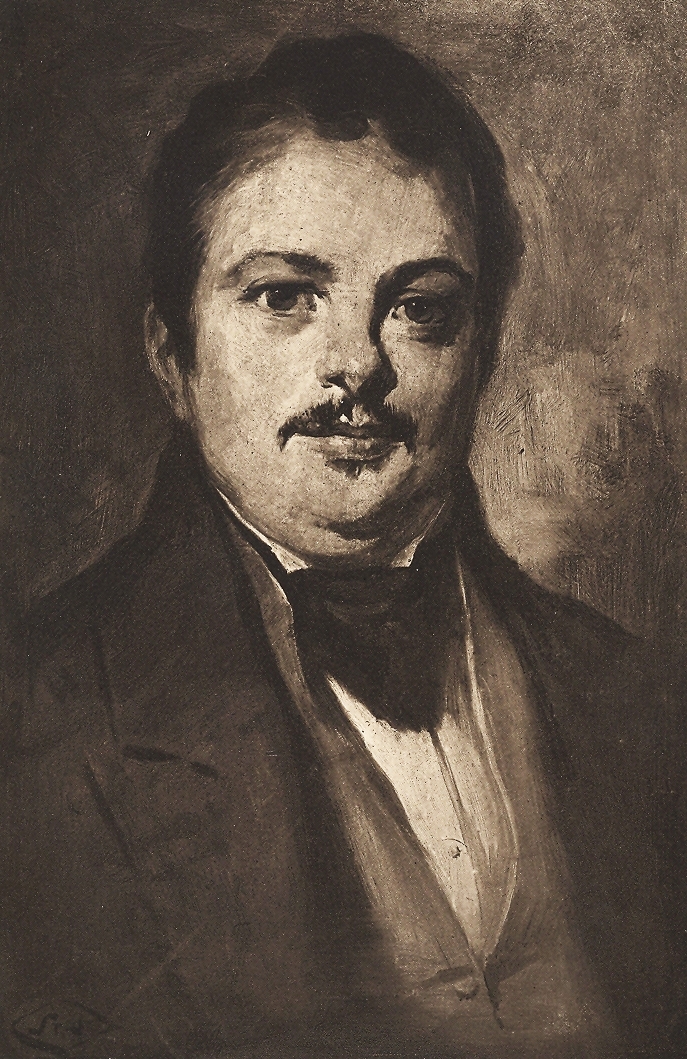
Poursuivons. L’homme de talent « sans amis » est finalement diverti de sa route fatale vers la Seine par des amis, justement, qui le cherchaient pour lui apprendre la bonne nouvelle de sa nomination, par leur entremise, à la tête d’un journal. En outre, le « zéro social » avait beaucoup fait parler de lui dans les cercles mondains, par sa proximité avec la salonnière très en vue dont il était un favori mais qui devait finalement le pousser au suicide. Voilà pour la cohérence de composition d’une œuvre truculente en même temps que tragique, les deux mêlés non pas, comme dans les véritables chefs-d’œuvre, de façon à renforcer le tragique par le contraste de personnages secondaires, mais dans la ratatouille d’un esprit inapte au tragique, aveugle. La face à la fois poupine et porcine du jeune Balzac, avec un double menton à vingt ans et quelques (cf. le portrait ci-dessous), pourra difficilement infirmer ce jugement d’un point de vue caractérologique.
Pour ce qui est du style, je crois qu’« une étreinte aussi forte que leur amour » suffit à en rendre compte. Quand Balzac veut décrire quelque chose de très intense, c’est le mot « chatouilles » qui lui vient sous la plume, ce qui n’étonnera guère de la part d’un romancier « physiologiste ». Quant à la pensée, « [j]’ai un sérail imaginaire où je possède toutes les femmes que je n’ai pas eues » : c’est ainsi que l’antiquaire miraculeux décrit sa grande sagesse. À ce compte, il est fort peu d’hommes qui soient dépourvus de sagesse car sans doute en trouve-t-on fort peu qui manquent entièrement de ce genre d’imagination.
Il est temps de se poser la question, si nous voulons tenir notre place dans la littérature mondiale. Pour une personne qui se destinerait à l’écriture, l’exemple de Balzac n’est ni meilleur ni moins bon que Gaston Lagaffe. Il peut certes arriver qu’en prenant des modèles supérieurs à nos capacités on ne parvienne à rien de bon, d’authentique, de durable : la question est de savoir dans quelle mesure un Français a les moyens de choisir d’autres modèles qu’un Balzac. C’est le véritable problème, qui n’est pas le goût du public français, lequel peut très bien, on le sait, lire et goûter des auteurs étrangers supérieurs.
*
Ce n’est pas parce qu’un enfant aime peindre que c’est un fou dont la peinture est la thérapie.
*
Je trouve qu’il n’y a pas assez d’amendements déposés sur les textes de loi au Parlement.
*
Il paraît que les autorités chinoises considèrent que l’Occident est entré dans une phase terminale de déclin. C’est réconfortant de savoir qu’on n’est pas tout seul.
*
Mathématiques et Politique :
Quelques apories d’Alain Badiou
Selon Alain Badiou, dans son Éloge des mathématiques (2015), si l’on ne connaît pas les mathématiques contemporaines, et particulièrement si l’on ne connaît pas « certains théorèmes des années soixante-dix et quatre-vingt », on ne saurait parler de l’infini car on en a « une compréhension pauvre et fausse ». Nous croyons quant à nous que c’est la conception qui décrit par là même comme pauvre et fausse la discussion de l’infini chez les grands philosophes qui doit être pauvre et fausse, et qu’une telle affirmation est de la suffisance. Puisque Kant, puisque Leibniz, puisque Descartes n’ont pas connu ces théorèmes de nos années soixante-dix et quatre-vingt, la critique porte forcément sur eux également (même si Badiou ne paraît pas s’en rendre compte, aveuglé par la suffisance), or nous trouvons leur compréhension de l’infini suffisamment pertinente quand d’étroits esprits spécialisés, plus récents, en conduisent d’aucuns à de tels contes.
Du reste, la suite du petit livre (d’entretiens) de Badiou ne vérifie pas son affirmation en discutant l’infini de manière bien originale, du moins y est-t-il question tantôt de l’infini dans ce qu’il a de plus classique et tantôt de bizarreries restant indiscutées, telles que « toute une hiérarchie d’infinis de plus en plus puissants ». L’idée d’infini puissant n’a certainement aucun avenir philosophique, quoi que disent les théorèmes.
(ii)
Dans le même livre, la démonstration de l’inexistence de Dieu se fonde sur la logique classique (« ce qui précisément est contradictoire » : cf. la citation complète ci-dessous) et n’est donc nullement suffisante de la part d’un philosophe qui prétend faire usage de la « logique paracohérente », « qui s’accommode des contradictions », dans sa pensée et son œuvre. Il faut en effet qu’il montre de surcroît que la logique paracohérente ne s’accommode pas de la contradiction qu’il prétend trouver dans l’existence de Dieu. Cette démonstration manquant, l’existence de Dieu peut être contradictoire et cependant possible, paraît-il, comme une de ces contradictions dont s’accommode la logique paracohérente. Il faut par conséquent montrer que l’usage de cette logique est autre chose qu’une facilité grossière qui permet d’un côté de maintenir des propositions que l’on tient pour vraies en dépit de la logique classique mais d’un autre côté serait sans emploi quand la logique classique permet d’écarter ce que l’on tient pour faux.
« [O]n démontre en effet – très jolie et très simple démonstration – qu’il ne peut exister un ensemble de tous les ensembles. Mais il est alors impossible, si le multiple axiomatisé est la forme immanente de l’être en tant qu’être, qu’il existe un être tel que tout être soit en lui, car ce devrait être un multiple de tous les multiples, ce qui précisément est contradictoire. » (Éloge des mathématiques, IV)
(iii)
Badiou parle de « l’aristocratie » des mathématiques, car « les mathématiques ont pris un tour inaccessible ». Qu’en est-il de l’aristocratie des éclairagistes de théâtre ? Nous prenons cet exemple non point parce que, dans la grande tradition française du philosophe vaudevilliste, Badiou a écrit pour le théâtre, mais parce qu’Antonin Artaud a parlé de cette spécialité de manière inspirée. Pour qui n’est pas éclairagiste, la technique est inaccessible, du moins en l’état de la formation de cette personne. Si celle-ci consacrait suffisamment de temps à l’une ou l’autre technique, les mathématiques et l’éclairage théâtral, la technique lui deviendrait accessible, en fonction de ses capacités. Par conséquent, lorsqu’on parle d’aristocratie des mathématiques, on ne les a pas encore distinguées de n’importe quelle autre spécialité du savoir ; et ce n’est pas tant à la philosophie de montrer que tel domaine spécialisé de connaissances a philosophiquement de l’importance qu’aux spécialistes eux-mêmes d’établir en quoi leur spécialité peut présenter de l’intérêt en dehors des questions techniques de son domaine circonscrit (ce dont ils sont généralement incapables, de manière convaincante).
Lorsque Badiou prétend trouver un intérêt des mathématiques, ou même seulement de la formation mathématique, en politique, il se fourvoie complètement, et ce sans doute moins encore par méconnaissance du politique que des mathématiques, qu’il connaît plus en praticien qu’en philosophe. Badiou croit en effet que la rigueur de la démonstration mathématique permet à l’esprit formé par elle d’éviter les écueils du débat public, le vague des notions, le symbolisme douteux, les pièges de la rhétorique, que les mathématiques sont l’instrument d’un « accord absolu » possible en politique. Or les problèmes mathématiques sont fondés sur des définitions : « soit a, ceci… ; b, cela… » mais aucun objet de ce monde n’est susceptible d’une définition au sens mathématique, dans la mesure où ces objets sont des objets d’expérience et non des objets de l’intuition pure a priori.
Même les objets de la physique sont seulement des schémas du monde de notre expérience. Quand, dans ses expérimentations, un physicien laisse rouler une bille sur une pente pour en mesurer la vitesse, il crée un schéma du réel dans lequel le frottement de la pente et la résistance de l’air sont plus ou moins négligeables, et la formule résultant de ses mesures est un résultat correct à l’intérieur de l’imprécision considérée, à savoir que le frottement et la résistance du milieu ne modifient le résultat qu’au niveau de la fraction de seconde et que le physicien utilise, dans son expérimentation, un chronomètre dont la seconde est l’unité. On voit donc qu’un accord absolu sur les mesures du dispositif schématique n’empêcherait nullement que la transposition de ces mesures à des dispositifs où les frottements et la résistance prendraient de l’ampleur conduise à fausser les prédictions. L’accord absolu de la méthode expérimentale n’a qu’une valeur relative dans l’expérience (l’empirie) : il faut la corréler à l’ensemble des autres expérimentations (sur les frottements, la résistance du milieu, etc.) qui peuvent, dans l’empirie, influer sur le phénomène. Ces développements sur la physique montrent que même les problèmes de physique ne se laissent pas définir au sens mathématique, comme des objets isolés : les objets de l’empirie ne sont pas connus a priori mais comme des ensembles de qualités et de relations dont on n’utilise que des schémas. Les prédictions rendues possibles par les mesures physiques ne sont valables que pour un ensemble de conditions particulières : plus les conditions réelles s’éloignent des conditions du schématisme, moins les prédictions peuvent être fiables.
Si l’on conçoit, à présent, la politique comme une simple physique sociale, nos remarques précédentes s’appliquent encore : on traiterait les problèmes sociaux selon le schématisme propre aux sciences. La critique de l’anthropologie comme détrimentale à l’homme, comme objectification illégitime du sujet pensant, n’est guère soutenable pour ceux qui, dans le même temps, conçoivent la politique comme une physique.
Mais en politique, la notion mathématique d’« accord absolu » au terme d’une démonstration est encore moins pertinente, car ce serait un accord absolu sur ce que veulent les gens, et cette volition ne dépend pas de façon absolue d’une démonstration. Une démonstration de ce que doivent vouloir les gens, appelons-le le bien commun, ne peut avoir qu’un faible effet sur les volitions particulières. Même en accordant que les gens doivent vouloir le bien commun, et même en s’accordant en outre sur ce qu’est ce bien commun, une démonstration ne modifie pas fondamentalement la volition dans un sens ou dans l’autre ; la contrainte de la loi s’impose. Ainsi, même si la démonstration avait en politique un effet contraignant sur l’admission, il est certain qu’au contraire des mathématiques, où l’admission est le fin mot de l’histoire (l’accord intellectuel absolu conclut le problème), cet accord absolu resterait lettre morte quant à son objet politique à défaut d’une contrainte spécifique sur les conduites particulières, la loi.
De sorte que les mathématiques ne peuvent avoir aucune efficacité privilégiée en politique par rapport à toute autre forme de discipline intellectuelle. Au contraire, l’habitude d’employer ses facultés sur des objets a priori plutôt que sur des objets de l’expérience empirique, par exemple dans l’étude du droit, prédispose bien moins l’esprit au traitement des problèmes politiques.
*
EN
Shortcomings of the First Amendment
1/ Free speech easement of the public space derives from a power able to discretionarily favor some speech and repress other;
2/ Legislatures keep voting speech-averse statutes knowing their judicial evisceration will take time and therefore the statutes have the deterrent effects the legislatures desire.
1/
American historian Alfred Whitney Griswold is quoted saying “Books won’t stay banned. They won’t burn. Ideas won’t go to jail. In the long run of history, the censor and the inquisitor have always lost.” Of course, it means that books won’t burn as a result of state action without judicial redress, but the imprecision of the utterance sounds ominous, as if it meant or could mean “you have no right to burn books.” As far as state action is concerned, there is no difference between book burning and censorship, if not that a state (or state church or state single party) that would burn books but fail to prohibit its selling, owning, etc., would be a better place for speech than a state censoring books. But as far as people are concerned, book burning doesn’t make much sense unless it is done in the public space but then, if I burned books on the street, I would be arrested by the police so soon as they can get their hands on me saying I am a public danger, jeopardizing others’ safety – regardless of my speech rights. There is a special issue here that, even with the best will to procure easements for speech in public space, must thwart private attempts to use that mightily demonstrative form of expression, namely book burning. In France, some years ago, some workers in the field of theatrical arts burned in public copies of a book written by a member of the government. Some media were shocked as it reminded them of Nuremberg and the Nazis, although the demonstrators were private persons acting on their own initiative and no public official endorsed with state power; but the real issue is that the protestors probably impugned municipal decrees or some other local public space regulation, which probably the cameras only prevented from being actioned by the authorities.
What some scholars call free speech easements of the public space smacks of arbitrariness. When some march, the judge “eases,” that is, she prevents existing regulations from being actioned, but if others, the formers’ opponents marched, she would let the regulations apply with full force. Easement conveys the idea of suspension of laws and regulations, so the ultimate rule is not the law itself but the decision to apply or suspend it. This is rule of law by name only.
All marches for civil rights in the sixties were made possible by judges who imposed the suspension of public space regulations. The judges decided that the marches had to take place in spite of the regulations. Had people wanted to oppose civil rights through marches of their own and had judges not adopted a strictly equal stance for these, such marches would have been stopped by police for breach of public space regulation. The crux of the matter is that when judges pronounce easement for one cause, the same judges cannot pronounce the same for the opposite cause because the easement is based on a reasoning that the one cause, say promotion of civil rights, deserves free speech protection over public space regulation and therefore the opposite cause deserves it not, because otherwise public space regulations as such would be void (at least anyone invoking the First Amendment could have them suspended, that is, public space regulation would yield to free speech protection in every conceivable instance).
2/
While Supreme Court’s decision NAACP v. Clairborne Hardware (1982) makes it clear that boycott is protected free speech, a host of states passed anti-BDS bills nevertheless, which must be eviscerated presently one after the other, in a long, tedious, seemingly endless process, like cutting off the Hydra’s heads. Therefore, First Amendment law itself protects censorship.
First Amendment law protects censorship because it is not effectual at protecting speech at all, as one sees that case law cannot prevent the most blatant disregard by legislatures. Legislatures pass bills with all the deterrent effects intended on speech for the whole duration of the judicial review, knowing the latter’s result well beforehand and preparing their next version of the same bill in the meantime. What are the legal checks on legislatures passing bills they know are unconstitutional? I want to stress the word legal in “legal checks” because, as far as public debate, that is, other democratic checks are concerned, when one reads essays expatiating on “Israel boycott is not free speech” (Reuters, Jan 10, 2019) while Claiborne Hardware has been extant for decades, it makes one sick; obviously, Reuters is no check here. (The only reason why Israel boycott could, de jure, not be free speech is that Israel boycott is no boycott, which is absurd.) One cannot compel private individuals or entities to talk without disregarding the content of the law, but there should exist a mechanism that prevents legislatures from passing unconstitutional bills, as in some European countries where constitutional review takes place before the law becomes law.
*
Democrats “champion the cause of free speech” abroad, but in their country they push for hate speech laws and other exceptions to free speech.
*
Religion or Psychotherapy
Westernization is the cause of all mental illnesses. Western psychotherapy is not the solution but part and parcel of the problem. Of course, we are talking of “functional” illnesses, that is, those with no organic cause. Upon organic illnesses psychotherapy has no effect whatsoever, and on functional illnesses anything would work the same as psychotherapy, or even no treatment at all would work the same, sometimes the illness recedes, sometimes not, there is no proof that any psychotherapy works better than no psychotherapy, scholars have demonstrated it (Eysenck, etc.). It is a dirty business. The very idea of reaching to a psychotherapist shows disregard for spiritual guidance and a willingness to live according to Western standards rather than the tradition.
Stop calling everything psychotherapy. Not because a kid wants to paint is he a lunatic and painting his therapy.
In the West, everything is therapy because they’re all insane.
In the West, they are so insane that, when they see a masterpiece, they exclaim: Such good therapy!
In the West, food is so expensive because it is not only food but also therapy.
In the West, love is a therapy.
In the West, in case of trouble, they ask: What went wrong with the therapy?
In the West, there is no good and evil, only good therapies and bad therapies.
Law 24: On Hate Crimes and Love Crimes
Intro
1 Definition
2 Preliminary Dismissal of Deceptive Appearances
3 Discussion
Intro
In Europe they have hate crime laws, hate speech laws, and police states. (Cf. City of Houston v. Hill, U.S. 1987, holding that “[t]he freedom of individuals verbally to oppose or challenge police action without thereby risking arrest is one of the principal characteristics by which we distinguish a free nation from a police state.” By this well-thought definition European countries are not free nations but police states indeed.)
In U.S. they only have hate crime laws.
What makes hate crime laws so unexceptional?
1 Definition
“Hate crimes are offenses that are committed because of the actual or perceived race, color, religion, national origin, or sexual orientation of another individual or group of individuals. … Various state courts found that, since the U.S. Constitution’s First Amendment protects speech and thought, even when that speech or thought is offensive, any law criminalizing thought should be rendered unconstitutional.” (Hate crimes by Kristin L. Stewart, J.D. [excerpt] in Encyclopedia of American Law, D. Schultz ed., 2002)
If a crime is found to be this or that “(name a crime) as a hate crime,” penalties are increased.
2 Preliminary Dismissal of Deceptive Appearances
Contrary to appearances, hate crime laws in the United States are probably not designed to protect the white population from black criminals. How, then, could such appearances have arisen?
First, we are told about an epidemics of hate crimes. “If you believe the news, today’s America is plagued by an epidemic of violent hate crimes” is from the presentation of the book Hate Crime Hoax: How the Left is Selling a Fake Race War (2019) by Wilfred Reilly, assistant professor of political science at Kentucky State University.
Second, we know the massive proportion of black inmates in the prison population of the States: cf. The New Jim Crow: Mass Incarceration in the Age of Colorblindness (2012) by Michelle Alexander, visiting professor at Union Theological Seminary, New York City.
Third, in Wisconsin v. Mitchell, 1993, the U.S. Supreme Court upheld a hate crime state statute. A group of black men had assaulted a white boy after watching the film Mississippi Burning. It was found their attack was racially motivated and the increased penalty of the instigator, Todd Mitchell, justified.
From (1), (2) & (3), one would swear blacks are responsible for the epidemic of hate crime. Indeed, it is hard to see how a crime epidemic, namely a hate crime epidemic, would not be reflected in the prison inmates population, that is, how the disproportionate numbers of black inmates in prison would not reflect the hate crime epidemic, especially considering the emblematic precedent of the U.S. Supreme Court on hate crime laws applies to a black defendant who challenged the constitutionality of his increased penalty.
This is a deceptive appearance. In reality hate crime laws protect minorities.
3 Discussion
i
Hate crime laws trivialize crime
“This book is as timely as today’s headlines. Professor Lawrence has written a powerful, persuasive, and eloquent call for more effective action by Congress and the states to deal with these despicable crimes. Civil Rights is still the unfinished business of America. Hate crimes are uniquely destructive and divisive, because their impact extends far beyond the victim. They poison entire communities and undermine the ideals for which America stands. They deserve to be punished with the full force of the law, and Professor Lawrence’s book brings us closer to that important goal.” Senator Edward M. Kennedy on Punishing Hate: Bias Crimes under American Law (2002) by Frederick M. Lawrence.
This praise by Sen. Kennedy contains all the appalling mistakes an informed person is supposed not to make when thinking and talking about crime and the law.
“This book is as timely as today’s headlines.”
It is known, it is even common-sense, since at least Roscoe Pound (Criminal Justice in America, 1930), that to resort to designing criminal law in hysterical reaction to headlines is the worst one can think of, it is Lynch mentality smuggled into the legislative bodies and through them into the courts.
Sen. Kennedy’s is the confession he was a headline-law maker, one who made headline laws. With lawmakers like him, it is headlines which make laws. Yet no one knows what the headlines reflect (a few people believe they reflect reality). If media were neutral reporting agencies, then, given what has been said in II about New Jim Crow, media treatment of crime would reflect the makeup of prison population (because prison population is a good token for the known figure of crime), that is to say the media would devote the same share of crime news to black crime as the share of black inmates population in prisons. Is this the case?
If this is not, even if it were because the media are not racist whereas lawmakers, the police and the judiciary are, it turns out they make their headlines according to their own notions rather than to an actual state of things. If the state of the society as far as crime is concerned is institutional (colorblind) racism, i.e. a New Jim Crow, and the media correct this because they go against the stream, then admittedly their headlines are no different from political pamphlets; therefore legislators are not bound to take their headlines as guidelines, any more than they are to follow the views of any scholar, intellectual, or writer.
The same holds with the media coverage of hate crime. Sen. Kennedy wants to legislate in a “timely” fashion, following the headlines. Given what has just been said, however, he is nothing but the willing audience of a hate crime law lobby, whereas the true situation might or might not support a need for new or further legislation. Obviously, if the coverage is a hoax (Wilfred Reilly), no legislation is called for by the timely headlines. (Needless to say, the notion of timely headlines is absurd: Reread the sentence and you’ll see Sen. Kennedy actually talks of timely headlines; however there is but one timely time for news headlines.)
“These despicable crimes”
Which crimes are not despicable? Crimes that a senator is more likely to commit, like embezzlement?
“Hate crimes are uniquely destructive and divisive, because their impact extends far beyond the victim.”
That the impact of all crimes “extends far beyond the victim” is on the contrary the obvious truth, one at the foundation of the secular distinction between tort law and criminal law, and hardly, therefore, could a premise be more unsupportive of the conclusion, namely, that hate crimes are unique.
“They poison entire communities and undermine the ideals for which America stands.”
One would swear other crimes are mere trifles.
“They deserve to be punished with the full force of the law.”
Yes, like any other crime. Actually, a good axiom of jurisprudence is that crimes deserve to be punished with the full force of the law. Accordingly, since every crime is punishable by the full force of the law, one cannot make a difference between one crime and the same crime “as a hate crime.”
If such a difference were legitimate, it would actually imply a decrease in penalties for hate crimes.
ii
Hate crimes are crimes of passion,
therefore the penalty must be decreased, not increased
Here come the love crimes.
I had intended the word as a joke. I thought: If one talks of hate crimes, there must be love crimes too, which is absurd. Then I remembered the crimes of passion (crimes passionnels): “The ‘crime of passion’ defense challenges the mens rea element by suggesting that there was no malice aforethought, and instead the crime was committed in the ‘heat of passion’.” (Wikipedia: Crime of passion)
Crimes of passion are what I would like to call the love crimes. Love is a passion. Hate is no less a passion than love –sometimes love turns to hate– and therefore, as the crime of passion defense applies to love crimes, the defense applies to hate crimes too.
Think about Todd Mitchell, the black defendant in Wisconsin v. Mitchell who “instigated an attack against a white young boy.” He had just been watching the film Mississippi Burning, which stirred the rage of oppression in his heart, to the point he could not stand it anymore. His brothers and sisters in race had been enslaved, trafficked, segregated, Jim-Crowed for centuries. Hatred was stirred in him, his spirits cried for vengeance. A young white boy walked by.
Even if Mitchell had been animated by an ideology, by the liberal ideology that cannot stress enough the evils of a system and the burden of debt currently weighing upon the white man till the end of times, even if he had been an avid reader of liberal books, still his deed would not be an ideological crime –because there is no such thing under the U.S. Constitution, which protects freedom of conscience– but a crime of passion.
(Even the minutest premeditation in coldest blood could be a crime of passion, I find, because hate is a passion, just like the cheated husband who premeditates his wife’s death could invoke the defense in my eyes, because from love to despair time may elapse but the heat of passion remains, the heat of passion is not the same thing as the heat of the moment.)
But the Supreme Court –Rehnquist Court (surely this rings a little bell)– did not see a liberal black boy under the dramatic and melodramatic influence of a Hollywood blockbuster stuffed with the most advanced techniques of emotions and mind manipulation, no, and “the Wisconsin statute…was not punishing the defendant for his or her bigoted beliefs or statements, but rather the predicted ramifications of his or her crime” (oyez.org). Mark these words: A hate crime law does not punish a defendant for his or her bigoted beliefs or statements. I have no idea what the Court, or its commentator, means by “the predicted ramifications of the crime” and as I have not read the whole decision yet I reserve my judgment, only saying it looks like a mighty innovation in the field of criminal law and I’m surprised it is not more discussed in academia and among advocates of hate crime laws, who keep saying, instead, that hate crime laws punish bigoted biases (one also talks of bias crimes).
So very true is it that hate crimes are crimes of passion that it is even positive law in the gay panic defense. A man subject to homosexual advances may react violently with assault, battery, murder attempt, sometimes the seducer’s death. The defendant can invoke gay panic defense at his trial and if the motion is accepted his act will be treated as a crime of passion. As the reader can well imagine, statutes to that effect have disappeared from about every legal system in the western world, and now the same acts are likely to be treated as hate crimes with increased rather than decreased penalties. (Likely because how could such a reaction not be the sign of strong biases?)
iii
Hate crimes are crimes of passion
and like other crimes of passion they have no place left amidst our laws
Today crimes of passion are hardly law any longer. A man finding his wife with another man will shoot them and then kill himself, and perhaps his kids in the bargain, because he knows society will not pardon him the heat of passion. He knows only cuckolders are excused nowadays.
As one, therefore, sees crime of passion laws dwindling, one must draw the consequences as to the notion itself, which includes hate crimes. Hate crimes can have no place amidst our laws.
iv
Hate crime laws shift the tendency of regimes from majoritarian to countermajoritarian
In aristocratic regimes, the nobility is a minority too.
If one agrees the purpose of hate crime laws is not, contrary to appearances, or not only to hold the grudge of black people against whites for a past of slavery and unequal segregation in check, then one must consider the following reasoning.
Hate crime laws are designed to protect minorities from the violent manifestation of biases. That minorities would bear a natural grudge against the majority for the latter’s entrenched position and status does not seem to ever enter the mind of advocates of bias crime laws and I have never heard one such advocate express concern for the safety of individuals in the majority due to a grudge of this kind. Yet it occurs to me that, if I belonged to a minority and the majority had privileged status in the society, I would resent the fact. In case I expressed my resentment with violent acts, that would be hate crime then, would it not? But no, we are never told of such psychological problems; one has to know the U.S. Supreme Court’s decisions to be aware that anti-white feelings can be a bias, and in some European countries you would look for the same kind of precedent as Wisconsin v. Mitchell in vain (but not because such crimes never happen).
All in all, one can safely bet that a risk of increased penalties exists above all for crimes where victims are from minorities. Therefore, if a criminal who is neither a hate criminal nor a love criminal, only an indifferent criminal who wants money, thinks –and I claim the media and politicians have inoculated this thinking in him– that he risks increased penalties if his victim belongs to a minority, then the obvious consequence is that he will avoid picking a victim among identifiable minorities and on the contrary target individuals from the majority. Hate crime laws point to the majority as self-evident victim for “passionless” criminals. Clearly, a government must have strong countermajoritarian mechanisms to be able to pass such laws – to the point that one wonders what role is left to its majoritarian mechanisms.
v
Hate crime laws are hate speech laws
This section is divided in two parts (a) and (b), the former being the mere quote of an earlier writing, Hate crime laws are unconstitutional (Law 20).
a/ Hate crime laws are unconstitutional view-based discrimination.
It’s time the courts declared hate crime laws unconstitutional. This is long overdue. How can hate speech be protected as the U.S. Supreme Court intends (Brandenburg v. Ohio [1969], R.A.V. v. City of St. Paul [1992], Snyder v. Phelps [2011], Matal v. Tam [2017]) when public figures known for taking positions some call hate speech must always fear being provoked to offenses, even minor, that would lead to aggravated punishment while the opponents who provoked the incidents have no such Damocles sword hanging over their heads?
Let’s take an example. If a public figure vilified by LGBT groups as a hater gets entangled in a brawl with LGBT hecklers, he may face hate crime charges while the others will face unruly behavior charges or such like (they are not known for being haters because they’re the ones who call people haters and the media follow that stance).
The “haters” (who have a constitutional right to hate speech) are at greater risk of frame-up because for them even the slightest charges can be greatly detrimental due to the increased penalties with which hate crimes are dealt with. Hate crime laws protect a minority heckler’s veto. Due to such legislation, whole classes of people are therefore deprived of their full rights to political participation for lack of equal protection under the law. This is government repression of political opponents.
b/ Hate crime laws are conceived as disguised hate speech laws.
Discretionary police and prosecution power serves to squelch speech in scores of contexts, by making pretextual use of laws against disorderly conduct, trespass, unlawful assembly, disobeying a lawful order (like orders to move or keep moving), breach of the peace, and other such low-level criminal statutes, and scholars point out the failure of courts to address the issue properly.
The issue must be of increased concern when to low-level incriminations may be added the hate crime label. Since there have been various cases of “petty larceny, as a hate crime,” one can well imagine charges such as “trespass, as a hate crime” or “disobeying a lawful order, as a hate crime.”
Often, in the usual cases, charges are dropped, and the victim of malicious policing is no more heard of. In the case of hate crimes there could be no dropping of the charges, for obvious reasons. Therefore, since police power can be used to squelch one’s speech and the courts have no sure means to second-guess the discretionary use of police power (filming police on public space is a hazy legal issue: don’t you fancy it be a well-established right), I believe advocates of hate crime laws intend to take advantage of the situation to have hate crime laws serve as hate speech laws. I believe it for the simple reason that if hate speech laws were not unconstitutional these are the laws they would demand. We have seen it in Europe: the same rhetoric used in the U.S. in support of hate crime laws is used in Europe to advocate hate speech laws.
So long as hate crime laws exist, the U.S. is at risk of becoming –if not being already, through the judicially undetected, pretextual use of executive discretion– a police state like current European Old-World regimes.
 florent boucharel rAd-Free