
Tagged: Vikings
Ingeborg, A Viking Girl on the Blue Lagoon
Please support my film project Ingeborg, A Viking Girl on the Blue Lagoon, based on the research conducted by Dr Jacques de Mahieu, director of the Institute of Human Sciences in Buenos Aires (Instituto de Ciencia del Hombre de Buenos Aires).
According to Jacques de Mahieu (1915-1990), the Vikings went as far as the Pacific Islands. After they had helped develop a few civilizations in South America (or while they were doing so), they took their drakkars again and sailed to the Pacific. There they left traces of their presence too, in solar myths associated with white gods similar to those of the pre-Columbian peoples, in the fair skin of the aristocracy among the islanders, and in the red hat worn by tribal chiefs, as in Peru, in memory of the red or fair hair of the Vikings. Norwegian explorer Thor Heyerdahl confirmed such data but considered white migrations to Pacific islands to be even more ancient. (As explained below, Mahieu himself was aware of earlier migrations to America.)
My aim with this film is to shed light on these events by depicting the life of Vikings in the Pacific (hence the Blue Lagoon of the title). Viewers will be told the story of a young Viking girl, called Ingeborg, on the far-away islands. Let us follow her steps on the blue lagoon’s sand.

O Ingeborg, let me sing my song for you…
*
Remember that Greenland under the Vikings was a full-fledged colony replete with men, women, and children. Vikings took their women with them when they had a purpose of colonization, as the Goths had already done before them. Of course, when raids were organized for looting, they did not take women with them on such occasions.
When, after a few reconnoitering travels from Greenland and/or Vinland (their other colony on the North American continent), navigating along the coastline, they decided that those lands on the South would provide good settlements, they brought women with them.
The story of Quetzalcoatl, the blond-bearded ‘god’ of the Aztecs, tells us something about it. Quetzalcoatl was a Viking whose real name was, according to De Mahieu, Ullman*. During one of his trips further to the South, some Vikings, led by the ‘god’ Tezcatlipoca, rebelled against him. With loyal followers, he then left the rebels and the country altogether.
Whether it is these men or others from the same people who later travelled from America to the Pacific islands, I assume they took their women with them, and thus a little girl called Ingeborg might well have trodden with her soft, tender feet the warm sand of the atolls, her long sunny hair shaded by the palms of the blue lagoon, as early as 12-13th A.D.
* Ulmén: (arauc. ghulmen) m. Chile Entre los indios araucanos, hombre rico, que por serlo es respetado e influyente. (Definition of ulmén from a Spanish-American dictionary: “Among Araucanian Indians, a wealthy man, as such respected and influential.”) I don’t know if Jacques de Mahieu knew this term, which looks almost identical with the name Ullman he says was the name of the historical Viking behind the Quetzalcoatl myth. According to Aztec legends, Quetzalcoatl possessed great worldly riches. Given the likeness, here we could have the same linguistic phenomenon as reflected in such Spanish expressions as ser un Cortés (to be a Cortes) or ser un Don Juan (to be a Don Juan); that would be, proper, “to be an Ullman,” whether that Ullman is the one from Mexico or another Viking explorer and settler.
*
When the Spanish Conquistador Francisco de Orellana made his expedition on the Amazon River, he once met with the Amazons, women from an all-woman tribe. The missionary priest of the expedition, Gaspar de Carvajal, who chronicled the events, described these women as tall and white-skinned. The Indians that the Spaniards made prisoners told them these women were living on their own and that they used to get spouses from other tribes, formerly from another White tribe, now disappeared, and currently with Indians. Orellana then named the river after these women.
It should be noted that stories about women living on their own and/or training in fighting are few in history besides this chronicle. Herodotes mentions a similar tribe among the Scythians (those whom Herodotes called Scythians were later called Goths, whereas the Huns were later called Scythians, which can be confusing; if we follow classical traditions about Scythians, i.e. ancient authors such as Jornandes, Herodotes’s Scythians are the same as Goths). Likewise, Icelandic sagas deal with a few characters of so-called Virgins of the Shield, or Shieldmaidens (Skjaldmær), female warriors.
The Indians told the Spaniards that the Amazons lived in stone houses, unlike any other Indian tribe in the region. The other White people of Amazonia (those Whites who used to be in contact with the Amazons but disappeared before the period of the Conquest) were also fairly developed, with roads and stone buildings, according to the Indians**.
In academia it has long been thought, in spite of pervasive local legends about “lost cities,” that no such developed culture was possible in the region, especially since the soils would not be fertile. Two lines of argument have undermined this position. 1/ Along the river, the soil is extremely fertile; it is called terra preta (black soil) in Portuguese and is the most fertile in the world. It results from human intervention, that is, manure. 2/ Recently, American archaeologist Dr Michael Heckenberger found remnants of stone buildings in the area of terra preta, which would confirm the oral tradition about Amazons living in stone houses. From the records, no Indian tribe known today in the region has ever developed such a culture.
** Iara, senhora das águas: “Iara ou Uiara (do tupi ‘y-îara ‘senhora das águas’) ou Mãe-d’água, segundo o folclore brasileiro, é uma sereia. Não se sabe se ela é morena, loira ou ruiva, mas tem olhos verdes e costuma banhar-se nos rios, cantando uma melodia irresistível. Os homens que a vêem não conseguem resistir a seus desejos e pulam nas águas e ela então os leva para o fundo; quase nunca voltam vivos e depois os comem. Os que voltam ficam loucos e apenas uma benzedeira ou algum ritual realizado por um pajé consegue curá-los. Os índios têm tanto medo da Iara que procuram evitar os lagos ao entardecer. Iara antes de ser sereia era uma índia guerreira, a melhor de sua tribo.” (Wikipedia; my emphasis twice) This description of Amazonian Tupi goddess Iara as a green-eyed (i.e. depigmented-eyed) mermaid who previously was a member of a female-warrior tribe tallies with Orellana’s white Amazons.
Furthermore, the identification of Amazon women with goddess Iara is ascertained by the legend about the talismans known as muiraquita: “O Muiraquitã era um amuleto sagrado e mágico que as Icamiabas [my emphasis] presenteavam os homens que anualmente vinham fecunda-las. Dizem que possuem propriedades terapêuticas e grande fortuna trás a todo aquele que possuir um desses singulares amuletos. Quanto ao significado esotérico de Muiraquitã, devemos decompor seu nome em vocábulos, para compreender sua simbologia feminina: Mura = mar, água, Yara – senhora, deusa, Kitã = flor. Podemos então interpretá-lo como ‘A deusa que floriu das águas’.” Icamiabas is a native name for the Amazons; they are believed to be the ones who distributed among the tribes of the region those magic talismans whose name is said to mean “the goddess that came out of the waters,” which is precisely what is said above about Iara the green-eyed warrior goddess.

Muiraquita
*
Jacques de Mahieu’s research on pre-Columbian America went further into the past than the Vikings’ time. He writes that the American civilization of the Olmecs is a creation of white immigrants who became the ruling class over the population of Indios. The cultural achievements and the remnants of the white population of the Olmec and early Tiahuanacu culture were the base for the early Maya culture.
Later the Vikings founded a new realm at Tiahuanacu, which became the centre of civilization in America with about 100,000-150,000 inhabitants. Later they founded the Inca empire. Here the state was based on a caste-system divided between the ‘sons of the sun’ (white kings and nobles) and the aboriginal Indio population.
In Peru, the Spaniards reported several times meeting whites, especially in the upper caste of the Incas, where women were described as blonde and fair-skinned, reminding them of “Castilian beauties.” For some reason historians tend to dismiss these accounts by the Conquistadores as deceptive.
The Inquisition in America destroyed almost all documents from pre-Columbian civilizations. Jacques de Mahieu, and several others, also said that Templars sailed to America when their order was destroyed in Europe. The Templars were an order of noblemen originally founded by Norman knights. They seem to have practiced a Gnostic form of Christianity. It is said that Cathars joined their ranks after the Crusade that annihilated their community as such. Templars’ ranks being filled with Norman gentry, descendants of King Rollo and the Vikings, these men, according to De Mahieu, knew about America, as their relatives from across the Atlantic had made several trips between the two continents, informing Norman rulers of America’s existence and leaving them navigation maps. De Mahieu wrote about maps he had found in the town of Rouen, Normandy. With the help of such maps, Templars would have been able to sail to America in order to escape persecution in Europe.
When the Spaniards came, and with them the Inquisition, the Church would destroy all traces of Templar presence in America. The Gnostic teachings that the Church attempted to erase by smothering Cathars and Templars –in the same way that the Church pursued them in the Visigothic kingdom of Septimania (Languedoc), burning practically all extant texts in Gothic language– were caught in its grip as far as pre-Columbian America!
*
I have in my library an abridged version, in French translation, of the General History of the Things of New Spain (Historia general de las cosas de Nueva España, 1569) by Fray Bernardino de Sahagún, Spanish missionary in Mexico, knowledgeable in Nahuatl and all things Indian. His book was written before the prohibition by Emperor Felipe II, in 1577, imposed on all research about American Indians’ customs.
In a chapter called “Evangelization before the Conquista,” Sahagún describes various items hinting at a knowledge of the Catholic faith by Indians. He opines that the Indians had been converted to the Christian faith in a remote past but, as they were no more Christians at the time of the Conquista, they must have forgotten most of what had been carried to them by some long-dead missionaries.
Among traces of white pre-Hispanic presence in America, Sahagun names the following. Although there were no plants or cereals, such as wheat, nor animals, such as cows, of European origin in America (a fact with which Jacques de Mahieu disagrees: According to the latter, Canis ingæ, for instance, a species of dog that was living as domestic animal by some Indian peoples at the time of the Conquista, was brought there by the Vikings), there existed similar cultural elements, such as:
1/ Paintings found in Oaxaca depicting something that is very much alike the Crucifixion of Jesus Christ;
2/ Such devotional practices as oral confession and water baptism;
3/ In different places (Campuche, Potonchán), the missionaries met Indians who knew several stories from the Scriptures well.
These were, according to Sahagún, remnants of remote Christian evangelization in America. On the other hand, some customs and myths he describes remind one of Scandinavian lore. Vide, for instance, the following descriptions (my translation): “All the brave and soldiers who die on the battlefield are transported to the palace of the Sun. In the morning, at sunrise, they take on their armors and march toward the Sun with clamors and loud noise. Then they march before Him while simulating battles for their pleasure.” Which looks like the Walhalla of Scandinavian warriors (but perhaps all warriors around the world have similarly rowdy afterlife abodes). & (At the end of times or rather at the end of the present cycle) “The sun will not rise, and from outer space will come down the monstrous, horrifying Tzitzimes to devour men and women.” Which reminds one of the Ragnarok (and its monstrous dragon Nidhogg).
Finally, Sahagun describes what we already said above, that Quetzalcoatl, leader of the Toltecs of Tula (Thule?), was opposed by some of his men, here described as necromancers, chief among whom was Tezcatlipoca, god of putrefaction, and that he left his people, not without announcing that he would come back. Whence came the fact that the Spaniards at first were welcomed by the Aztecs as returning gods.

Vikigen Quetzalcoatl (The Viking Quetzalcoatl), watercolor by Ossian Elgström, 1931
(serving as cover illustration for a 1991 collection of ethnographic studies)
This work shows that the idea of Vikings having played an influential role in pre-Columbian America was already in circulation at an early date.
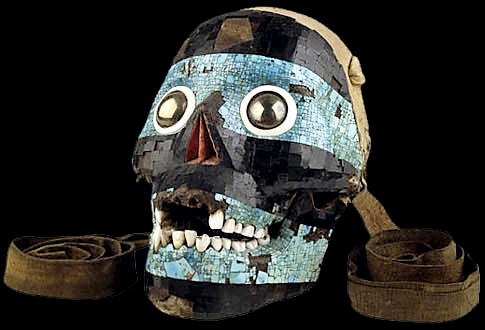
Tezcatlipoca the Necromancer
*
With regard to the Pacific islands, the following early anthropological observations about local populations by famous explorers Bougainville and Cook may corroborate Mahieu and Heyerdahl’s writings, if the former’s reports did not trigger the latter’s research in that particular direction to begin with.
“Le peuple de Taiti est composé de deux races d’hommes très différentes … [Pour les uns] Rien ne distingue leurs traits de ceux des Européens; et s’ils étaient vêtus, s’ils vivaient moins à l’air et au grand soleil, ils seraient aussi blancs que nous. … La seconde race est d’une taille médiocre, a les cheveux crépus et durs comme du crin et ses traits diffèrent peu de ceux des mulâtres.” (Voyage autour du monde) Our translation: “Taiti’s people is composed of two very different races. … [As to the first] Nothing in their traits differs from those of Europeans, and had their custom been to wear clothes rather than to live outdoors under the sun, they would be as white as we are. … The second race is of shorter size, their hair is frizzy and stiff as horsehair, and their traits are hardly different from those of mulattos.”
As to Captain Cook, here is how he describes chief Waheatua (I translate from the French version I have in my library): “He had a pretty fair complexion and his hair was smooth and light brown, reddish at the tip.” (Il avait un teint assez blanc, et les cheveux lisses d’un brun léger, rougeâtres à la pointe.)

Albert Brenet, Arrivée de Bougainville à Tahiti
*
The research of Jacques de Mahieu has been carried on by Prof. Vicente Pistilli, who founded in Asuncion the Instituto Paraguayo de Ciencia del Hombre on the model of Mahieu’s Buenos Aires institute. Here is a short biography, from Pistilli’s book La Cronología de Ulrich Schmidel, Instituto Paraguayo de Ciencia del Hombre, 1980:
El autor señor don Vicente Pistili S. nació en Asunción el 27 de Febrero de 1933. Graduóse de Bachiller en Ciencias y Letras del Colegio Nacional de la Capital en el año 1951. Obtuvo los siguientes títulos universitarios : Topógrafo (1954), Licenciado en Matemática (1955), Ingeniero Civil (1958), Malariólogo y Sanitarista (1962), Licenciado en Filosofía (1965), Licenciado en Teología (1967). (…) El Profesor Ingeniero Don Vicente Pistilli S. ha colaborado con la Educación Paraguaya, siendo el primer docente a Tiempo Completo en Matemática del Colegio Nacional de la Capital. (…)
Cuando en 1972, el Profesor Doctor Don Jacques de Mahieu publicó la comunicación cientifica “Las Inscripciones Rúnicas Precolombinas del Paraguay” [my emphasis], el profesor Pistilli comprendió en toda su magnitud la importancia que tenía el descubrimiento arqueológico del notable investigador francés, quien abría una vía nueva para la investigación de nuestro pasado precolombino. Así fué como, conjuntamente con un grupo de intelectuales paraguayos, crearon el Instituto Paraguayo de Ciencia del Hombre, asociación civil de carácter científico. (…)
Pistilli ha dirigido equipos nacionales de investigacion arqueológica, con resultados positivos en todas ellas, relevándose inscripciones rúnicas, dibujos nórdicos, bosques sagrados, caminos precolombinos y monolitos tallados. Además ha realizado importantes investigaciones lingüísticas, las cuales confirman la influencia nórdica precolombina en el Paraguay.
Pensées IV
C’est l’esprit scientifique qui a modifié la physionomie de la foi chrétienne, laquelle ne présente plus que quelques traits en commun avec la foi du moyen-âge et s’en distingue par de nombreux autres. Si une telle évolution était au contraire un mouvement endogène d’épuration des éléments de superstition non spécifiquement chrétiens au sein de la religion, cela signifierait tout de même que nous ne pouvons être sûrs que la foi ne soit pas appelée à disparaître sous la forme que nous lui connaissons ; cette variabilité est de nature à anéantir toute présomption en matière de pratique. L’idée que la religion a plus agi sur l’humanité que la philosophie est apparemment vraie. Cependant, il faut examiner l’évolution des religions au fil des siècles pour comprendre qu’elles suivent des mouvements impulsés par des idées en dehors d’elles (mouvements qu’elles cessent de combattre dès lors qu’ils se sont imposés malgré elles).
Le placebo fonctionne dans 70 % des cas. Par conséquent, dans tout système de croyance, le guérisseur peut obtenir 70 % de guérisons. Si la médecine moderne obtient par ses traitements, mettons, 85 % de succès, pour les 15 % restants un système de croyance est l’occasion de relancer les dés. Mais la médecine moderne a grandement érodé l’effet placebo de la croyance.
Supplément au Voyage de Bougainville. Pour un Viking qui les voit, les sauvages sont des êtres chétifs, malingres : des skraelings. Pour un philosophe des Lumières, ce sont des hommes robustes et sains par l’effet de la Nature. Ces sauvages vivent dans une inquiétude permanente des calamités naturelles, des guerres (p. 174), qui leur fait un devoir d’une procréation massive ; pourquoi vouloir nous les faire envier ?
Une objection au déterminisme est qu’il entraînerait « logiquement » le fatalisme. C’est faux. Tel homme informé de son décès imminent du fait d’une maladie incurable se gobergera, tel autre se recueillera, tel autre accomplira enfin le projet toujours remis à plus tard. L’attitude face au déterminisme est déterminée. Le « hasard », en statistique (« lois du hasard »), n’implique aucunement que les variations ne soient pas déterminées par des facteurs.
Les contenus sexuels de la culture, même subventionnée, sont volontiers mis en avant comme « subversifs », et en un sens c’est vrai, et cela le sera toujours, car la civilisation repose sur le pacte social hobbesien. Subversif ad vitam æternam.
Si c’est l’oisiveté qui corrompt, il faut se demander dans quelle mesure l’enfant le plus doué n’est pas aussi oisif à l’école que le pire des cancres.
Lire un journal c’est se fier à une rhétorique partisane et partiale, lire deux journaux c’est perdre son temps.
Dans la mare, le canard est à côté de la cane : qui regardera la cane ? Mais quand elle a ses canetons, plus personne ne regarde le canard.
La question que se pose l’homme aux commencements de sa vie, c’est : « Comment serai-je heureux ? » Puis cette question le trouble moins que cette autre : « Que laisserai-je au monde ? »
Quand je fais remarquer à X. qu’il n’est pas permis de dire tout et son contraire, il me reproche d’appauvrir la vie.
Le paradis des houris, je l’avoue, est un peu charnel, mais la félicité des élus, aveugle et sans compassion pour les réprouvés, n’est pas non plus très magnanime. Non, point de barbarie et de supplices éternels ! Les damnés joueront du violon pour les élus occupés à banqueter. Ils pourront ainsi profiter du spectacle tout en se rendant utiles et agréables.
Business Cycles. Le cycle économique implique de ne rien faire contre la récession, et, parce que la population est affectée, de faire croire que le nécessaire est fait. C’est la fonction des politiciens. Dans le cas de ceux qui sont « au pouvoir », elle peut être présentée comme suit : dispose of in case of need (à jeter en cas de besoin).
Quand les femmes sont arrivées massivement sur le marché du travail, on ne savait déjà plus comment occuper la main-d’œuvre.
Make-Work. Ce n’est pas parce que l’économie a besoin de notre travail que nous travaillons ; nous travaillons parce que nous ne saurions pas quoi faire de notre temps libre.
Dans le monde des passions, il est possible de n’avoir de but plus haut que celui d’être recherché par les femmes, dont on méprise le jugement. Le même raisonnement peut s’appliquer au succès littéraire. Dans un cas, le bonheur est d’être aimé des femmes, dans l’autre il est d’être lu des sots.
C’est une loi de nécessité que le riche méprise ouvertement le pauvre car, parmi ces pauvres, il est des hommes d’esprit qui prévaudront à la fin contre lui, par le nom qu’ils laisseront à la postérité, alors que lui-même aura sacrifié sa renommée post mortem à la pénible acquisition des biens de ce monde. Sans un droit légitime à ce mépris le plus outrageant, personne ne prendrait la peine de devenir riche, et la prospérité du corps social s’en trouverait menacée. C’est une grande injustice de ne pas reconnaître l’abnégation des riches (car le mépris en question ne les dédommage pas de la perte d’immortalité, pas plus que les menus plaisirs qu’ils peuvent s’offrir), et de cette injustice tous les pauvres sont coupables, les hommes d’esprit les premiers. C’est pourquoi je pense qu’il sera plus difficile au pauvre d’entrer au paradis qu’au fameux chameau de passer par le chas d’une aiguille.
La morale résumée : tout est permis, rien n’est gratuit.
L’argent, c’est ce qui reste quand on a perdu toute sa culture.
La classe que l’on appelait servile s’appelle aujourd’hui entrepreneuriat. Le serviteur d’hier est l’entrepreneur d’aujourd’hui : le cuisinier à demeure est devenu restaurateur, l’homme à tout faire, patron d’une boîte aux lettres de plomberie-électricité, la domestique, femme de ménage à son compte. Voilà les entrepreneurs. Pour ce qui est de l’économie, la technostructure s’en occupe.
Rien de grand ne s’est fait sans passion. (Hegel) A grande passion is the privilege of people who have nothing to do. (Oscar Wilde)
Schopenhauer l’a dit : pour celui qui pense, il n’est pas de bien plus précieux que le temps libre (freie Muße). Dès lors, n’aurait-il pas incité ses lecteurs à surmonter les préjugés contre le Loto ?
Le vrai problème n’est pas le chômage de masse mais le travail de masse.
L’humanité doit tout aux cyniques. Quel cynique, par exemple, que l’homme qui inventa la roue, qui trouvait que marcher est une bêtise, quand les autres disaient que c’est un devoir.
Pour un certain penseur de journal, récemment, il faut éviter le biais de l’anthropomorphisme quand on se représente la vie extraterrestre. Pour Kant, mêmes causes ont mêmes effets : la vie extraterrestre ne doit pas être très différente de la vie sur terre.
Dans leur grande majorité, les cas sociaux ont été des enfants élevés par une mère célibataire (single mother) (Herrnstein & Murray, 1994). Dans quelle mesure l’organization man largement absent de son foyer en raison du travail place-t-il son épouse dans le rôle de single mother face à leurs enfants ? La réponse est à chercher dans la délinquance juvénile des beaux quartiers (drogue, etc.). — Crise d’adolescence vs. Culture de pauvreté. Je fais l’hypothèse que la notion de crise d’adolescence a servi à désigner en fait la délinquance juvénile des beaux quartiers, dont la cause principale est à chercher du côté de l’intégration dysfonctionnelle du foyer de l’organization man trop accaparé par son travail, où la mère (quand elle ne travaillait pas encore, à l’époque de l’apparition et de l’usage du concept) est la plupart du temps réduite au statut de single mother face à ses enfants. L’existence de cette délinquance est à l’origine de la crise du système pénal en Occident, dans la mesure où, précisément du fait de la théorisation par le concept de crise d’adolescence (lequel a tout de même un support biologique dans les modifications hormonales de cet âge), ce système ne pouvait plus fonctionner de manière universelle-abstraite et punir indistinctement les infractions : il était entendu que les manquements à la loi par ces délinquants en crise d’adolescence ne pouvaient être punis avec, si même ils devaient être punis le moins du monde, la même rigueur que les mêmes actes commis par ceux qui, loin d’être en « crise », sont dans l’apprentissage de la culture de pauvreté qui est leur destin. Il était également entendu que l’enfant de l’organization man finirait par s’amender, étant suffisamment intelligent pour comprendre son intérêt. La crise de l’adolescence, moyennant une attitude souple du système répressif, se résoudrait au bénéfice commun de l’individu et de la collectivité. Cela a eu deux conséquences. Tout d’abord, une telle inégalité devant la loi, dès lors qu’elle devait avec le temps devenir de plus en plus apparente, entraîna par contrecoup une tolérance envers la délinquance de la culture de pauvreté, donc une tolérance généralisée envers toute une série de violations de la loi plus ou moins mineures, et de moins en moins mineures, et un émoussement de l’indignation morale à l’égard de l’illégalité en général (la réaction à cette tendance, avec la « tolérance zéro », semble encore loin d’avoir pris suffisamment d’ampleur pour exercer un effet appréciable). Ensuite, l’habitude de l’impunité chez les jeunes délinquants des classes moyennes et supérieures provoqua l’explosion de la criminalité en col blanc, la dissolution de l’intégrité morale de la classe managériale. L’ancien délinquant juvénile a certes renoncé à son imitation, sur le mode révolté, de la culture de pauvreté, mais il a transposé celle-ci dans le cadre de son activité d’adulte, l’organisation et la bureaucratie, avec cette conséquence que la criminalité et le mépris de la loi sont endémiques du haut en bas de l’échelle sociale.
Mars 2014
 florent boucharel rAd-Free