
Tagged: Salvador Dali
Subliminal XIII: The Merguez Undergloss (I Can’t Stand It)
In Subliminal XII (here) (Complements), I pictured myself as a man engaged in a lonely struggle attempting to expose subliminal practices in advertising. The truth is that it is far from being the case, as a brief search on YouTube can convince anyone that the topic is very hot. Scores of videos, viewed by hundreds of thousands, even millions of people, just do the same as I do. Yet the advertising industry and media carry on their business unconcerned.
To be sure, many of these videos seem to circulate chiefly in certain networks preoccupied with the power of an agency they call the Illuminati. I understand that these Illuminati would be some organization inside the freemasonry, the top managers of the whole business, so to speak, apparently having (according to some) direct communication with Satan, which plans they intend to fulfill on this earth. Subliminal techniques, in this peculiar view, would serve Illuminati’s goal of world domination.
That some die-hard Christians, faced with the secularization of our societies and cultures (perhaps a sham, this secularization, in fact), are apt to explain things in terms of spiteful, inimical agencies – and the Devil himself – is hardly a surprise. That they are, on the other hand, if not the only ones, at least the most active and successful (counting the number of viewers of their videos) in exposing subliminal techniques, and thus in contributing to the knowing of our times, in short that they proved to be the spearhead of the movement toward the truth, even if it be only in that field, must be a little shocking for die-hard secularists.
Advertisers are like conjurers. If you knew the conjurer’s tricks, you wouldn’t go to his show. Likewise, if you knew how advertising worked, advertising would fail to achieve its goal, which is to influence behavior. That such is its goal is somewhat concealed by our society, its laws and law courts’ calling it “commercial information” notwithstanding the fact that such “information” is always aiming at the consumer’s purchase in the economic interest of the “informant.” Given this goal – suggestion –, advertising must remain undiscussed and unexamined if it ought to be efficient. Democracy has proved often enough over time that it can accommodate to complete lack of transparency in numerous matters; yet, on the plane of principles, both concepts – democracy and opacity – undermine each other, so how one reconciles the status of advertising with our national constitutions is a problem that so far has remained unresolved.
…………….Case 96 Boodles SEX
Cases 96 & 97 are taken from Vanity Fair n° 672, August 2016 (English edition: “Vanity Fair is published by the Condé Nast Publications Ltd., Vogue House, Hanover Square, London,” p. 26).

Case 96
The above picture shows a woman’s face looking at the viewer. Albeit the model’s chin seems to rest on her left hand, not a single flesh fold one would expect from the pressure of the palm on the fatty parts of the chin can be seen. Evidently, the picture is a montage. Perhaps the hand doesn’t even belong to the same model.
Now, if you take a closer look at the area where the hand is supposed to be in contact with the chin, the feeling arising is actually that of distance rather than contact. It seems that the graphic designer made no effort to create an illusion of contact, and that he wanted to tell us a quite different story than that of a chin resting on a hand, which a quick glance at the advert first suggests Gestalt-wise.
The model wears a cream-colored jersey. The fabric’s fold on the shoulder is extremely peculiar; I can’t figure out how the jersey could become so folded, unless it has been very poorly cut… or the fold designed to that effect for the ad. So let’s take a closer look at this fold. I have outlined nothing in the picture because I think the effect is obvious. The hand, seemingly used to support the model’s chin, is in fact clenching an object that protrudes from it, on its right, and is suggested by a double fabric fold. This object is no other than a penis. It is a still flaccid or half flaccid penis curving downward, and the hand masturbates it, making it bob to and fro because of its not being quite stiff yet.
Furthermore, the two folds delineating the penis can be connected to a third one further on the left, the resulting compound making a stylized vulva.
…………….Case 97 Creed SEX
Case 97

97 – 2

97 – 3
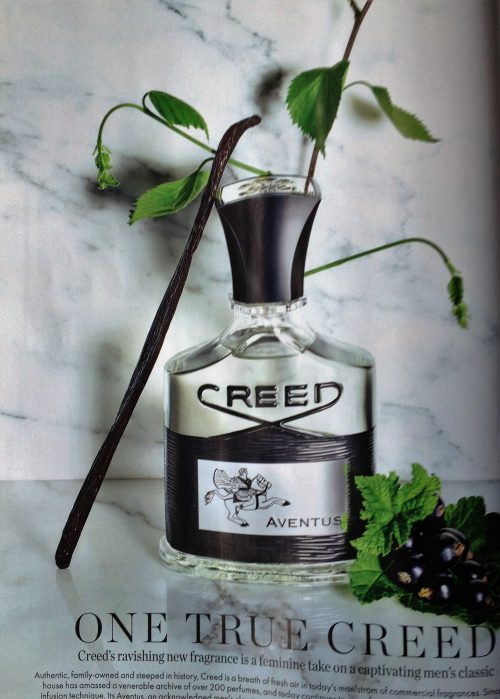
The above picture 1 is taken from a two-page ad for the new Creed woman perfume Aventus For Her, of which it is the first page, showing only the “classic” Aventus perfume for men. We see the perfume bottle salient on a marble-like whitish background and some greenery probably representing the fragrances involved and which I identify as blackcurrants, mint, and licorice. The licorice stick is leaning against the bottle top. Its tip is reminiscent of a penis, which I have outlined in red.
The curvature is suggestive and, although the stalk somewhat tapers toward the tip, the glans neatly partitions from the shaft thanks to a visible ridge. The texture of the stick provides veins on the shaft (I outlined one) as well as finer creases around the frenulum (a few being outlined).
I suggest this penis-like object is in fact a clitoris. Just above the point where the meatus would be, lies a dark area given to construe as the shadow of one of the mint leaves. The whole display of shadows looks messy and not quite according to the laws of optics. This particular shadow delineates a pool, that is, an ejaculate pool. Its smoky aspect could also represent some sprayed substance, a cloud of fine moisture particles emanated from the clitoris due to arousal. In short, the arrangement suggests to you the effect that Aventus perfume will have on women: it will arouse them and make them wet and receptive and consenting to any sexual proposition.
…………….Case 98 L’Oréal SEX
Cases 98-102 are taken from the American magazine Glamour, August 2016.

Case 98

98 – 2
98 – 3
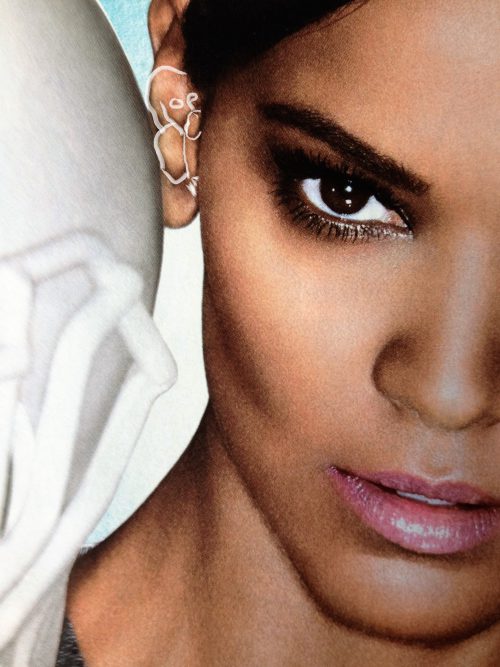
The present ad for L’Oréal “Infallible Pro-Glow” is endorsed by Ethiopian model and actress Liya Kebede, whose name appears on the bottom left of the upper picture, for those, like me, who did not know the model. Not that the name was known to me either, but I was made aware in that way that she was a celebrity. Mentioning the name might betray that the celebrity in question is not so famous, after all – or does it mean that it was thought she would be impossible to recognize in the ad due to massive airbrushing of the picture?
I don’t know what the apparatus on the left of the upper picture is; it looks like some hairdresser’s or gymnastics equipment. On another plane, it looks like a human skull looking at the model, with the chrome parts drawing the jaws and mouth.
The model is looking at the viewer. Among the intricate patterns of the left ear (the model’s right ear) a fellatio has been embedded, which I have outlined in white. Next to the model’s temple appears a penis – shaft, glans, and meatus visible. Its impressive size can be measured by comparing it with the human face drawn beside it, the mouth of which being entirely concealed by the glans. The performer of the fellatio must be currently licking the shaft.
…………….Case 99 Johnson & Johnson’s Aveeno SEX
Case 99

99 – 2
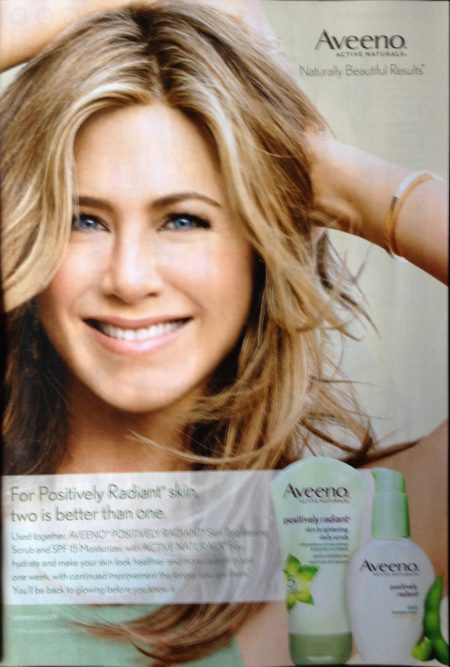
Another case of celebrity endorsement, this time for Johnson & Johnson’s Aveeno daily scrub and daily moisturizer (to be used together). (For theoretical considerations on celebrity endorsement, see Case 39 here.)
Contrary to Case 98 with actress Liya Kebede, the celebrity here is not named. She’s the American actress Jennifer Aniston. I guess she’s more expensive a model than her colleague Liya, whose name must appear on the ads.
At the bottom right of the ad, a string bean (French bean) is leaning against the moisturizer bottle. Two beans are out of their pod. The whole thing is a naïve (I mean the pictorial genre) representation of an erect penis. I don’t need to outline anything; it’s as plain as the nose on your face. The pointed tip may hint, if you like, at a condom.
…………….Case 100 Chanel Eau Tendre SEX

Case 100
In this picture there is wind, but looking carefully you will find that it is impossible to tell from which direction the wind blows. If you look at the cap of the perfume bottle, blown away from it, and at the model’s dress, the wind blows from behind her back. If, on the other hand, you look at the model’s hair and shawl, the wind blows from left to right. The apparent inconsistency, likely to be missed on conscious level by many viewers, suggests a maelstrom of sensations; surely this is something of the sort the creators will tell you if you ask them what they mean with such multidirectional winds.
Yet there is something else than just that. Salvador Dali has devoted a whole book, The Tragic Myth of Millet’s Angelus (in the original French Le Mythe tragique de l’Angélus de Millet), 1963, to Jean-François Millet’s painting L’Angélus (below), in which he explains among other things that the man’s hat is concealing an erection. Dali shows a cartoon in which a naked character can be seen in the same position as the man in the painting, holding a hat at the level of his genitals; when the character takes his hands off the hat because he needs them at once for another use, the hat does not fall and instead stays in the same position, so the viewer understands the hat is maintained by the character’s erect penis. Dali tells us that this subliminal erection (I don’t remember if he uses the word “subliminal”), together with the woman’s attitude, which he describes as mantis-like, was what spooked him as a child after he first saw this painting.
In the advert here, the same technique may have been used (intentionally here, whether Millet’s effect was intentional or not). The dress would look as if it were blown forward by a powerful wind but, as the shawl and hair a few centimeters higher are blown in the opposite direction, it would not be wind but instead a powerful erection that elevates the dress in such a manner. The ad would thus appeal to women’s penis envy (Freud) by subliminally depicting a woman with a huge penis capable of mighty erections.

…………….Case 101 Unilever’s Dove SEX

Case 101
Another case of celebrity endorsement (see Cases 98 & 99). The personality endorsing the product is, I suppose, the woman seen in the ad and her name the one given under the quoted words, namely, Simona Di Dio. I searched for this name on the Web and found that no single Simona Di Dio can be deemed a celebrity but a few of them, if any, because I found one dancer (a belly dancer, actually), one poetess, one lawyer… As the ads talks of perspiration, I suppose our Simona here is the dancer. So much for celebrity endorsement.
They were right anyway not to use a better-known personality for their ad, because they intended to have her tell a lie. The quote reads: “I didn’t know an antiperspirant could make my underarms softer and smoother.” Let’s ponder for a moment over how things happened. Did Simona, one day, buy Dove Advanced Care and became aware after using it that her underarms had become softer and smoother so she wanted to advertise the fact to the whole world and reached out to Unilever to that effect, or was Simona (if she exists at all) called by the advertising agency to appear in an ad under words alleged to be hers for cash payment? Well?
In a way, the process is the same with all celebrity endorsements. The glitterati do not care a dime about the product they advertise (as long as it does not damage their image), they only care about the money they get from being associated with it. In most cases, however, it’s not so direct; if it’s an actor, for instance, who’s paid, he will play a little sketch in a TV spot or pose for a picture. Here, it is the celebrity’s own words that are supposedly quoted, and the name has the same function as a signature.
Moreover, the copy reads as follows: “Dove Advanced Care goes way beyond protection. 9 out of 10 women agreed that it made their underarms soft and smooth.” Can Unilever prove it? Can they show the questionnaire, the answers given to it, the research protocols? Can they explain how the survey was carried out? Perhaps they can – why not? – but the material is their propriety and they won’t disclose it. Only courts of law could compel them to disclose their proprietary material, but on what ground? Figures without sources, it’s what advertising is all about.
…………….Case 102 Chevrolet Malibu Suicide

Case 102
Where does “a complete 180 on the ordinary” (copy) drive you? According to this ad, it may well lead you to the brink of an abyss.
Albeit “Drive Safely” is written on the license plate (in red letters), the Chevrolet Malibu stands on some perilous edge. If you look at the visible front wheel, you see a diagonal line running behind it in a slightly upward straight direction. Even though the white wall on the right of the car continues further toward the front, this line, beyond which nothing is to be seen (below the wheel and car) but a black space, a different space from that on which the car is now standing, indicates the end of the parking lot, or whatever that place is. The parking lot opens on a mountain scenery under bright sky. The feeling conveyed is that of height, the parking lot looks as if it were accessed through an opening in a mountain slope, and the line the car is about to cross if it advances just a little farther is the edge of a chasm. By escaping the ordinary, the advertisers thus seem to mean indulging one’s suicidal tendencies.
That advertising would appeal to some Thanatos urges (death wish) in man comes as no surprise. That a car is a fitting object to make appeals of this kind goes without saying, given the death toll our societies are paying to their road networks. – Appealing to (and exacerbating) aggressiveness when selling cars, as the ad in Case 88 does (here), may be regarded as criminal, by the way, bearing this death toll in mind, because those who use their cars and see driving as an outlet to their aggressiveness are likely to provoke more accidents. If research proves this intuitive view wrong, and the counterintuitive view that these people have less accidents right, then I would be glad to be informed of it.
…………….Complements
Several ads in Glamour magazine are copyrighted (you can see the copyright symbol on Case 99’s picture, for instance). This is something I have found frequently in magazines’ American editions but much more infrequently, or even not at all, in other countries’ editions at my disposal. For instance, I do not find a single copyrighted ad in the Vanity Fair August issue, English edition, from which Cases 96 & 97 above are taken.
Does it betray a pettifogging spirit in American business law? Be that as it may, it looks like I’m infringing on legal rights by using copyrighted material (as in Case 99). All I can say for my defense is, please go back to Subliminal Junk XII (here), Complements, and to Eric McLuhan’s quote. It explains why, when writing The Mechanical Bride and Culture Is Our Business, Marshall McLuhan did not ask for permission before using several advertisements in these books, because his publisher found it was not necessary. If it was unnecessary in Canada only, or whatever the publisher’s country was (Marshall McLuhan being a Canadian, I assume his publisher was in Canada, but whatever the country is, it is only one country in any case), then the books still would have had to require permissions for sales outside that country, in other legal contexts, that is – a point on which Eric McLuhan does not say a word, which in turn leads me to assume, provisionally, that permission is unnecessary worldwide, no matter how strange that sounds (but remember we’re dealing with multinational companies on the one hand, internet on the other hand, and that nation states look a little irrelevant in this context).
Yet it is astonishing that, in one and the same issue, some ads are copyrighted and others are not. Some companies copyright their ads and some don’t. I have no idea what is to be inferred from the practice, or its absence, but, still, here are the companies that copyright their ads and those that don’t in the Glamour issue for August 2016:
Copyright: Maybelline LLC (4 ads), Levi Strauss & Co., Estée Lauder Inc. (2 ads), CliniqueLaboratoires LLC, L’Oréal USA Inc. (10 ads), Garnier LLC (7 ads), Johnson & Johnson Consumer Inc. (3 ads), Allergan (2 ads), Jockey International Inc., Unilever (2 ads), Kao USA Inc., Procter & Gamble (4 ads), Mondelez International Group, Simple (2 ads), Merck Sharp & Dohme B.V., Del Monte Foods Inc., GEICO, Otsuka America Pharmaceutical Inc., Kraft (2 ads, p. 121, p. 133), Bayer, Condé Nast (p. 135).
No Copyright: Nordstrom, Condé Nast (pp. 6-7), Essie, Unilever (3 ads), Sunglass Hut, Buffalo David Bitton, AG Jeans, Chanel, Current/Elliot, Forever21, Paula’s Choice, Covergirl BeautyU, Arm & Hammer, Ogxbeauty, Kraft (p. 115), It’s A Ten Haircare, Chevrolet, Epicurious, Wet Brush, Hair Recipes.
Though the un-copyrighted ads tend to be for minor brands, this is not always the case (Chanel, Chevrolet). Some companies or groups even have some of their ads copyrighted and others not, in the same issue (Condé Nast, Unilever, Kraft).
August 2016
Subliminal Junk X
In his four books, written from 1973 to 1989, Wilson Bryan Key has discussed perhaps between 100 and 200 cases of subliminal advertising, for a research extending over 20-25 years. The other material he collected has not been published. What I am intending to demonstrate is that you can easily extract 100 cases from press publications over a three-months period.
For the present issue, number X of my Subliminal Advertising (now Subliminal Junk) series, I keep extracting advertisements from the same magazines and newspapers I have been using for issues I-IX, namely fifteen issues altogether of various papers, dated March, April, and May 2015. In Subliminal Junk IX, I wrote that lack of time and patience prevented me from presenting more cases from the same papers. This is not good advertising of myself – if I have no time and patience to do something well enough, then I really should consider leaving it alone – and, besides, I have more patience than the average guy, so that is no good excuse either. In fact, what keeps me from showing all the subliminals I find is the redundancy and repetition in the technique; in many cases, adding examples would only be boring to the reader. In a way, I am doing honor to the advertisements I select. Many are discarded in the process, not on the ground, though, that they are devoid of subliminal junk, but because I do not find their junk exciting enough.
At the end of this post, the number of cases will be 79 – or 81 if you include the two first case studies, one on Microsoft (here) and the other on Peugeot (here), which I made before starting the Subliminal Advertising (now Subliminal Junk) series. The seven following cases are taken from: Vanity Fair from May 2015 (Case 74), Vanity Fair from April 2015 (75-7), and Vogue Italian Edition from May 2015 (78-9).
………………Case 74 Dom Perignon SEX
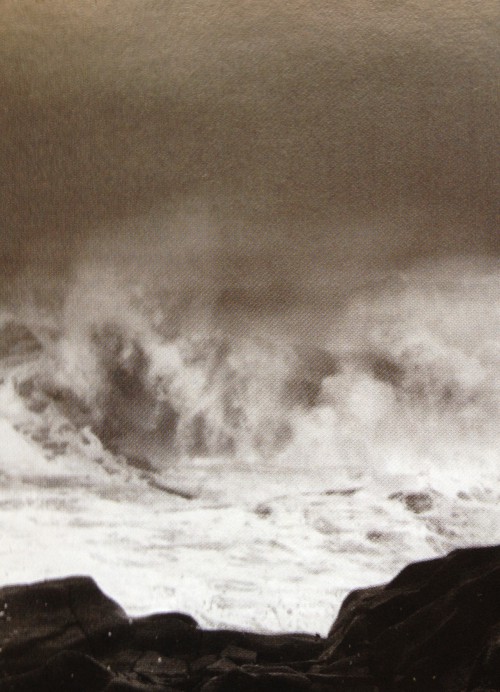
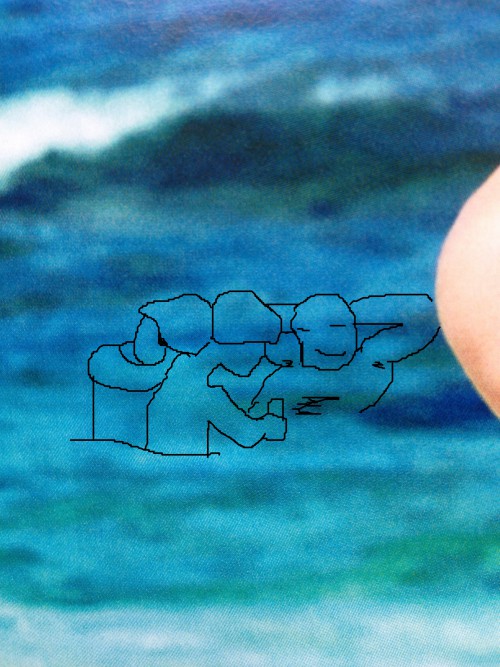
This one is from the same as Case 35 (here), to which I refer you for the whole picture and the word SEX embedded among the sea spray. (The whole picture, by the way, is topical: a phallic object (champagne bottle) and explosive sea spray. On the backward, towards the right, I have outlined a couple of interesting drawings that have been added to bolster the ad’s impact. Pictures 74-2 and 74-3 show the same part of the advert twice because the artist used a technique known by those who are acquainted with Salvador Dali’s painting Slave Market With the Disappearing Bust of Voltaire. The technique consists in setting two different reality objects as one pictorial object; in Dali’s painting, a group of body shapes are Voltaire’s face at the same time.
On Picture 74-2, I show three faces. The face on the left is that of a half-conscious woman, sick because of alcohol consumption. I did the best I could in the outlining but I strongly advise you to look at the Picture 74, the bare one, to get a more appropriate idea of the artist’s rendition of a drunken woman falling out of consciousness or miserable with feelings of faintness. The second face, toward the right, is that of another woman. That one is in distress too, her black eyes wide open while she vomits. Close against her on the right is a man’s face, smiling, not disgusted at all by what is happening. He probably knows he will achieve his goal now, with this or both women. I can see a wig on his head, which makes him a fine eighteenth-century roué, very much in line, I guess, with what a Dom Perignon connoisseur is likely to admire.
On Picture 74-3, we come back to the first woman’s face, but this time it shows something different, albeit the idea is not so different. It shows a woman bent forward, hair falling and almost touching the ground, hands pressed against the knees. She too is in a dejected state due to excessive drinking. While she copes with her present misery, a smiling bearlike creature is gently grabbing at her. His face is against her buttocks, his paw clasping her thigh. The bear, although not altogether deprived of seeming benevolence, looks as if he were intent on taking advantage of the situation.
This is the message subliminally addressed to viewers: Intoxicate your preys with Dom Perignon and –voilà! – it’s done.
This would be the male reader’s viewpoint. For the female reader, however, such an interpretation would make the advert repulsive, so there must be other possible interpretations available to her, or to both sexes for that matter. Woman number one, then, instead of fainting from intoxication, would be gently falling in a post-copulatory swoon, having just climaxed. As to woman number two, something would be forced into her mouth, namely a penis, and she would look distressed due to her fear that it may choke her, or because she is already choking, to the great amusement of the roué looking at this rough scene of oral sex. Finally, the woman in Picture 74-3 would not be on the verge of vomiting, but simply waiting for the bear to mount her. Such scenes are probably repulsive to most men and women, and to many a Dom Perignon patron too, at conscious level — but on a subliminal plane it seems to be another story.
Subliminal Case 74

74-2

74-3
…………….Case 75 Louis Vuitton SEX
This advertisement for Louis Vuitton is of the same series designed for the manufacturer as Case 33 (here). First, I would like to call your attention on the way the model is wearing her bag. Although we have the typical background of bright sky and blue sea so appealing to dejected employees, the woman is fearing something is going to happen to her. She is holding the bag against her chest, looking at a distance, as if she had been suddenly aware of a desperado’s presence. The scene, in fact, is mildly nerve-racking. It’s only because you do not expect such tone in a tropical, and topical, advert for a handbag that you did not perceive it at first. Well, you did not perceive it, maybe, but your lizard brain has registered the model’s disquiet nevertheless – because it has no social expectations like yourself, I mean your conscious self, which is easily tricked by advertisers because of the preconceived notions we are all using as shortcuts to deal with the requirements of everyday life.
That lizard brain of yours also registered something else. On the turquoise waves a drawing has been embedded. It represents two kids and a man, all naked. One kid is leaning against the other’s shoulder. Maybe he’s tired, maybe he’s ashamed, maybe he’s crying. The other kid is masturbating the man’s penis. The man is lying on the back, both hands under his head. He’s enjoying. This is subliminal pedophilia, something we have already come across (Case 52 here). As a first guess, I’d say it will (discarding any sexual stimulation effect) contribute to heighten in the female viewer the anxiety produced by perceiving, unconsciously most of the time, the model’s apprehensiveness. Mirror cells in the brain tend to reproduce as yours the emotions you perceive on others; that is their function, and I suggest they will reproduce emotions even when you fail to interpret these emotions correctly at conscious level. Choosing a handbag is in itself an anxious experience – all choices imply some degree of anxiety – and here it is connected with status anxiety, like all fashion. Anxiety advertising is aimed at producing the right crisis in the mind.
Uninformed readers may object that mirror cells cannot be induced to react in the present case, as people know it is only an advertisement and the model is acting. In reality, our mirror cells function as usual even when we know that the person we look at is simulating emotions. Without such a functioning in the face of all our knowledge, movie theaters would remain empty. It is because people let themselves be moved by acting that they enjoy cinema, and they can do that because even their knowledge of the whole stuff’s being acting and simulation does not prevent their mirror cells to induce in them the emotional states they perceive. The difference between a good actor and a bad one is that the former is capable of mimicking emotions most perfectly, whereas the latter lets perceive a discrepancy between his behavior or attitude and the emotion he is supposed to be acting. Bad actors betray that their inner state is alien to their role, and such discrepancy makes them, and the whole scene, ridiculous; despite our willingness, our mirror cells cannot be fooled by bad actors, and we resent them for the poor performance.
These remarks allow one to describe the impact of advertising, even printed advertising, in terms of mirror cells. Advertising models are asked to express emotions, which the photographer will try to capture on the picture. In Case 75, I suggested that the model is expressing some feeling of anguish that would remain unperceived at conscious level insomuch as it makes no sense at all for the uninformed consumer that fear should be made use of in that kind of advertising, especially with a cliché bright sky, blue sea background. As it makes no sense, the stimuli that would allow the correct interpretation remain unattended.
One thing, however, must be added. The model here has not been asked to play genuine anguish. In fact, she was asked to look disquieted, with her gaze and her holding the bag against her chest, but not entirely so, in order to confuse the brain and prevent any possibility that the right interpretation be brought to consciousness. The way she is holding the bag against her chest is ambiguous, the gesture is soft, there is no muscular tension, no crispation as would be expected from true disquiet. So, in a way this is a case of bad acting, some stimuli indicating one emotional state and some other stimuli from the same source indicating another emotional state. Except that the discrepancy here has been designed intentionally, so that the viewer will more easily discard the stimuli that make no sense, i.e. anguish or, more mildly, disquiet, since are also present the stimuli that make perfect sense to the conscious mind – a young woman strolling on a beach or a riviera by a fine summer day with her handbag, which she carries most gently, and why not against her chest, if she likes? Her looks seem a bit odd, for sure… but, wait, she’s so young and at that age one is easily troubled. So far so good. If the character is troubled, then there is something troubling about the advertisement. I just wanted to be sure you noticed. Finally, the discrepancy may serve the purpose of disquieting the unattending brain and thus remaining engraved inside as a puzzle, something unexplained and thus potentially threatening (despite the conscious interpretation of the ad as being innocuous, trite stuff). And then there is the subliminal drawing of pedophiliac erotica.

Case 75

75-2
75-3
……………..Case 76 Patek Philippe SEX
We have already seen this advert, Case 29 (here), where I show a sex embed. As with Case 74 above, the sex embed is not only a sex embed, no more than it is solely, it goes without saying, the shades of a coppice in the background. There is also present a semi-erect penis. The testes have been painted prominent. It’s not so much about the penis, this time, as about the reproductive stamina.
If you’re interested, you can find another sex embed stuck to the woman’s left shoulder. Above this embed are two faces, which I do not care to outline, but that you may find too. It’s the woman’s parents, the father on the left, with large whiskers, a Colonel Goodchild of sorts, the mother on the right, fateful and zombie-looking, with a face larger than her man’s.

Case 76

76-2
…………….Case 77 Elie Saab SEX
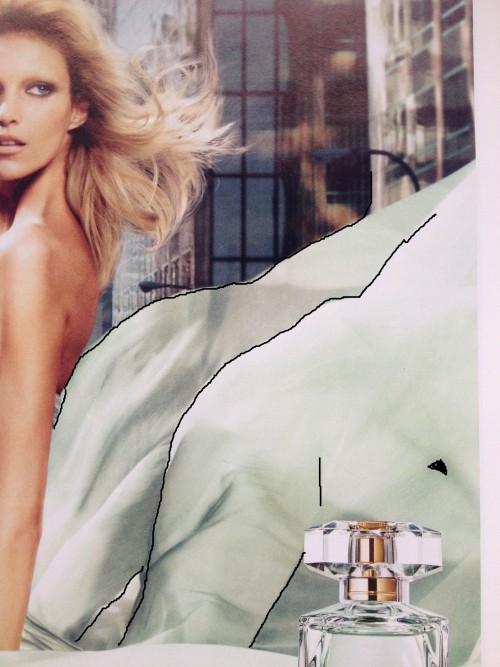
Same as Case 30 (here). Besides the sex embed in the model’s hair, the folds of her dress, nicely swollen by the wind, delineate a copulation. We see two bottoms and two backs. The woman’s pubis is concealed by the top of the perfume bottle but I have indicated the navel (though I’m not inventing it: it’s there) so you can orient yourselves in these folds. The woman is on her knees, the man on her, they’re making it more ferarum, which is the Latin for doggy-style, if you care to know. The man, though, is not well oriented on her mate’s back, he is bending toward the left, probably toward another mate, which he is kissing or on whom he is performing a cunnilingus.
Also, looking back at the picture 30-1, you’ll see the model’s body is slightly tilted, whereas the writings below are quite horizontal, that is, when the writings of the page are horizontal the body is tilting toward the right. The model is therefore leaning against something, and as she can’t be leaning against her veils flaunting in the wind, she is leaning against a man’s body.

Case 77
77-2
…………….Case 78 Louis Vuitton SEX
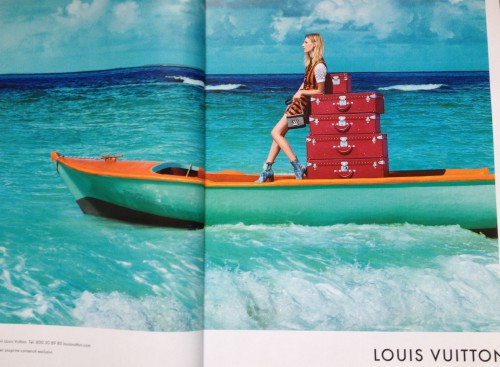
From the same series as Cases 33 and 75. I have nothing to say about the picture itself. Please proceed directly to Pictures 78-2 and 78-3, and into the turquoise waters where strange Tritons and Nereids are having a subliminal orgy. On the left side, a woman is licking the testes of a semi-erect penis bending toward the left. No doubt the penis will be full hard soon. Close against the woman on her right, we can see the back and buttocks of another woman, sat on a penis. A third woman, further on the right and a little below, is also impaled on a penis, and smiles at you. (The smiling head could be that of a fourth woman, though, as it is separated from the bottom with the penis inside it, a bottom which can be completed instead by a female back and a black-haired head contiguous to it on the right side.) From this group further to the right and below, a woman is taken more ferarum by a crocodile or a doglike creature on her back. Her visage expresses intense contentment. (We have already come across subliminal bestiality, in Case 59 here.) In the space between these two lovers, another face is staring at you; it is a smiling death’s head, or just another Mister Grin.
From this case I conclude that women too like pornography, providing it be subliminal.
Case 78

78-2

78-3
……………..Case 79 QC Terme Spas and Resorts SEX
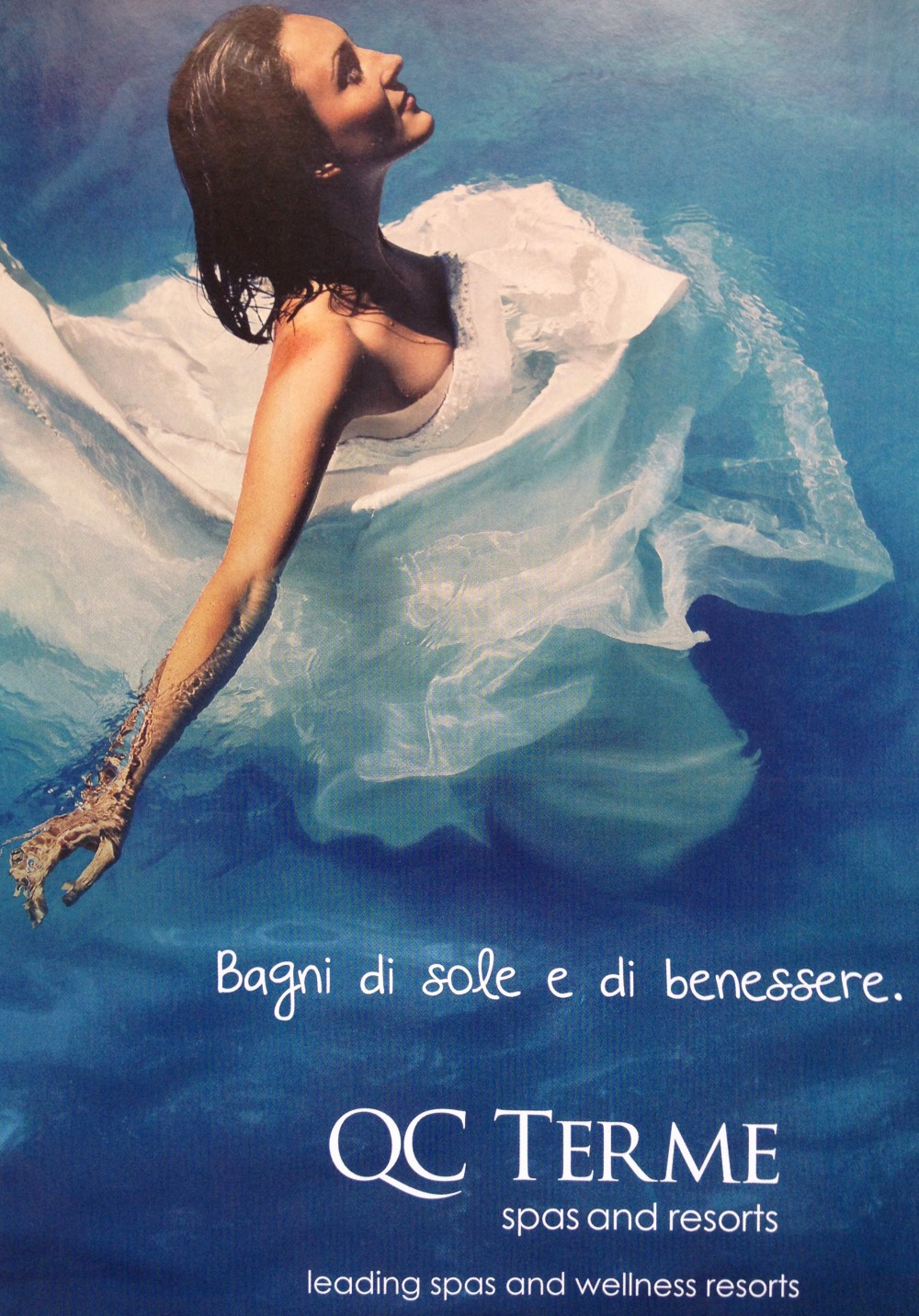
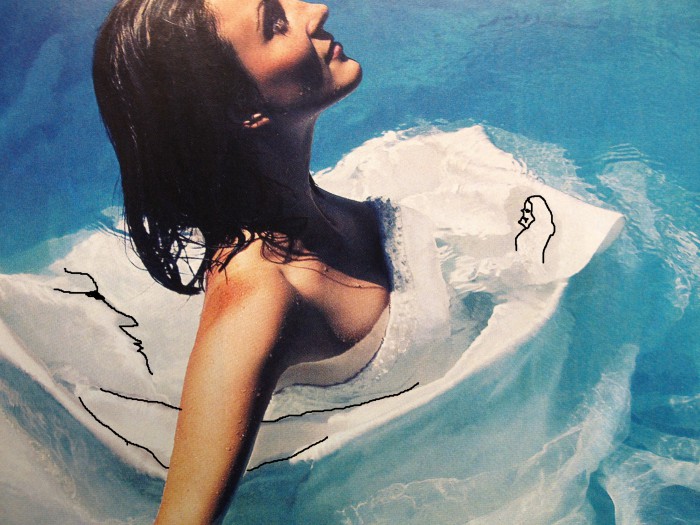
The model’s expression is well-being. On Picture 79-2, she is embraced by a subliminal man (à la Modigliani, not my favorite embeds: I prefer more realistic objects, more difficult to object to by opponents), and besides a little Death figure, very realistically drawn with skeleton and the customary cloak and hood, is staring at her with its typical grin. Please take a closer look at Picture 79-1 to appreciate the fine rendition of the skull. Health concerns are involved, as you have understood.
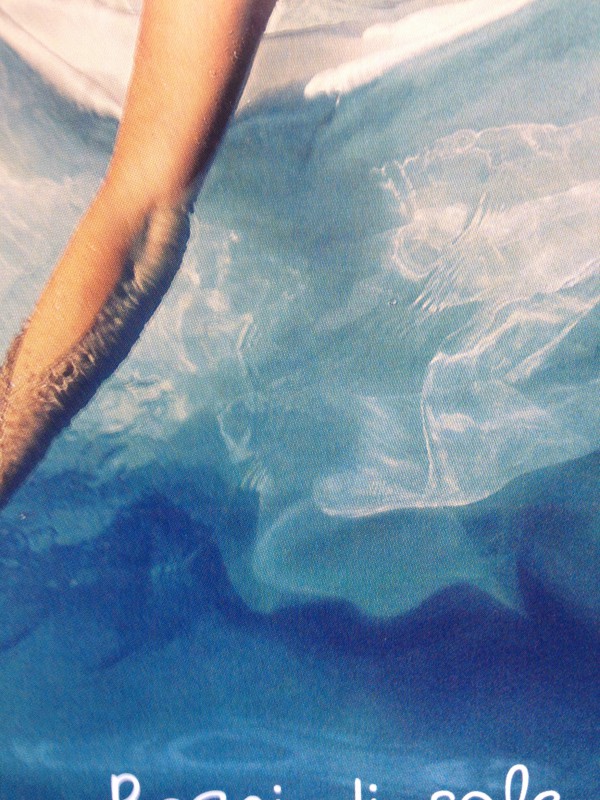
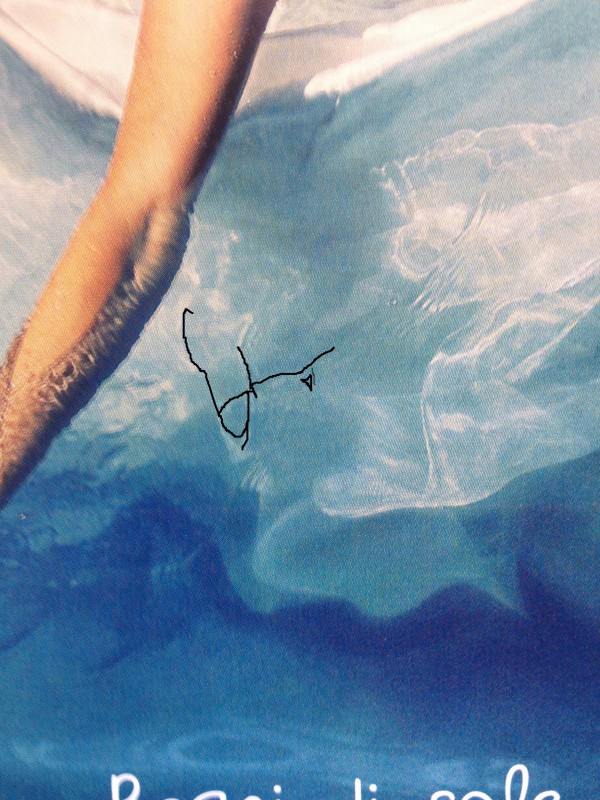
Pictures 79-3 and 79-4 display a fellatio, rather ethereal, admittedly, but it’s there nonetheless, and the white smears at the tip of the glans and further below indicate ejaculation. EPC (extra-pair copulation) prospects in spas and resorts have served as material for the advertiser.
Case 79
79-2
79-3
79-4
September 2015
 florent boucharel rAd-Free