
Tagged: free speech
Lessons in Law 11: The Clueless Panopticon
Crack Hills Have Eyes: The Clueless Panopticon
“More American police officers died during prohibition of alcohol than any other time in history. 300 died in 1930 alone. After prohibition ended, police deaths didn’t reach 200 a year again until the year Nixon declared war on drugs.”
As this person mentions interesting data on Prohibition, I have these also:
“By 1930, more than a third of the inmates in the nation’s federal prison system were persons convicted of violating the Volstead Act [Eighteenth Amendment’s implementing federal legislation]. That statistic demonstrates that a major effect of prohibition was the growth of federal prisons. As late as the 1890s, the federal government had no prisons at all ; the small number of persons jailed for committing federal crimes were held in state prisons.” (G. Edward White, American Legal History, 2014)
Nevertheless I regard Prohibition as a “noble experiment” (Herbert Hoover) and was even in touch with the Prohibition Party, which still exists. Please consider sending membership application:
https://www.prohibitionparty.org/
As to the war on drugs, allow me to quote a previous lesson (Lesson 9):
“There’s been a crack pandemic in Paris, France, these last years, with an area now known as Crack Hill (la colline du crack) in the North-Eastern parts of the city. Neighbors talking of a “hell,” a “nightmare,” and other such words has become commonplace. Authorities are pouring millions of taxpayer money in a so-called crack plan doing nothing but distributing under police surveillance new crack pipes every Thursday to the 1.500 crackheads (they know the numbers!) who roam on Crack Hill and paying for 400 hotel rooms for crackheads. Thus, the bureaucracy’s sole policy is to prevent the crackheads’ habit from turning them into blood felons, with the result that they will remain an endless source of unpunished misdemeanors and lower-key felonies, an everlasting nightmare for the neighborhood. – This in a country where the numbers of police officers per inhabitant are extremely high (340 for 10,000 inhabitants, that is, one officer for 294 people, according to Wikipedia).” (Compare this 340 figure with Finland 130, Norway 188, Canada 188, Denmark 192, Sweden 195, UK 208, Switzerland 210, Australia 218, South Korea 227, Japan 234, Ireland 265, The Netherlands 295, USA 298. As 18 per cent of the French population is less than fifteen years old, we have 294-(294×0.18)=241, 1 police officer for 241 French people above fifteen. A university professor has more students than this.)
That’s the “war on drugs” they’ve got there: distributing crack pipes like the Salvation Army bowls of soup and lodging crackheads in hotel rooms at taxpayer’s expense, while the very same taxpayers are living a daily hell.
Not only do they live a hell but also the government is ruining them. You might say –maybe with French authorities– that people are free to take their things and leave if they don’t like the neighborhood, but wait a minute: If they own their house, they won’t be able to sell it at a fair price, they won’t get the price they would if the government had enforced the law instead of letting a Crack Hill sprout.
But the icing on the cake… as I said, they know everything, they know the numbers (1.500), they know how many rooms and how many pipes are needed, they know the names, I guess, and the records of everyone, and who dates whom. They know everything and won’t do a thing. – Crack Hills Have Eyes: The Powerless Panopticon!
Now, when last weekend (first weekend of May 2021) and the next days neighbors, were reported shooting firework mortars at crackheads, my, I can’t say I am surprised.
*
‘A Culture of Fear and Censorship‘
A Christian Finnish politician has been charged with multiple hate crimes, after she tweeted a Bible verse and criticised homosexuality, and could face up to 6 years in prison as a result. (National File)
“Paul Coleman, the Executive Director of ADF International, who is representing Päivi Räsänen: The Finnish Prosecutor General’s decision to bring these charges against Dr. Räsänen creates a culture of fear and censorship. It is sobering that such cases are becoming all too common throughout Europe. If committed civil servants like Päivi Räsänen are criminally charged for voicing their deeply held beliefs, it creates a chilling effect for everyone’s right to speak freely.”
When the laws are such, no one can be surprised that prosecuting authorities make use of them. What creates a “culture of fear and censorship” in Finland is not the charges but the very laws that trigger them. And make no mistake, grassroots movements for repealing hate speech laws do not exist in European countries where such laws exist.
First, you won’t hear a lawyer ask for a change in the law where judicial review is as good as non-existent, which I believe is the case in most European countries. As a matter of fact, it is the case in France, where the judicial review of laws is the domain of a byzantine council where former members of the legislative and executive powers seat, that is, whose members are asked to review laws they passed in their former functions! Absent serious judicial review, trials do not offer the opportunity to revise the legislation.
And there is and has been no support for repealing hate speech and other speech suppression laws among the public opinions of these countries, nor in the media nor from any group of which I know, probably because, among other things, people know they would go against a state-terror state that does not hesitate to deprive people of their freedom because of their speech. That is, where a state has hate speech and other such laws, asking to repeal these laws is a remarkably exigent demand on such a state, a demand for which one could easily be labeled an enemy of the state.
ii
The defense chosen by Räsänen’s lawyer is doomed. On the one hand he refuses to criticize the Finnish law, probably for the following reason: To criticize the law would be an argument for judicial review of the law, which is not available to the defendant (this is a mere conjecture, but if judicial review is available, clearly the lawyer ought to make use of it). On the other hand he criticizes the step taken by prosecuting authorities –that is, the charges– as contrary to a ‘cornerstone of democracy,’ freedom of speech, but as the charges are based on Finnish law the argument aims at the wrong target: Judges (it should be juries if you ask me but we are dealing with a type of state devoid of refined conceptions of individual rights) will determine that the charges are conform to the law and condemn Räsänen. It is the law that is supposed to defend freedom of speech, so when the law requires to condemn someone for her speech, the judge, if not summoned to judicially review the law, will descry it as both defending speech and nonetheless instructing him or her to condemn someone for their speech because there are ‘necessary exceptions etc.’ Judges in their quality of ordinary judges are no judge of the law; they will examine the charges but they cannot, as ordinary judges, decide that the charges violate a fundamental guarantee when observing at the same time that the law commands the charges.
*
Political Cartel Persecution
In the parliamentary debates on the French bill against Muslim separatism the representative responsible for the bill (rapporteur général) said at some point that proselytism is forbidden, which is simply not true. Think of it, to claim religious freedom exists and at the same time declare that proselytism is forbidden! To be sure, in recent years French authorities took measures to restrain proselytism in the surroundings of schools –I have no idea how such measures can even be applied, so stupid it looks: does it mean people are forbidden to talk about religion in the surroundings of schools?– but of course proselytism is a fundamental right. As if one had no right to proclaim their faith!
Then they say speech laws in France distinguish between criticizing a religion, which would be allowed, and derogatory speech against people because of their religion, which is hate speech. Such a distinction is meaningless; one would say, for instance, “Bahaism is a moronic religion” and that would be fine, but if they said “Bahaism is a religion of morons” that would be hate speech. On the one hand that means you can skirt the law by mere phrasing, by immaterial speech warps with no effect on the content. On the other hand, and this is the truth of this distinction, it means the whole thing is at the discretion of prosecuting authorities (and in France prosecutors are both at the orders of the government and from the same body as allegedly independent judges); there is no rule of law anymore, it’s government arbitrariness throughout.
Then, once they have told you that censorship does not exist in France, that only the judge can rule that such and such speech is illicit, they pass legislative bills allowing the government to shut down associations, close mosques, seize material, etc., based on alleged hate speech without prior intervention of a judge!
Recently, the head of a Muslim charity was under accusations linked with terrorism. For two years he was subjected to police surveillance restricting his freedom because of the judicial proceedings against him. At the end of two years the judge cleared him of all charges: He never had any connection with terrorism, the judge said. In response the administration shut down his organization and the government is now gloating over it. How do you call that, if not a police state?
Likely you won’t even find the word Islam or Muslim in the bill, it’s a catch-all text. The government says it’s against Muslim separatism, not Corsican separatism (an example given by a cabinet member), but a future government may use it against all separatists they want or all people they want to call separatists, and conversely instruct the administration and prosecutors to apply the law in no circumstance whatsoever to such and such other groups. (When people who are the majority in the assembly of Corsica call themselves Corsican Nationalists, of course they are separatists because the ‘Nation’ is France, not Corsica. So the law can be aimed at them, no matter what the government says.) But the truth of such catch-all bills is that they must be implemented discriminatorily. Short of being a catch-all text, the bill would be declared unconstitutional as a result of its discriminatory nature, so the intended discrimination is left to its application by the executive.
ii
With the bill the government claims that restrictions on freedom of association are necessary to prevent foreign interference (Turkey was blamed several times in the debate). When Iran and Venezuela did the same with the same arguments, this was described as dictatorial moves. I guess the same people will express no objection here, as the associations targeted are not the same and they pay lip service to principles, having only their narrow interests in mind.
Reading a U.S. conservative commentator describing the evils of Venezuela, I would like to call his attention on America’s French NATO ally. This commentator tells how Venezuelan authorities stopped the airing of a TV soap about two sisters, Colombia and Venezuela, the latter, the bad one, having a dog called Little Hugo. Such a soap is not even imaginable in France, where recently private citizens have been held in police custody for mere jokes on the street (a placard reading Macronavirus) and others prosecuted for having beheaded an effigy of the president. After six months of police and judicial surveillance and a trial, these latter were not convicted. Still their ordeal was serious enough. And all this while a few months ago Kathy Griffin’s symbolic Trump beheading had been viral…
Satirical entertainment programs targeting the French president do not exist. In France the specific incrimination of insult to the head of state, actionable by prosecutors with no complaint filed and for which the principle “truth is no defense” obtained, was abolished in 2013 only. The specific crime was abolished, therefore… such speech is now regulated by the more general criminal law of insult to public officials, and in France insulting a public official is a more serious crime than insulting one’s neighbor.
Here there is no Western World but a New World and an Old World. (As long as antiterror laws in the U.S. do not blur the line – but still, as the same phenomenon leads legislators in Europe to push for even more repressive legislation, both the old and the new world going on the same path of repression, a span will remain.) The “enlightened West” is a myth here. There is only one “enlightened” country, and it is the United States of America; all others are sh*thole countries, to speak like a former Potus. Hence the principle: Hate speech is a crime in sh*thole countries. (That is, all countries but the United States of America.)
v
Contemporary lèse-majesté laws in Europe
Let us make a short trip through these countries via Wikipedia pages on lèse-majesté (interesting that the English word for this is a French word precisely).
Constitutional Monarchies
In Belgium, derogatory comments on the King or the royal family are punished with three years’ imprisonment.
In Denmark (where a legal Nazi Party exists), penalties for libel are doubled when the monarch or a member of the royal family are the targets (eight months’ imprisonment).
In Spain, two years.
In the Netherlands, “[i]n April 2018, the maximum punishment for lèse-majesté was reduced to four months, making it similar to that for insulting police officers and emergency workers.” (Before that date it was five years.)
The British monarchy seems to be more enlightened but this is according to Wikipedia and I keep some doubts about it.
Republics
In France, the specific incrimination as to the head of state (the President, endorsed with significant executive powers) was punished with one year’s imprisonment until 2000, when the law was changed and only a fine remained, before the law was eventually repealed in 2013 as I said in iv. The irony is that now the President is treated like other public officials and the penalty can be six months’ imprisonment, so between 2000 and 2013 the president was less “protected” than he is today and the repeal of 2013 was not even a progress of freedom of speech, quite the contrary.
In Italy, “impinging on the honour or prestige of the President is punishable with one to five years in jail.” The Italian President has more symbolic than executive power, so the incrimination is not as political a tool as it is in France, where the President is the person who actually governs (in most situations).
In Germany, “insulting the federal President is still illegal, but prosecution requires the authorisation of the President.” Same remark as for Italy: The German head of state has only symbolic powers.
In fact, these lèse-majesté laws are not the most relevant issue; one should look at libel law and how it protects public officials (like Presidents when they are a real executive power, as in France, U.S., and Iraq under Saddam Hussein) compared to other persons. Because then officials who are heads of state are political actors, so political criticism can be prosecuted as libel and political freedoms gagged.
Regarding other countries, in Morocco, it’s from one to five years’ imprisonment; in Brunei, up to three years. No major difference with the above, as you can see. – In comparison, in Thailand it’s from three to fifteen years’ imprisonment (and in Cambodia since 2018, from one to five years). In all these countries the monarch is a real executive power (no matter what the Constitution says in the last two).
*
Immigration and Consociationalism
Jus naturaliter speaking, legal migrants are under no compulsion to relinquish their worldviews: the moral contract with the host society is that they will be free in these societies just as the natives, and if the condition was that they had to denounce their views and living style, then they would eo ipso be second-rate citizens deprived of some fundamental freedoms.
Then, the truth about illegal immigrants is that they are wanted by the capitalists. In ancient democracies everybody was free and equal, “everybody,” that is, a handful of citizens surrounded by masses of slaves and helots. Same in the U.S. in Tocqueville’s time, all equal and free, but of course not the Negroes and not… the paupers (who had no voting and such rights, who knows how many people that made?). And it is the same today, we are all equal and free, but of course that doesn’t include the “illegal immigrants” who have been toiling in our sweating system for decades and without whom the system would crash overnight.
ii
In this context, the Ottoman model is not a far-fetched idea. In modern political theory what is known as consociationalism, or consociational democracy, may not be much remote from the functioning of the Ottoman polity or of any multiethnic empire of the past like the Austro-Hungarian empire also. What other alternative can there be, as Western societies have made the choice to accommodate masses of immigrants from other cultures, except complete suppression of cultures, a totalitarian mold raising the required conformity to levels so far unknown?
Has this choice been forced on Western populations by so-called globalist elites? But then it means middle classes really had no grip on their polities, so what exactly are they defending? their own alienation?
An alternative to consociationalism may be the American constitutional theory as exposed by Supreme Court judges: “We are not an assimilative, homogeneous society, but a facilitative, pluralistic one, in which we must be willing to abide someone else’s unfamiliar or even repellant practice because the same tolerant impulse protects our own idiosyncrasies. … In a community such as ours, ‘liberty’ must include the freedom not to conform. ” (Justice Brennan, on Michael H. v. Gerald D. [1989])
That may make America look sound very liberal but I still perceive it as more conservative than continental Europe (it is no accident, by the way, that of all European countries the U.K. left the European Union), where we’ve got authoritarian liberalism whereas in the States it remains PC liberalism (enforced by political correctness, not police and tribunals).
*
Home Affairs Colonial Policy
The main French social-democratic student union (UNEF) is under fire, some politicians calling for no less than its disbandment. In cause two things.
1/ A local branch of the union dared denounce on their website two professors, quoting their words as “Islamophobic.”
I can’t find the words in question with a quick search, the media seem more interested in telling the public that the national board of the union apologized for what the local branch did. The media will simply not buy that the professors might have made Islamophobic, that is hate speech.
To be precise, the blame has to do with the fact that the union posted words and photographs of the two professors. Such a blame is quite harmful because with a recent bill French authorities created a new crime, that of publishing personal data with malicious intent. The context being the beheading of a teacher by a Muslim boy after data of the victim were published on the Web. So now the union, which has always been a leading student union in the country, is tacitly accused of being calling for physical assassinations.
The character assassination they intended is perhaps objectionable enough in itself, but then it certainly is not the first time, in fact character assassination is the daily bread of political life, and it is quite telling that the razzmatazz takes place when the accusation is that of Islamophobia. The crime, actually, for the powers that be, is to raise that cry: Islamophobia!
Please note that this comes a couple of weeks after the government ordered a report on “islamogauchisme” (“islamo-leftism”) in academia.
2/ Moreover, the union dared organize meetings without male and white people present, in order for colored women to talk freely about racism and sexism as they see and/or live it.
The establishment calls this “racism.” Thus, we see how antidiscrimination laws or the antidiscrimination animus is used: in today’s France it means that colored people are not allowed to do anything without whites being present. You would think yourself in the colonies of old.
Lessons in Law 10: Libertarian Law
Bipartyism vs Multipartyism For Dummies
(Completes “Multipartyism is a corrupt form of people’s government” in Lesson 9)
From plurality voting to majority rule there must be, as far as the constitution of assemblies is concerned, a step of behind-doors negotiations between parties that escape voters’ choice entirely.
Bipartyism, the two-party system, means majority voting: The result is an absolute majority (above 50%). The electoral platform can be applied at once.
Multipartyism means plurality voting. Let us take three parties A, B and C with respective results 40%, 35% and 25%. Because the government needs majorities above 50% to have bills passed, party A must negotiate a coalition pact with B or C to get a majority in Parliament, usually in exchange of government positions. So, there will be a coalition government A+B or A+C formed upon a coalition pact that is different from all platforms presented to the electorate.
Let us now look at France, a multipartisan and parliamentary regime, where, that is, the government’s head is from the dominant party in the legislative body. The head of government thus governs based on a coalition pact bargained behind doors and not an electoral platform.
(There is in France another head of the executive, namely the president [président de la République], elected in a two-stage election that eliminates all candidates but two in the first stage, which could be seen as a kind of primaries, by which most voters are asked to express their best choice and then, at the second stage or general election, their second best [runoff principle]. The president in France has no power if the legislative assembly is of a different party, so I leave the dealing with him in parentheses even though he is the real ruler in case he is of the same majority as the assembly, so the real guy remains in parentheses, which shows you how absurd that system is. – In fact, the French president is in no way the “real guy” in the system, even when of the same party of the majority in Parliament: this is an illusion of commentators. Although he is elected on a platform which he does not have to discard the very next day, and he probably derives his greater aura as an institution from this, he cannot apply but the coalition pact of the coalition government. He is the coalition’s puppet.)
ii
“Because the government needs majorities above 50% to have bills passed”: Allow me to expatiate.
A vote on a bill is basically a yes-no question, votes are yes or no, so yes or no (pass or not) will at least get 50 percent of the votes. Those not present to vote (or with no proxy) or abstaining may make the result less than 50 (51) percent of members but that is not taken into account (a majority of members is not required, only a majority of votes).
One could also imagine an actual abstention vote (yes, no, or abstention, as in polls) that could then make the result less than 50 percent of voters, and then a bill could pass by a plurality vote.
All in all, what a government needs in the legislative body is enough people to vote the bills. This is why most multipartisan regimes make it compulsory for the first past the post (plurality winner) to start forming a coalition after election day, that is, to enter in a secret, clandestine coalition deal.
Some regimes do not, however (like Denmark): A government is formed from the party that has got a plurality of, say, 40 percent of the electorate’s vote and 40 percent of the seats in the legislative body. This minority government withholds the electoral platform for which it was elected but it will present bills to a legislative body where he only has 40 percent of yeses secured (we’re talking of an ‘ideal’ situation where party members are 100 percent aligned on the government’s platform but figures for U.S. Congress, for instance, give a 90 percent congruence). At some point or other, even there the government will have to form a coalition, as it has no bargaining power with the opposition except in this way (because a government’s only power on representatives is to offer government positions, as parliamentary regimes are those where representatives have no other ambition than to make it to the government, so a political coalition can only mean a coalition government in the final analysis).
Now such a system as I am describing is so disrespectful of the citizenry that even when parties make electoral deals where some withdraw candidates from some districts in exchange of the other parties withdrawing their candidates from other districts, that is, even though they are already agreed to form a coalition in case of victory, both parties still have no common platform and pretend to defend a platform of their own they know they won’t withhold unamended in case of victory.
This is the vicious nature of multipartyism.
In contrast I call the attention on the ‘top two’ system in the state of Washington, where after the primaries two candidates from the same party may be competitors in the general election. This is the true essence of a two-party system: The idea is not to get as many political parties as there are political ideologies, or currents, or opinions, or nuances (and in fact as there are politicians’ ego trips) but to get two parties where all ideas can find expression and in the frame of which they compete with one another. Two parties for all ideas.
*
Electoral College
One critic of the American Electoral College writes: “Certainly, if one believes that the person who receives the most votes should win, the implications for democracy are evident.” (L.S. Maisel) The author means suppression of the electoral college. But certainly, such implication is not at all evident. In both federal and unitary (nonfederal) systems the winner gets the most votes (so a “minority winner” is a bogus notion anyway): In U.S. the winner gets the most votes of the electoral college, elsewhere he gets the most votes according to the respective systems.
Look at the following map (found on Twitter a while ago, with no source mentioned).
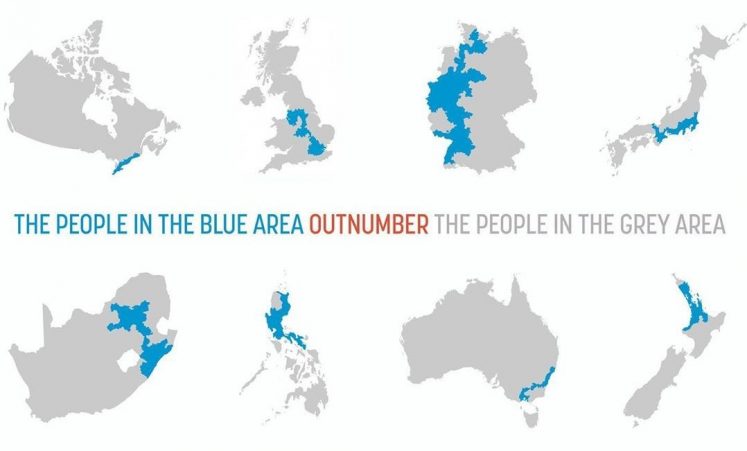
In all these countries one observes a marked demographic imbalance between geographic parts (Canada and Australia are particularly salient cases). In all these countries, without a single electoral district system there can be no “one man one vote” principle unless one divides the blue area in a multitude of districts and the grey area in few districts, which would be absurd as the districts would then be mere geographic fictions, which states in a federal union are not (they have historical meaning).
Indeed, as countries with single election districts are a small minority, the principle one man one vote is a rarity among democracies for national level elections of assemblies.
In any case, whether one, in demographically imbalanced nations, which are the rule rather than the exception, adopts a single district system or a multiple districts system with mathematic precision as to district equality re population numbers, departure from one man one vote in a federal system is constitutionally mandatory at the federal level. If this is not democratic, then a federal constitution is not democratic either in the first place and the subject is not the electoral college but the federal structure.
*
The Criminal’s Debt to Whom?
We all have heard of cases of alleged rape ending because the accused man pays money to his accuser and there is no trial. Something I don’t understand. Rape is a crime coming under criminal law. If one can have a rape trial cancelled by a financial deal, which satisfies prosecuting authorities, why is it not the same with, say, murder? The victim’s relatives could be given money (blood money) and the prosecutor would drop the case as a result of this financial compensation. Yet it does not happen: With murder there is a trial, only with rape there is not.
The implication is disturbing, as it amounts to saying that well-off rapists have no debt to the society but only to their victims.
If we’ve got criminal law rather than an all-encompassing tort law, it is because the government says criminals must pay their debt TO THE SOCIETY. Where there is no trial because of a financial agreement, like, as I said, in some rape cases, we are not talking of crime.
Assuming with great certainty that some other crimes (on paper), like assault, are subject to the same treatment (although the legislator never said a word on where to draw the line), the idea that justice treats differently the rich and the poor takes a more precise shape: No matter what they do, short of homicide, the rich must pay their debts not to the society but to their victims only, they cannot be criminals according to the system.
*
Prone Restraint
Derek Chauvin must have had an extremely incompetent lawyer, as he’s been found guilty even though his innocence is self-evident according to so many right-wingers. I’m urging the latter to be lawyers if they aren’t already. Let me tell you what the defense of Derek Chauvin should be, of which I haven’t heard a word among the vocal right-wingers taking Chauvin’s fate at heart.
Derek Chauvin used, according to his training, a technique called prone restraint which is banned in several cities in the states and several countries in the world for being haphazardly deadly. Therefore, as he conformed to his training, Chauvin is not to be held responsible for the death of George Floyd, but the authorities that allow the use by police of a haphazardly deadly technique are. Derek Chauvin obviously could not be convicted for intentional murder. He has been convicted for, in a nutshell, manslaughter or depraved-heart murder, that is, the jury found he applied the prone restraint technique that he is trained to apply, in an unsuitable manner. Yet the ban on the technique in several cities of the states and several countries in the world is proof enough that the technique is hazardous in itself, or at least difficult to handle without lethal risk for the persons subjected to it. Therefore, Chauvin must be cleared and the administration that keeps training police officers to apply prone restraint must compensate George Floyd’s relatives for their loss, which was predictable and thus avoidable through the banning of the technique.
That Floyd said he couldn’t breathe is no proof of Chauvin’s neglect, as the latter might have perceived that Floyd was simulating in order to escape (even if Floyd was already handcuffed, because being handcuffed never was an obstacle to running except for those who run on their hands).
A few months before Floyd’s death a similar affair had occurred in France, with the death of Rémi Chouviat on the occasion of a routine traffic control which degenerated in an altercation between Chouviat and the police and in Chouviat’s death after a prone restraint. It is known that trivial altercations are a significant source of homicide, and it is an even sorrier state of affairs when it is trivial altercations with the police that cause the termination of innocent citizens.
*
How To Curtail Crime
To reduce crime, numbers of police officers must be cut.
37 percent of homicides result from trivial altercations (Kenrick & Griskevicius, The Rational Animal, 2013). Merely pushing someone away, if he stumbles and falls on his head, he may die from skull injuries. That will be counted as homicide in statistics, and this is what homicide statistics are: 37 percent of trivial altercations turning bad. We don’t need cops to fight “crime” like this. We need cops to fight criminal organizations, but you never hear of criminal organizations being terminated. Here prevails a philosophy of fatalism: “Suppress one organization, another will take its place; besides they aren’t bad for the economy when you think about it, and Epstein committed suicide in his cell when the camera wasn’t working.” Corruption is rampant. The less cops the less state protection criminals will receive.
ii
Government protectionism of the black market goes far beyond police. And less cops on inner city streets equates to more dead blacks. L.A. riots were due, in part, to LACK of policing. And look at what’s happening now with that same return to lack of policing: violence in black communities. But it’s ok, it’s not the cops hurting them, now it’s their ‘own kind’… right? Faux libertarian circular logic. (D.B.S.)
My interlocutor obviously is for a police state. He made a mistake no true libertarian could make by conflating on the one hand “policing” and on the other hand “police” meant as police forces paid on taxpayer money. Saying more policing is needed, he wants us to hear more police bureaucracy, which is precisely the stance a libertarian is trained to dismiss from the outset.
That policing and police bureaucracy are not conflatable is what the history of the states tells us: “One defining element in American criminal law had not yet emerged by the opening of the nineteenth century: the idea that localities, states, and eventually the federal government should supply professional police forces to enforce criminal laws and protect the public from criminal behavior. Eventually, members of police forces would emerge as the primary enforcers of the criminal law, but for much of the nineteenth century those forces were nonexistent. Instead, private citizens would be summoned to respond to antisocial behavior, as when a ‘hue and cry’ would go up when someone had been accused of theft or an assault against a citizen.” (G. Edward White, American Legal History, 2014)
Now the change on this point is no more “defining” than any other characteristic of American criminal law, even though non-libertarians believe there can be no turning back from bureaucracy’s cancerous growth. For sure I am for defunding the police as much as I am for the suppression of standing armies and for the citizens’ right to bear arms, of which right it is my deep-seated belief the police bureaucracy is the foremost opponent, although it says nothing about it for a bureaucracy isn’t supposed to have an agenda of its own and yet it is what all bureaucracies have.
*
The Political Cartel
I believe in Free Speech. Whatever I say, you can mull over, agree, disagree, argue with, and I’ll do the same, respectfully. (P. Little)
“Respectfully” is Little’s own version of free speech, but if we set a “respectful” criterion on speech before allowing it to be free, there’s no free speech. A lot of speech is scornful, and this is the kind of speech that needs protection. If the government tells me to be respectful with them but their policies infuriate me, this is speech suppression by the government.
There is a distinction to make. It is less acceptable that you use scornful speech with your neighbor, because, although he may be a strong supporter of the policy that infuriates you, he isn’t directly responsible for it and has not asked for your vote in an election, unless he’s a public official, in which case your scornful speech will be more acceptable and protected. Thus, the scale of offensive speech acceptability is such in American law, from more to less: public officials, public figures (known personalities without public office but somewhat influential in the debate), and then the ordinary citizen (“your neighbor”). This is quite in agreement with the nature of the democratic debate. In state-terror states such as many European countries, the scale is the reverse: public officials get more protection from speech than the ordinary citizen. This is how a political cartel shields itself from criticism.
*
The Latest on Wikipedia’s Moon Landing Hoax Debunking

On the English page one reads: “The flag was rippled because it had been folded during storage – the ripples could be mistaken for movement in a still photo.”
Yet on the French page one reads: “The flag is not fluttering, it only seems to flutter because of its apparent ripples. The flag was made of rigid cloth reinforced with iron wire in order to imitate the rippled aspect of a flag fluttering in the wind.” (This is my translation of: « le drapeau ne flotte pas, il donne l’air de flotter en raison de son aspect plissé. Il est en fait fabriqué dans une toile renforcée de fil de fer rigide imitant l’aspect fripé d’un drapé battant dans le vent » Wikipedia page « Théories conspirationnistes sur le programme Apollo », at the date of April 29, 2021)
Assuming the details of the French debunking page are right, although the English page says nothing about a special make of the flag, that means they FAKED THE FLAG. They used a contrived flag to give the illusion that it was fluttering in the wind (where there is no wind).
Now let us examine the English story. The flag looked rippled because it had been folded during storage and remained still on the Moon, they say. So, the astronauts did not even take the pain to smooth the cloth for the picture, by stretching it a little bit? They took the pain to take a photo with the flag, because it would be nice and patriotic, but it did not occur to them that the flag would look awkwardly rippled because of having been folded during storage! No, the French-speaking page must be the more honest of the two: They wanted the flag to look as if it were fluttering in the wind and they FAKED IT to that end.
People who do not shy away from tricks, what credit should they be given?
ii
What’s wrong with making it look like it’s rippling? Isn’t an artistic touch possible?
My interlocutor’s question is: What’s wrong with making a flag look as if it were fluttering in the wind where there is absolutely no air? – This flag is and will remain forever a fiasco.
“Neil, it’s cool you went on the Moon but… a good artistic picture is what matters.”
iii
A few years ago, the ripples on the flag, as one debunking went, were not due to air but to the shock caused on the flag by sticking the pole in the lunar ground. Apparently, as none of the two pages I quoted mention this, said debunker was nuts and I’m the only one who remembers his debunking. I hope he wasn’t relying on official sources because that would mean they are changing their debunking versions over time. That two contemporary pages differ in their debunking, such that for one the ripples on the flag are accidental and for the other intentional, is enough trouble like that, and one already wonders: Who are these nutty debunkers?
 florent boucharel rAd-Free