
Tagged: Wilson Bryan Key
Subliminal Advertising
The following completes the two previous case studies I (here) and II (here).
Authors who have written on subliminal advertising, such as Wilson Bryan Key, pioneer in the field, (Subliminal Seduction, 1973; Media Sexploitation, 1976; The Clam-Plate Orgy, 1980; and The Age of Manipulation, 1989), and August Bullock (The Secret Sales Pitch. An Overview of Subliminal Advertising, 2004), adopted a Freudian viewpoint on the subject, assuming that the analysis made by advertisers themselves were on those kinds of lines. My guess is that this assumption is based on Vance Packard’s exposure of The Hidden Persuaders (1957), in which for the first time the public was made aware of the extent with which so-called motivational research (MR) was used in commercial advertising; Packard seemed to believe MR was based on psychoanalysis. However, reading one of the first practitioners of motivational research, Ernest Dichter’s best-known book The Strategy of Desire (1960) brings no confirmation of the importance of psychoanalysis in the latter’s thought. In that book, Freud and psychoanalysis are mentioned a couple of times, not in a subservient way, and indeed Gestalt psychology is mentioned oftener and seems to have exerted a greater influence. Be that as it may, there is no need to resort to Freudian unconscious in order to explain subliminal advertising, and the fact that Key and Bullock rely so much on that theorizing is a weakness rather than a strength, since the validity of specific psychoanalytic theses is quite shaky, to say the least (see Hans J. Eysenck, for instance).
Among the people presented by Packard, “the most genial and ingratiating of all the major figures operating independent depth-probing firms,” motivational researcher James Vicary, started, the same year as The Hidden Persuaders appeared, a business called Subliminal Projection Corporation, intended to sell subliminal projectors for television and the silver screen. However, public outcry made him cancel his plans. Today, subliminal techniques, in the US, are prohibited on TV — but not on cinema (see Bullock): What makes the difference relevant according to the law? one may ask. As to paper advertising, it goes undisturbed.
Our brain is made of several parts, corresponding to different stages of our evolution. The most archaic part is what we call the “reptilian brain,” located in the brainstem. Mammals have it in common with reptiles, birds, and fish. The two other parts are the paleocortex or limbic system (emotions) and the neocortex (thinking). It is sometimes talked of an “old brain” (as limbic system including the brainstem a.k.a. reptilian brain) and a “new brain” (neocortex). The reptilian brain is the organ of survival: In remote life conditions, it was continuously scanning the environment in order to detect threats and objects of vital interest. In primates and humans, it is visual. Research has shown that it visualizes objects even before these enter our consciousness. The principle of subliminal images is that they are visualized by the reptilian brain without entering our consciousness. Advertisers believe this can impact consumer behavior (the “sovereign consumer”), relying on what is known as the Poetzl effect, according to which subconsciously visualized images are stored in an unconscious memory whence they may influence behavior.
……………………………… Case 1 Beachcomber (from French weekly Le Point, March 12, 2015)
A happy family is going to the beach. There might perhaps be something striking in the fact that her bath suit is a bit too large for the girl on the right, and one does not see clearly either what the smiling lady is looking at; she seems to be gazing either in the void or just before the man’s pelvis, that is at his erect penis, but these are only suggestive, non-subliminal or half-subliminal tricks. There is, however, a subliminal SEX painted on the man’s shirt. (First picture shows the ad, second picture shows the shirt, third picture shows the shirt with the SEX delineated so you can compare with picture 2.) (Click To Enlarge)

Subliminal Case 1 – Picture 1

Subliminal Case 1 – Picture 2
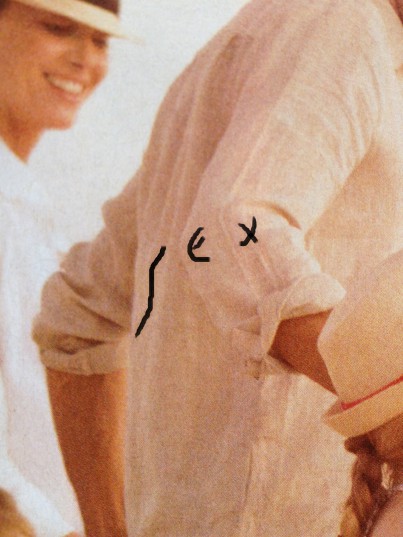
Subliminal Case 1 – Picture 3 (Subliminal SEX is delineated)
…………………………….. Case 2
From Time Magazine, March 30, 2015, on a Briefing page, a soda can is shown to illustrate a news on diet sodas. Although it is not brand advertising, it is some all brands-encompassing advertising for soda consumption, and one can find SEXes painted at the bottom of the can. On picture 3, one SEX has been delineated, forming a straight line; an alternative SEX is on picture 4, with same S and E but X taken from above so the three letters form a triangle. Other S, E and X, even bigger than these ones, can be picked up.
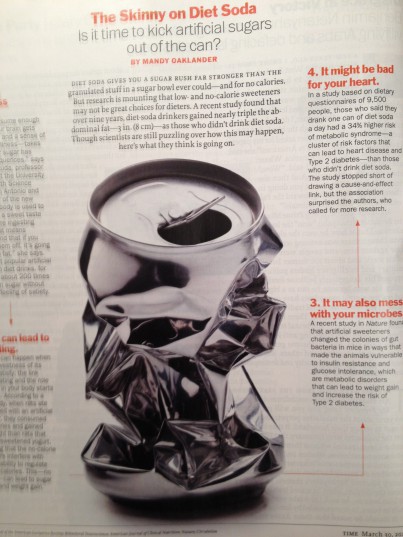
Case 2 – 1

Case 2 – 2

Case 2 – 3 (Subliminal SEX has been delineated)

Case 2 – 4 (Subliminal SEX has been delineated)
……………………………. Case 3
From Time Magazine, March 30, 2015, p.46, the following picture of three actors from a movie presented on p.45. People in the media call it film criticism, some other people call it advertising. Whether subliminal techniques are required for film criticism, I don’t know, but I can see SEXes in the picture, in the background on the left, where some shady area is apparent, inside of which clouds of embedded letters can be perceived. Several overlapping SEXes pop up, of which I have delineated one.

Case 3 -1

Case 3 – 2

Case 3 – 3 (One embed delineated. More can be found.)
………………………………. Case 4 Mandarin Oriental Hotel Group (The Economist, March 27, 2015)
It’s only a lady (she may be famous but I don’t know her) looking at us or someone from inside a car. All is trim and neat in the picture, except for a little chrome bar on the right side below the window, where some small graffiti are visible. When you look closer, you can see three letters, X, S, E, which makes a SEX puzzle (for your reptilian brain to play with).

Case 4 – 1

Case 4 – 2 (All is neat and trim, but why is the chrome bar flyblown?)

Case 4 – 3 (See?)
March 2015
Menjadi Kawan
Generally speaking, people who are fond of pop-rock music do not pay much attention to what is made outside of America and/or their own countries, and people interested in “world music” do not pay much attention to musicians outside the Western world writing music inspired by Western pop-rock styles.
As a student in foreign languages, on the Internet I have come across much interesting material from abroad unknown by my fellow countrymen and fellow Westerners, although to my ears it proves equal to the indie music I used to listen to in my younger days and which received significant coverage.
I have chosen to present the following song on this blog, with my translation of the lyrics. (I know that one normally loses in feeling and imagination when one grasps the lyrics, and this is true even for the English-speaking listeners of English bands, but as I hope you will see there is something interesting in the lyrics of this song as well.)
The song Nak Tak Nak is performed by the Malaysian artist Nadia – real name Zarina Mohd (Mohammed) Ali – and is taken from her 1999 album Unggul (meaning Superior). According to her communication, she has written both the music and the lyrics of this song.
The name Nadia, comparing to her clearly Muslim real name, seems to indicate the will to address a Westernized or Westernization-leaning Malaysian audience, or simply young people bored by their families (because Nadia is both known in Muslim and Western cultures, it is more open to interpretation. However, it is far from being unmistakably Western, I must admit). The rather sober album jacket (see below) depicts her in what seems to me a post (decreasing) high trip condition, whatever the substance may have been, soft or otherwise, and so is hinting at the pusher culture so common in Western pop-rock music – the Beatles were the greatest pushers of all times (W.B. Key). It could also turn out that she is only recovering from a performance. In any case, to my knowledge, the drugs theme is absent from the lyrics I shall discuss. Nadia has reached celebrity status in Malaysia in the nineties.
Her voice in this song conveys a delightful boyish exuberance that accords finely with the story of adolescent uncertainties and self-affirmation which the lyrics is, according to my understanding of it, picturing.
The song, however fine, has not attracted much attention on YouTube, contrary to her famous hit Salam Untuk Kekasih, whose video has been viewed more than 2.6 million times. Please take a few minutes to listen:
Now the lyrics.
……….
Nak Tak Nak
1
Nak tak nak kalau tak nak sudah ! (Nak tak nak !)
Menjadi kawan !
2
Sungguh aku tak peduli apa orang kata
Tentang kita atau sesiapa (-a !)
Aku tak peduli kerna aku tak bersalah
Tak bersalah, tak bersalah.
3
Sungguh aku tak peduli bila orang kata
Tentang kita atau sesiapa (-a !)
Aku tak peduli kerna aku lebih rela
Lebih rela
Menjadi kawan.
2
4
Sungguh aku tak peduli bila orang kata
Aku gila, aku gila (-a !)
Aku tak peduli kerna bukan gila
Bukan gila, bukan gila ( ya, ya, ya … )
1(×3) – 2 – 3 – 1(×3)
………………..
Translation
Child No Child
Stop thinking I’m a child,
And let’s be friends!
Really I don’t care what people say
About us or anyone;
I don’t care because I’m doing no wrong,
Doing no wrong, doing no wrong.
Really I don’t care what people say
About us or anyone;
I don’t care because above all I want,
Above all I want
To make friends with you.
Really I don’t care when people say
I’m crazy, I’m crazy.
I don’t care because I ain’t crazy,
Ain’t crazy, ain’t crazy.
…………………
A few words on the translation.
As to the title of the song, and its first line, I am deliberately choosing a meaning that is not the obvious one a Malaysian speaker would understand first. As a matter of fact, the phrase Nak tak nak, kalau tak nak sudah, colloquially means: “Do you want or not: if not, then farewell,” and it would be understood as the careless, carefree invitation of a modern young woman to make “friends” with a man. It would be the customary rock’n’roll attitude everyone expects, and the conventions of informal language make it implicit that such is the meaning one has to retain. However, the word nak is a contraction of either one of two words, the first being to “want” (hendak), the second a “child” (anak). So the meaning I suggest reads as: The child is not a child; as there’s no child, farewell the child. Which means: The person you say is a child has grown up and her feelings are not those of a child anymore, so don’t call her a child. Which, again, means : Stop thinking I’m a child (because I love you).
With this meaning the lyrics is consistent and the story beautiful. With the other, more obvious meaning, the content is a slight. With this other one, “I can live with or without you,” for example – a slight to a woman, which is even worse –, one can’t help expecting the reply “A**hole.” The reply never comes, however, because broadcasting is one-sided.
The careless and offending meaning in Nadia’s lyrics derives from the fear of being a dupe of love. It is this fear that often makes double meaning compulsory in the language of passion, as a possible escape door. If I have been a dupe, then remember I told you I did not care! This is saving face. Besides, carelessness is supposed to be cool, whereas being in love is uncool: it is old-fashioned. (And, indeed, lack of passion must be cool if passion is of the nature of fire.)
I can’t live without you. No one would say such words these days. Yet everybody feels that this means love and that no other words could convey the feeling.
Some people, analyzing the lyrics of many love songs and finding them wanting in verisimilitude or analogy with real-life situations, have concluded that the singers are in fact addressing… their mothers, that they belong to a “maternally starved generation” (W.B. Key). That males in the Western world would be maternally deprived may indeed make sense, and yet love has always been crazy, so it is no surprise either when love songs do not seem to deal with the real world. But craziness is as real as rationality. Besides, there may exist fine natures that crave for the sufferings of passion and long for the martyrdom of love. These are the heroic natures, repressed in our times. Those people that feel a call to being heroes may experience the realm of love is the last possible ground of their endeavors. Some others might also sing the sufferings of love in order to be admired as heroes.
To conclude, the lyrics, as you have noted, is not particularly original. However, the song is moving. Because when someone says she doesn’t care what people say, the chances are she suffers from what people say. She wishes they would shut up. Admittedly, it can be a mere nuisance rather than suffering proper, but then the idea conveyed still is that of strength of character. In both cases, the story inspires reverence toward the young woman (almost a child) who dares endure being called crazy for the sake of her love or of going her way. If bombast underlies her words, and we ought to be scornful, then there aren’t many pieces of art that stand the test.
March 2015

 florent boucharel rAd-Free