
Tagged: subs
Subliminal Advertising VII: Ghosts from Epinal
At my grandparents’ house, hanging on the wall of the lavatory were a couple of Epinal printings, old images that peddlers used to sell as entertainment, as one would have some pleasant time looking for the hidden objects in them. These printings were quite popular, and some really tricky as riddles, even though the caption or legend told viewers in florid style what object to look for. Thus, relatives and guests at my grandparents’ house could enjoy the riddles while in the lavatory.
This may account for my not being very much surprised, years later, as I read Wilson B. Key’s books on subliminal advertising, because the techniques he described reminded me that, in former times, artists from the small French town of Epinal, in the province of Lorraine, did just the same. Only their goals were different. An innocent game then, it is now utilized to penetrate consumers’ psyches in order to manipulate their purchasing behavior.
In the following case studies, 47 to 52, from the April 2015 issue of the magazine Vogue (American edition), besides a few new cases of sex embeds, I presently extend the scope of the ‘Subliminal Advertising’ series by providing examples of hidden objects Epinal-wise (Cases 51 and 52).
Before, as you may have heard or read about Wilson Bryan Key in dismissing and disparaging terms, if you have ever read or heard of him at all, it will be useful to quote some respected scholars who acknowledge his contribution. The following lines are taken from the book Sex in Advertising, 2003, ed. Tom Reichert and Jacqueline Lambiase. W.B. Key authored a chapter in this book, which is certainly one of his last written contributions (he died in 2008). Interestingly, in the section ‘About the Contributors’, the editors have this to say about him: ‘He is currently CEO of Mediaprobe Inc., an international consulting and educational firm, and is writing a new book on media analysis.’ To my knowledge, the book alluded to has never been published; it would be great if the manuscript, even if unfinished, could someday find its way to a publisher.
Quotes:
This book also includes original work by Wilson Key, one of the most prolific (and widely read) writers on the issue of sexual embeds in advertising and media [and, in fact, the one author who discovered and exposed the practice. FB]. Key’s writings … have sold millions and influenced not only a generation, but sparked considerable controversy as well. (p. x)
Possible proof of his influence is brought forth by several surveys. One, cited in Haberstroh, 1994, a book aimed at discrediting Key’s findings, shows that 62 percent of Americans agree with the statement that advertisers utilize subliminal techniques – and the more educated one is, the likelier he is to agree. According to another survey, cited in Acland, 2011 (Acland has read Haberstroh and, like Haberstroh, he finds Key’s ideas ‘kooky’), the figure reaches 81 percent, among which 44 percent believe it has some effect on purchasing behavior. All in all, however widespread Key’s influence might have been, academic and other research and writing on the matter remains strikingly shy, if not nonexistent if one looks for books that support the idea and carry on with the work on that direction.
Although sex in advertising is a controversial topic in and of itself, nothing in this area raises more debate than the supposed use of sexual embeds. Often referred to as subliminal advertising, sexual embeds are defined as referents or forms of sexual representation designed to be perceived subconsciously. Common types of embeds include: the word sex; objects that are shaped or positioned like genitalia and sexual acts; and small, hidden images of naked people, body parts, and genitalia. Sexual embeds are integrated into images by ad creators and are intended to go undetected by those viewing the ad. … Controversy pertains to the existence and supposed effects of sexual embeds. (p.25)
Have you heard of the controversy? If yes, was it recently? Do you think the issue is being duly debated in the public sphere? Do you know of public personalities expressing themselves on the issue?
As embeds trigger unconscious recognition, they stimulate sexual arousal and motivation. Ultimately, observers are motivated toward goal-directed behavior (e.g. movement toward the stimulus). When embeds are consciously detected their power diminishes because viewers’ defense mechanisms are stimulated. (p.27)
Many researchers and advertising professionals consider embeds to be a hoax because controlled research has not substantiated their effects, and they doubt that media professionals intentionally use embeds. … At this point, interested readers are encouraged to review work in sexual embed research to reach their own conclusions. (p.27)
May the present series contribute to interested readers’ reaching their own conclusions, knowing extra-lab research on sexual embedding in actual media advertisements is scarce.
……………Case 47 Ralph Lauren SEX
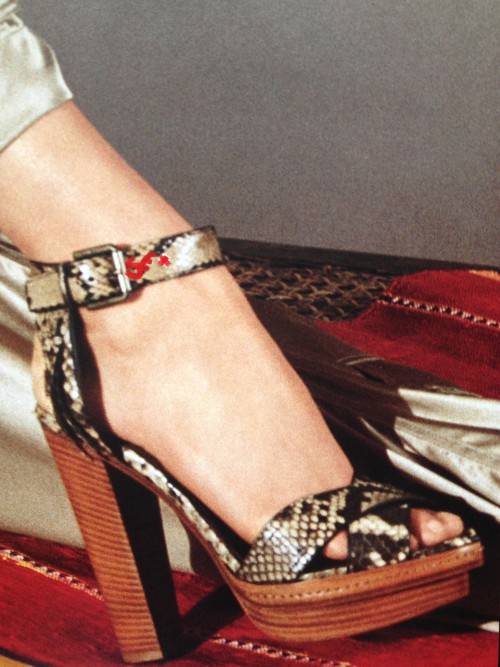
The word sex has been embedded on the crocodile skin-looking material of the lady’s sandal. The color patterns of said material are frankly irregular, hinting at real animal skin. The S and E show up as black marks, whereas the X appears in a white rhombus next to E. The rhombus is made of four of the units that seem to constitute the hide’s scaly texture: these four units’ intersection in the white rhombus makes an X. If you’re not satisfied with this X, maybe you will agree, then, that the next white stain on the right, a bigger one, shows an X-like shape.
As I said that this time, I would look for more than mere word embeds, I would like to call your attention to the lady’s left hand. The middle and third fingers are touching a button from the trousers or shirt (it’s not very clear), a button that seems to be the only one of its kind in this particular place. When one remembers that the word ‘button’, in English as well as other European languages such as French (bouton), can designate the clitoris, one is led to infer that the image is meant to be subconsciously perceived, and felt, as a scene of masturbation.
Alluring women via female onanism makes perfect sense in a context where, according to the Hite Report on Female Sexuality, 70 percent of women will never experience orgasm if not by means of masturbation. Of course, the relevant question here is not so much whether said report gives an accurate picture of the reality as whether advertisers tend to opine it does.

Case 47

47 – 2
47 – 3
…………….Case 48 Estée Lauder SEX
On this one, I have outlined a banal hairline sex embed on the blonde lady’s head. More can be found on both ladies.
This advertisement, however, triggered my interest for another reason. You can’t see the blonde lady’s hand, so you won’t easily admit she’s grasping the brunette’s buttocks. In fact, her hands may lie slightly below the buttocks, but very close to them, just far enough to defuse any eagerness at indignation. The idea remains the same: Between these two women goes some special intimacy that includes erotic body contact. Unless, of course, the brunette is standing between parallel bars or is a legless cripple who has been carried up on an armchair, on which arms the blonde’s hands are resting, but I think we can safely discard such interpretations although we’d rather advertisers didn’t tap our sex drives with so much compulsion.

Case 48

48 – 2

48 – 3
…………….Case 49 Gucci SEX
Another sex embed on sandals. The sandals’ reptile skin material, by the way, color and all, is the same as in Case 47 above. It shows that, intriguingly, Gucci (Kering group) and Ralph Lauren have the same sorts of ideas about shoes at the same time.

Case 49

49 – 2

49 – 3
…………….Case 50 Burberry SEX
We have already seen in this series two ads from the same Burberry campaign, involving models Naomi Campbell and Jourdan Dunn (Cases 17 and 26). However, contrary to both previous ones, on this ad we can see their uncovered legs. What will we see next? This campaign is a million-dollar striptease. (The advertisers responsible for this campaign might expostulate that they have not launched the different ads in such striptease arrangement, but all more or less together. If this is true, it still allows that a consequent number of people will be exposed to the campaign in the same sequence as has been the case for me.)

Case 50

50 – 2

50 – 3
…………….Case 51 Calvin Klein SEX
We arrive at Epinal, Lorraine. For Calvin Klein Jeans, the pop singer Justin Bieber is exhibiting his abdominal muscles. In the business jargon we call that a beefcake image: an athletic, scantily clad man. He seems to be admiring his abdominals. Is he? Are you? I guess the huge penis embedded on his abdomen will not leave you indifferent either; you might even dream about it afterwards (Poetzl effect), unless, maybe, I show it to you. (The exact same kind of embed is described in Wilson Key’s book The Age of Manipulation.)

Case 51

51 – 2
……………..Case 52 Cadillac CHILD PORN
Now we go where Epinal artists of old would never have dreamt of. In that New Epinal, there is no limit to the wildest fantasies.
This is an advertisement for Cadillac, a General Motors marque. It extends on six pages, three times two, of which I bring forth nb 1 & 2 (picture with legend Case 52) and 5 & 6 (picture with legend 52-4). (Pages 3 & 4 are just blah blah that no one reads: it isn’t even technical information, but pseudo-philosophy in aphorisms: “It is not the critic who counts” etc. This sentence, the first one in the blah blah, intended at most to be read cursorily, perceived but not processed, could actually be construed to effect a subliminal injunction to relinquish critical thinking).
The two pictures distinguish themselves from all other ads on this Vogue issue by their realistic depiction of our urban world and life. Instead of garish, gay dresses, people wear dark, dull clothes, their faces are worn and concerned. It should serve as a reminder, by the way: Why do you buy bright dresses when you know you cannot put them on because you would be regarded like an alien from Mars, would make yourself too conspicuous and thus the target of comments? Anyway, this is the real word, from which Cadillac owners withdraw.
To make it more nightmarish, the graphic designer has embedded hidden objects in the pictures. Remember, most people take pains to avoid looking at advertisements, so advertisers must find a way to attract people’s attention in spite of their reluctance and avoidance. One way to do it is to wave hello to the reptilian brain (limbic system), that part of the brain that is permanently scanning its environment, having done the same ever since it has been the survival tool of an ancient primate lurking in primeval wilderness in quest for food and fear of deadly attacks. The reptilian brain will perceive the embeds without your knowing it. Once perceived by the limbic system and thus stored inside the implicit memory system, hidden embeds can tell their little stories undisturbed to our drives and motivations. Expectations with respect to ads, as vapid and insignificant material, in a word as noise, will contribute to prevent perceptions of embeds from accessing consciousness. So you won’t see the ghoulish faces and zoomorphic demons embedded by mercenary artists in the thousands of commercial messages to which you are exposed on a daily basis.
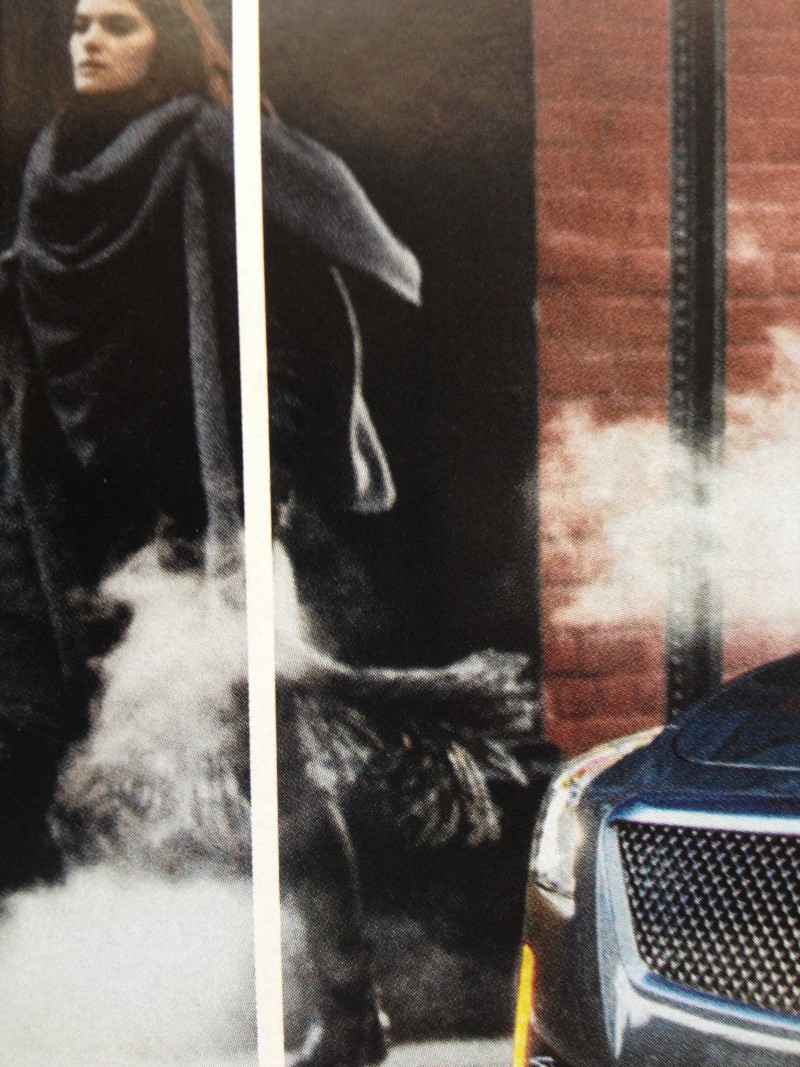
On picture 52-3, I have outlined a few SEXes, but also an eerie face staring at you from a waft of fog, and an awe-inspiring cow-like, bosomy goddess blowing smoke from her nostrils. My outlining is not adequately conveying the actual eeriness of the former face and stare, I find, but my artistic drawing skills haven’t been much exercised as of late.
With respect to picture 52-6, I must ask you to be prepared to anything. The sex embed on the greyish air is nothing. On the left-hand side, between the two realistic-looking, middle-class, dark-clad wretches on foot, one sees a pole, maybe a streetlamp. It is given a prominent position in the picture. Not only that, but it also displays a large number of confused black and white forms. These are the forms to which I would like to draw your attention, because it is there the graphic designer has embedded a variety of meaningful images.
At the bottom, two faces are smooching, a man on the left, a woman on the right. The woman has long hair. The man is middle-aged at least, given the baldness on the top of his head.
From the bottom go directly to the top. There I have outlined two ghostly faces. The face on the left is a skull. That on its right is some demon-like fiend.
Below these haunting faces, something very nasty is going on. A young girl is forced to perform a fellatio. The physiognomy of the face, as well as its dimension compared to the penis, indicate a child, unmistakably. This is subliminal child pornography!
Should be enough for the present. Some of you will react like: ‘You want to make us see what you yourself are projecting on the picture, but I won’t.’ To those I would like to remind Epinal printings. You won’t see the hidden object in the printing unless you look for it. But it is there. Someone has put it there, not my or your imagination. The trick has been known for a long time.

Case 52
52 – 2

52 – 3 with Epinal hidden embeddings

52 – 4

52 – 5

52 – 6 with Epinal hidden embeddings
May 2015
Subliminal Advertising V: Vanity Fair (Without Thackeray)
After the April issue of Vanity Fair (Cases 24-32 from Subliminal Advertising IV), I thought the May issue would be interesting too, as regards sex embeds. Several ads from the April issue are also found on the May issue, like Case 24 and Case 25, and a few others that I didn’t bother to bring forward, so the subscribers who receive the magazine each month, or the regular buyers, are sure to get their share of repeated exposure which is the main principle of advertising as a conditioning process.
Counting pages on both issues, I find 60 pages of commercial advertising out of an overall 172 pages in the April ‘special’ issue, and 46 pages out of an overall 148 in the May issue, which makes 34.9% and 31.1% respectively (the special, bigger issue has a greater proportion of advertisements), and this does not even include the back cover ads, infomercials, advertorials, ‘Fanfairs’, ‘Hot Tracks’, ‘My Stuff’, ‘Portraits’ of commercial artists selling their last outputs, and so on and so forth.
The seven case studies presented here outline, as previously, the sex embeds. One way to get the clearest picture of what is going on is to download the photographs focusing on the embeds, outlined and not (for instance, pictures 33-2 and 33-3 below), then opening both on your computer and shifting the mouse on the lower screen bar from one to the other, so that my delineation of the embed will project on the photograph and then leave it again according to the mouse’s movement, the photograph staying in place, as one is only the duplicate of the other plus the embeds outlined. This procedure will make the embeds obvious to the most impercipient, I believe.
Of course, if you don’t wish to download anything, it always helps to enlarge the pics by clicking on them, or even by enlarging the internet window through command ‘Ctrl plus +’ (press Ctrl and + at the same time, as many times as you want the window enlarged).
All this research on sex embeds doesn’t imply I am convinced they have potent effects or even have effects at all. However, even if the effect is unsure, as the technique costs little — or rather nothing since the graphic designer’s working time is compensated anyway and it makes no difference whether he or she’s adding shades or sparks or droplets or sex embeds — it seems that advertisers believe they ought to use the technique, and they do use it.
One final thought before the case studies. If advertising, as its advocates claim, is so important for our economy, then what a vibrant homage it is to artists, those (in the view of a few people who look at themselves as practical minds) ‘losers’! People working on ads have artistic training. At a time when middle management, even top management, is being increasingly performed by computers, and experts are being increasingly replaced by expert systems, i.e., computers, human artists are still needed to perform that part of the economy whose global revenues in 2010 amounted to 503 billion dollars worldwide (Shaver & An, Ed., The Global Advertising Regulation Handbook, 2014). Parents who discourage their kids’ artistic inclinations seem very injudicious, even according to their own materialistic standards, because kids may end up earning much more working for advertising agencies than as accountants. In any case, what the advocates of advertisement’s claim amounts to is that our economy needs the artist more than the organization man, whose function is being automatized and computerized.
…………….Case 33 Louis Vuitton SEX
The lady is waiting on a pier with an extravagant profusion of luggage. The sex embed is on her boots. The signal on the tip of the pier reads ‘Privé Private Please.’ ‘Privé’ is the French for ‘private.’ Zooming on the board, you realize these words are not the first of a phrase, like “private pier”; they stand alone on a meaningless board. A private pier, however, conveys the idea of VIP-ness, and the advertisement as a whole the idea that very important people consume very much.

Case 33

33 – 2

33 – 3
…………….Case 34 Gucci SEX
The borderline between hair and forehead, with all its underbrush, is a convenient place to embed SEXes à gogo. We have a real sex jungle here.

Case 34

34 – 2

34 – 3
……………..Case 35 Dom Perignon SEX
The expensive champagne brand Dom Perignon uses no color on this one, expect golden letters for the brand name. The word sex is embedded on the stylized sea spray. The X is frankly neat and obvious as a white relief on this piece of commercial relievo.

Case 35

35 – 2

35 – 3
…………….Case 36 Clarins SEX
As in Case 15 (here), the word sex is embedded as a reflection on the sunglasses. Such reflections are typical background elements to which no attention is paid, even if geometrically speaking they are not in the background at all (since they are even closer to the viewer than the face itself, the glasses protruding from the forehead).

Case 36

36 – 2

36 – 3
…………….Case 37 Olay SEX
Another case of hairline sex embedding (see Case 33).

Case 37

37 – 2

37 – 3
…………….Case 38 Michael Kors SEX
Another case of sunglass reflections sex embedding. The difference with Case 35, however, is that the reflections on the latter are saturated: many objects, some sort of posh villa with greenwood trees, can be seen as reflections, among which the word sex has been embedded, whereas in the present case the apparent reflection is only that of a flat surface like the sea or a beach or a sand desert, and the sky. The word sex is embedded on this emptiness. I have outlined two different, partially overlapping embeds (37-3 and 37-4).

Case 38

38 – 2

38 – 3

38 – 4
…………….Case 39 Etihad SEX
This one is my favorite from the lot and I will take a few minutes to explain why. First of all, it uses celebrity endorsement, the woman there being the famous actress Nicole Kidman. Celebrity endorsement is described by D. Lakhani as subliminal advertising (according to Shakeel Ahmad Sofi, 2014, an Indian scholar who has studied the effects of these kinds of ads on a sample population of Kashmiri students), because one is induced to purchase a product upon motivations that have nothing to do with the product’s characteristics. This is stretching the meaning of ‘subliminal’ very much, for, although people like to say they buy products due to the latter’s intrinsic qualities, marketers know consumers should not be taken seriously in that respect. Marketers also know celebrity endorsement sells well.
For women, the endorsement here triggers identification, I suppose. For men, it triggers plain sexual arousal in an extravagantly gross fashion. Shoes off, on her couch or bed inside the aircraft cabin, wearing a somewhat creased evening dress (it’s really bedtime), Nicole Kidman is looking at you in the eyes. Furthermore there is the name Etihad in Arabic, no doubt a ‘marker’; in the same way as Audi’s international slogan Vorsprung durch Technik relies on the psychological ‘marker’ (be the fact true or not) of uncompromisingly reliable German technology (the idea of keeping the German language was the British agency BBH’s by the way: see R. Heath 2012), Arabic calligraphy evokes (be the facts true or not) Gulf oil wells and luxury and harem mysteries, so the male viewer is transported in a fantasy where he is a desert sheikh and the Hollywood star a sex slave from his harem, and the grossness of the sexual overtone (hardly an innuendo) becomes irresistible.
In such a context I was expecting the embeds to be rather shy, for two reasons. First, with due respect to the endorsing celebrity. Second, because the clients (Etihad) being desert sheikhs and outdoor Puritans*, they could miss the humor and jocularity of sex-embedding, as, for instance, capital punishment is still, in a spectacular fashion, in vigor among them (through fire squads, which is not as picturesque, however, as in neighboring Saudi Arabia, where beheading fairs are performed). These two factors would dampen, I conjectured, the artist’s embedding mania.
*(When I use the phrase ‘outdoor Puritans’, I do not mean these people are hypocrites. What occurs behind doors is no great secret among them, I should think. However, many Westerners will call these mores hypocritical, as repressed monogamists and ‘zerogamists’ carpet-bombed with mass media sexual fantasies are expected to do.)
The embeds are shy indeed; they almost seem to apologize for being there. But they are there anyway. One of them lies on a white pillow, as an arabesque of slight shades and folds. Others are on the couch, whose cover’s velvety fabric provides the milieu for the embed culture. I have outlined only a few of these.
Post Scriptum. As I find the same ad in German Der Spiegel of the same month, it’s likely it appears in most magazines of significance throughout the world. The price of such a global campaign (including NK’s compensation, and payment for advertising space on dozens of the most expensive media) must be enormous. Needless to say, it is paid by the consumer: marketing costs are included in the final price.

Case 39

39 – 2

39 – 2

39 – 4

39 – 5
April 2015
 florent boucharel rAd-Free