
Tagged: subliminal
Subliminal XIV: From the Czech Republic with Junk
Travel diaries from Aug. 24 to Aug. 28, Prague, Czech Republic.
……………Socialist Child-Sex Propaganda

This poster I photographed at the Museum of Communism. I think the artist had a lot of fun, but apparently no one noticed. This is a piece of propaganda (or information: let me know) from Socialist Czechoslovakia, during the war of Korea, accusing the US of using bacteriological weapons.
The group of children in the background drew my attention. The Negro boy, whose hand rests on the little blonde girl’s shoulder, is looking at her with a lecherous gaze. The Chinese girl plays at making sandcastles with a pail, while the blond boy kneeling behind her is holding her, arm stretched, by the shoulder, his face flushed and grinning. Looks like doggy-style sex! The penetration is concealed from the viewer by the dress of the grieved and indignant Korean woman. The third boy is looking at his comrade’s doing (not at the sandcastles game, mind) with evident enjoyment.
…………….Pretend You Saw Nothing
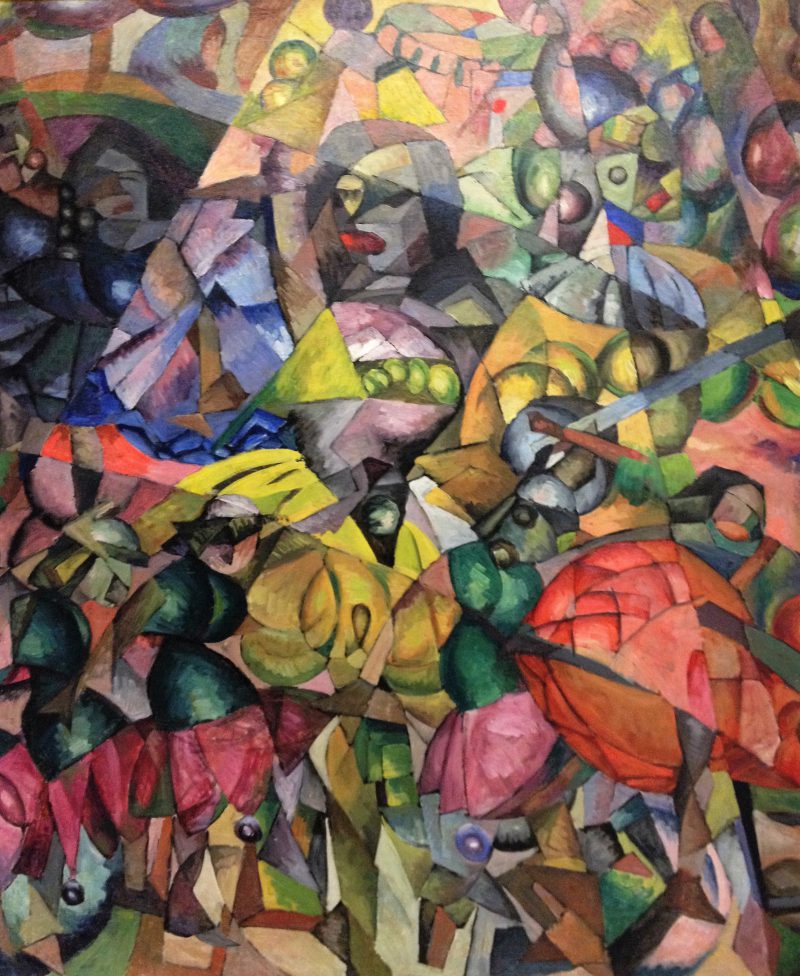
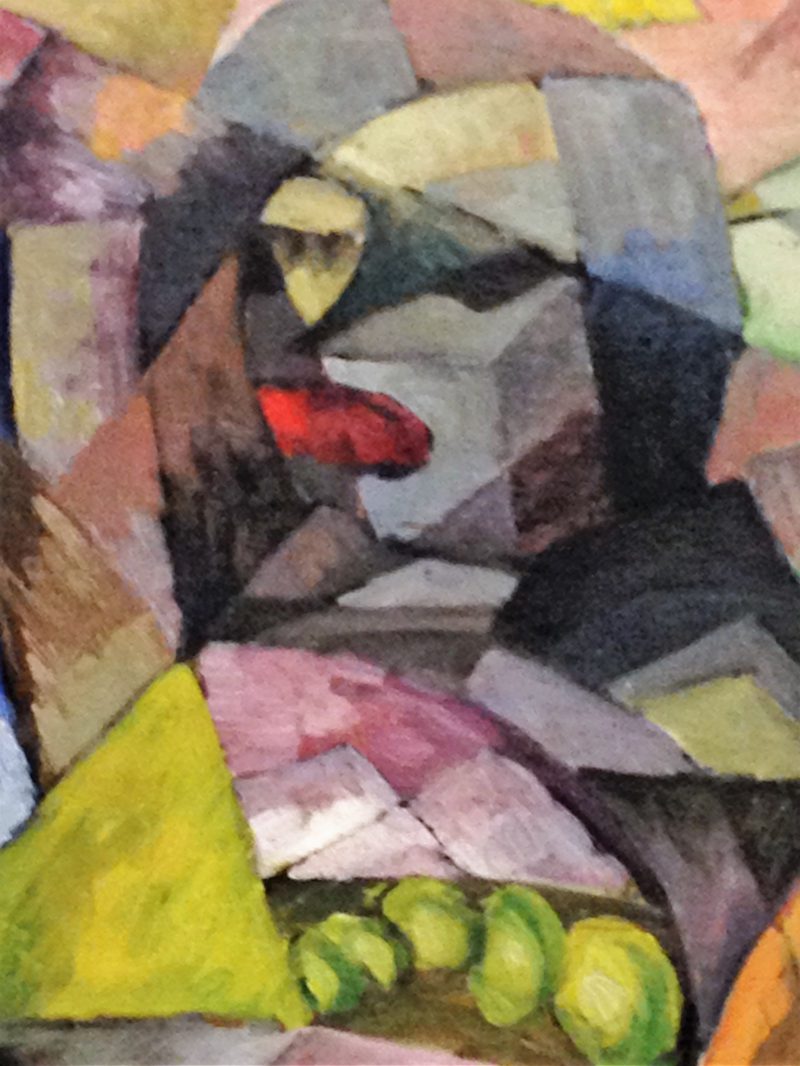
This Cubist fellatio can be admired at the National Gallery – Veletrzni Palac. The artist is Russian painter Aristarkh Lentulov (who in Soviet times became chairman of the Society of Moscow Artists), and this work from 1912 is called A Ballet Theme.
If I be not the first to have noticed that peculiar detail in Lentulov’s masterpiece, yet nothing in the material environment of the gallery drew my attention to the explicit material I would encounter while looking at the painting (no mention like “this painting contains sexually oriented material that may be offensive to some people and not suitable for persons under the age of eighteen”).
……………Orgasm Guaranteed
From your regular Czech women’s magazine (lifestyle, cooking, children…), this sex toy ad. ORGASMUS guaranteed. The future belongs to machines.


…………….The Benefits of Cannabis a la Czech
From the same women’s magazine as above, this ad for the Czech company Cannaderm’s products. [Removed]
From internet copywriting: “Cannaderm brings a new approach to skin care. Cannaderm for every age, for all skin types, even for the very sensitive skin of small children or skin with eczema, acne or psoriasis. The synergic effects of healing hemp, mutual combinability and the wide range of products guarantee the potential of putting together a cosmetic range ‘to fit’. For easier orientation the packaging is colour coded and also contains the recommended combination of products.
“Cannaderm Made in the Czech Republic. We use unique recipes, modern technology and the best quality ingredients. All our products Cannaderm are approved by the State Health Institute of the Czech Republic and are certified for sale in the EU.”
Not to omit (read “triple distilled”):

From internet copywriting: “Euphoria Cannabis Vodka is made of extra smooth grain vodka, blended with natural cannabis leaves and cannabis seeds. It is 100% natural product. Each bottle is hand-made. Enjoy the rich taste of freedom!” &
“Beautiful cannabis bud infused in extra smooth vodka 40%. Cannabis leaves extract cannabis oil and CBD. 100% natural product with great cannabic taste and relaxing effects!” &c.
……………Complements
“All our dishes are served with a beer,” according to the placard at the entrance. But in the end the beer is charged. Seeing the bill, you say to yourself: “What’s the use complaining? I should have made the point clear with the waiter from the start.” However, it’s not even sure, not even likely that you would have paid the expected CZK270 for the ordered schnitzel; there must have been a trick even there, the placard probably contained a heap of qualifications in tiny fonts at the bottom, and so, after being made aware of these by the waiter, you would have had to raise from your chair and leave the place to find another one, no doubt with the same placard…
McDonald’s vs the Pettifoggers
It’s just the same where I live. Most cafés and restaurants in Paris touristic arrondissements are managed by people who want to make the most of your pockets at the fastest rate: poor quality of the food, poor service, not enough space, insane prices… Many play music loud so you will feel like leaving as soon as you sit down. French cafés and restaurants see tourists as pigeons. Once I saw the following at a café near the Pantheon (allegedly a prestigious, safe place). Some Japanese tourists ordered food, the waiter asked them what they wanted to drink, they said tap water (for free) and they insisted to make him understand. He pretended not to understand and brought a water bottle that he had just opened. They had to pay for it. He even cursed them in French, to himself, but of course they understood that they were insulted and had to swallow their pride.
Years ago, they said fast foods would never set foot in the country of gastronomy, i.e., France. More recently, they said Starbucks would never set foot in the country of cafés. Even more recently, I told my friends: “I’ve designed an advertising campaign for Pret A Manger – it says Pret A Manger: Soon in France,” and here they are, in the country of the baguette. The reason? People don’t care to go to nasty places where mean pettifoggers will treat them like dirt. When you come to Paris, let me recommend you three places where to eat and have a drink: McDonald’s, Starbucks, and Pret A Manger.
We all know tourism has generated those shoddy service industries that cater to the “ideal” customer, the tourist, one who will never come back, one, thus, who will never complain, returning to their countries the next day, replaced by a new wave. French cafés and restaurants don’t care what you, tourists, think of their food or of the service, they don’t even give a dime for what you think of la France: they take your money and what you get for it you’d rather pay for not having it. And don’t ask for tap water, because although it is free on the paper of which laws are made, it will cost you the humiliation of your life.
You may say guidebooks are here to help prevent such bad experiences. In theory, yes, but the addresses they will give you, if they’re good restaurants, then the chances are they will be full of people from all the offices around, in their workaday formal dress, whereas you will be dressed in tourist’s attire – casually – and you will soon feel that you look like morons.
Art & the Organization Man
From The Organization Man (1956) by William H. Foote: “Profiles are also worked up for work in individual companies. At Sears, Roebuck there are charts that diagram the optimum balance of qualities required. Here is the one an executive values:

“A man does not have to match this profile exactly, but it won’t help him at all if his line zigs where the chart zags. Take a man who scores considerably higher than the 10th percentile on aesthetic values, for example; such people, Sears notes, ‘accept artistic beauty and taste as a fundamental standard of life. This is not a factor which makes for executive success. … Generally, cultural considerations are not important to Sears executives, and there is evidence that such interests are detrimental to success’.”
There is much good sense in that view expressed by Sears because, as the best definition ever for culture, concise and elegant, goes, “culture is the learning of the leisure class” (economist Tibor Scitovsky), which means that the organization man is an overworked windbag.
Interestingly, Whyte was already writing in the 1950s about those corporations that claimed they were willing to recruit people with literary (cultural) profile and training, yet never recruited them. I have heard this claim from today’s corporations repeated time and again – so nothing has changed and I guess the above diagram, with aesthetic taste seen as quite irrelevant, still holds for today’s organization man.
And yet, “Wu cites a 1990 study that claimed that in the US about 20 to 30 per cent of the market in New York was due to corporate collecting, and outside the city about half.” (Julian Stallabrass, Art Incorporated, 2004) Contemporary art is a reminder – the reminder that people that work are poor devils. Half the market for contemporary art is made of corporate collecting: top executives adorning their offices with the excremental fantasies of slackers! Ask the connoisseur how much corporations pay artists for splashed mud and monochromes (remember, the organization men’s aesthetic acumen – his taste – approximates zero: see diagram) and compare with your own earnings!
Possible consequences: “Recently, in the Netherlands, a middle-sized bank, i.e. the DSB Bank, came into serious financial trouble for this exact same reason. Only a couple of months before, the bank had bought art for tens of millions of euros, and received a loan from another bank in order to build a museum that was to be named after the DSB bank’s CEO. These prestigious undertakings were one of the reasons that the bank had no financial reserves left when business slowed down due to the financial crisis. As a result, in September 2009 the DSB Bank was declared bankrupt.” (A.P. Buunk et al., 2011) Bankrupted because of dabbling in art.
And then there is the advertising industry, packed with artists (renegades?) and so vital to the organization man’s economic interests…
September 2016
World Premiere: Eric McLuhan says his say about subliminal messages
Many have wondered at the lack of acknowledged permissions for using the ads in both books [The Mechanical Bride and Culture Is Our Business]. The reason is that permissions were unnecessary: the ads were available for free. Editors at Vanguard had found a curious legal fiction. Advertisers were being given huge tax breaks on the grounds that they were engaged in a sort of educational enterprise, “educating the public” about products so that it might better make informed choices. The upshot is that anyone can make use of the (government-supported) ads for free providing they were not being used as ads, but as educational materials, for educative purposes. Needless to say, the agencies were reluctant to let these matters become known to the public.
This is the excerpt from Dr Eric McLuhan’s introduction to the 2014 edition of Culture Is Our Business by Marshall McLuhan (from Subliminal Junk XII here) concerning which I reached out to Eric McLuhan. This move initiated an exchange of emails between Eric McLuhan and me. Eric’s first four emails were published as Comments to Subliminal Junk XIII (here). I presently make an entry with these emails and two more, due to their importance. Here are they.

Eric McLuhan on Settee with Pet Dog Finnegan
August 15
Dear Florent Boucharel,
Thank you for your intriguing letter. I was unable to access either of the links that you included, but never mind. It would have been interesting to see the sources you cite. The notion of “subliminal junk” rings a lot of bells here: I spent years investigating things subliminal and am something of an expert re the matter. However…
Let me say right off that I have no personal legal or legalistic expertise in the matter of copyright of ads. The publishers (Vanguard, for Mechanical Bride, and McGraw-Hill for Culture Is Our Business) gave my father freedom to use any ads he wished, and he did so, never once asking permission. Vanguard set the stage by doing the initial research–I assume it was done by their legal department. McGraw-Hill evidently took their word for it. We never heard of a single objection from any of the owners of any of the ads used in either book. Both publishers, by the way, are located in New York. The Bride never went on sale, but Culture Is Our Business did, and copies were sold outside the US, though I have no idea how many.
Lots of teachers use ads in their courses and I have no knowledge of any of them ever seeking permission to discuss an ad used in a class or classroom. Of course, there is a multitude of textbooks for teachers to use and hundreds of ads in them, but frankly I have never checked to see if permission was asked or given. I seem to recall that these books routinely list the sources of ads in their “Acknowledgements” section, as do art textbooks for the images that they use. But all of them are academic textbooks.
I am quite certain that it is safe to study ads in the classroom without permission; I assume, from past and present experience, that it is safe to provide students with copies of ads that are being studied in a classroom setting for academic purposes. The sole proviso would be that the ads are being used as specimens for academic scrutiny and not AS ads.
Regards,
Eric
*
August 16
Dear Florent,
Well! You are a devotee of Bill Key’s! I too was a fan of his when he put out the first three books, starting with Subliminal Seduction, and subsequently.
As I mentioned, I taught embedding techniques until recently–I retired a couple of years ago. Let me suggest a couple of things. One thing that damaged Key’s credibility was that he quickly became very sophisticated in his ability to detect subliminals; as it were, he was working at a post-doc level while his readers were still at the undergraduate level. I found the same problem: I could see things clearly that were still opaque to my students. So I had to tone it down, restrict my exhibits to the simplest and most obvious ones or I would lose them.
I’d suggest that you try something similar. In each of your reports, have several sections. Make the first a group of simple and easy examples, obvious things; the second, a little more subtle; and the third, the not-so-obvious group. And put headings on the groups.
Eventually, I began my class on subliminals (I used a carousel tray of 80 slides) with covers of Playboy magazines. Very effective: slightly naughty and caught everybody’s attention. Here’s the secret: since the first issue, Playboy has embedded their signature icon, the rabbit, somewhere in every single cover. They still do it. The homework assignment for that class was to visit a newsstand and examine the cover of the current issue and “find the rabbit.” Playboy covers are not only entertaining, but VERY useful as a training device.
You see, the Playboy artists use every single embedding technique several times over the course of a year or two of covers, with a lot of them repeated because after all there are not that many techniques–it’s a matter of theme and variation. But after scrutinizing 20-25 covers, the audience becomes quite expert in spotting the rabbit–and some of the covers are really clever embeds! THEN I hit them with a few ads, and they are often ahead of me. Seldom do I need to explain what is going on: the audience does it for me.
Even so, I begin with a few obvious ads, and then get progressively more subtle.
*
August 17
I have never written up the way that I taught subliminals using Playboy covers. I just did it, each year for a dozen or more. Actually, I think that my letter to you is the first time I have written anything about it. It was–and is–a very powerful means of teaching the subject. I’d suggest that you find somewhere a cache of covers, from the first issues to the present, and made a file of them. (When you do, I’d appreciate a copy!) They fall into a small number of groups if sorted by techniques, and exhibit a wide range of sophistication from simple to complex in each group. Actually, now that you mention it, it might be fun to put together a small book on the subject as an approach to ads and kindred items.
Playboy is a useful tool because their usage is all in the spirit of play and has no moral judgments attached or implied. Nearly everyone who writes on the topic, and I include Bill Key here, along with his detractors–nearly everyone feels compelled to work up moral indignation to a fever pitch. All of that is actually irrelevant. Try this: take any criticism text on subliminals and remove from it every vestige of moralism, and see what is left. It is quite the same with how people approach criticism of media. You are required to express a moral position. If you don’t, the assumption is that you approve of it. So in self-defence you must state whether you approve or disapprove. People want to know, right off, “is it a good thing or a bad thing?” The moment you tell them, they are relieved of the responsibility of examining the thing any further: they know now what and how to think. My father made a point of never giving his moral opinion of the things he examined, so was widely accused of being an advocate. Except once. His first book on ads, The Mechanical Bride, included a lot of moral outlook. He learned from that experience and you will be hard pressed to find thereafter any similarly moralistic tone in his subsequent writings or his lectures. The second book on ads, Culture is Our Business, is entirely free of moralism. Along the same line, you might like to have a look at Wyndham Lewis’s essay, “The Greatest Satire is Non-Moral.” The non-moral approach pulls the teeth of the opposition.
My class on subliminals was part of a larger discussion of artistic techniques and ways of managing the attention and, just as importantly, crafting the inattention of the beholder. Consequently I never experienced opposition from faculty, though occasionally a student would object, either on moral grounds, or because he or she simply couldn’t see the things I was exhibiting. Every serious artist, whether poet or painter or sculptor, etc., spends at least as much time on the elements of inattention as on those things the beholder is to attend to. The language of figure and ground, which we use often in Laws of Media: The New Science, is well suited to these discussions. Ground is the area of inattention, the 95% area of any experience. Another word for it is “medium.” It provides the way of seeing whatever is figure. Ground is the mode of perception. Another word for the ground area is “style.” Ground is by definition the part that people are trained or induced to ignore, and they have great resistance to any incursions into their areas of ignorance. People will defend to the death their right to preserve their ignorance!
*
August 18
Here’s an idea of what I meant by a cache of covers: http://www.playboy.com/articles/playboy-covers-guide It does not include ALL of the covers for individual years, but gives quite enough to work with. Quite a number of sites will supply examples.
Of course, if you can find a box-full of actual mags, so much the better. But perhaps you know someone who can make digital copies of these for use as a display. (If you do, please send me a copy!)
If you go to the site above, look especially at the following (play “find the rabbit”):
1960 March, November
1961 March, April, July
1962 Feb., March, April, June, Aug., Dec.
1963 March, Aug.
1964 March, May, Dec.
1965 March, June, Oct., Nov., Dec.
1966 June, July, Nov., Dec.
1967 Feb., March, Nov.
1968 December
1970 May, July, Nov.
1971 April, Aug.
1972 March, April, June
1973 Feb., June, Aug., Oct.
1974 June, Nov.
1976 May, June, July, Aug.
1977 May, Nov….
But you get the idea. Look through the rest.
Occasionally, you’ll see white (rabbit-shaped) paper cutouts obscuring parts of anatomies–for the obvious reasons. Too titillating. Ignore the cutouts: they are not the embedded rabbits.
I have underlined several dates, above: these are particularly fine and challenging examples (1973, 1974, 1976). If they stump you, ask me.
Present company excepted, moral indignation generally takes the place of understanding. Try editing out the moralism from one of your own earlier fine posts and see what is left. I imagine it will be just fine, and harder-hitting. (The moralism component is one of the things that got Bill Key fired.)
Wyndham Lewis pointed out that if you criticize someone for being immoral, he and she can sort of snigger and joke that yes, they WERE being naughty, wink wink nudge nudge ha ha–that is, they can turn the criticism to account. Being banned-in-Boston does have a certain PR value. But if you satirize them/show them up instead as being stupid or ignorant or insensitive, why, there’s no PR value in that. You got ’em. All they can do is get angry, and that works against them.
The moral approach encourages somnambulism in your readers. I’m not sure that that is the response you wish to promote.
*
August 19





 florent boucharel rAd-Free