
Category: English
Ingeborg, A Viking Girl on the Blue Lagoon
Please support my film project Ingeborg, A Viking Girl on the Blue Lagoon, based on the research conducted by Dr Jacques de Mahieu, director of the Institute of Human Sciences in Buenos Aires (Instituto de Ciencia del Hombre de Buenos Aires).
According to Jacques de Mahieu (1915-1990), the Vikings went as far as the Pacific Islands. After they had helped develop a few civilizations in South America (or while they were doing so), they took their drakkars again and sailed to the Pacific. There they left traces of their presence too, in solar myths associated with white gods similar to those of the pre-Columbian peoples, in the fair skin of the aristocracy among the islanders, and in the red hat worn by tribal chiefs, as in Peru, in memory of the red or fair hair of the Vikings. Norwegian explorer Thor Heyerdahl confirmed such data but considered white migrations to Pacific islands to be even more ancient. (As explained below, Mahieu himself was aware of earlier migrations to America.)
My aim with this film is to shed light on these events by depicting the life of Vikings in the Pacific (hence the Blue Lagoon of the title). Viewers will be told the story of a young Viking girl, called Ingeborg, on the far-away islands. Let us follow her steps on the blue lagoon’s sand.

O Ingeborg, let me sing my song for you…
*
Remember that Greenland under the Vikings was a full-fledged colony replete with men, women, and children. Vikings took their women with them when they had a purpose of colonization, as the Goths had already done before them. Of course, when raids were organized for looting, they did not take women with them on such occasions.
When, after a few reconnoitering travels from Greenland and/or Vinland (their other colony on the North American continent), navigating along the coastline, they decided that those lands on the South would provide good settlements, they brought women with them.
The story of Quetzalcoatl, the blond-bearded ‘god’ of the Aztecs, tells us something about it. Quetzalcoatl was a Viking whose real name was, according to De Mahieu, Ullman*. During one of his trips further to the South, some Vikings, led by the ‘god’ Tezcatlipoca, rebelled against him. With loyal followers, he then left the rebels and the country altogether.
Whether it is these men or others from the same people who later travelled from America to the Pacific islands, I assume they took their women with them, and thus a little girl called Ingeborg might well have trodden with her soft, tender feet the warm sand of the atolls, her long sunny hair shaded by the palms of the blue lagoon, as early as 12-13th A.D.
* Ulmén: (arauc. ghulmen) m. Chile Entre los indios araucanos, hombre rico, que por serlo es respetado e influyente. (Definition of ulmén from a Spanish-American dictionary: “Among Araucanian Indians, a wealthy man, as such respected and influential.”) I don’t know if Jacques de Mahieu knew this term, which looks almost identical with the name Ullman he says was the name of the historical Viking behind the Quetzalcoatl myth. According to Aztec legends, Quetzalcoatl possessed great worldly riches. Given the likeness, here we could have the same linguistic phenomenon as reflected in such Spanish expressions as ser un Cortés (to be a Cortes) or ser un Don Juan (to be a Don Juan); that would be, proper, “to be an Ullman,” whether that Ullman is the one from Mexico or another Viking explorer and settler.
*
When the Spanish Conquistador Francisco de Orellana made his expedition on the Amazon River, he once met with the Amazons, women from an all-woman tribe. The missionary priest of the expedition, Gaspar de Carvajal, who chronicled the events, described these women as tall and white-skinned. The Indians that the Spaniards made prisoners told them these women were living on their own and that they used to get spouses from other tribes, formerly from another White tribe, now disappeared, and currently with Indians. Orellana then named the river after these women.
It should be noted that stories about women living on their own and/or training in fighting are few in history besides this chronicle. Herodotes mentions a similar tribe among the Scythians (those whom Herodotes called Scythians were later called Goths, whereas the Huns were later called Scythians, which can be confusing; if we follow classical traditions about Scythians, i.e. ancient authors such as Jornandes, Herodotes’s Scythians are the same as Goths). Likewise, Icelandic sagas deal with a few characters of so-called Virgins of the Shield, or Shieldmaidens (Skjaldmær), female warriors.
The Indians told the Spaniards that the Amazons lived in stone houses, unlike any other Indian tribe in the region. The other White people of Amazonia (those Whites who used to be in contact with the Amazons but disappeared before the period of the Conquest) were also fairly developed, with roads and stone buildings, according to the Indians**.
In academia it has long been thought, in spite of pervasive local legends about “lost cities,” that no such developed culture was possible in the region, especially since the soils would not be fertile. Two lines of argument have undermined this position. 1/ Along the river, the soil is extremely fertile; it is called terra preta (black soil) in Portuguese and is the most fertile in the world. It results from human intervention, that is, manure. 2/ Recently, American archaeologist Dr Michael Heckenberger found remnants of stone buildings in the area of terra preta, which would confirm the oral tradition about Amazons living in stone houses. From the records, no Indian tribe known today in the region has ever developed such a culture.
** Iara, senhora das águas: “Iara ou Uiara (do tupi ‘y-îara ‘senhora das águas’) ou Mãe-d’água, segundo o folclore brasileiro, é uma sereia. Não se sabe se ela é morena, loira ou ruiva, mas tem olhos verdes e costuma banhar-se nos rios, cantando uma melodia irresistível. Os homens que a vêem não conseguem resistir a seus desejos e pulam nas águas e ela então os leva para o fundo; quase nunca voltam vivos e depois os comem. Os que voltam ficam loucos e apenas uma benzedeira ou algum ritual realizado por um pajé consegue curá-los. Os índios têm tanto medo da Iara que procuram evitar os lagos ao entardecer. Iara antes de ser sereia era uma índia guerreira, a melhor de sua tribo.” (Wikipedia; my emphasis twice) This description of Amazonian Tupi goddess Iara as a green-eyed (i.e. depigmented-eyed) mermaid who previously was a member of a female-warrior tribe tallies with Orellana’s white Amazons.
Furthermore, the identification of Amazon women with goddess Iara is ascertained by the legend about the talismans known as muiraquita: “O Muiraquitã era um amuleto sagrado e mágico que as Icamiabas [my emphasis] presenteavam os homens que anualmente vinham fecunda-las. Dizem que possuem propriedades terapêuticas e grande fortuna trás a todo aquele que possuir um desses singulares amuletos. Quanto ao significado esotérico de Muiraquitã, devemos decompor seu nome em vocábulos, para compreender sua simbologia feminina: Mura = mar, água, Yara – senhora, deusa, Kitã = flor. Podemos então interpretá-lo como ‘A deusa que floriu das águas’.” Icamiabas is a native name for the Amazons; they are believed to be the ones who distributed among the tribes of the region those magic talismans whose name is said to mean “the goddess that came out of the waters,” which is precisely what is said above about Iara the green-eyed warrior goddess.

Muiraquita
*
Jacques de Mahieu’s research on pre-Columbian America went further into the past than the Vikings’ time. He writes that the American civilization of the Olmecs is a creation of white immigrants who became the ruling class over the population of Indios. The cultural achievements and the remnants of the white population of the Olmec and early Tiahuanacu culture were the base for the early Maya culture.
Later the Vikings founded a new realm at Tiahuanacu, which became the centre of civilization in America with about 100,000-150,000 inhabitants. Later they founded the Inca empire. Here the state was based on a caste-system divided between the ‘sons of the sun’ (white kings and nobles) and the aboriginal Indio population.
In Peru, the Spaniards reported several times meeting whites, especially in the upper caste of the Incas, where women were described as blonde and fair-skinned, reminding them of “Castilian beauties.” For some reason historians tend to dismiss these accounts by the Conquistadores as deceptive.
The Inquisition in America destroyed almost all documents from pre-Columbian civilizations. Jacques de Mahieu, and several others, also said that Templars sailed to America when their order was destroyed in Europe. The Templars were an order of noblemen originally founded by Norman knights. They seem to have practiced a Gnostic form of Christianity. It is said that Cathars joined their ranks after the Crusade that annihilated their community as such. Templars’ ranks being filled with Norman gentry, descendants of King Rollo and the Vikings, these men, according to De Mahieu, knew about America, as their relatives from across the Atlantic had made several trips between the two continents, informing Norman rulers of America’s existence and leaving them navigation maps. De Mahieu wrote about maps he had found in the town of Rouen, Normandy. With the help of such maps, Templars would have been able to sail to America in order to escape persecution in Europe.
When the Spaniards came, and with them the Inquisition, the Church would destroy all traces of Templar presence in America. The Gnostic teachings that the Church attempted to erase by smothering Cathars and Templars –in the same way that the Church pursued them in the Visigothic kingdom of Septimania (Languedoc), burning practically all extant texts in Gothic language– were caught in its grip as far as pre-Columbian America!
*
I have in my library an abridged version, in French translation, of the General History of the Things of New Spain (Historia general de las cosas de Nueva España, 1569) by Fray Bernardino de Sahagún, Spanish missionary in Mexico, knowledgeable in Nahuatl and all things Indian. His book was written before the prohibition by Emperor Felipe II, in 1577, imposed on all research about American Indians’ customs.
In a chapter called “Evangelization before the Conquista,” Sahagún describes various items hinting at a knowledge of the Catholic faith by Indians. He opines that the Indians had been converted to the Christian faith in a remote past but, as they were no more Christians at the time of the Conquista, they must have forgotten most of what had been carried to them by some long-dead missionaries.
Among traces of white pre-Hispanic presence in America, Sahagun names the following. Although there were no plants or cereals, such as wheat, nor animals, such as cows, of European origin in America (a fact with which Jacques de Mahieu disagrees: According to the latter, Canis ingæ, for instance, a species of dog that was living as domestic animal by some Indian peoples at the time of the Conquista, was brought there by the Vikings), there existed similar cultural elements, such as:
1/ Paintings found in Oaxaca depicting something that is very much alike the Crucifixion of Jesus Christ;
2/ Such devotional practices as oral confession and water baptism;
3/ In different places (Campuche, Potonchán), the missionaries met Indians who knew several stories from the Scriptures well.
These were, according to Sahagún, remnants of remote Christian evangelization in America. On the other hand, some customs and myths he describes remind one of Scandinavian lore. Vide, for instance, the following descriptions (my translation): “All the brave and soldiers who die on the battlefield are transported to the palace of the Sun. In the morning, at sunrise, they take on their armors and march toward the Sun with clamors and loud noise. Then they march before Him while simulating battles for their pleasure.” Which looks like the Walhalla of Scandinavian warriors (but perhaps all warriors around the world have similarly rowdy afterlife abodes). & (At the end of times or rather at the end of the present cycle) “The sun will not rise, and from outer space will come down the monstrous, horrifying Tzitzimes to devour men and women.” Which reminds one of the Ragnarok (and its monstrous dragon Nidhogg).
Finally, Sahagun describes what we already said above, that Quetzalcoatl, leader of the Toltecs of Tula (Thule?), was opposed by some of his men, here described as necromancers, chief among whom was Tezcatlipoca, god of putrefaction, and that he left his people, not without announcing that he would come back. Whence came the fact that the Spaniards at first were welcomed by the Aztecs as returning gods.
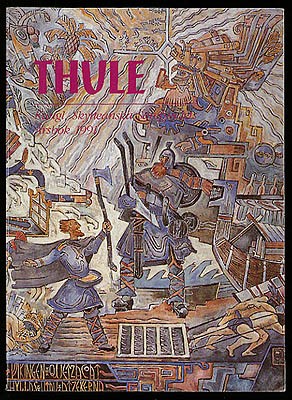
Vikigen Quetzalcoatl (The Viking Quetzalcoatl), watercolor by Ossian Elgström, 1931
(serving as cover illustration for a 1991 collection of ethnographic studies)
This work shows that the idea of Vikings having played an influential role in pre-Columbian America was already in circulation at an early date.
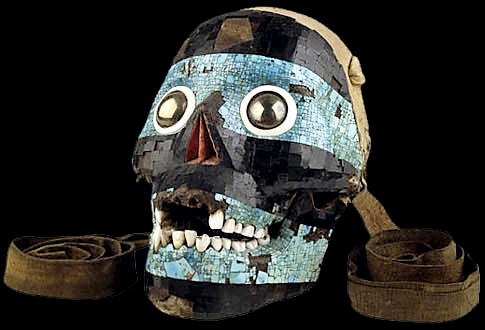
Tezcatlipoca the Necromancer
*
With regard to the Pacific islands, the following early anthropological observations about local populations by famous explorers Bougainville and Cook may corroborate Mahieu and Heyerdahl’s writings, if the former’s reports did not trigger the latter’s research in that particular direction to begin with.
“Le peuple de Taiti est composé de deux races d’hommes très différentes … [Pour les uns] Rien ne distingue leurs traits de ceux des Européens; et s’ils étaient vêtus, s’ils vivaient moins à l’air et au grand soleil, ils seraient aussi blancs que nous. … La seconde race est d’une taille médiocre, a les cheveux crépus et durs comme du crin et ses traits diffèrent peu de ceux des mulâtres.” (Voyage autour du monde) Our translation: “Taiti’s people is composed of two very different races. … [As to the first] Nothing in their traits differs from those of Europeans, and had their custom been to wear clothes rather than to live outdoors under the sun, they would be as white as we are. … The second race is of shorter size, their hair is frizzy and stiff as horsehair, and their traits are hardly different from those of mulattos.”
As to Captain Cook, here is how he describes chief Waheatua (I translate from the French version I have in my library): “He had a pretty fair complexion and his hair was smooth and light brown, reddish at the tip.” (Il avait un teint assez blanc, et les cheveux lisses d’un brun léger, rougeâtres à la pointe.)

Albert Brenet, Arrivée de Bougainville à Tahiti
*
The research of Jacques de Mahieu has been carried on by Prof. Vicente Pistilli, who founded in Asuncion the Instituto Paraguayo de Ciencia del Hombre on the model of Mahieu’s Buenos Aires institute. Here is a short biography, from Pistilli’s book La Cronología de Ulrich Schmidel, Instituto Paraguayo de Ciencia del Hombre, 1980:
El autor señor don Vicente Pistili S. nació en Asunción el 27 de Febrero de 1933. Graduóse de Bachiller en Ciencias y Letras del Colegio Nacional de la Capital en el año 1951. Obtuvo los siguientes títulos universitarios : Topógrafo (1954), Licenciado en Matemática (1955), Ingeniero Civil (1958), Malariólogo y Sanitarista (1962), Licenciado en Filosofía (1965), Licenciado en Teología (1967). (…) El Profesor Ingeniero Don Vicente Pistilli S. ha colaborado con la Educación Paraguaya, siendo el primer docente a Tiempo Completo en Matemática del Colegio Nacional de la Capital. (…)
Cuando en 1972, el Profesor Doctor Don Jacques de Mahieu publicó la comunicación cientifica “Las Inscripciones Rúnicas Precolombinas del Paraguay” [my emphasis], el profesor Pistilli comprendió en toda su magnitud la importancia que tenía el descubrimiento arqueológico del notable investigador francés, quien abría una vía nueva para la investigación de nuestro pasado precolombino. Así fué como, conjuntamente con un grupo de intelectuales paraguayos, crearon el Instituto Paraguayo de Ciencia del Hombre, asociación civil de carácter científico. (…)
Pistilli ha dirigido equipos nacionales de investigacion arqueológica, con resultados positivos en todas ellas, relevándose inscripciones rúnicas, dibujos nórdicos, bosques sagrados, caminos precolombinos y monolitos tallados. Además ha realizado importantes investigaciones lingüísticas, las cuales confirman la influencia nórdica precolombina en el Paraguay.
Subliminals XVII: Harvard Business Redux
“Tell the men of the East to look out for the men of the West. The irrepressible Yank is knocking at the doors of their temples and he will want to sell ‘em carpet-sweepers for their harems and electric light plants for their temple shrines.” (Frank Norris, The Octopus)
After you read this new essay on subliminal advertising, I am confident you will be aware that the connection between the above quote and the essay is at best flimsy. In this the quote does no differ in the least from the usage in the publishing market, where publishing houses remunerate editing staff specialized in irrelevant and shallow quotations – the shallower the better. But the above quote also differs from the usual practice inasmuch as it is largely irrelevant but not at all shallow.
That quotation business reminds me of some author’s 6-page (!) Acknowledgments at the end of his book. He does not acknowledge his editors’ quotation job (there are no chapter-heading quotations in that one) but he is so frank and scrupulous in his thankyous to his “ghostwriter,” “editor,” “senior editor,” “researchers,” to Mr so-and-so for the title of the book, and for such and such idea in the book, and for the very idea of the book, and so on and so forth, that one realizes after perusing this that the author’s contribution is at most that single acknowledgments section, and his name on the cover.
Yet I have got another quote for you, which will reverberate with the former one over these intercalary considerations of mine.
“James Joyce’s book [Finnegans Wake] is about the electrical retribalization of the West and the West’s effect on the East: The West shall shake the East awake. …while ye have the night for morn … Joyce’s title refers directly to the Orientalization of the West by electric technology and to the meeting of East and West.” (Marshall McLuhan, War and Peace in the Global Village)
Harem or, more precisely, Purdah: A man who wants to see the world with his own eyes needs baggage consignment.
Cases 109 to 113 are taken once again from Harvard Business Review (for previous HBR cases see here). The issue is October 2016. It is extremely important to deal with cerebral material because, as you know, zombies must be shot in the head. (“Cerebral” refers to “Harvard,” of course, not to “Business.”)
……………Case 109 Eva Air SEX

Case 109

109-2

109-3
Eva Air is a Taiwanese airline company. The hostess has just served the passenger his meal and invites him to enjoy it by a gesture of the hand. Her other hand is concealed by copy; given how that other hand is positioned, one may think she holds something in it, for otherwise the hand would not be, as it is, somewhat lifted in the air but rather down along her body, but as she probably needed both her hands to carry the trail, and besides one sees no object whatever, coffee pot or anything like that, some parts of which would be sticking out of the concealing copy insert, in fact both hands are empty. Consequently, the concealed hand is making the same gesture as the visible hand, and what the hostess is inviting the customer to enjoy is not his meal but herself: she opens her arms to him and his embrace. This is a first subliminal effect.
Then there is a subliminal effect with the visible hand too. As you can see, a glass of wine placed between the hand and the photograph (and viewer) creates by refraction an optical illusion on the hostess’ visible hand. Through the glass, part of her forefinger is seen bigger as it is. Your brain, by experience, normally corrects such illusions and in fact, looking quickly at the picture you will not even notice (in the sense of paying attention to) the altered proportions. I beg you pay attention to these and carefully consider the object you now see. I have outlined the subliminal embed (picture 109-3) but did a poor job with the computer mouse and am convinced you can see the penis better on the “blank” picture (109-2). The glass swells the finger’s phalange into the shape of a penis glans, to which the other phalanges provide the shaft. The knuckle bone at the finger’s root looks like a testicle.
…………….Case 110 Harvard Business Review’s Online Exclusive SEX

Case 110
This is an ad for HBR’s online newsletter, dubbed “insider newsletter.” The logo above the copy shows a stylized torso with what seems to be a magic wand – represented as a stick radiating several, multidirectional beams. The object mixes magic and technology, since in the context of modern communication it could be seen as an electric antenna, and the beams as electric or radio waves.
It mixes more than just that. The stick is held in the middle of the torso, not at its margin. If you extend it in imagination, it reaches the groin. The stick is actually a huge erect penis, and it is giving off a massive ejaculate, in several spurts. The spurts are multidirectional because of a vigorous handshake applied to the penis.
……………Case 111 Wharton University of Pennsylvania’s Executive SEX Education

Case 111
Copy: “Transformation. ‘The moment I knew there were no limitations to what I could achieve’.” In quotation marks, so we know the utterer of these memorable words is the model. The guy’s transformation is rendered by graphic means by the somewhat fuzzy contours of several of his parts, such as his hair and shirt; the fuzziness does not result from my hand trembling while taking the picture, it is in the original. The guy is transforming before our very eyes, and the background, above his head, is no background at all but a thermic, misty halo emanating from his body as a result of energetic processes at the heart of his transformation.
If we believe the copy, this uncanny mutation will enable the lad to overcome all limitations. Now what, according to you, are the obvious limitations of this guy? He doesn’t seem to lack either intelligence or the qualities inherent to a friendly person. On the other hand, he clearly is a geek. Try to imagine a better representation of a hopeless geek… You cannot. The limitations of our buddy here are sexual.
Executive education is often aimed at people with scientific and engineering training who want to make more money and achieve higher status in the organization world to which they are bound, by opening executive positions to them. As trainees in science and engineering, they demonstrated intelligence and a capacity for long studies and hard work. Now it is time to make men of spineless clowns, and this is what executive education is for. As a consequence, the present ad is a mere copycat of Jerry Lewis’s film The Nutty Professor (1963), whose French title, Docteur Jerry et Mister Love, makes obvious the parodic reference of the film to Stevenson’s famous story about a man’s transforming personality – in the original it is the transformation of a respectable notable into a perverse brute, and in the parody the transformation of a geek into a ladykiller. Higher status is the main tool for overcoming males’ sexual limitations, and key to higher status is, they claim, executive education.
…………….Case 112 Wells Fargo SEX

Case 112

112-2
The erotic content of the ad is hardly mistakable. The woman is sexually aroused. I have drawn two straight lines (picture 106-2) to show the tilting of her head. She is about to kiss the man or is inviting him by her attitude to kiss her. Her eyes are half-closed, these are “bedroom eyes” (seductive eyes). Her lips are puckered up. We see a perfectly triangular, dark area on her trousers at the level of genitals as if the fabric were wet with moisture of arousal. The man seems rather indifferent, which means this has happened to him so many times, at every business trip, the lucky guy.
Complement. Among the many preposterous distortions of reality in films of mass consumption, the female character taking sexual initiative is one of the best jokes – even better than female warriors, another recent staple of these products which is such bad taste and so much absurdity, knowing that a man’s slap sends a woman flying meters away (I don’t know this from experience, but I don’t need experience to know that it is so). We owe the ubiquitous initiative-taking woman of the movies to the following consideration. The hero being the man, he must be rewarded – with sex (if he is not rewarded with sex, he is a failure, not a hero). But as a hero, his behavior ought not to evidence the vulgar commonalities of his sex, that is, urgent interest in sexual acts, lechery, womanizing, and prostitutes-seeking. The only way for the film maker to solve the dilemma is to introduce on a systematic basis an initiative-taking female character who rewards the hero with her love and body, toward the middle of the film, while he is fully absorbed in his mission and quest.
……………Case 113 Harvard Business School of SEX and Drugs

Case 113

113-2
Copy: “Where experienced executives become exceptional leaders.” Ex-perienced, ex-ecutives, ex-ceptional: sex, sex, sex.
The black man on the right has a penis embedded on his shirt (picture 113-2).
With his bony finger he points toward the penis of the other black man, showing it to the white guy on the left: “You see that penis?” The penis must be erect, as the guy looks to the girl and gestures toward her as if to grab her. With her left arm, the girl is giving hint of a defensive move, as if to avoid the latter’s assault; this is just a reflex, she perhaps is a little scared by the dimensions of his penis but fundamentally she thinks it is okay to be inseminated by him. (Curiously, the skin color of each of her arms is not the same, the left one being tanned –or hairy!–, the right one being not, as if the former arm were another person’s intending to grab her wrist from under the table. Possibly she is going to be gang raped.)
There is a fifth person on the left, another guy, of whom we only see the hands and shirtsleeves. He holds his pen as a junkie holds a syringe for a shot, with his thumb on top of the piston.
The ad, thus, is about what is needed to make of “experienced executives” tolerable members of the society.
……………Complements
Job outsourcing by multinationals: Everybody knows… but nobody knows who.
As a Comment to Subliminals XIV (here), I wrote: “I will see if I can find multinationals’ job figures by country. Then we will know which countries would be most impacted by automation. We may call Nike an American company but I believe they employ more Chinese than Americans. If this is true, they may contribute a higher share to Chinese economic growth than to American growth and, on the other hand, the automation of Nike factories would impact Chinese work more than American work. [In the mean time I have been looking for Nike job figures by country and did not find them. Hard task, it seems. Probably with some reason…]”
The reason is, I now know, that companies are not compelled to divulge their job figures country by country. That, again, probably with some reason.
“U.S. Rep. Gary Peters (D-MI) introduced a bill that would require publicly-traded corporations to disclose the number of employees they have in the United States and overseas. Under current law, companies must disclose their total number of employees in annual Securities and Exchange Commission filings. Peters’ bill, titled the Outsourcing Accountability Act, wouldn’t create a new regulation, but rather change the existing rule so companies would have to break down their employment figures by nation and state.” (2012) (source)
The bill was voted down.
“Data from the U.S. Department of Commerce showed that ‘U.S. multinational corporations, the big brand-name companies that employ a fifth of all American workers… cut their work forces in the U.S. by 2.9 million during the 2000s while increasing employment overseas by 2.4 million’.” (source)
You bet companies don’t want to break down their job figures! That bill is key. When the American people realize (with figures) that their favorite brands employ 100 or 1.000 or 10.000 times more Chinese than Americans, they will start questioning their approach to consumption, I believe.
Add fiscal outsourcing, which is done by most big companies, as admitted by The Economist, and what I said about American multinationals contributing more to foreign growth than to American growth is wholly warranted: “The volume of money moving through such havens [i.e. “the most tax- and regulation-efficient jurisdictions”] on the way to their final destination has risen sharply since 2000 and currently makes up about 30% of all FDI [foreign direct investment].” (TE, Sep 17th-23rd 2016)
When I say “nobody knows who (does),” whereas all multinationals do, this simply means that people ought to get the figures presented to them in tables ranking the companies from highest to lowest outsourcing figures. Support the Outsourcing Accountability Act.
The Winner Takes All
Wikileaks reveals: “Qatar giving Bill Clinton $1m for 5-minute meeting.” That is some $3.333 per second of presence. At this rate, Bill Clinton earns the same as 2,361,480 average Americans (Mean personal income $44,510, US Census Bureau).
If you take median income ($30,240), he earns as much as 3,475,842 or about 3.5 million average Americans.
Full-time minimum wage in US is $15,080. Bill Clinton earns the same as 6,970,125 or about 7 million American workers at the minimum wage.
The poverty line in US is $11,770. At his Qatari rates, Bill Clinton earns as much as 8,930,287 or about 9 million Americans at the poverty line.
If you know the mean/median income of the 46.7 million Americans below the poverty line (Census Bureau figures for 2014), then you can find how many millions of American paupers Bill Clinton is worth.
October 2016
 florent boucharel rAd-Free