
Tagged: Wilson Bryan Key
World Premiere: Eric McLuhan says his say about subliminal messages
Many have wondered at the lack of acknowledged permissions for using the ads in both books [The Mechanical Bride and Culture Is Our Business]. The reason is that permissions were unnecessary: the ads were available for free. Editors at Vanguard had found a curious legal fiction. Advertisers were being given huge tax breaks on the grounds that they were engaged in a sort of educational enterprise, “educating the public” about products so that it might better make informed choices. The upshot is that anyone can make use of the (government-supported) ads for free providing they were not being used as ads, but as educational materials, for educative purposes. Needless to say, the agencies were reluctant to let these matters become known to the public.
This is the excerpt from Dr Eric McLuhan’s introduction to the 2014 edition of Culture Is Our Business by Marshall McLuhan (from Subliminal Junk XII here) concerning which I reached out to Eric McLuhan. This move initiated an exchange of emails between Eric McLuhan and me. Eric’s first four emails were published as Comments to Subliminal Junk XIII (here). I presently make an entry with these emails and two more, due to their importance. Here are they.

Eric McLuhan on Settee with Pet Dog Finnegan
August 15
Dear Florent Boucharel,
Thank you for your intriguing letter. I was unable to access either of the links that you included, but never mind. It would have been interesting to see the sources you cite. The notion of “subliminal junk” rings a lot of bells here: I spent years investigating things subliminal and am something of an expert re the matter. However…
Let me say right off that I have no personal legal or legalistic expertise in the matter of copyright of ads. The publishers (Vanguard, for Mechanical Bride, and McGraw-Hill for Culture Is Our Business) gave my father freedom to use any ads he wished, and he did so, never once asking permission. Vanguard set the stage by doing the initial research–I assume it was done by their legal department. McGraw-Hill evidently took their word for it. We never heard of a single objection from any of the owners of any of the ads used in either book. Both publishers, by the way, are located in New York. The Bride never went on sale, but Culture Is Our Business did, and copies were sold outside the US, though I have no idea how many.
Lots of teachers use ads in their courses and I have no knowledge of any of them ever seeking permission to discuss an ad used in a class or classroom. Of course, there is a multitude of textbooks for teachers to use and hundreds of ads in them, but frankly I have never checked to see if permission was asked or given. I seem to recall that these books routinely list the sources of ads in their “Acknowledgements” section, as do art textbooks for the images that they use. But all of them are academic textbooks.
I am quite certain that it is safe to study ads in the classroom without permission; I assume, from past and present experience, that it is safe to provide students with copies of ads that are being studied in a classroom setting for academic purposes. The sole proviso would be that the ads are being used as specimens for academic scrutiny and not AS ads.
Regards,
Eric
*
August 16
Dear Florent,
Well! You are a devotee of Bill Key’s! I too was a fan of his when he put out the first three books, starting with Subliminal Seduction, and subsequently.
As I mentioned, I taught embedding techniques until recently–I retired a couple of years ago. Let me suggest a couple of things. One thing that damaged Key’s credibility was that he quickly became very sophisticated in his ability to detect subliminals; as it were, he was working at a post-doc level while his readers were still at the undergraduate level. I found the same problem: I could see things clearly that were still opaque to my students. So I had to tone it down, restrict my exhibits to the simplest and most obvious ones or I would lose them.
I’d suggest that you try something similar. In each of your reports, have several sections. Make the first a group of simple and easy examples, obvious things; the second, a little more subtle; and the third, the not-so-obvious group. And put headings on the groups.
Eventually, I began my class on subliminals (I used a carousel tray of 80 slides) with covers of Playboy magazines. Very effective: slightly naughty and caught everybody’s attention. Here’s the secret: since the first issue, Playboy has embedded their signature icon, the rabbit, somewhere in every single cover. They still do it. The homework assignment for that class was to visit a newsstand and examine the cover of the current issue and “find the rabbit.” Playboy covers are not only entertaining, but VERY useful as a training device.
You see, the Playboy artists use every single embedding technique several times over the course of a year or two of covers, with a lot of them repeated because after all there are not that many techniques–it’s a matter of theme and variation. But after scrutinizing 20-25 covers, the audience becomes quite expert in spotting the rabbit–and some of the covers are really clever embeds! THEN I hit them with a few ads, and they are often ahead of me. Seldom do I need to explain what is going on: the audience does it for me.
Even so, I begin with a few obvious ads, and then get progressively more subtle.
*
August 17
I have never written up the way that I taught subliminals using Playboy covers. I just did it, each year for a dozen or more. Actually, I think that my letter to you is the first time I have written anything about it. It was–and is–a very powerful means of teaching the subject. I’d suggest that you find somewhere a cache of covers, from the first issues to the present, and made a file of them. (When you do, I’d appreciate a copy!) They fall into a small number of groups if sorted by techniques, and exhibit a wide range of sophistication from simple to complex in each group. Actually, now that you mention it, it might be fun to put together a small book on the subject as an approach to ads and kindred items.
Playboy is a useful tool because their usage is all in the spirit of play and has no moral judgments attached or implied. Nearly everyone who writes on the topic, and I include Bill Key here, along with his detractors–nearly everyone feels compelled to work up moral indignation to a fever pitch. All of that is actually irrelevant. Try this: take any criticism text on subliminals and remove from it every vestige of moralism, and see what is left. It is quite the same with how people approach criticism of media. You are required to express a moral position. If you don’t, the assumption is that you approve of it. So in self-defence you must state whether you approve or disapprove. People want to know, right off, “is it a good thing or a bad thing?” The moment you tell them, they are relieved of the responsibility of examining the thing any further: they know now what and how to think. My father made a point of never giving his moral opinion of the things he examined, so was widely accused of being an advocate. Except once. His first book on ads, The Mechanical Bride, included a lot of moral outlook. He learned from that experience and you will be hard pressed to find thereafter any similarly moralistic tone in his subsequent writings or his lectures. The second book on ads, Culture is Our Business, is entirely free of moralism. Along the same line, you might like to have a look at Wyndham Lewis’s essay, “The Greatest Satire is Non-Moral.” The non-moral approach pulls the teeth of the opposition.
My class on subliminals was part of a larger discussion of artistic techniques and ways of managing the attention and, just as importantly, crafting the inattention of the beholder. Consequently I never experienced opposition from faculty, though occasionally a student would object, either on moral grounds, or because he or she simply couldn’t see the things I was exhibiting. Every serious artist, whether poet or painter or sculptor, etc., spends at least as much time on the elements of inattention as on those things the beholder is to attend to. The language of figure and ground, which we use often in Laws of Media: The New Science, is well suited to these discussions. Ground is the area of inattention, the 95% area of any experience. Another word for it is “medium.” It provides the way of seeing whatever is figure. Ground is the mode of perception. Another word for the ground area is “style.” Ground is by definition the part that people are trained or induced to ignore, and they have great resistance to any incursions into their areas of ignorance. People will defend to the death their right to preserve their ignorance!
*
August 18
Here’s an idea of what I meant by a cache of covers: http://www.playboy.com/articles/playboy-covers-guide It does not include ALL of the covers for individual years, but gives quite enough to work with. Quite a number of sites will supply examples.
Of course, if you can find a box-full of actual mags, so much the better. But perhaps you know someone who can make digital copies of these for use as a display. (If you do, please send me a copy!)
If you go to the site above, look especially at the following (play “find the rabbit”):
1960 March, November
1961 March, April, July
1962 Feb., March, April, June, Aug., Dec.
1963 March, Aug.
1964 March, May, Dec.
1965 March, June, Oct., Nov., Dec.
1966 June, July, Nov., Dec.
1967 Feb., March, Nov.
1968 December
1970 May, July, Nov.
1971 April, Aug.
1972 March, April, June
1973 Feb., June, Aug., Oct.
1974 June, Nov.
1976 May, June, July, Aug.
1977 May, Nov….
But you get the idea. Look through the rest.
Occasionally, you’ll see white (rabbit-shaped) paper cutouts obscuring parts of anatomies–for the obvious reasons. Too titillating. Ignore the cutouts: they are not the embedded rabbits.
I have underlined several dates, above: these are particularly fine and challenging examples (1973, 1974, 1976). If they stump you, ask me.
Present company excepted, moral indignation generally takes the place of understanding. Try editing out the moralism from one of your own earlier fine posts and see what is left. I imagine it will be just fine, and harder-hitting. (The moralism component is one of the things that got Bill Key fired.)
Wyndham Lewis pointed out that if you criticize someone for being immoral, he and she can sort of snigger and joke that yes, they WERE being naughty, wink wink nudge nudge ha ha–that is, they can turn the criticism to account. Being banned-in-Boston does have a certain PR value. But if you satirize them/show them up instead as being stupid or ignorant or insensitive, why, there’s no PR value in that. You got ’em. All they can do is get angry, and that works against them.
The moral approach encourages somnambulism in your readers. I’m not sure that that is the response you wish to promote.
*
August 19





Subliminal Junk X
In his four books, written from 1973 to 1989, Wilson Bryan Key has discussed perhaps between 100 and 200 cases of subliminal advertising, for a research extending over 20-25 years. The other material he collected has not been published. What I am intending to demonstrate is that you can easily extract 100 cases from press publications over a three-months period.
For the present issue, number X of my Subliminal Advertising (now Subliminal Junk) series, I keep extracting advertisements from the same magazines and newspapers I have been using for issues I-IX, namely fifteen issues altogether of various papers, dated March, April, and May 2015. In Subliminal Junk IX, I wrote that lack of time and patience prevented me from presenting more cases from the same papers. This is not good advertising of myself – if I have no time and patience to do something well enough, then I really should consider leaving it alone – and, besides, I have more patience than the average guy, so that is no good excuse either. In fact, what keeps me from showing all the subliminals I find is the redundancy and repetition in the technique; in many cases, adding examples would only be boring to the reader. In a way, I am doing honor to the advertisements I select. Many are discarded in the process, not on the ground, though, that they are devoid of subliminal junk, but because I do not find their junk exciting enough.
At the end of this post, the number of cases will be 79 – or 81 if you include the two first case studies, one on Microsoft (here) and the other on Peugeot (here), which I made before starting the Subliminal Advertising (now Subliminal Junk) series. The seven following cases are taken from: Vanity Fair from May 2015 (Case 74), Vanity Fair from April 2015 (75-7), and Vogue Italian Edition from May 2015 (78-9).
………………Case 74 Dom Perignon SEX
This one is from the same as Case 35 (here), to which I refer you for the whole picture and the word SEX embedded among the sea spray. (The whole picture, by the way, is topical: a phallic object (champagne bottle) and explosive sea spray. On the backward, towards the right, I have outlined a couple of interesting drawings that have been added to bolster the ad’s impact. Pictures 74-2 and 74-3 show the same part of the advert twice because the artist used a technique known by those who are acquainted with Salvador Dali’s painting Slave Market With the Disappearing Bust of Voltaire. The technique consists in setting two different reality objects as one pictorial object; in Dali’s painting, a group of body shapes are Voltaire’s face at the same time.
On Picture 74-2, I show three faces. The face on the left is that of a half-conscious woman, sick because of alcohol consumption. I did the best I could in the outlining but I strongly advise you to look at the Picture 74, the bare one, to get a more appropriate idea of the artist’s rendition of a drunken woman falling out of consciousness or miserable with feelings of faintness. The second face, toward the right, is that of another woman. That one is in distress too, her black eyes wide open while she vomits. Close against her on the right is a man’s face, smiling, not disgusted at all by what is happening. He probably knows he will achieve his goal now, with this or both women. I can see a wig on his head, which makes him a fine eighteenth-century roué, very much in line, I guess, with what a Dom Perignon connoisseur is likely to admire.
On Picture 74-3, we come back to the first woman’s face, but this time it shows something different, albeit the idea is not so different. It shows a woman bent forward, hair falling and almost touching the ground, hands pressed against the knees. She too is in a dejected state due to excessive drinking. While she copes with her present misery, a smiling bearlike creature is gently grabbing at her. His face is against her buttocks, his paw clasping her thigh. The bear, although not altogether deprived of seeming benevolence, looks as if he were intent on taking advantage of the situation.
This is the message subliminally addressed to viewers: Intoxicate your preys with Dom Perignon and –voilà! – it’s done.
This would be the male reader’s viewpoint. For the female reader, however, such an interpretation would make the advert repulsive, so there must be other possible interpretations available to her, or to both sexes for that matter. Woman number one, then, instead of fainting from intoxication, would be gently falling in a post-copulatory swoon, having just climaxed. As to woman number two, something would be forced into her mouth, namely a penis, and she would look distressed due to her fear that it may choke her, or because she is already choking, to the great amusement of the roué looking at this rough scene of oral sex. Finally, the woman in Picture 74-3 would not be on the verge of vomiting, but simply waiting for the bear to mount her. Such scenes are probably repulsive to most men and women, and to many a Dom Perignon patron too, at conscious level — but on a subliminal plane it seems to be another story.

Subliminal Case 74

74-2

74-3
…………….Case 75 Louis Vuitton SEX
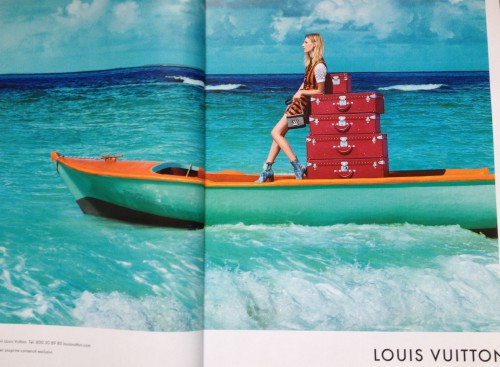
This advertisement for Louis Vuitton is of the same series designed for the manufacturer as Case 33 (here). First, I would like to call your attention on the way the model is wearing her bag. Although we have the typical background of bright sky and blue sea so appealing to dejected employees, the woman is fearing something is going to happen to her. She is holding the bag against her chest, looking at a distance, as if she had been suddenly aware of a desperado’s presence. The scene, in fact, is mildly nerve-racking. It’s only because you do not expect such tone in a tropical, and topical, advert for a handbag that you did not perceive it at first. Well, you did not perceive it, maybe, but your lizard brain has registered the model’s disquiet nevertheless – because it has no social expectations like yourself, I mean your conscious self, which is easily tricked by advertisers because of the preconceived notions we are all using as shortcuts to deal with the requirements of everyday life.
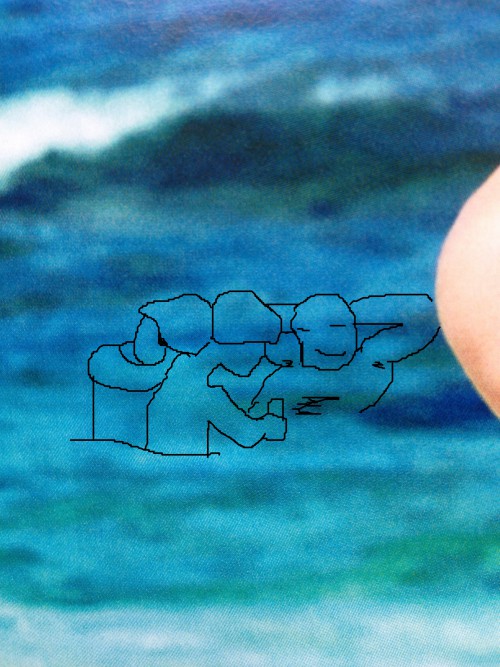
That lizard brain of yours also registered something else. On the turquoise waves a drawing has been embedded. It represents two kids and a man, all naked. One kid is leaning against the other’s shoulder. Maybe he’s tired, maybe he’s ashamed, maybe he’s crying. The other kid is masturbating the man’s penis. The man is lying on the back, both hands under his head. He’s enjoying. This is subliminal pedophilia, something we have already come across (Case 52 here). As a first guess, I’d say it will (discarding any sexual stimulation effect) contribute to heighten in the female viewer the anxiety produced by perceiving, unconsciously most of the time, the model’s apprehensiveness. Mirror cells in the brain tend to reproduce as yours the emotions you perceive on others; that is their function, and I suggest they will reproduce emotions even when you fail to interpret these emotions correctly at conscious level. Choosing a handbag is in itself an anxious experience – all choices imply some degree of anxiety – and here it is connected with status anxiety, like all fashion. Anxiety advertising is aimed at producing the right crisis in the mind.
Uninformed readers may object that mirror cells cannot be induced to react in the present case, as people know it is only an advertisement and the model is acting. In reality, our mirror cells function as usual even when we know that the person we look at is simulating emotions. Without such a functioning in the face of all our knowledge, movie theaters would remain empty. It is because people let themselves be moved by acting that they enjoy cinema, and they can do that because even their knowledge of the whole stuff’s being acting and simulation does not prevent their mirror cells to induce in them the emotional states they perceive. The difference between a good actor and a bad one is that the former is capable of mimicking emotions most perfectly, whereas the latter lets perceive a discrepancy between his behavior or attitude and the emotion he is supposed to be acting. Bad actors betray that their inner state is alien to their role, and such discrepancy makes them, and the whole scene, ridiculous; despite our willingness, our mirror cells cannot be fooled by bad actors, and we resent them for the poor performance.
These remarks allow one to describe the impact of advertising, even printed advertising, in terms of mirror cells. Advertising models are asked to express emotions, which the photographer will try to capture on the picture. In Case 75, I suggested that the model is expressing some feeling of anguish that would remain unperceived at conscious level insomuch as it makes no sense at all for the uninformed consumer that fear should be made use of in that kind of advertising, especially with a cliché bright sky, blue sea background. As it makes no sense, the stimuli that would allow the correct interpretation remain unattended.
One thing, however, must be added. The model here has not been asked to play genuine anguish. In fact, she was asked to look disquieted, with her gaze and her holding the bag against her chest, but not entirely so, in order to confuse the brain and prevent any possibility that the right interpretation be brought to consciousness. The way she is holding the bag against her chest is ambiguous, the gesture is soft, there is no muscular tension, no crispation as would be expected from true disquiet. So, in a way this is a case of bad acting, some stimuli indicating one emotional state and some other stimuli from the same source indicating another emotional state. Except that the discrepancy here has been designed intentionally, so that the viewer will more easily discard the stimuli that make no sense, i.e. anguish or, more mildly, disquiet, since are also present the stimuli that make perfect sense to the conscious mind – a young woman strolling on a beach or a riviera by a fine summer day with her handbag, which she carries most gently, and why not against her chest, if she likes? Her looks seem a bit odd, for sure… but, wait, she’s so young and at that age one is easily troubled. So far so good. If the character is troubled, then there is something troubling about the advertisement. I just wanted to be sure you noticed. Finally, the discrepancy may serve the purpose of disquieting the unattending brain and thus remaining engraved inside as a puzzle, something unexplained and thus potentially threatening (despite the conscious interpretation of the ad as being innocuous, trite stuff). And then there is the subliminal drawing of pedophiliac erotica.

Case 75

75-2
75-3
……………..Case 76 Patek Philippe SEX
We have already seen this advert, Case 29 (here), where I show a sex embed. As with Case 74 above, the sex embed is not only a sex embed, no more than it is solely, it goes without saying, the shades of a coppice in the background. There is also present a semi-erect penis. The testes have been painted prominent. It’s not so much about the penis, this time, as about the reproductive stamina.
If you’re interested, you can find another sex embed stuck to the woman’s left shoulder. Above this embed are two faces, which I do not care to outline, but that you may find too. It’s the woman’s parents, the father on the left, with large whiskers, a Colonel Goodchild of sorts, the mother on the right, fateful and zombie-looking, with a face larger than her man’s.

Case 76

76-2
…………….Case 77 Elie Saab SEX
Same as Case 30 (here). Besides the sex embed in the model’s hair, the folds of her dress, nicely swollen by the wind, delineate a copulation. We see two bottoms and two backs. The woman’s pubis is concealed by the top of the perfume bottle but I have indicated the navel (though I’m not inventing it: it’s there) so you can orient yourselves in these folds. The woman is on her knees, the man on her, they’re making it more ferarum, which is the Latin for doggy-style, if you care to know. The man, though, is not well oriented on her mate’s back, he is bending toward the left, probably toward another mate, which he is kissing or on whom he is performing a cunnilingus.
Also, looking back at the picture 30-1, you’ll see the model’s body is slightly tilted, whereas the writings below are quite horizontal, that is, when the writings of the page are horizontal the body is tilting toward the right. The model is therefore leaning against something, and as she can’t be leaning against her veils flaunting in the wind, she is leaning against a man’s body.

Case 77

77-2
…………….Case 78 Louis Vuitton SEX
From the same series as Cases 33 and 75. I have nothing to say about the picture itself. Please proceed directly to Pictures 78-2 and 78-3, and into the turquoise waters where strange Tritons and Nereids are having a subliminal orgy. On the left side, a woman is licking the testes of a semi-erect penis bending toward the left. No doubt the penis will be full hard soon. Close against the woman on her right, we can see the back and buttocks of another woman, sat on a penis. A third woman, further on the right and a little below, is also impaled on a penis, and smiles at you. (The smiling head could be that of a fourth woman, though, as it is separated from the bottom with the penis inside it, a bottom which can be completed instead by a female back and a black-haired head contiguous to it on the right side.) From this group further to the right and below, a woman is taken more ferarum by a crocodile or a doglike creature on her back. Her visage expresses intense contentment. (We have already come across subliminal bestiality, in Case 59 here.) In the space between these two lovers, another face is staring at you; it is a smiling death’s head, or just another Mister Grin.
From this case I conclude that women too like pornography, providing it be subliminal.
Case 78

78-2

78-3
……………..Case 79 QC Terme Spas and Resorts SEX
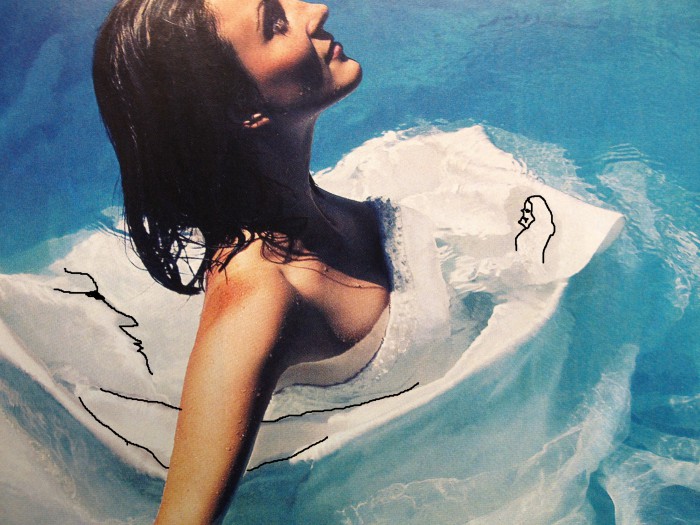
The model’s expression is well-being. On Picture 79-2, she is embraced by a subliminal man (à la Modigliani, not my favorite embeds: I prefer more realistic objects, more difficult to object to by opponents), and besides a little Death figure, very realistically drawn with skeleton and the customary cloak and hood, is staring at her with its typical grin. Please take a closer look at Picture 79-1 to appreciate the fine rendition of the skull. Health concerns are involved, as you have understood.
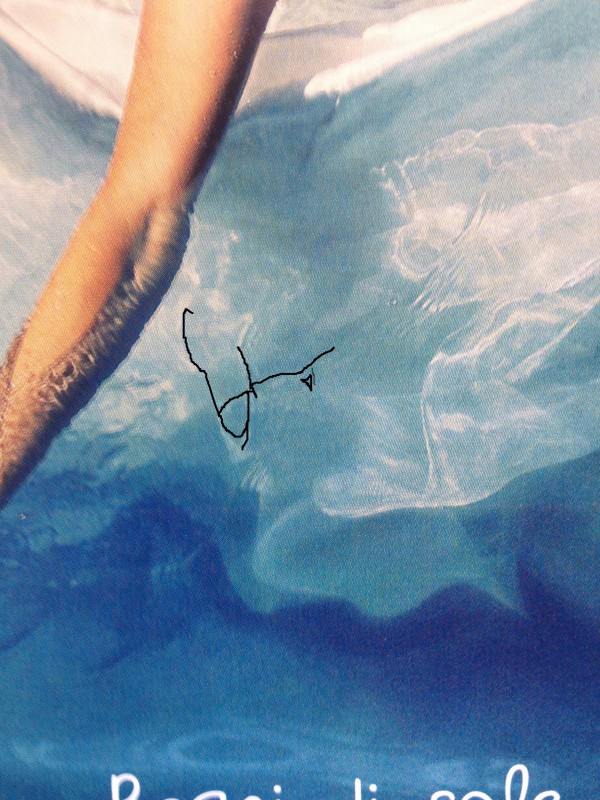
Pictures 79-3 and 79-4 display a fellatio, rather ethereal, admittedly, but it’s there nonetheless, and the white smears at the tip of the glans and further below indicate ejaculation. EPC (extra-pair copulation) prospects in spas and resorts have served as material for the advertiser.

Case 79
79-2

79-3
79-4
September 2015
 florent boucharel rAd-Free