
Tagged: Marshall McLuhan
Subliminals XVII: Harvard Business Redux
“Tell the men of the East to look out for the men of the West. The irrepressible Yank is knocking at the doors of their temples and he will want to sell ‘em carpet-sweepers for their harems and electric light plants for their temple shrines.” (Frank Norris, The Octopus)
After you read this new essay on subliminal advertising, I am confident you will be aware that the connection between the above quote and the essay is at best flimsy. In this the quote does no differ in the least from the usage in the publishing market, where publishing houses remunerate editing staff specialized in irrelevant and shallow quotations – the shallower the better. But the above quote also differs from the usual practice inasmuch as it is largely irrelevant but not at all shallow.
That quotation business reminds me of some author’s 6-page (!) Acknowledgments at the end of his book. He does not acknowledge his editors’ quotation job (there are no chapter-heading quotations in that one) but he is so frank and scrupulous in his thankyous to his “ghostwriter,” “editor,” “senior editor,” “researchers,” to Mr so-and-so for the title of the book, and for such and such idea in the book, and for the very idea of the book, and so on and so forth, that one realizes after perusing this that the author’s contribution is at most that single acknowledgments section, and his name on the cover.
Yet I have got another quote for you, which will reverberate with the former one over these intercalary considerations of mine.
“James Joyce’s book [Finnegans Wake] is about the electrical retribalization of the West and the West’s effect on the East: The West shall shake the East awake. …while ye have the night for morn … Joyce’s title refers directly to the Orientalization of the West by electric technology and to the meeting of East and West.” (Marshall McLuhan, War and Peace in the Global Village)
Harem or, more precisely, Purdah: A man who wants to see the world with his own eyes needs baggage consignment.
Cases 109 to 113 are taken once again from Harvard Business Review (for previous HBR cases see here). The issue is October 2016. It is extremely important to deal with cerebral material because, as you know, zombies must be shot in the head. (“Cerebral” refers to “Harvard,” of course, not to “Business.”)
……………Case 109 Eva Air SEX

Case 109

109-2

109-3
Eva Air is a Taiwanese airline company. The hostess has just served the passenger his meal and invites him to enjoy it by a gesture of the hand. Her other hand is concealed by copy; given how that other hand is positioned, one may think she holds something in it, for otherwise the hand would not be, as it is, somewhat lifted in the air but rather down along her body, but as she probably needed both her hands to carry the trail, and besides one sees no object whatever, coffee pot or anything like that, some parts of which would be sticking out of the concealing copy insert, in fact both hands are empty. Consequently, the concealed hand is making the same gesture as the visible hand, and what the hostess is inviting the customer to enjoy is not his meal but herself: she opens her arms to him and his embrace. This is a first subliminal effect.
Then there is a subliminal effect with the visible hand too. As you can see, a glass of wine placed between the hand and the photograph (and viewer) creates by refraction an optical illusion on the hostess’ visible hand. Through the glass, part of her forefinger is seen bigger as it is. Your brain, by experience, normally corrects such illusions and in fact, looking quickly at the picture you will not even notice (in the sense of paying attention to) the altered proportions. I beg you pay attention to these and carefully consider the object you now see. I have outlined the subliminal embed (picture 109-3) but did a poor job with the computer mouse and am convinced you can see the penis better on the “blank” picture (109-2). The glass swells the finger’s phalange into the shape of a penis glans, to which the other phalanges provide the shaft. The knuckle bone at the finger’s root looks like a testicle.
…………….Case 110 Harvard Business Review’s Online Exclusive SEX
Case 110
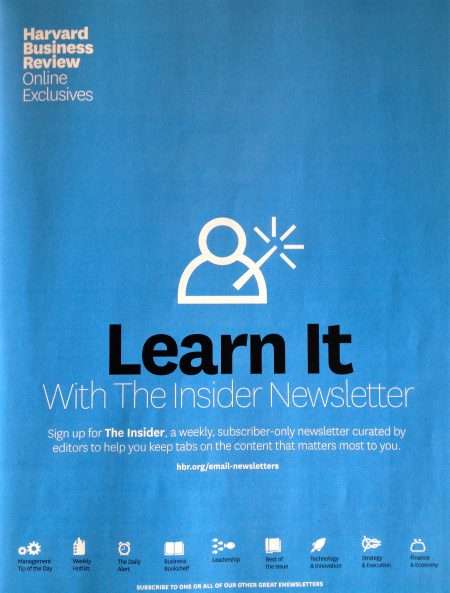
This is an ad for HBR’s online newsletter, dubbed “insider newsletter.” The logo above the copy shows a stylized torso with what seems to be a magic wand – represented as a stick radiating several, multidirectional beams. The object mixes magic and technology, since in the context of modern communication it could be seen as an electric antenna, and the beams as electric or radio waves.
It mixes more than just that. The stick is held in the middle of the torso, not at its margin. If you extend it in imagination, it reaches the groin. The stick is actually a huge erect penis, and it is giving off a massive ejaculate, in several spurts. The spurts are multidirectional because of a vigorous handshake applied to the penis.
……………Case 111 Wharton University of Pennsylvania’s Executive SEX Education

Case 111
Copy: “Transformation. ‘The moment I knew there were no limitations to what I could achieve’.” In quotation marks, so we know the utterer of these memorable words is the model. The guy’s transformation is rendered by graphic means by the somewhat fuzzy contours of several of his parts, such as his hair and shirt; the fuzziness does not result from my hand trembling while taking the picture, it is in the original. The guy is transforming before our very eyes, and the background, above his head, is no background at all but a thermic, misty halo emanating from his body as a result of energetic processes at the heart of his transformation.
If we believe the copy, this uncanny mutation will enable the lad to overcome all limitations. Now what, according to you, are the obvious limitations of this guy? He doesn’t seem to lack either intelligence or the qualities inherent to a friendly person. On the other hand, he clearly is a geek. Try to imagine a better representation of a hopeless geek… You cannot. The limitations of our buddy here are sexual.
Executive education is often aimed at people with scientific and engineering training who want to make more money and achieve higher status in the organization world to which they are bound, by opening executive positions to them. As trainees in science and engineering, they demonstrated intelligence and a capacity for long studies and hard work. Now it is time to make men of spineless clowns, and this is what executive education is for. As a consequence, the present ad is a mere copycat of Jerry Lewis’s film The Nutty Professor (1963), whose French title, Docteur Jerry et Mister Love, makes obvious the parodic reference of the film to Stevenson’s famous story about a man’s transforming personality – in the original it is the transformation of a respectable notable into a perverse brute, and in the parody the transformation of a geek into a ladykiller. Higher status is the main tool for overcoming males’ sexual limitations, and key to higher status is, they claim, executive education.
…………….Case 112 Wells Fargo SEX

Case 112
112-2
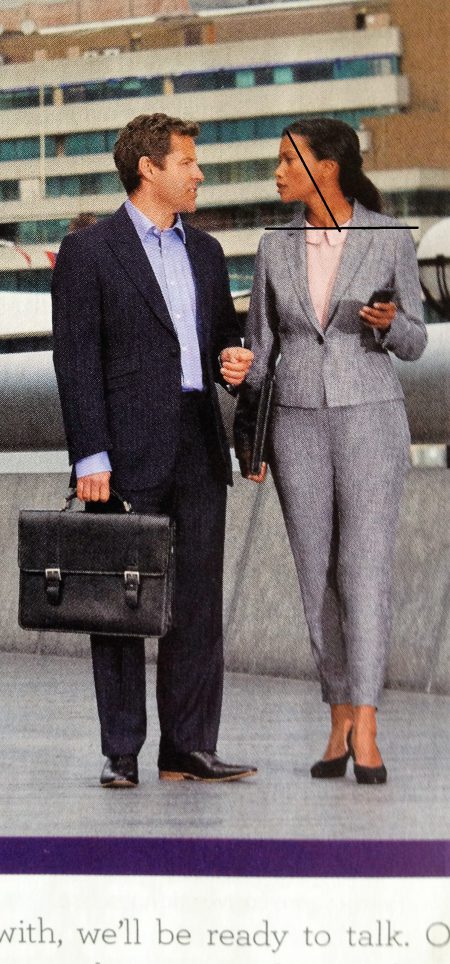
The erotic content of the ad is hardly mistakable. The woman is sexually aroused. I have drawn two straight lines (picture 106-2) to show the tilting of her head. She is about to kiss the man or is inviting him by her attitude to kiss her. Her eyes are half-closed, these are “bedroom eyes” (seductive eyes). Her lips are puckered up. We see a perfectly triangular, dark area on her trousers at the level of genitals as if the fabric were wet with moisture of arousal. The man seems rather indifferent, which means this has happened to him so many times, at every business trip, the lucky guy.
Complement. Among the many preposterous distortions of reality in films of mass consumption, the female character taking sexual initiative is one of the best jokes – even better than female warriors, another recent staple of these products which is such bad taste and so much absurdity, knowing that a man’s slap sends a woman flying meters away (I don’t know this from experience, but I don’t need experience to know that it is so). We owe the ubiquitous initiative-taking woman of the movies to the following consideration. The hero being the man, he must be rewarded – with sex (if he is not rewarded with sex, he is a failure, not a hero). But as a hero, his behavior ought not to evidence the vulgar commonalities of his sex, that is, urgent interest in sexual acts, lechery, womanizing, and prostitutes-seeking. The only way for the film maker to solve the dilemma is to introduce on a systematic basis an initiative-taking female character who rewards the hero with her love and body, toward the middle of the film, while he is fully absorbed in his mission and quest.
……………Case 113 Harvard Business School of SEX and Drugs
Case 113

113-2
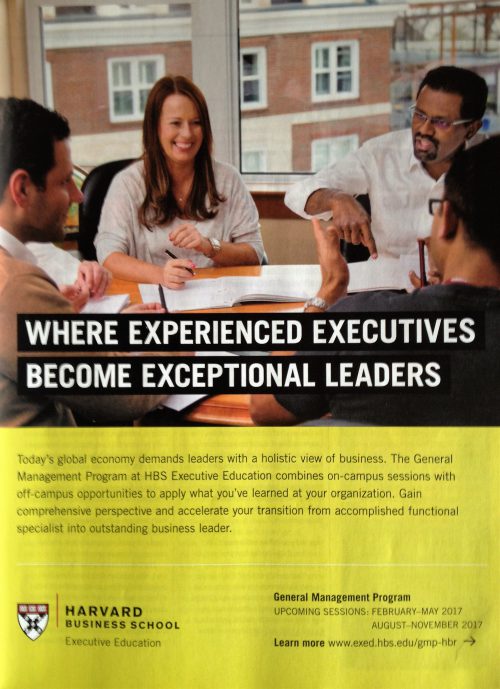
Copy: “Where experienced executives become exceptional leaders.” Ex-perienced, ex-ecutives, ex-ceptional: sex, sex, sex.
The black man on the right has a penis embedded on his shirt (picture 113-2).
With his bony finger he points toward the penis of the other black man, showing it to the white guy on the left: “You see that penis?” The penis must be erect, as the guy looks to the girl and gestures toward her as if to grab her. With her left arm, the girl is giving hint of a defensive move, as if to avoid the latter’s assault; this is just a reflex, she perhaps is a little scared by the dimensions of his penis but fundamentally she thinks it is okay to be inseminated by him. (Curiously, the skin color of each of her arms is not the same, the left one being tanned –or hairy!–, the right one being not, as if the former arm were another person’s intending to grab her wrist from under the table. Possibly she is going to be gang raped.)
There is a fifth person on the left, another guy, of whom we only see the hands and shirtsleeves. He holds his pen as a junkie holds a syringe for a shot, with his thumb on top of the piston.
The ad, thus, is about what is needed to make of “experienced executives” tolerable members of the society.
……………Complements
Job outsourcing by multinationals: Everybody knows… but nobody knows who.
As a Comment to Subliminals XIV (here), I wrote: “I will see if I can find multinationals’ job figures by country. Then we will know which countries would be most impacted by automation. We may call Nike an American company but I believe they employ more Chinese than Americans. If this is true, they may contribute a higher share to Chinese economic growth than to American growth and, on the other hand, the automation of Nike factories would impact Chinese work more than American work. [In the mean time I have been looking for Nike job figures by country and did not find them. Hard task, it seems. Probably with some reason…]”
The reason is, I now know, that companies are not compelled to divulge their job figures country by country. That, again, probably with some reason.
“U.S. Rep. Gary Peters (D-MI) introduced a bill that would require publicly-traded corporations to disclose the number of employees they have in the United States and overseas. Under current law, companies must disclose their total number of employees in annual Securities and Exchange Commission filings. Peters’ bill, titled the Outsourcing Accountability Act, wouldn’t create a new regulation, but rather change the existing rule so companies would have to break down their employment figures by nation and state.” (2012) (source)
The bill was voted down.
“Data from the U.S. Department of Commerce showed that ‘U.S. multinational corporations, the big brand-name companies that employ a fifth of all American workers… cut their work forces in the U.S. by 2.9 million during the 2000s while increasing employment overseas by 2.4 million’.” (source)
You bet companies don’t want to break down their job figures! That bill is key. When the American people realize (with figures) that their favorite brands employ 100 or 1.000 or 10.000 times more Chinese than Americans, they will start questioning their approach to consumption, I believe.
Add fiscal outsourcing, which is done by most big companies, as admitted by The Economist, and what I said about American multinationals contributing more to foreign growth than to American growth is wholly warranted: “The volume of money moving through such havens [i.e. “the most tax- and regulation-efficient jurisdictions”] on the way to their final destination has risen sharply since 2000 and currently makes up about 30% of all FDI [foreign direct investment].” (TE, Sep 17th-23rd 2016)
When I say “nobody knows who (does),” whereas all multinationals do, this simply means that people ought to get the figures presented to them in tables ranking the companies from highest to lowest outsourcing figures. Support the Outsourcing Accountability Act.
The Winner Takes All
Wikileaks reveals: “Qatar giving Bill Clinton $1m for 5-minute meeting.” That is some $3.333 per second of presence. At this rate, Bill Clinton earns the same as 2,361,480 average Americans (Mean personal income $44,510, US Census Bureau).
If you take median income ($30,240), he earns as much as 3,475,842 or about 3.5 million average Americans.
Full-time minimum wage in US is $15,080. Bill Clinton earns the same as 6,970,125 or about 7 million American workers at the minimum wage.
The poverty line in US is $11,770. At his Qatari rates, Bill Clinton earns as much as 8,930,287 or about 9 million Americans at the poverty line.
If you know the mean/median income of the 46.7 million Americans below the poverty line (Census Bureau figures for 2014), then you can find how many millions of American paupers Bill Clinton is worth.
October 2016
World Premiere: Eric McLuhan says his say about subliminal messages
Many have wondered at the lack of acknowledged permissions for using the ads in both books [The Mechanical Bride and Culture Is Our Business]. The reason is that permissions were unnecessary: the ads were available for free. Editors at Vanguard had found a curious legal fiction. Advertisers were being given huge tax breaks on the grounds that they were engaged in a sort of educational enterprise, “educating the public” about products so that it might better make informed choices. The upshot is that anyone can make use of the (government-supported) ads for free providing they were not being used as ads, but as educational materials, for educative purposes. Needless to say, the agencies were reluctant to let these matters become known to the public.
This is the excerpt from Dr Eric McLuhan’s introduction to the 2014 edition of Culture Is Our Business by Marshall McLuhan (from Subliminal Junk XII here) concerning which I reached out to Eric McLuhan. This move initiated an exchange of emails between Eric McLuhan and me. Eric’s first four emails were published as Comments to Subliminal Junk XIII (here). I presently make an entry with these emails and two more, due to their importance. Here are they.

Eric McLuhan on Settee with Pet Dog Finnegan
August 15
Dear Florent Boucharel,
Thank you for your intriguing letter. I was unable to access either of the links that you included, but never mind. It would have been interesting to see the sources you cite. The notion of “subliminal junk” rings a lot of bells here: I spent years investigating things subliminal and am something of an expert re the matter. However…
Let me say right off that I have no personal legal or legalistic expertise in the matter of copyright of ads. The publishers (Vanguard, for Mechanical Bride, and McGraw-Hill for Culture Is Our Business) gave my father freedom to use any ads he wished, and he did so, never once asking permission. Vanguard set the stage by doing the initial research–I assume it was done by their legal department. McGraw-Hill evidently took their word for it. We never heard of a single objection from any of the owners of any of the ads used in either book. Both publishers, by the way, are located in New York. The Bride never went on sale, but Culture Is Our Business did, and copies were sold outside the US, though I have no idea how many.
Lots of teachers use ads in their courses and I have no knowledge of any of them ever seeking permission to discuss an ad used in a class or classroom. Of course, there is a multitude of textbooks for teachers to use and hundreds of ads in them, but frankly I have never checked to see if permission was asked or given. I seem to recall that these books routinely list the sources of ads in their “Acknowledgements” section, as do art textbooks for the images that they use. But all of them are academic textbooks.
I am quite certain that it is safe to study ads in the classroom without permission; I assume, from past and present experience, that it is safe to provide students with copies of ads that are being studied in a classroom setting for academic purposes. The sole proviso would be that the ads are being used as specimens for academic scrutiny and not AS ads.
Regards,
Eric
*
August 16
Dear Florent,
Well! You are a devotee of Bill Key’s! I too was a fan of his when he put out the first three books, starting with Subliminal Seduction, and subsequently.
As I mentioned, I taught embedding techniques until recently–I retired a couple of years ago. Let me suggest a couple of things. One thing that damaged Key’s credibility was that he quickly became very sophisticated in his ability to detect subliminals; as it were, he was working at a post-doc level while his readers were still at the undergraduate level. I found the same problem: I could see things clearly that were still opaque to my students. So I had to tone it down, restrict my exhibits to the simplest and most obvious ones or I would lose them.
I’d suggest that you try something similar. In each of your reports, have several sections. Make the first a group of simple and easy examples, obvious things; the second, a little more subtle; and the third, the not-so-obvious group. And put headings on the groups.
Eventually, I began my class on subliminals (I used a carousel tray of 80 slides) with covers of Playboy magazines. Very effective: slightly naughty and caught everybody’s attention. Here’s the secret: since the first issue, Playboy has embedded their signature icon, the rabbit, somewhere in every single cover. They still do it. The homework assignment for that class was to visit a newsstand and examine the cover of the current issue and “find the rabbit.” Playboy covers are not only entertaining, but VERY useful as a training device.
You see, the Playboy artists use every single embedding technique several times over the course of a year or two of covers, with a lot of them repeated because after all there are not that many techniques–it’s a matter of theme and variation. But after scrutinizing 20-25 covers, the audience becomes quite expert in spotting the rabbit–and some of the covers are really clever embeds! THEN I hit them with a few ads, and they are often ahead of me. Seldom do I need to explain what is going on: the audience does it for me.
Even so, I begin with a few obvious ads, and then get progressively more subtle.
*
August 17
I have never written up the way that I taught subliminals using Playboy covers. I just did it, each year for a dozen or more. Actually, I think that my letter to you is the first time I have written anything about it. It was–and is–a very powerful means of teaching the subject. I’d suggest that you find somewhere a cache of covers, from the first issues to the present, and made a file of them. (When you do, I’d appreciate a copy!) They fall into a small number of groups if sorted by techniques, and exhibit a wide range of sophistication from simple to complex in each group. Actually, now that you mention it, it might be fun to put together a small book on the subject as an approach to ads and kindred items.
Playboy is a useful tool because their usage is all in the spirit of play and has no moral judgments attached or implied. Nearly everyone who writes on the topic, and I include Bill Key here, along with his detractors–nearly everyone feels compelled to work up moral indignation to a fever pitch. All of that is actually irrelevant. Try this: take any criticism text on subliminals and remove from it every vestige of moralism, and see what is left. It is quite the same with how people approach criticism of media. You are required to express a moral position. If you don’t, the assumption is that you approve of it. So in self-defence you must state whether you approve or disapprove. People want to know, right off, “is it a good thing or a bad thing?” The moment you tell them, they are relieved of the responsibility of examining the thing any further: they know now what and how to think. My father made a point of never giving his moral opinion of the things he examined, so was widely accused of being an advocate. Except once. His first book on ads, The Mechanical Bride, included a lot of moral outlook. He learned from that experience and you will be hard pressed to find thereafter any similarly moralistic tone in his subsequent writings or his lectures. The second book on ads, Culture is Our Business, is entirely free of moralism. Along the same line, you might like to have a look at Wyndham Lewis’s essay, “The Greatest Satire is Non-Moral.” The non-moral approach pulls the teeth of the opposition.
My class on subliminals was part of a larger discussion of artistic techniques and ways of managing the attention and, just as importantly, crafting the inattention of the beholder. Consequently I never experienced opposition from faculty, though occasionally a student would object, either on moral grounds, or because he or she simply couldn’t see the things I was exhibiting. Every serious artist, whether poet or painter or sculptor, etc., spends at least as much time on the elements of inattention as on those things the beholder is to attend to. The language of figure and ground, which we use often in Laws of Media: The New Science, is well suited to these discussions. Ground is the area of inattention, the 95% area of any experience. Another word for it is “medium.” It provides the way of seeing whatever is figure. Ground is the mode of perception. Another word for the ground area is “style.” Ground is by definition the part that people are trained or induced to ignore, and they have great resistance to any incursions into their areas of ignorance. People will defend to the death their right to preserve their ignorance!
*
August 18
Here’s an idea of what I meant by a cache of covers: http://www.playboy.com/articles/playboy-covers-guide It does not include ALL of the covers for individual years, but gives quite enough to work with. Quite a number of sites will supply examples.
Of course, if you can find a box-full of actual mags, so much the better. But perhaps you know someone who can make digital copies of these for use as a display. (If you do, please send me a copy!)
If you go to the site above, look especially at the following (play “find the rabbit”):
1960 March, November
1961 March, April, July
1962 Feb., March, April, June, Aug., Dec.
1963 March, Aug.
1964 March, May, Dec.
1965 March, June, Oct., Nov., Dec.
1966 June, July, Nov., Dec.
1967 Feb., March, Nov.
1968 December
1970 May, July, Nov.
1971 April, Aug.
1972 March, April, June
1973 Feb., June, Aug., Oct.
1974 June, Nov.
1976 May, June, July, Aug.
1977 May, Nov….
But you get the idea. Look through the rest.
Occasionally, you’ll see white (rabbit-shaped) paper cutouts obscuring parts of anatomies–for the obvious reasons. Too titillating. Ignore the cutouts: they are not the embedded rabbits.
I have underlined several dates, above: these are particularly fine and challenging examples (1973, 1974, 1976). If they stump you, ask me.
Present company excepted, moral indignation generally takes the place of understanding. Try editing out the moralism from one of your own earlier fine posts and see what is left. I imagine it will be just fine, and harder-hitting. (The moralism component is one of the things that got Bill Key fired.)
Wyndham Lewis pointed out that if you criticize someone for being immoral, he and she can sort of snigger and joke that yes, they WERE being naughty, wink wink nudge nudge ha ha–that is, they can turn the criticism to account. Being banned-in-Boston does have a certain PR value. But if you satirize them/show them up instead as being stupid or ignorant or insensitive, why, there’s no PR value in that. You got ’em. All they can do is get angry, and that works against them.
The moral approach encourages somnambulism in your readers. I’m not sure that that is the response you wish to promote.
*
August 19





 florent boucharel rAd-Free