
Category: Subliminal
Subliminal Advertising VI: Cosmopolitan Spiegel
The advertising community is not particularly interested in confessing to the use of subliminal messages, and there appears to be no good source to document their prevalence. Back in the 1980s, I asked an advertising executive at Wyse Advertising if he had any insights into the use of subliminal messages in advertising. … He estimated that about 10% of all ads use some form of subliminal technique. (Glenn G. Sparks, Media Effects Research. A Basic Overview, Fifth Edition, 2015, p.216)
The quote is from a course manual for undergraduate students in the communications field authored by a professor at Purdue University. The fact that the manual has gone through five editions so far is testimony to its success and perhaps to its quality as teaching material. Such a quote should be proof enough that the subject of subliminal advertising is not, as some believe, an ‘urban legend’ or a hoax for self-proclaimed ‘hoax busters’ — shooting anything that moves — to bust. The advertising executive’s confession is gold, although the correct figure, as far as current printed advertising is concerned (newspapers, magazines, billboards), is closer to 100% than to 10% at this juncture.
When advertisers themselves confess to the practice, the denying attitude of some scholars (among them a few self-proclaimed hoax busters) strikes one as very odd. When I read, for instance, the following (quoted by Sparks, p.217):
Perhaps now is the time to lay the myth of subliminal sorcery to rest and direct our attention to other, more scientifically documented ways of understanding the causes of human behavior and improving our condition. (Pratkanis, The cargo-cult science [sic] of subliminal persuasion, 1992)
I have only this to say: Go tell the advertisers.
As Sparks explains, Pratkanis found out that products such as tapes based on alleged subliminal techniques and marketed to increase self-esteem or improve one’s moods (a $50 million business in 1990, according to Acland, 2011) are placebos. This is certainly worth knowing but does not allow one to talk about a ‘myth of subliminal sorcery.’ Wilson Bryan Key contends that subliminal persuasion in media advertising relies on the priming offered by media content – in newspapers the bad news (content) primes for the good news (ads), on Mcluhanian lines, and in magazines it is the lifestyle-oriented content that primes for the ads. As the priming effect is missing in the material tested by Pratkanis, his experiments have nothing to say on such a persuasion system.
But, I repeat, if subliminal advertising has no effect according to laboratory experiments, this information should be forwarded primarily to the advertisers themselves, who — as I am documenting on this website with the present series — are using subliminal techniques extensively, at least in the sex embed variety, on which I am currently concentrating. Otherwise, I don’t know if it’s the same for you but I really feel that disparaging terms such as ‘cargo-cult science’, ‘myth’, ‘sorcery’ sound like a design to defuse the potential consequences of consumers’ concern upon vested interests. This feeling, I know, is not rational, for what is rational is to maintain that scholars are independent from vested interests; the bombast in these disparagements is only the camouflage of the naive. For naive it is, indeed, to presume advertising agencies don’t know their job, considering their own research gets financing which an (independent) academic scholar would never dream of. An advertiser is likely to know his job, despite his claims to the contrary.
In this context, the confession of the advertising executive quoted above is, once again, striking, since the proprietary knowledge of advertising agencies is guaranteed by law from public scrutiny.
The following advertisements are taken from the German weekly Der Spiegel dated April 11, 2015 (Cases 40-43), and the magazine Cosmopolitan (UK Edition) dated May 2015 (Cases 44-46).
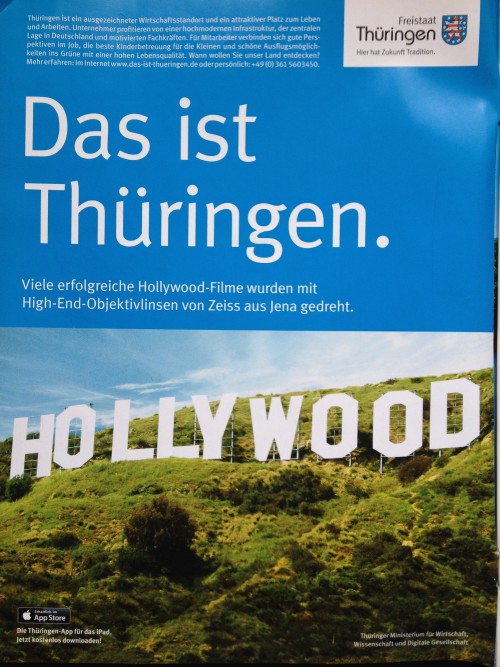
…………….Case 40 Freistaat Thüringen SEX
When the Free State of Thuringia, one of Germany’s Länder, or any public collectivity advertises, with the taxpayer’s money, its existence on the market, in order to allure tourists or investors, or for whatever reason, it contracts with an expensive advertising agency. The presence of sex embeds comes as no surprise.
case 40

40-2 click to enlarge

40-3 click to enlarge
…………….Case 41 Deutsche Bahn SEX
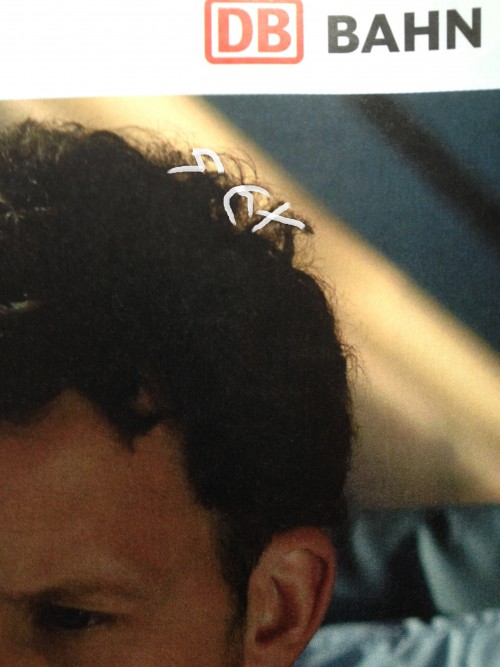
This one is for the German railways company. In the world of advertisement, men have not learned to comb their hair nor to shave their beards, because uncombed hair and incipient beard are convenient settings where to embed SEXes. As a result of men’s so often seeing uncombed hair and incipient beards on advertisements, the scruffy looks have become trendy in the real world.
There could be another reason for incipient beards being fashionable. The world of advertisements is a world of total freedom and enjoyment of one’s time and pleasure, without restraint; in that world there is simply no place for the organization man, with his suit and tie and long working weeks and subservience to the organization’s goals. The numerous organization men from the real world are torn between their real-life condition and the social desirability of appearing fashionable in accordance with advertisement’s canons. Incipient beard is the answer. Sporting an incipient beard, the suit-and-tie organization man is telling the world: “See? I have not shaved this morning, I do what I want, I am no relic from the oppressive past,” and that makes him socially acceptable, given that social acceptability is mostly based on appearance (fashion) and determined by advertisement conditioning. Ironically, the grooming of an incipient beard is much ado; you must shave or trim it regularly lest it become an unfashionable full beard.
As to the Deutsche Bahn advertisement, please observe how the embed is exposed in the light rather than camouflaged by the darker areas of the background.

Case 41

41-2
41-3
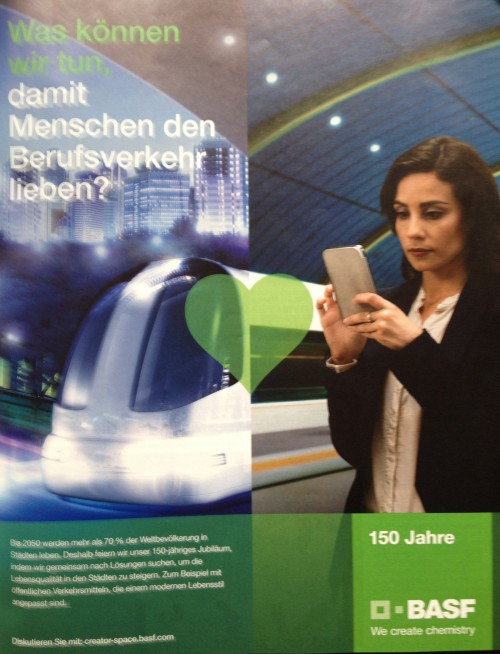
…………….Case 42 BASF SEX
Case 42

42-2

42-3
…………….Case 43 Book Cover SEX
I can’t say for sure whether the embed lies on the book cover or on the advertisement alone, because I haven’t had the book in my hands. I wouldn’t be surprised in the least if the embeds lied on the real cover. The book is supposed to be a serious one; this is why, certainly, it needs a bit of subliminal up-sexing.

Case 43

43-2 click to enlarge

43-3 click to enlarge
…………….Case 44 Dior SEX

Case 44

44-2

44-3
…………….Case 45 Garnier SEX
To find the sex embeds, follow her look.

Case 45

45-2

45-3
…………….Case 46 Hyundai SEX
To create the sensation of speed, the graphic designer has fuzzed parts of the picture, a banal technique whose advantage is to make embedding very convenient. I have outlined one sex embed. Use your own skills and try to find the others. Enjoy.

Case 46

46-2

46-3
Subliminal Advertising V: Vanity Fair (Without Thackeray)
After the April issue of Vanity Fair (Cases 24-32 from Subliminal Advertising IV), I thought the May issue would be interesting too, as regards sex embeds. Several ads from the April issue are also found on the May issue, like Case 24 and Case 25, and a few others that I didn’t bother to bring forward, so the subscribers who receive the magazine each month, or the regular buyers, are sure to get their share of repeated exposure which is the main principle of advertising as a conditioning process.
Counting pages on both issues, I find 60 pages of commercial advertising out of an overall 172 pages in the April ‘special’ issue, and 46 pages out of an overall 148 in the May issue, which makes 34.9% and 31.1% respectively (the special, bigger issue has a greater proportion of advertisements), and this does not even include the back cover ads, infomercials, advertorials, ‘Fanfairs’, ‘Hot Tracks’, ‘My Stuff’, ‘Portraits’ of commercial artists selling their last outputs, and so on and so forth.
The seven case studies presented here outline, as previously, the sex embeds. One way to get the clearest picture of what is going on is to download the photographs focusing on the embeds, outlined and not (for instance, pictures 33-2 and 33-3 below), then opening both on your computer and shifting the mouse on the lower screen bar from one to the other, so that my delineation of the embed will project on the photograph and then leave it again according to the mouse’s movement, the photograph staying in place, as one is only the duplicate of the other plus the embeds outlined. This procedure will make the embeds obvious to the most impercipient, I believe.
Of course, if you don’t wish to download anything, it always helps to enlarge the pics by clicking on them, or even by enlarging the internet window through command ‘Ctrl plus +’ (press Ctrl and + at the same time, as many times as you want the window enlarged).
All this research on sex embeds doesn’t imply I am convinced they have potent effects or even have effects at all. However, even if the effect is unsure, as the technique costs little — or rather nothing since the graphic designer’s working time is compensated anyway and it makes no difference whether he or she’s adding shades or sparks or droplets or sex embeds — it seems that advertisers believe they ought to use the technique, and they do use it.
One final thought before the case studies. If advertising, as its advocates claim, is so important for our economy, then what a vibrant homage it is to artists, those (in the view of a few people who look at themselves as practical minds) ‘losers’! People working on ads have artistic training. At a time when middle management, even top management, is being increasingly performed by computers, and experts are being increasingly replaced by expert systems, i.e., computers, human artists are still needed to perform that part of the economy whose global revenues in 2010 amounted to 503 billion dollars worldwide (Shaver & An, Ed., The Global Advertising Regulation Handbook, 2014). Parents who discourage their kids’ artistic inclinations seem very injudicious, even according to their own materialistic standards, because kids may end up earning much more working for advertising agencies than as accountants. In any case, what the advocates of advertisement’s claim amounts to is that our economy needs the artist more than the organization man, whose function is being automatized and computerized.
…………….Case 33 Louis Vuitton SEX
The lady is waiting on a pier with an extravagant profusion of luggage. The sex embed is on her boots. The signal on the tip of the pier reads ‘Privé Private Please.’ ‘Privé’ is the French for ‘private.’ Zooming on the board, you realize these words are not the first of a phrase, like “private pier”; they stand alone on a meaningless board. A private pier, however, conveys the idea of VIP-ness, and the advertisement as a whole the idea that very important people consume very much.

Case 33

33 – 2

33 – 3
…………….Case 34 Gucci SEX
The borderline between hair and forehead, with all its underbrush, is a convenient place to embed SEXes à gogo. We have a real sex jungle here.

Case 34

34 – 2

34 – 3
……………..Case 35 Dom Perignon SEX
The expensive champagne brand Dom Perignon uses no color on this one, expect golden letters for the brand name. The word sex is embedded on the stylized sea spray. The X is frankly neat and obvious as a white relief on this piece of commercial relievo.

Case 35

35 – 2

35 – 3
…………….Case 36 Clarins SEX
As in Case 15 (here), the word sex is embedded as a reflection on the sunglasses. Such reflections are typical background elements to which no attention is paid, even if geometrically speaking they are not in the background at all (since they are even closer to the viewer than the face itself, the glasses protruding from the forehead).

Case 36

36 – 2

36 – 3
…………….Case 37 Olay SEX
Another case of hairline sex embedding (see Case 33).

Case 37

37 – 2

37 – 3
…………….Case 38 Michael Kors SEX
Another case of sunglass reflections sex embedding. The difference with Case 35, however, is that the reflections on the latter are saturated: many objects, some sort of posh villa with greenwood trees, can be seen as reflections, among which the word sex has been embedded, whereas in the present case the apparent reflection is only that of a flat surface like the sea or a beach or a sand desert, and the sky. The word sex is embedded on this emptiness. I have outlined two different, partially overlapping embeds (37-3 and 37-4).

Case 38

38 – 2

38 – 3

38 – 4
…………….Case 39 Etihad SEX
This one is my favorite from the lot and I will take a few minutes to explain why. First of all, it uses celebrity endorsement, the woman there being the famous actress Nicole Kidman. Celebrity endorsement is described by D. Lakhani as subliminal advertising (according to Shakeel Ahmad Sofi, 2014, an Indian scholar who has studied the effects of these kinds of ads on a sample population of Kashmiri students), because one is induced to purchase a product upon motivations that have nothing to do with the product’s characteristics. This is stretching the meaning of ‘subliminal’ very much, for, although people like to say they buy products due to the latter’s intrinsic qualities, marketers know consumers should not be taken seriously in that respect. Marketers also know celebrity endorsement sells well.
For women, the endorsement here triggers identification, I suppose. For men, it triggers plain sexual arousal in an extravagantly gross fashion. Shoes off, on her couch or bed inside the aircraft cabin, wearing a somewhat creased evening dress (it’s really bedtime), Nicole Kidman is looking at you in the eyes. Furthermore there is the name Etihad in Arabic, no doubt a ‘marker’; in the same way as Audi’s international slogan Vorsprung durch Technik relies on the psychological ‘marker’ (be the fact true or not) of uncompromisingly reliable German technology (the idea of keeping the German language was the British agency BBH’s by the way: see R. Heath 2012), Arabic calligraphy evokes (be the facts true or not) Gulf oil wells and luxury and harem mysteries, so the male viewer is transported in a fantasy where he is a desert sheikh and the Hollywood star a sex slave from his harem, and the grossness of the sexual overtone (hardly an innuendo) becomes irresistible.
In such a context I was expecting the embeds to be rather shy, for two reasons. First, with due respect to the endorsing celebrity. Second, because the clients (Etihad) being desert sheikhs and outdoor Puritans*, they could miss the humor and jocularity of sex-embedding, as, for instance, capital punishment is still, in a spectacular fashion, in vigor among them (through fire squads, which is not as picturesque, however, as in neighboring Saudi Arabia, where beheading fairs are performed). These two factors would dampen, I conjectured, the artist’s embedding mania.
*(When I use the phrase ‘outdoor Puritans’, I do not mean these people are hypocrites. What occurs behind doors is no great secret among them, I should think. However, many Westerners will call these mores hypocritical, as repressed monogamists and ‘zerogamists’ carpet-bombed with mass media sexual fantasies are expected to do.)
The embeds are shy indeed; they almost seem to apologize for being there. But they are there anyway. One of them lies on a white pillow, as an arabesque of slight shades and folds. Others are on the couch, whose cover’s velvety fabric provides the milieu for the embed culture. I have outlined only a few of these.
Post Scriptum. As I find the same ad in German Der Spiegel of the same month, it’s likely it appears in most magazines of significance throughout the world. The price of such a global campaign (including NK’s compensation, and payment for advertising space on dozens of the most expensive media) must be enormous. Needless to say, it is paid by the consumer: marketing costs are included in the final price.

Case 39

39 – 2

39 – 2

39 – 4

39 – 5
April 2015
 florent boucharel rAd-Free