
Tagged: subliminal advertising
Subliminal XVI: My Life in Subliminals
“When one comes to the ultra-modern profession of advertising, responded Schliemann, – the science of persuading people to buy what they do not want, – he is in the very center of the ghastly charnel-house of capitalist destructiveness, and he scarcely knows which of a dozen horrors to point out first.” (Upton Sinclair, The Jungle, 1906)
“Today’s superstars [superstar companies] are using modern science to push advertising into areas that have not been tried before, raising difficult ethical questions about what ‘free choice’ means in a capitalist economy.” (The Economist, September 17th-23rd 2016)
What these “areas that have not been tried before” are, is not to be gathered, however, from that issue of The Economist. They seem to discover advertising only today, more than a hundred years after Upton Sinclair talked of it as “the very center of the ghastly charnel-house of capitalist destructiveness.” Still, it is with this admission – by a fierce mouthpiece of capitalism – of the reality of some strange “science” at the service of advertising, “raising difficult ethical questions…in a capitalist economy,” that we are proud to introduce our new cases of subliminal junk.
Cases 103-108 are taken from Harvard Business Review, September 2016.
……………Case 103 BASF Bestiality

Case 103

103-2

103-3
The model, a swarthy, scruffy, unshaven man seems to come out of a film on the Mexican Revolution. After having conquered tierra y libertad, he now enjoys the fruits of his labor on a land of his own, gazing with touching emotion at gorgeous sweet peppers he holds in his hands – his own peppers.
A table is set on the left side of the advert, with a salad bowl and a glass of what looks more like grenadine syrup than wine. After seeing this ad, for one thing BASF poisons will be associated in your mind with luxurious green goods, and poor but dignified campesinos.
Then there is a subliminal embed in the glass of grenadine, which I have outlined. A naked woman is sitting on her knees. Her head is tilting back as a big dog sniffs her pussy; she expects him to lick her genitals. As the dog wears a necklace, it is probably her own pet dog, which she acquired to satisfy her lust in this way. This is bestiality.
……………Case 104 Stanford Business School of SEX

Case 104

104-2
This one for a top Ivy League university, and more specifically for its executive education department. The main character in the show, the man on the right, has a somewhat disheveled and thoroughly scruffy look about him – the very look that is abhorrent to all corporate organizations throughout the world. This, however, is good selling pitch, meaning: Take a break from the horrendous monotonousness of your dreary corporate life by enrolling to our program and be for a couple of days, or weeks, the bum you dream to be.
But the ad promises more than that. On picture 104-2 I have drawn a straight line to show what the man is looking at, namely the woman’s breast. Looking at her breast and grasping invisible objects in the air… First watch, then touch; he already has his hands in position, all it takes now is a 90-degree turn.
The woman is smiling at him, encouragingly. Besides, she could not escape his grasping if she wanted, because she is manacled. Her hands are tied together exactly like manacled hands, and her watch wrist provides the clear suggestion of manacles.
The man is thinking so hard about sexual acts with the woman that he is projecting laser penises from his brain (picture 104-2). One is just leaving his skull. A second one, very bright, is bolting toward her face. Below that one, a third penis, very fat, is about to reach her on the nose, where she will have to handle it to her mouth, I guess.
The third character is the loser you do not want to be. If you look carefully, he seems quite depressed. At first glance, you may think he is looking at and listening to the other guy, but in fact he just stares into space, brewing over the failure of his life. To the very hardcore sex action that is going to take place he will remain spectator merely; he is so much of a loser that he cannot even have enough spite to be willing to prevent it. As he sits quite close to the woman, she may be his girlfriend; but his luck with her is over. You can’t be a loser and keep your sweetheart when the Stanford boy comes in.
…………….Case 105 Rosalind Franklin University of Medicine and Science of SEX

Case 105
The copy reads: “What did one doctor discover during the Ebola crisis? Herself.” And she is looking fondly at one of the above men’s bum. You see her looking at the top of the world, at the stars, you say she is a mature woman with dreams (read greedy ambition) determined to fulfill them and to become one of the worthies of this world. Which amounts – follow the straight line I draw – to finding a man with nicely-shaped buttocks. She looks at the only one whose presence is primarily marked by his conspicuous buttocks. And if you enroll at Rosalind, this is precisely what you will find at last. They promise. If you are already married, then you will find the man with whom to cuckold your husband at last. Promised.
……………Case 106 Harvard Business School of Hot SEX

Case 106
“Great leaders never stop evolving.” I would never have imagined that great leaders look like that. The man on the left is just ridiculous, with half-cooked Chinese noodles dangling from his hand. The man in the middle is a juggler: there is a small cake in equilibrium on top of his coffee cup. Jugglery is the specialty of circus clowns and was formerly that of court jesters and buffoons. The lady is actually running: only the tip of her right foot touches the ground, perhaps it does not even touch it – a movement she could not make if she were walking (the other foot has been cropped out of the picture so you can imagine it does not touch the ground either). Her overcoat almost seems to have fallen from her right shoulder (you need to look at it with attention to find out that both her shoulders are still covered), it does not cover the right side of her chest, and anyway she looks quite unkempt. Her right hand lies on a jacket button, which she may be opening, in the process of taking off the jacket. Her eyes are closed and she smiles, her face turned in the men’s direction. She is in a state of sexual arousal or even in an act of solitary sex. Expecting more (in her never-ending evolving), she is running in her haste to reach the place of the three’s sexual rendezvous, and such is her lustful haste that she is undressing while running. Harvard Business School: last chance of hot sex for desperate cases.
……………Case 107 Laugh & Suck
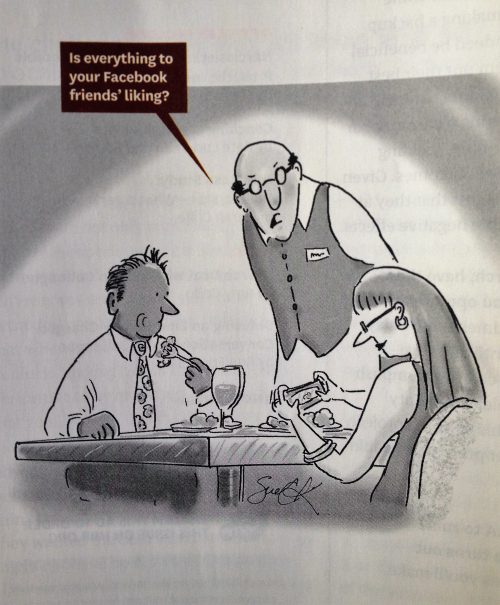
Case 107
A funny cartoon, and it is signed SUCK.
……………Case 108 Bottega Veneta SEX
& a nice SEX embed for good measure. (You don’t even have to enlarge the pics to see it perfectly.)
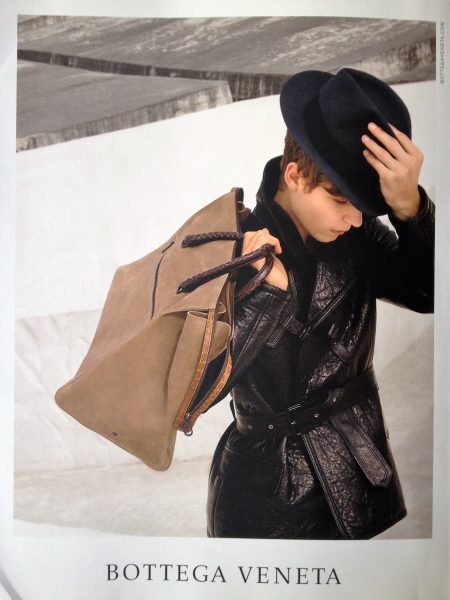
Case 108
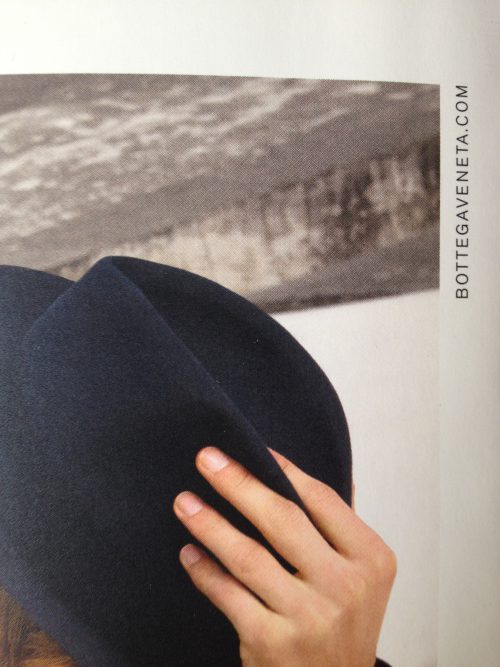
108-2

108-3
……………Complements: My Life in Subliminals
Subliminals have been a major influence on my musical tastes. The first cassette tape I bought in my life was an album by band INXS, after seeing their clip Need You Tonight (1987) a couple of times on TV. Then, the first laser disc I bought was an album by band Simply Red, after seeing a couple of times on TV their clip Something Got Me Started (1991). Both were successful bands in my teens. Retrieving their clips on YouTube recently, I found the following.
Need You Tonight
The singer’s leather jacket, near the zipper, on the chest, sports the letters SEX, in chrome or something like that, vertically. The “embed” is not particularly hard to detect, and if I remember well I had detected it before buying the album. Even though, among the various subliminal techniques used in the film The Exorcist (1973), exposed by Wilson Bryan Key in Media Sexploitation (1976), there are flash images of a ghastly face; as the filmmakers themselves explained, some people see these images consciously, others do not (in this way they intended to dismiss the idea that the technique is subliminal). It could be the same with the SEX here. If you’re not really watching the clip but rather listening to it while doing something else (as occurs with TV viewing, which is often done together with another activity), the letters on the jacket may escape your conscious attention. Be that as it may, let’s say the SEX on the jacket is not subliminal at all but obvious. This is still a case of using the written word as a way to “sex up” the show. As it seems, it is hot to sport the word SEX on one’s jacket. (Or is it cool, rather?)
To see if that would elicit reaction, I dropped a comment on YouTube in the form of a question: “Is it the word SEX I read on his jacket?” No reaction so far. I hope I haven’t spoilt the fans’ pleasure with an indiscreet remark.
Something Got Me Started
From 2:20 to 2:34 (instrumental part) one hears a faint female voice speaking in the background. However, what that voice says is not to be got at all. Here is the best example I have found so far of a subliminal technique in music/on TV: the voice can be heard, by attentive listeners, but the words never. And I bought the disc. The sequence occurs after a female voice has whispered “I really love you,” to which the singer reacts with an “Ooooh” of arousal. Both songs, by the way, make supraliminal use of whispers (“Come over here” at the beginning of Need You Tonight) – already the conscious content is highly eroticized in both cases.
Here as well I left a comment on YouTube: “From 2:20 to 2:34 one hears a faint female voice speaking, if you listen carefully. Can someone tell me what she says?” No answer so far. If you’re a sound engineer and intrigued by this too, please contact me because I am ready to pay for having these occult words deciphered.
October 2016
World Premiere: Eric McLuhan says his say about subliminal messages
Many have wondered at the lack of acknowledged permissions for using the ads in both books [The Mechanical Bride and Culture Is Our Business]. The reason is that permissions were unnecessary: the ads were available for free. Editors at Vanguard had found a curious legal fiction. Advertisers were being given huge tax breaks on the grounds that they were engaged in a sort of educational enterprise, “educating the public” about products so that it might better make informed choices. The upshot is that anyone can make use of the (government-supported) ads for free providing they were not being used as ads, but as educational materials, for educative purposes. Needless to say, the agencies were reluctant to let these matters become known to the public.
This is the excerpt from Dr Eric McLuhan’s introduction to the 2014 edition of Culture Is Our Business by Marshall McLuhan (from Subliminal Junk XII here) concerning which I reached out to Eric McLuhan. This move initiated an exchange of emails between Eric McLuhan and me. Eric’s first four emails were published as Comments to Subliminal Junk XIII (here). I presently make an entry with these emails and two more, due to their importance. Here are they.

Eric McLuhan on Settee with Pet Dog Finnegan
August 15
Dear Florent Boucharel,
Thank you for your intriguing letter. I was unable to access either of the links that you included, but never mind. It would have been interesting to see the sources you cite. The notion of “subliminal junk” rings a lot of bells here: I spent years investigating things subliminal and am something of an expert re the matter. However…
Let me say right off that I have no personal legal or legalistic expertise in the matter of copyright of ads. The publishers (Vanguard, for Mechanical Bride, and McGraw-Hill for Culture Is Our Business) gave my father freedom to use any ads he wished, and he did so, never once asking permission. Vanguard set the stage by doing the initial research–I assume it was done by their legal department. McGraw-Hill evidently took their word for it. We never heard of a single objection from any of the owners of any of the ads used in either book. Both publishers, by the way, are located in New York. The Bride never went on sale, but Culture Is Our Business did, and copies were sold outside the US, though I have no idea how many.
Lots of teachers use ads in their courses and I have no knowledge of any of them ever seeking permission to discuss an ad used in a class or classroom. Of course, there is a multitude of textbooks for teachers to use and hundreds of ads in them, but frankly I have never checked to see if permission was asked or given. I seem to recall that these books routinely list the sources of ads in their “Acknowledgements” section, as do art textbooks for the images that they use. But all of them are academic textbooks.
I am quite certain that it is safe to study ads in the classroom without permission; I assume, from past and present experience, that it is safe to provide students with copies of ads that are being studied in a classroom setting for academic purposes. The sole proviso would be that the ads are being used as specimens for academic scrutiny and not AS ads.
Regards,
Eric
*
August 16
Dear Florent,
Well! You are a devotee of Bill Key’s! I too was a fan of his when he put out the first three books, starting with Subliminal Seduction, and subsequently.
As I mentioned, I taught embedding techniques until recently–I retired a couple of years ago. Let me suggest a couple of things. One thing that damaged Key’s credibility was that he quickly became very sophisticated in his ability to detect subliminals; as it were, he was working at a post-doc level while his readers were still at the undergraduate level. I found the same problem: I could see things clearly that were still opaque to my students. So I had to tone it down, restrict my exhibits to the simplest and most obvious ones or I would lose them.
I’d suggest that you try something similar. In each of your reports, have several sections. Make the first a group of simple and easy examples, obvious things; the second, a little more subtle; and the third, the not-so-obvious group. And put headings on the groups.
Eventually, I began my class on subliminals (I used a carousel tray of 80 slides) with covers of Playboy magazines. Very effective: slightly naughty and caught everybody’s attention. Here’s the secret: since the first issue, Playboy has embedded their signature icon, the rabbit, somewhere in every single cover. They still do it. The homework assignment for that class was to visit a newsstand and examine the cover of the current issue and “find the rabbit.” Playboy covers are not only entertaining, but VERY useful as a training device.
You see, the Playboy artists use every single embedding technique several times over the course of a year or two of covers, with a lot of them repeated because after all there are not that many techniques–it’s a matter of theme and variation. But after scrutinizing 20-25 covers, the audience becomes quite expert in spotting the rabbit–and some of the covers are really clever embeds! THEN I hit them with a few ads, and they are often ahead of me. Seldom do I need to explain what is going on: the audience does it for me.
Even so, I begin with a few obvious ads, and then get progressively more subtle.
*
August 17
I have never written up the way that I taught subliminals using Playboy covers. I just did it, each year for a dozen or more. Actually, I think that my letter to you is the first time I have written anything about it. It was–and is–a very powerful means of teaching the subject. I’d suggest that you find somewhere a cache of covers, from the first issues to the present, and made a file of them. (When you do, I’d appreciate a copy!) They fall into a small number of groups if sorted by techniques, and exhibit a wide range of sophistication from simple to complex in each group. Actually, now that you mention it, it might be fun to put together a small book on the subject as an approach to ads and kindred items.
Playboy is a useful tool because their usage is all in the spirit of play and has no moral judgments attached or implied. Nearly everyone who writes on the topic, and I include Bill Key here, along with his detractors–nearly everyone feels compelled to work up moral indignation to a fever pitch. All of that is actually irrelevant. Try this: take any criticism text on subliminals and remove from it every vestige of moralism, and see what is left. It is quite the same with how people approach criticism of media. You are required to express a moral position. If you don’t, the assumption is that you approve of it. So in self-defence you must state whether you approve or disapprove. People want to know, right off, “is it a good thing or a bad thing?” The moment you tell them, they are relieved of the responsibility of examining the thing any further: they know now what and how to think. My father made a point of never giving his moral opinion of the things he examined, so was widely accused of being an advocate. Except once. His first book on ads, The Mechanical Bride, included a lot of moral outlook. He learned from that experience and you will be hard pressed to find thereafter any similarly moralistic tone in his subsequent writings or his lectures. The second book on ads, Culture is Our Business, is entirely free of moralism. Along the same line, you might like to have a look at Wyndham Lewis’s essay, “The Greatest Satire is Non-Moral.” The non-moral approach pulls the teeth of the opposition.
My class on subliminals was part of a larger discussion of artistic techniques and ways of managing the attention and, just as importantly, crafting the inattention of the beholder. Consequently I never experienced opposition from faculty, though occasionally a student would object, either on moral grounds, or because he or she simply couldn’t see the things I was exhibiting. Every serious artist, whether poet or painter or sculptor, etc., spends at least as much time on the elements of inattention as on those things the beholder is to attend to. The language of figure and ground, which we use often in Laws of Media: The New Science, is well suited to these discussions. Ground is the area of inattention, the 95% area of any experience. Another word for it is “medium.” It provides the way of seeing whatever is figure. Ground is the mode of perception. Another word for the ground area is “style.” Ground is by definition the part that people are trained or induced to ignore, and they have great resistance to any incursions into their areas of ignorance. People will defend to the death their right to preserve their ignorance!
*
August 18
Here’s an idea of what I meant by a cache of covers: http://www.playboy.com/articles/playboy-covers-guide It does not include ALL of the covers for individual years, but gives quite enough to work with. Quite a number of sites will supply examples.
Of course, if you can find a box-full of actual mags, so much the better. But perhaps you know someone who can make digital copies of these for use as a display. (If you do, please send me a copy!)
If you go to the site above, look especially at the following (play “find the rabbit”):
1960 March, November
1961 March, April, July
1962 Feb., March, April, June, Aug., Dec.
1963 March, Aug.
1964 March, May, Dec.
1965 March, June, Oct., Nov., Dec.
1966 June, July, Nov., Dec.
1967 Feb., March, Nov.
1968 December
1970 May, July, Nov.
1971 April, Aug.
1972 March, April, June
1973 Feb., June, Aug., Oct.
1974 June, Nov.
1976 May, June, July, Aug.
1977 May, Nov….
But you get the idea. Look through the rest.
Occasionally, you’ll see white (rabbit-shaped) paper cutouts obscuring parts of anatomies–for the obvious reasons. Too titillating. Ignore the cutouts: they are not the embedded rabbits.
I have underlined several dates, above: these are particularly fine and challenging examples (1973, 1974, 1976). If they stump you, ask me.
Present company excepted, moral indignation generally takes the place of understanding. Try editing out the moralism from one of your own earlier fine posts and see what is left. I imagine it will be just fine, and harder-hitting. (The moralism component is one of the things that got Bill Key fired.)
Wyndham Lewis pointed out that if you criticize someone for being immoral, he and she can sort of snigger and joke that yes, they WERE being naughty, wink wink nudge nudge ha ha–that is, they can turn the criticism to account. Being banned-in-Boston does have a certain PR value. But if you satirize them/show them up instead as being stupid or ignorant or insensitive, why, there’s no PR value in that. You got ’em. All they can do is get angry, and that works against them.
The moral approach encourages somnambulism in your readers. I’m not sure that that is the response you wish to promote.
*
August 19





 florent boucharel rAd-Free