
Subliminal XII: Transmarginal Advertising
Back to our Subliminal Junk series! (Go to Index for previous issues.)
For an explanation of the title “Transmarginal Advertising,” go to Complements, after Cases 88-95 below.
……………Case 88 Tyrannosaurus Toyota
An advert from the Italian weekly L’Espresso (October 1st, 2015).
Is it possible to miss the ferocious look of the car, with its headlights designed as brutish eyes and the bumper as the mouth of a furious animal ready to attack? It seems possible, yes, because who would admit, even to themselves, that they buy a car that looks frightful – a car that takes one back to some fantasy prehistoric times when cavemen rode dinosaurs to raid on their enemies and exterminate them to the last man?
Here you get an illustration to some scholarly conclusions I find thus expressed: “It is well-known that staring eyes can elicit fear in humans and other nonhuman species (Eibl-Eibesfeldt 1989; Aiken 1998) because such patterns are associated with ambushing predators and aggressive conspecifics (Coss 2003). Eyespots are exploited by certain organisms to ward off potential predators and sometimes they are even present in art, architecture, and design (Joye 2007). For example, some car brands seem to tap into these arousing effects by designing vehicles whose headlights are similar to frowning and threatening ‘eyes,’ which can give them a conspicuously aggressive look (Coss 2003; Joye 2007). Recent research by Aggarwal and McGill (2007) indeed confirms that car fronts are perceived as face-like and can express different types of emotions.” (“Evolutionary Store Atmospherics” – Designing with Evolution in Mind, Yannick Joye, Karolien Poels, and Kim Willems, in Evolutionary Psychology in the Business Sciences, G. Saad ed., 2011) The “seem” in the next to last sentence (“some car brands seem to tap”) is superfluous: They do tap into these effects.
In the last sentence the authors cite some research that tends to show people are conscious of their perception of car fronts as being face-like. No doubt you can, in a psychology lab, draw the attention of people on the fact, but I suggest the perception is not conscious during purchase decision, for a man who would acknowledge he is buying a car because of its threatening and aggressive look would by the same token admit to himself either that he needs to compensate for some deficiencies in his life or that he is a public danger. Besides, if the same man is conscious of the ferocious look of his car, then certainly he can reflect that others will be conscious of it too and that they may make inferences from his choice of such a car to the kind of man he is, namely a man in need of compensation for deficiencies or an outright antisocial person, or both. Therefore, I think the ferocious aspect of the car as pictured in the advert remains largely subliminal. If perceived at conscious level, it will be explained away as unintentional, when in reality it is his sick mind manufacturers and advertisers are tapping.

Case 88

88-2
……………Case 89 El Corte Inglès SEX
Cases 89 to 92 are taken from the Spanish magazine ¡Hola! (September 30, 2015).
El Corte Inglès is a local store chain. On this ad you only see a model leaning against the frame of what seems to be a huge mirror. Or maybe it’s just an empty frame because no reflection is to be seen; instead, it’s the same whitish, empty wall inside and outside the frame. And the model is leaning against it. The copy, in Spanish, says “Inspiras otoño,” or “inspire autumn.” The local store chain advertises its autumn fashion collection.
Yet this is not all. The back of the model’s left hand is in contact with some gilded pattern of the frame. This adornment is an erect penis, of which I have outlined the testes, the shaft, and the glans (picture 89-3). What would make you overlook that it is an erect penis is not only the downward direction of the penis but also the somewhat warped proportions of the shaft and glans. No matter how realistic the curvature of the shaft, it tapers at the junction with the glans, which makes the latter look extremely big. The model is caressing it with the back of her hand. Moreover, the index finger is pointing to the model’s mouth, which may be telling you she is intent on putting the penis in her mouth.

Case 89

89-2

89-3
…………….Case 90 Jo Malone (London) SEX
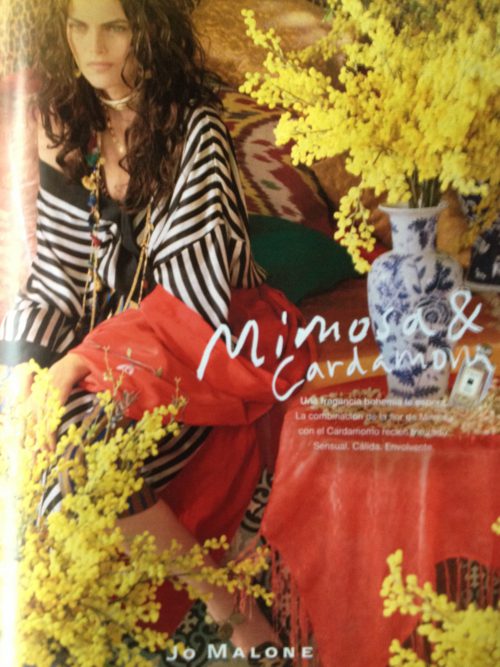
The copy says that the combination of mimosa and cardamom is “sensual, warm and enveloping.” Fine. Now, strangely, part of the tablecloth is hooked to, I don’t know for sure, either a branch of mimosa or the model’s ankle just behind it (more likely the branch, however). This, in my opinion, is completely crazy. How could the advertisers overlook such a blunder? Couldn’t they just disentangle the tablecloth from the plant or the model’s ankle bracelet before taking the picture? How much were these incompetent fools paid for the shot?
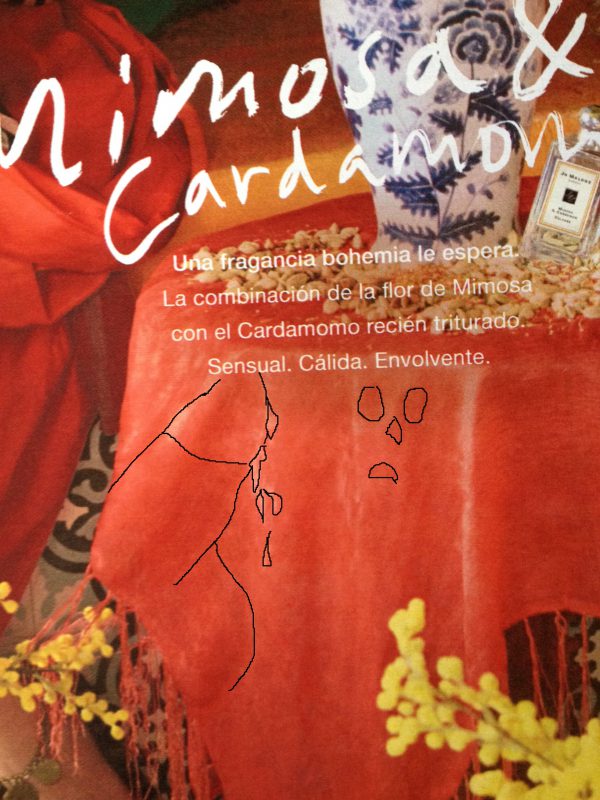
Yet, when you look more carefully at the tablecloth, you see that the fold it is making due to its entanglement with the mimosa looks like an erect penis. It’s not that they needed the hooking to make the fold, because most of the picture seems to have been airbrushed and they could have airbrushed any type of fold they wanted, but they needed a dissonant element to draw your subconscious attention to the subliminal sexual depiction. From the tip of the penis, sperm, drawn as white irregular blots, is spurting (sluggishly). This ejaculation happens on the same spot where the copy’s word “sensual” is written.
Further on the right of the penis, you can see a spectral face on the cloth. The model herself has something eerie about her. She may be described, except for the closed mouth, as been completely thoughtless and emotionless, as if zombified.
Case 90

90-2
90-3
…………….Case 91 Travelkids SEX
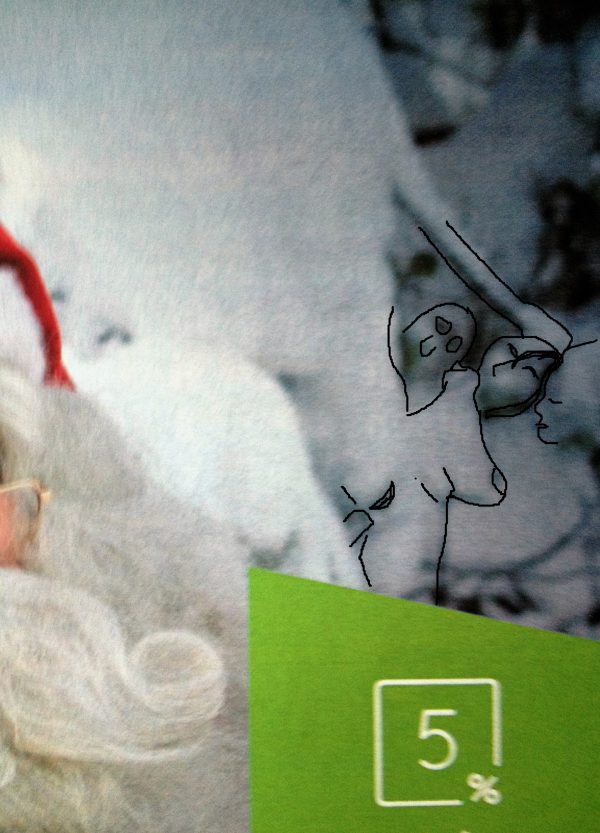
Travelkids organizes travels and sojourns “for the family.” Yet, in case you would find it a bit trite, they suggest you may find more excitement than just that. I am not talking about the meeting with Santa Claus, which is the copy line, but of the subliminal embed in the background. A woman is laid with two men. One man is lying beneath her; you can see his face, looking at you, between her right thigh and her right breast. The other man’s face is against her face. I have also outlined what seem to be a stretched arm and a hand resting on the woman’s head, hinting at the possible presence of a third man. The man beneath the woman is penetrating her in the anus (picture 91-3). The vaginal slit may be stuffed with a penis too, if you look carefully, but I have not outlined this because I’m not so sure there.

Case 91

91-2
91-3
…………….Case 92 Rabat (Barcelona Madrid Valencia) SEX
The bust shows almost only naked parts, uncovered skin. The pattern of the few centimeters of dress that you can see looks like spermatozoa.
Under the model’s eyes, in the shady area, have been embedded a couple of SEXes which I leave to you to spot.
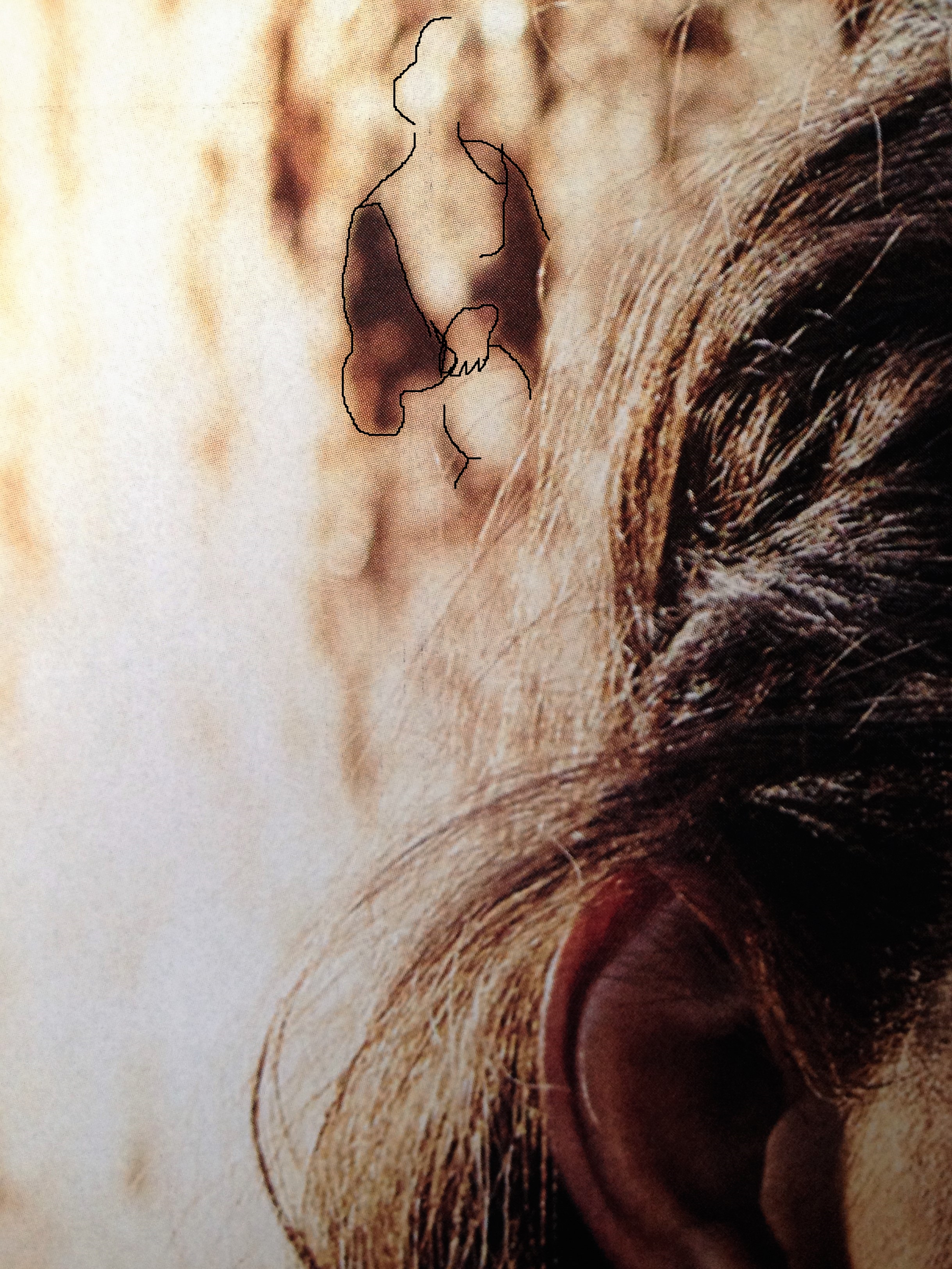
What I have concentrated on is the subliminal presence, in the background, of a woman wearing only a dark shirt or blouse wide open on her naked breast. The blouse has fallen down her shoulders, slightly, so the shoulders too are largely uncovered. Her left hand is on her vagina. The inclination of the head hints at a moment of abandon. That subliminal woman is masturbating.

Case 92

92-2
…………….Case 93 Gucci SEX
Cases 93 to 95 are from Cosmopolitan UK Edition, October 2015.
On the left page of this two-page advert for perfume, you can see, beside the name of the brand and the copy (“Underneath it all she wears Gucci Bamboo” – this by itself is eroticism, isn’t it?), a Japanese-like ink print, complete with birds in bamboo trees and grass by a river. The river stream and grass stand for a moist, oozing vaginal slit with pubic hair.
The model on the right page, wearing a risqué evening dress, is looking at you intensely. You too are on the picture, mind you, because albeit you may think the shadow on the wall is hers, whose shadow is it that is on her? There is only one shadow and that’s the shadow of a man with erect penis (outlined on picture 93-2). This is whom the woman is looking at.

Case 93

93-2
…………….Case 94 Pantene SEX
Are words necessary? I don’t know how to tell you, but there’s not even a façade of propriety in your world. You talk like a person of worth and dignity, and yet that’s the kind of stuff your guests will find in your living room, on the sofa or under the coffee table – depictions of fellatio.
Please take a look at what I wrote on Case 72 (here), where I already discussed the “blow dry” copy. The present advert confirms that I am right. For, yes, it’s a fellatio that you’re seeing just now. And it’s a fellatio that was intended, with that hairdryer and that wide-open mouth. Had it not been intended, there would have been some guy in the staff telling the others: “Shouldn’t we do something to make the picture look less like a fellatio?” And someone would have replied: “Oh yes, it’s true some people will think of a fellatio! Let’s do something about it.” No, they wanted it that way.

Case 94
……………Case 95 Fiat SEX
A female hand is about to apply lipstick to a car rear light. Because, as the copy goes, the rear light is as glossy as lipstick. On the other hand, the stick is about to penetrate the dark space between the red glossy “lining” of the rear light. Another sexual representation.
Why do women put on lipstick in the first place? According to evolutionary psychologists, it’s a way to simulate sexual arousal, since her lips tend to redden and shine when a woman is aroused; such a state of arousal being in its turn sexually arousing for men, lipstick makes women more attractive. It’s like swollen genitals during estrus among certain primate species. Among species with visible estrus, a female can take no rest at these periods because all males want to copulate with her, and even if she’s monopolized by one dominant male he won’t stop copulating with her, in case she would be inseminated by another male despite his vigilance (and he wants to counter the other male’s semen with his own: this is called sperm competition, see my Science of Sex series).
In echo with Case 88 (Tyrannosaurus Toyota), even though the ad is obviously aimed at women, its copy intends to be alluring to aggressiveness: “The Icon Reloaded. Change the Fiat 500? That’s crazy talk. So we set out to subtly style-up the little beauty. Take a look at the red hot halo-style rear lights with body coloured inserts. Just one of many ferociously fashionable (author’s emphasis) touches that make the new Fiat 500 even glossier. Shine baby, shine.” Being fashionable is not enough, one must be “ferociously” fashionable. Many a psychologist (even among evolutionary psychologists) will tell you women are not aggressive… They don’t live in the same world as us, seemingly. Women are aggressive and when they mean business they know how to use men as weapons.
“Icon” can apply both to the car and the customer, that is, the female ad viewer. If the latter needs “reloading,” and that can mean something very organic such as vagina-loading (this is consistent with the whole seduction line of the ad), she may reach out for the car.

Case 95
…………….Complements
Have I the right to make use of all these adverts without asking permission? I have read several scholarly books dealing (more or less competently) with advertising, and they all thank the companies for their kind permission to let them use their material.
On one occasion, when Kentucky Fried Chicken faced a viral campaign on the Web because of a racist ad, first they hinted ominously at unpermitted use of their advert by the people who launched the campaign. Then they pulled the ad like good boys.
Still, I find it would be strange that the companies that otherwise pay for an advertisement to be made for one of their products and also pay for that advert to appear in various media, object to another medium showing the same material without asking money for it. To be sure, I take the liberty of making comments on that material, which the other media never do (they take the money and shut up – that’s what they call informing the public). This is why I add here the following excerpt from Eric McLuhan’s introduction to the 2014 edition of Marshall McLuhan’s book Culture Is Our Business (1970):
Many have wondered at the lack of acknowledged permissions for using the ads in both books [The Mechanical Bride and Culture Is Our Business]. The reason is that permissions were unnecessary: the ads were available for free. Editors at Vanguard had found a curious legal fiction. Advertisers were being given huge tax breaks on the grounds that they were engaged in a sort of educational enterprise, “educating the public” about products so that it might better make informed choices. The upshot is that anyone can make use of the (government-supported) ads for free providing they were not being used as ads, but as educational materials, for educative purposes. Needless to say, the agencies were reluctant to let these matters become known to the public.
And, on behalf of advertisers, thank you for the tax breaks.
Whether this legal provision applies to my case or not, I haven’t the slightest clue (under which jurisdiction lies this blog is unknown to me), but I guess that if multinationals want to crush me or anyone, they have the means. But I, on my side, have nothing to lose. (They perhaps have the means to buy me, as an alternative, who knows?)
I’ve got nothing to lose and besides I’m not alone; there is at least one living dead with me, namely Aldous Huxley, whose Brave New World Revisited (1958), written some 25 years after Brave New World, I urge you to read, especially, regarding the present topic, its chapter IX “Subconscious Persuasion,” which I quote:
Poetzl was one of the portents which, when writing Brave New World, I somehow overlooked. There is no reference in my fable to subliminal projection. It is a mistake of omission which, if I were to rewrite the book today, I should most certainly correct.
Last but not least, a quote from William James on his views about the “transmarginal field of consciousness,” in The Varieties of Religious Experience (1902):
Such rapid abolition of ancient impulses and propensities [by religious conversion] reminds us so strongly of what has been observed as the result of hypnotic suggestion that it is difficult not to believe that subliminal influences play the decisive part in these abrupt changes of heart, just as they do in hypnotism. Suggestive therapeutics abound in records of cure, after a few sittings, of inveterate bad habits with which the patient, left to ordinary moral and physical influences, had struggled in vain. Both drunkenness and sexual vice have been cured in this way, action through the subliminal seeming thus in many individuals to have the prerogative of inducing relatively stable change (author’s emphasis). If the grace of God miraculously operates, it probably operates through the subliminal door, then.
and
Incursions from beyond the transmarginal region have a peculiar power to increase conviction.”
And the money-grubbers would deem it below their dignity to make use of such a powerful tool at their disposal?
July 2016


