
Tagged: Wilson Bryan Key
Subliminal Advertising VI: Cosmopolitan Spiegel
The advertising community is not particularly interested in confessing to the use of subliminal messages, and there appears to be no good source to document their prevalence. Back in the 1980s, I asked an advertising executive at Wyse Advertising if he had any insights into the use of subliminal messages in advertising. … He estimated that about 10% of all ads use some form of subliminal technique. (Glenn G. Sparks, Media Effects Research. A Basic Overview, Fifth Edition, 2015, p.216)
The quote is from a course manual for undergraduate students in the communications field authored by a professor at Purdue University. The fact that the manual has gone through five editions so far is testimony to its success and perhaps to its quality as teaching material. Such a quote should be proof enough that the subject of subliminal advertising is not, as some believe, an ‘urban legend’ or a hoax for self-proclaimed ‘hoax busters’ — shooting anything that moves — to bust. The advertising executive’s confession is gold, although the correct figure, as far as current printed advertising is concerned (newspapers, magazines, billboards), is closer to 100% than to 10% at this juncture.
When advertisers themselves confess to the practice, the denying attitude of some scholars (among them a few self-proclaimed hoax busters) strikes one as very odd. When I read, for instance, the following (quoted by Sparks, p.217):
Perhaps now is the time to lay the myth of subliminal sorcery to rest and direct our attention to other, more scientifically documented ways of understanding the causes of human behavior and improving our condition. (Pratkanis, The cargo-cult science [sic] of subliminal persuasion, 1992)
I have only this to say: Go tell the advertisers.
As Sparks explains, Pratkanis found out that products such as tapes based on alleged subliminal techniques and marketed to increase self-esteem or improve one’s moods (a $50 million business in 1990, according to Acland, 2011) are placebos. This is certainly worth knowing but does not allow one to talk about a ‘myth of subliminal sorcery.’ Wilson Bryan Key contends that subliminal persuasion in media advertising relies on the priming offered by media content – in newspapers the bad news (content) primes for the good news (ads), on Mcluhanian lines, and in magazines it is the lifestyle-oriented content that primes for the ads. As the priming effect is missing in the material tested by Pratkanis, his experiments have nothing to say on such a persuasion system.
But, I repeat, if subliminal advertising has no effect according to laboratory experiments, this information should be forwarded primarily to the advertisers themselves, who — as I am documenting on this website with the present series — are using subliminal techniques extensively, at least in the sex embed variety, on which I am currently concentrating. Otherwise, I don’t know if it’s the same for you but I really feel that disparaging terms such as ‘cargo-cult science’, ‘myth’, ‘sorcery’ sound like a design to defuse the potential consequences of consumers’ concern upon vested interests. This feeling, I know, is not rational, for what is rational is to maintain that scholars are independent from vested interests; the bombast in these disparagements is only the camouflage of the naive. For naive it is, indeed, to presume advertising agencies don’t know their job, considering their own research gets financing which an (independent) academic scholar would never dream of. An advertiser is likely to know his job, despite his claims to the contrary.
In this context, the confession of the advertising executive quoted above is, once again, striking, since the proprietary knowledge of advertising agencies is guaranteed by law from public scrutiny.
The following advertisements are taken from the German weekly Der Spiegel dated April 11, 2015 (Cases 40-43), and the magazine Cosmopolitan (UK Edition) dated May 2015 (Cases 44-46).
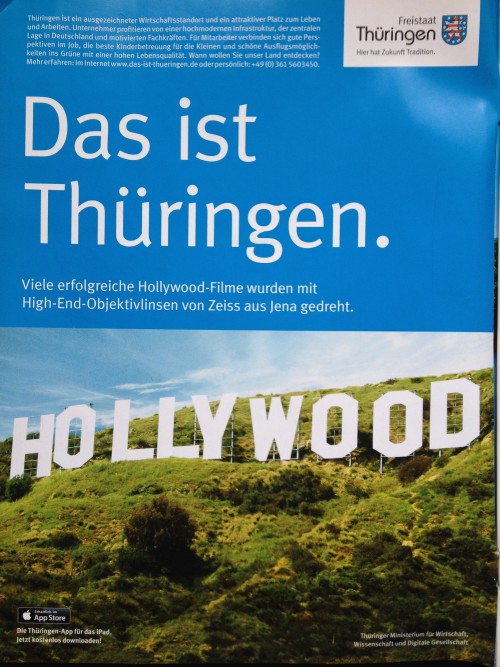
…………….Case 40 Freistaat Thüringen SEX
When the Free State of Thuringia, one of Germany’s Länder, or any public collectivity advertises, with the taxpayer’s money, its existence on the market, in order to allure tourists or investors, or for whatever reason, it contracts with an expensive advertising agency. The presence of sex embeds comes as no surprise.
case 40

40-2 click to enlarge

40-3 click to enlarge
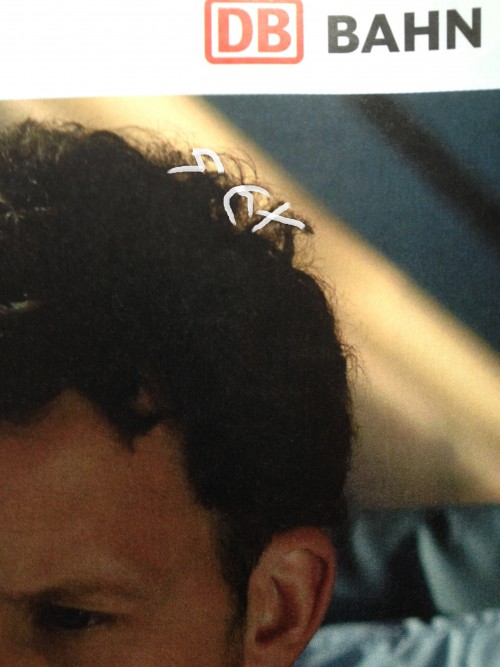
…………….Case 41 Deutsche Bahn SEX
This one is for the German railways company. In the world of advertisement, men have not learned to comb their hair nor to shave their beards, because uncombed hair and incipient beard are convenient settings where to embed SEXes. As a result of men’s so often seeing uncombed hair and incipient beards on advertisements, the scruffy looks have become trendy in the real world.
There could be another reason for incipient beards being fashionable. The world of advertisements is a world of total freedom and enjoyment of one’s time and pleasure, without restraint; in that world there is simply no place for the organization man, with his suit and tie and long working weeks and subservience to the organization’s goals. The numerous organization men from the real world are torn between their real-life condition and the social desirability of appearing fashionable in accordance with advertisement’s canons. Incipient beard is the answer. Sporting an incipient beard, the suit-and-tie organization man is telling the world: “See? I have not shaved this morning, I do what I want, I am no relic from the oppressive past,” and that makes him socially acceptable, given that social acceptability is mostly based on appearance (fashion) and determined by advertisement conditioning. Ironically, the grooming of an incipient beard is much ado; you must shave or trim it regularly lest it become an unfashionable full beard.
As to the Deutsche Bahn advertisement, please observe how the embed is exposed in the light rather than camouflaged by the darker areas of the background.

Case 41

41-2
41-3
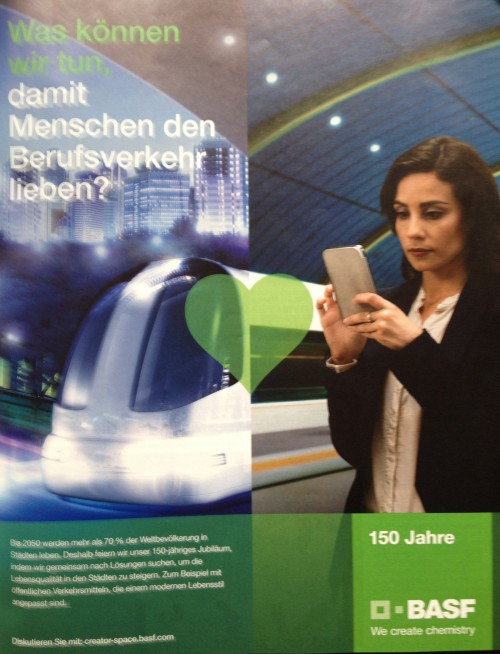
…………….Case 42 BASF SEX
Case 42

42-2

42-3
…………….Case 43 Book Cover SEX
I can’t say for sure whether the embed lies on the book cover or on the advertisement alone, because I haven’t had the book in my hands. I wouldn’t be surprised in the least if the embeds lied on the real cover. The book is supposed to be a serious one; this is why, certainly, it needs a bit of subliminal up-sexing.

Case 43

43-2 click to enlarge

43-3 click to enlarge
…………….Case 44 Dior SEX

Case 44

44-2

44-3
…………….Case 45 Garnier SEX
To find the sex embeds, follow her look.

Case 45

45-2

45-3
…………….Case 46 Hyundai SEX
To create the sensation of speed, the graphic designer has fuzzed parts of the picture, a banal technique whose advantage is to make embedding very convenient. I have outlined one sex embed. Use your own skills and try to find the others. Enjoy.

Case 46

46-2

46-3
Subliminal Advertising III: Night and Day Pollution
Cases 10 to 14 are taken from a single issue of the French news weekly L’Express, dated March 18-24, 2015. Cases 15 to 23 come from a single issue of the French women’s weekly magazine Elle, dated March 20, 2015.
Although taken from French journals, many of these ads are promoting multinationals’ brands and were designed by advertising agencies with international marketing in view (I am quite confident they can be found in other countries too).
Same as previously (for more case studies, and for the theory, please click on the Subliminal category from the menu on the right), for each case I present an overall picture of the ad first, then a picture focusing on the relevant part of it, where the subliminal or subliminals are, and finally a third picture with the sub outlined on my computer so you can compare with picture 2. Case 15 has only two pictures since a picture 2 wasn’t needed. Case 16 has five pics, because I focus on two different spots.
…………… Case 10 The No Sex Fear
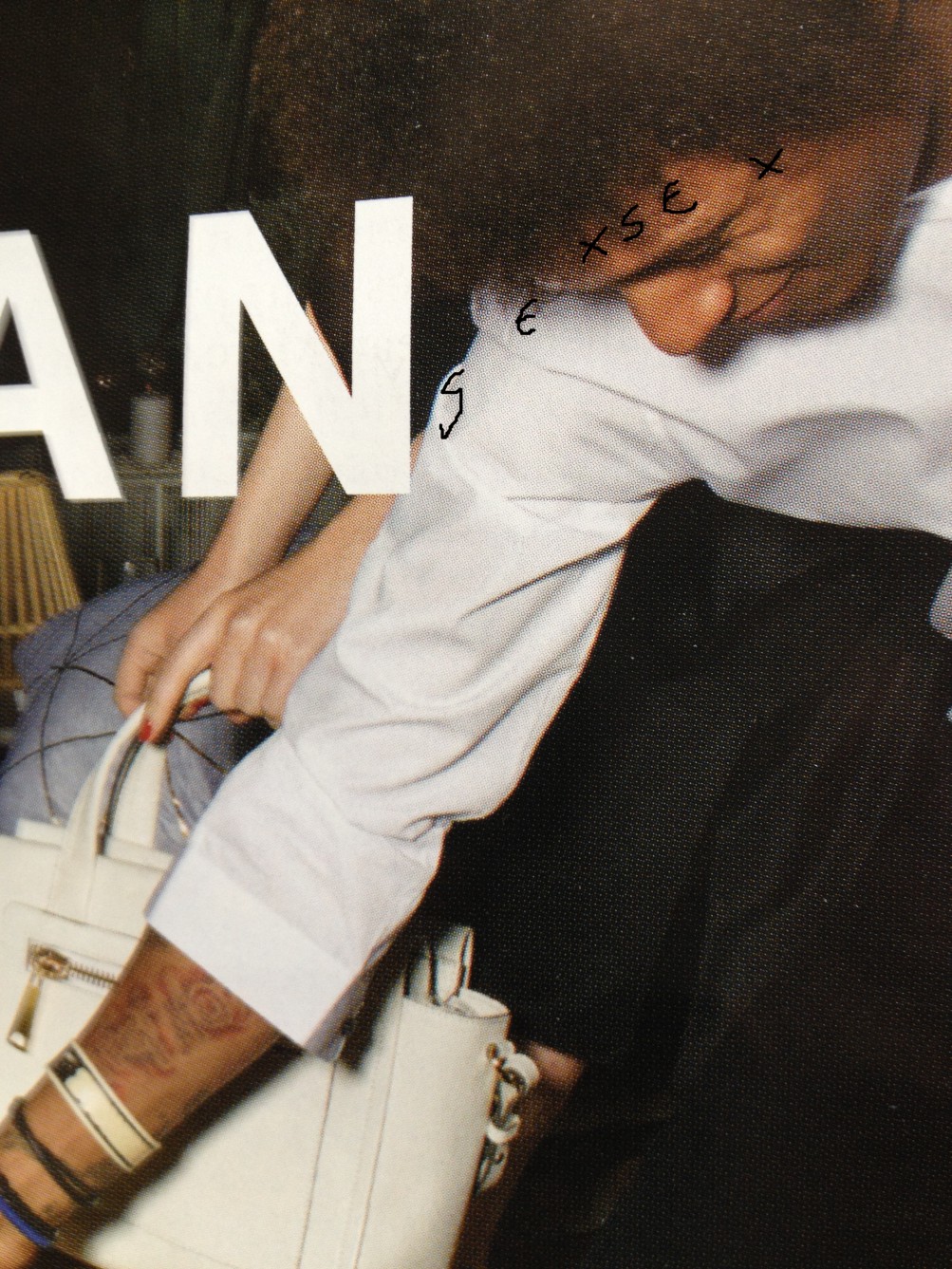
On this ad for the fashion brand Hogan sex embeds are located on the dancing man on the right. I have outlined two embeds on his right arm and forehead, but there are several more tiny ones on his shoes and one more on his arm tattoo as well. Interestingly enough, most conspicuous from his tattoo is the word NO. With the outlined sex embeds the message, actually, reads NO SEX.
One way to analyze this subliminal message would be that it is a vicious injunction meant to subliminally hinder sex life, because sexually deprived people would be more receptive to advertising and consume more. I believe this would be a line of argument favored by W.B. Key, pioneer in the study of subliminal advertising, whom I have already cited (here).
I can see at least two other reasons for a No Sex subliminal message. It would be reassuring to young women. The party displayed in the ad only suggests fun, mind you. In other words, it is not showing the last decent moments (very relatively decent, in fact) before a sex orgy. It happens sometimes that girls who only want to have fun end up having sex without caring for it. Doesn’t it?
On the other hand, the No Sex message could also be a reminder: We remind you that you have no sex in your life. As the main targets of this brand are young people, a good deal of them never had sex. Given that sex is a passage from child to adult, the fear that one might never experience sex and become an adult is a real factor in adolescent psychology. This is the no sex fear, which the ad intents to exploit subliminally.

Case 10

10 – 2
10 – 3
…………… Case 11
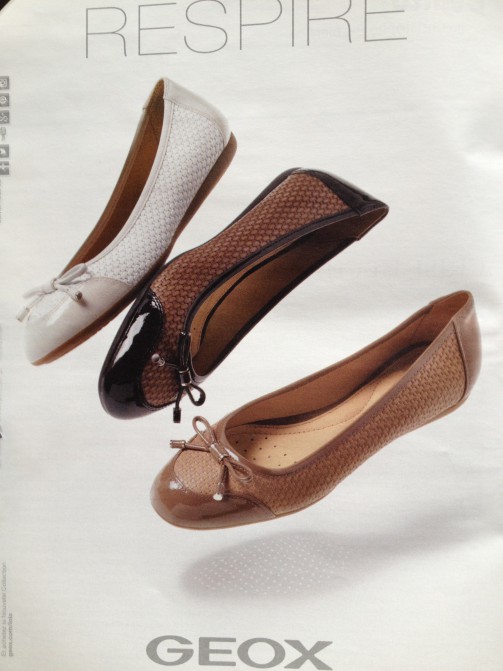
On this ad for the Italian-based fashion brand Geox, the pattern of the displayed shoes offers an easy opportunity for embedding. In the shadow of the white shoe’s lace, the graphist has painted an E. The S and X are provided by the pattern itself, slightly darkened in the case of the X.
Case 11

11 – 2

11 – 3
……………. Case 12
This brand of coffee advertises a partnership with Nespresso. At first sight, given the dull aspect of the ad, full of boring text that no one would ever care to read, I told myself there must be something bold to look for. I wasn’t disappointed. See the shadows on the jersey.

Case 12

12 – 2

12 – 3
…………… Case 13
This one for the state-owned French bank La Banque Postale.

Case 13

13 – 2

13 – 3
……………. Case 14
This one promotes the DVDs of the American TV series Boardwalk Empire. The blood on the face delineates, rather conspicuously, the letters S and X. The letter E is there, of course, but not so apparent.

Case 14

14 – 2

14 – 3
…………… Case 15 Emporio Armani
With this case begins the series from the women’s magazine Elle. The sex embeds have been painted as reflections on the girl’s glasses.

Case 15

15 – 2
……………. Case 16 Ralph Lauren
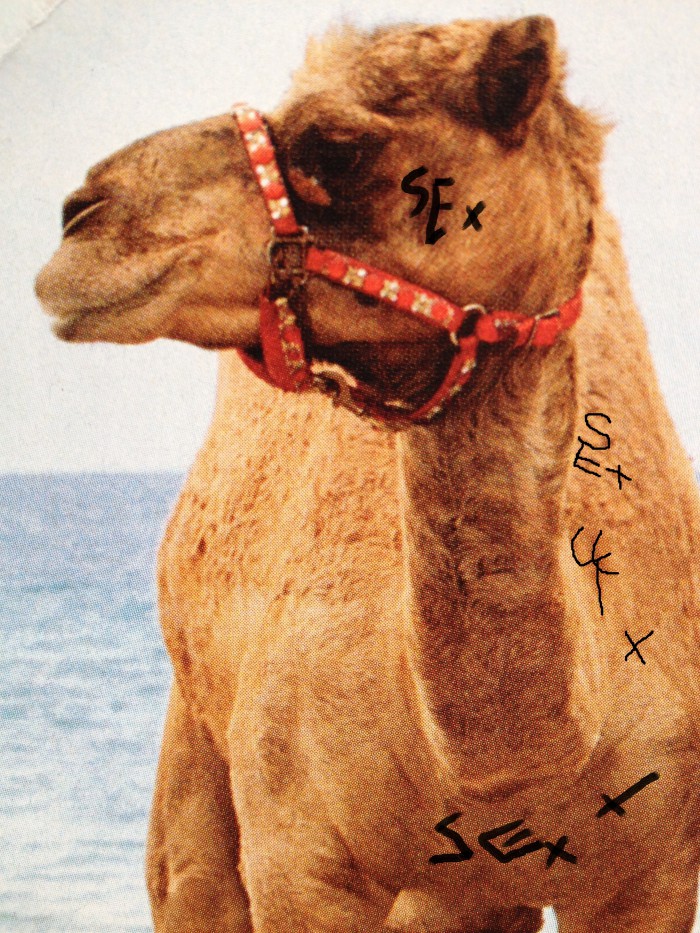
The main camel in the background is covered with embeds. I have outlined the four most conspicuous. The gown of the lady exhibits at least one sex embed too, at the bottom, painted as folds and shades.

Case 16

16 – 2
16 – 3

16 – 4

16 – 5
……………. Case 17 Burberry
These are models Naomi Campbell and Jourdan Dunn. Naomi’s lips have been adorned with a SEX, embedded amidst the natural furrows of these fleshy parts.

Case 17

17 – 2

17 – 3
…………… Case 18 Salvatore Ferragano

Case 18

18 – 2

18 – 3
……………. Case 19 Kenzo

Case 19

19 – 2

19 – 3
……………. Case 20 ba&sh

Case 20

20 – 2

20 – 3
…………… Case 21 Furla
The sex embed lies on the lady’s dress. The S has been painted as a fold, the E is a lighter red than the background, and the X is made via the seam.

Case 21

21 – 2

21 – 3
…………… Case 22 What For Shoes

Case 22

22 – 2

22 – 3
…………… Case 23 La Redoute
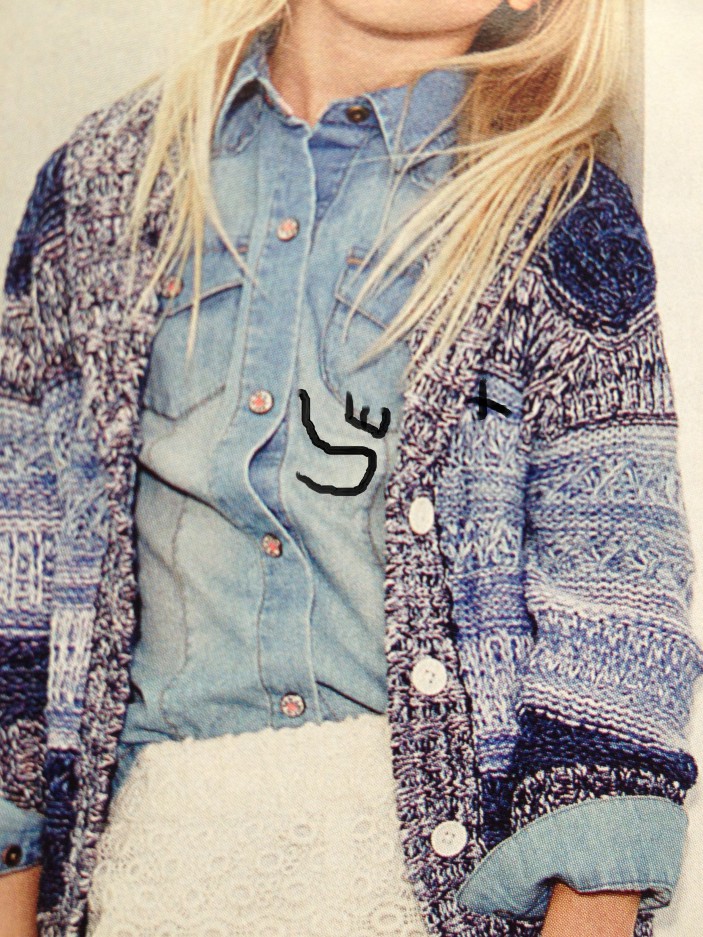
Last but not least, a sex embed on a preadolescent girl, for the French distance selling company La Redoute.

Case 23

23 – 2
23 – 3
March 2015
 florent boucharel rAd-Free