
Tagged: criminal law
Law 12: The Lunar Breeze Effect Flag
The Lunar Breeze Effect Flag
For full understanding of the following, read section The Latest on Wikipedia’s Moon Landing Hoax Debunking in Law 10.
“Neil, it’s cool you went on the Moon but… a good artistic picture is what matters.”
“One that ties the room together.”
So you take the French Wikipedia version for granted. Yet the English Wikipedia version is different: “The flag was rippled because it had been folded during storage – the ripples could be mistaken for movement in a still photo.” Here there is no word about an intention to tie the room together, the ripples are accidental, they are folds due to storage which turn out to make the flag look as if it were fluttering in the wind.
As if the authors of the English Wikipedia page dared not confess what my interlocutor endorses wholeheartedly. As if, namely, they doubted it was judicious to fake a flag fluttering in the wind in a picture shot on the moon. As if they dared not confess it because of the issue involved in taking people for idiots.


*
Crack Hills Have Eyes 2
See Law 11.
Politicians make laws (lawmaker=the legislative power) and they also enforce laws as executive power (from which police take their orders). What my post denounced about Crack Hill is that politicians qua executive power do not enforce the law politicians vote qua legislative power. That is, as taking crack is a criminal offence, politicians qua executive are taking a very light view of the law when they enforce it by distributing pipes and paying hotel rooms to criminals. If this is their idea of the issue, then they must take the initiative of a legislative debate to repeal the law and decriminalize crack consumption, and stop telling people they enforce the law by ignoring it. This is a huge problem, because when executive officials do not want to enforce the law, they don’t bother to have it repealed, they just instruct the services, the admnistration (police etc.) to ignore it, or to do as they please. A crackhead in France may live in a free hotel room with new pipes every Thursday or behind bars, it all depends on the police’s mood. This is not the rule of law.
ii
Government protectionism of the black market.
Yes, government and police protectionism of the black market, since without police forces the government could do nothing, so the police are always responsible (if only by abiding) whereas one may imagine cases where only police are responsible while the executive authorities know nothing of what is going on.
Now, as my interlocutor compared enforcement of Eighteenth Amendment and the Volstead Act (Prohibition) with the contemporary war on drugs, let me add the following. The same politicians who in France are implementing the brilliant crack plan I have just been talking of, eschewing enforcement of national drug laws, are eager to point at the figures of prison inmates in the U.S. (highest rate of prison inmates per inhabitant in the world, so they say) as a reason why they ought not to follow the same path. In several other, perhaps most European countries, the same discourse can be heard. But these fellows dare not repeal their own national drug laws, and the result of this slighting of the law is that these countries are not rule of law countries anymore. The prison population figure is the price the United States is paying for upholding the rule of law. God Bless America for that. In Europe they are leaving everything at the discretion of the bureaucracy. Whether one will be punished for consuming drugs depends not on the law (which still says they must be punished) but on how they were perceived at some point by some person in the bureaucracy, some cop, who will have them prosecuted in spite of the unwritten rule of bureaucracy saying that those poor devils should be left alone.
The poor devil who did not please the cop will be prosecuted, a judge will hear him and, say we are in France, a country of written law, the judge, although he has heard of the bureaucratic rule, will open the legal code at the page where the article laying down the penalties for consuming drugs lies, and he will condemn the poor devil. (Compared to the functionarial nonentity that a French judge is, American judges are intellectuals.)
This is what European politicians are so proud of – the fact that no one knows what to expect. They revel in a world of arbitrariness.
*
Biden supports suppressing online “misinformation,” press secretary says.
Was it on his electoral platform or does he just add it now as an extra?
*
Justin Trudeau dismisses critics of internet censorship bill as “tin foil hats.”
The same person explained that derogatory speech is the same as shouting fire in a crowded theater – the classic example in SCOTUS (Supreme Court of the United States) case law that would serve to send his bill to the garbage can.
*
Lying
“Free speech” lawyer argues “lying” should be an impeachable offense.
The levels of nincompoopery in academia (“law professor at George Washington University”) are staggering. To think that these people are comfortable talking about truth and lies as they do… They really have got no clue. Let me take an example. Husband and wife want to divorce because it turns out they don’t see things the same way. One issue to settle is who will keep the children. Why is it an issue? Because husband and wife both want to raise the kids according to his or her own views and ideas, according to how he or she sees things. Will you ask a law professor at George Washington University to tell the judge whose ideas are truths and whose are untruths, calling the latter lies, before taking a decision? Nonsense. If an amicus curiae talked like that (within an acceptable margin in the frame of the society – as expressing some ideas, like belief in witchcraft or alien abductions, would probably be detrimental in the case to the party expressing these ideas) he would be dismissed at once, as trying to impose his or her own set of preconceived ideas.
ii
What I wrote may sound confusing, at least for two kinds of people in America. Some will remember that experts in American courts are experts of the parties, who try to sustain their party’s position, whereas I seem to be talking of experts of the courts, which exist in civil law (as opposed to common law) countries, experts who had rather remain as neutral as possible in order not to fall into disrepute.
Others will remember that in America jury trial is the rule in civil trials and I seem to omit the fact completely. In fact, divorce trials by jury are rare even in the U.S.: « Only a few states allow for any type of jury trial in a divorce case. Even then, those states limit the issues that can go before a jury. For example, Texas, which has the most liberal rules concerning jury trials in divorce cases, is the only state that allows juries to decide which parent gets custody of the children and where the children will live. » (rightlawyers.com) Unless most divorces occur in Texas, the majority of divorced American parents must abide by a decision on who is to keep the children which was not taken by a jury.
Still, if an expert smugly told the judge, like some professor of George Washington University, that the kids cannot be in custody of the father, for instance, because the father voted for Trump and Trump is a liar so you cannot rely on such a one to take care of kids, she would be laughed at or I do not know my judge. Yet she writes books like that, which tells you what a tyrant she must be in her classroom, even if people shrug shoulders at her in most other circumstances.
Now, judges are probably more of an official’s profile than the majority of people, so the fact that divorce trials are not decided by juries is also more likely to be detrimental to parents who hold certain ideas, even not so fringe as belief in alien abductions. I should think a parent known to be a Gab user, for instance, is likely to lose his kids in a divorce court when a divorce is filed. Prove me wrong.
*
UK government accused of promoting a “nanny state” with proposed online ban on high calorie food ads.
Is commercial speech speech or rather the polluting of speech? Commercial speech wasn’t protected in the US before the 1970s (Virginia State Pharmacy Board v. Virginia Citizens Consumer Council, 1976). This is the kind of view that makes authoritarian regimes comfortable with their speech suppression systems, as they can say to their people: See, we’re protecting you and your free thinking from the relentless, nauseating pushing by unthinking business whose sole aim is profit. In any case, while the US Supreme Court has found that commercial speech is speech, it does not grant it the same level of protection as non-commercial speech, so the UK policy here described could be implemented in the states too within the law.
*
Bonkers About Lèse-Majesté
Prince Harry complains about online “misinformation” calls First Amendment “bonkers.”
Prince Harry: “I’ve got so much I want to say about the First Amendment; I still don’t understand it, but it is bonkers.” No surprise: “In 2013, the Ministry of Justice admitted that the Treason Felony Act 1848 had accidentally been ditched. The 165-year-old law threatens anyone calling for the abolition of the monarchy with life imprisonment.” (The Sun, Oct 20, 2016)
Information about lese-majeste legislation in UK is deceptive: As the headline from The Sun shows, they make all sorts of claims, so much so that nobody can know what the legal situation is. (Call that the rule of law?) On Wikipedia page Lèse-majesté, for UK they write: “The Treason Felony Act of 1848 makes it an offence to advocate for the abolition of the monarchy. Such advocation is punishable by up to life imprisonment under the Act. Though still in the statute book, the law is no longer enforced.” Yet the source for that is a Dec 2013 paper by The Guardian, “Calling for abolition of monarchy is still illegal, UK justice ministry admits,” with subtitle “Department wrongly announced that section of law threatening people with life imprisonment had been repealed.” The government spreads misinformation on the issue. That the law be no longer enforced does not mean it will not be enforced in case someone violates it; only, without proof to the contrary, that nobody dares speak freely on the issue! Except, probably, ‘accredited’ cartoonists trained in the art of sycophancy under the guise of joking, i.e., court jesters.
ii
As Harry has in his native country a history of blundering (google “Harry the Nazi”), it is relevant to stress that his calling American First Amendment “bonkers” is not one more blunder according to British royalty’s etiquette but on the contrary full compliance with it. The extraordinary sequence of the British government claiming lese-majeste laws void and then retracting, claiming to have repealed them and then denying, is the (one may say comical) confirmation that, deep within, these people see no wrong in punishing speech with life imprisonment. The appalling statute, worse than the classic example of Thai monarchy (where offensive speech about the King is punishable with a maximum of 15 years’ imprisonment, compared to 3 years for the Sultan of Brunei) and whose status is at best uncertain, that is, of which nobody can say it is no longer part of British law because British lawmakers won’t make such a declaration without denying it at once, is among other things what shapes Prince Harry’s animus.
Now, that “Department wrongly announced” the repeal of the lese-majeste law is big lese-majeste, if you ask me, and should be punished with hanging. Because if they have not hanged people there for a while it must be due to some misunderstanding.
*
None of Your Business
The US will join the “Christchurch Call” to eliminate extremist content online. (May 2021)
“New Zealand man jailed for 21 months for sharing Christchurch shooting video” (BBC News, June 2019). Making it a crime to share this video amounts to claiming that the government must be the only source of truth. The only source of truth will be at the same time the agency that restricts access to evidence. Under a constitutional regime the government can make no claim to be an exclusive authority as to what the truth is. Hence, by restricting access to evidence it overrides its constitutional function and mocks constitutional liberties.
Here is how the government proceeds. You learn what happened in Christchurch and then the government tells you that, given what happened in Christchurch, they are going to carry out a set of policies that will curtail your fundamental liberties for the sake of peace and order. Then, when a citizen says, “Let’s see what happened in Christchurch” and makes the video of the shooting available online, he’s punished with 21 months imprisonment for inciting violence (or whatever fallacy they used). Thus, what happened in Christchurch is none of your business even though based on this event you are going to lose greatly in terms of freedom, or more simply you are going to lose your freedom. – What happened in Christchurch is the government’s business and you have no right to ask for evidence. “The only source of truth will be at the same time the agency that restricts access to evidence.”
*
An Axiom
“Independent judges versus employees of the king. In the common law tradition, judges are fully independent. In the civil law tradition, judges are no more than employees of the king. They are strictly monitored by higher courts, which are in turn monitored in a remarkable extent by the central government.” (Gerrit De Geest, American Law: A Comparative Primer, 2020)
It should be stressed that this describes, as far as the civil law tradition is concerned, police states, because the state is entirely absorbed in the government. The axiom is therefore that civil law countries are police states.
ii
“the French, with their centuries-long tradition of presenting case law as pure interpretations of codified law.” (De Geest, 2020, p. 64)
Granting it is true of the judicial judge, it is not so with the administrative judge, which has originated much of the administrative law in France, whole parts of which are judge-made (« droit d’origine jurisprudentielle »). – The political cartel is fond of leaving to the judge all lawmaking that crushes individuals under the boot of the police state.
De Geest is excusable, however, from a common law viewpoint, for overlooking that the administrative judge is a judge at all: “Believe it or not, the Conseil d’État, that is, the French supreme court for administrative law, belongs to the executive branch, not the judicial branch!” p. 86) It’s not about believing and joking but about what common law countries do to bring police states to reason.
*
“A plea bargain in a criminal case is the equivalent of a settlement in a civil case.” (Gerrit De Geest, American Law: A Comparative Primer, 2020, p. 70)
No. Plea bargaining is a modality of prosecution, not its eschewing. It has nothing to do with the debate on compulsory prosecution vs. principle of opportunity, and by the way De Geest wrongly associates compulsory prosecution with the civil law tradition; in major civil law countries such as France, Germany, the Netherlands, Sweden, the principle of opportunity obtains.
Lessons in Law 10: Libertarian Law
Bipartyism vs Multipartyism For Dummies
(Completes “Multipartyism is a corrupt form of people’s government” in Lesson 9)
From plurality voting to majority rule there must be, as far as the constitution of assemblies is concerned, a step of behind-doors negotiations between parties that escape voters’ choice entirely.
Bipartyism, the two-party system, means majority voting: The result is an absolute majority (above 50%). The electoral platform can be applied at once.
Multipartyism means plurality voting. Let us take three parties A, B and C with respective results 40%, 35% and 25%. Because the government needs majorities above 50% to have bills passed, party A must negotiate a coalition pact with B or C to get a majority in Parliament, usually in exchange of government positions. So, there will be a coalition government A+B or A+C formed upon a coalition pact that is different from all platforms presented to the electorate.
Let us now look at France, a multipartisan and parliamentary regime, where, that is, the government’s head is from the dominant party in the legislative body. The head of government thus governs based on a coalition pact bargained behind doors and not an electoral platform.
(There is in France another head of the executive, namely the president [président de la République], elected in a two-stage election that eliminates all candidates but two in the first stage, which could be seen as a kind of primaries, by which most voters are asked to express their best choice and then, at the second stage or general election, their second best [runoff principle]. The president in France has no power if the legislative assembly is of a different party, so I leave the dealing with him in parentheses even though he is the real ruler in case he is of the same majority as the assembly, so the real guy remains in parentheses, which shows you how absurd that system is. – In fact, the French president is in no way the “real guy” in the system, even when of the same party of the majority in Parliament: this is an illusion of commentators. Although he is elected on a platform which he does not have to discard the very next day, and he probably derives his greater aura as an institution from this, he cannot apply but the coalition pact of the coalition government. He is the coalition’s puppet.)
ii
“Because the government needs majorities above 50% to have bills passed”: Allow me to expatiate.
A vote on a bill is basically a yes-no question, votes are yes or no, so yes or no (pass or not) will at least get 50 percent of the votes. Those not present to vote (or with no proxy) or abstaining may make the result less than 50 (51) percent of members but that is not taken into account (a majority of members is not required, only a majority of votes).
One could also imagine an actual abstention vote (yes, no, or abstention, as in polls) that could then make the result less than 50 percent of voters, and then a bill could pass by a plurality vote.
All in all, what a government needs in the legislative body is enough people to vote the bills. This is why most multipartisan regimes make it compulsory for the first past the post (plurality winner) to start forming a coalition after election day, that is, to enter in a secret, clandestine coalition deal.
Some regimes do not, however (like Denmark): A government is formed from the party that has got a plurality of, say, 40 percent of the electorate’s vote and 40 percent of the seats in the legislative body. This minority government withholds the electoral platform for which it was elected but it will present bills to a legislative body where he only has 40 percent of yeses secured (we’re talking of an ‘ideal’ situation where party members are 100 percent aligned on the government’s platform but figures for U.S. Congress, for instance, give a 90 percent congruence). At some point or other, even there the government will have to form a coalition, as it has no bargaining power with the opposition except in this way (because a government’s only power on representatives is to offer government positions, as parliamentary regimes are those where representatives have no other ambition than to make it to the government, so a political coalition can only mean a coalition government in the final analysis).
Now such a system as I am describing is so disrespectful of the citizenry that even when parties make electoral deals where some withdraw candidates from some districts in exchange of the other parties withdrawing their candidates from other districts, that is, even though they are already agreed to form a coalition in case of victory, both parties still have no common platform and pretend to defend a platform of their own they know they won’t withhold unamended in case of victory.
This is the vicious nature of multipartyism.
In contrast I call the attention on the ‘top two’ system in the state of Washington, where after the primaries two candidates from the same party may be competitors in the general election. This is the true essence of a two-party system: The idea is not to get as many political parties as there are political ideologies, or currents, or opinions, or nuances (and in fact as there are politicians’ ego trips) but to get two parties where all ideas can find expression and in the frame of which they compete with one another. Two parties for all ideas.
*
Electoral College
One critic of the American Electoral College writes: “Certainly, if one believes that the person who receives the most votes should win, the implications for democracy are evident.” (L.S. Maisel) The author means suppression of the electoral college. But certainly, such implication is not at all evident. In both federal and unitary (nonfederal) systems the winner gets the most votes (so a “minority winner” is a bogus notion anyway): In U.S. the winner gets the most votes of the electoral college, elsewhere he gets the most votes according to the respective systems.
Look at the following map (found on Twitter a while ago, with no source mentioned).
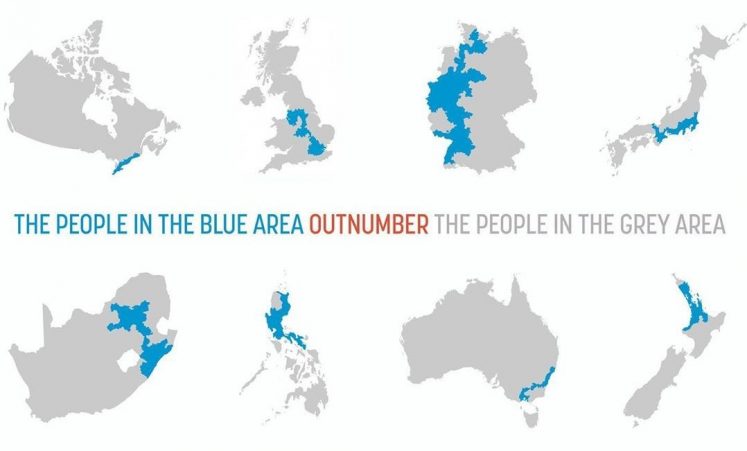
In all these countries one observes a marked demographic imbalance between geographic parts (Canada and Australia are particularly salient cases). In all these countries, without a single electoral district system there can be no “one man one vote” principle unless one divides the blue area in a multitude of districts and the grey area in few districts, which would be absurd as the districts would then be mere geographic fictions, which states in a federal union are not (they have historical meaning).
Indeed, as countries with single election districts are a small minority, the principle one man one vote is a rarity among democracies for national level elections of assemblies.
In any case, whether one, in demographically imbalanced nations, which are the rule rather than the exception, adopts a single district system or a multiple districts system with mathematic precision as to district equality re population numbers, departure from one man one vote in a federal system is constitutionally mandatory at the federal level. If this is not democratic, then a federal constitution is not democratic either in the first place and the subject is not the electoral college but the federal structure.
*
The Criminal’s Debt to Whom?
We all have heard of cases of alleged rape ending because the accused man pays money to his accuser and there is no trial. Something I don’t understand. Rape is a crime coming under criminal law. If one can have a rape trial cancelled by a financial deal, which satisfies prosecuting authorities, why is it not the same with, say, murder? The victim’s relatives could be given money (blood money) and the prosecutor would drop the case as a result of this financial compensation. Yet it does not happen: With murder there is a trial, only with rape there is not.
The implication is disturbing, as it amounts to saying that well-off rapists have no debt to the society but only to their victims.
If we’ve got criminal law rather than an all-encompassing tort law, it is because the government says criminals must pay their debt TO THE SOCIETY. Where there is no trial because of a financial agreement, like, as I said, in some rape cases, we are not talking of crime.
Assuming with great certainty that some other crimes (on paper), like assault, are subject to the same treatment (although the legislator never said a word on where to draw the line), the idea that justice treats differently the rich and the poor takes a more precise shape: No matter what they do, short of homicide, the rich must pay their debts not to the society but to their victims only, they cannot be criminals according to the system.
*
Prone Restraint
Derek Chauvin must have had an extremely incompetent lawyer, as he’s been found guilty even though his innocence is self-evident according to so many right-wingers. I’m urging the latter to be lawyers if they aren’t already. Let me tell you what the defense of Derek Chauvin should be, of which I haven’t heard a word among the vocal right-wingers taking Chauvin’s fate at heart.
Derek Chauvin used, according to his training, a technique called prone restraint which is banned in several cities in the states and several countries in the world for being haphazardly deadly. Therefore, as he conformed to his training, Chauvin is not to be held responsible for the death of George Floyd, but the authorities that allow the use by police of a haphazardly deadly technique are. Derek Chauvin obviously could not be convicted for intentional murder. He has been convicted for, in a nutshell, manslaughter or depraved-heart murder, that is, the jury found he applied the prone restraint technique that he is trained to apply, in an unsuitable manner. Yet the ban on the technique in several cities of the states and several countries in the world is proof enough that the technique is hazardous in itself, or at least difficult to handle without lethal risk for the persons subjected to it. Therefore, Chauvin must be cleared and the administration that keeps training police officers to apply prone restraint must compensate George Floyd’s relatives for their loss, which was predictable and thus avoidable through the banning of the technique.
That Floyd said he couldn’t breathe is no proof of Chauvin’s neglect, as the latter might have perceived that Floyd was simulating in order to escape (even if Floyd was already handcuffed, because being handcuffed never was an obstacle to running except for those who run on their hands).
A few months before Floyd’s death a similar affair had occurred in France, with the death of Rémi Chouviat on the occasion of a routine traffic control which degenerated in an altercation between Chouviat and the police and in Chouviat’s death after a prone restraint. It is known that trivial altercations are a significant source of homicide, and it is an even sorrier state of affairs when it is trivial altercations with the police that cause the termination of innocent citizens.
*
How To Curtail Crime
To reduce crime, numbers of police officers must be cut.
37 percent of homicides result from trivial altercations (Kenrick & Griskevicius, The Rational Animal, 2013). Merely pushing someone away, if he stumbles and falls on his head, he may die from skull injuries. That will be counted as homicide in statistics, and this is what homicide statistics are: 37 percent of trivial altercations turning bad. We don’t need cops to fight “crime” like this. We need cops to fight criminal organizations, but you never hear of criminal organizations being terminated. Here prevails a philosophy of fatalism: “Suppress one organization, another will take its place; besides they aren’t bad for the economy when you think about it, and Epstein committed suicide in his cell when the camera wasn’t working.” Corruption is rampant. The less cops the less state protection criminals will receive.
ii
Government protectionism of the black market goes far beyond police. And less cops on inner city streets equates to more dead blacks. L.A. riots were due, in part, to LACK of policing. And look at what’s happening now with that same return to lack of policing: violence in black communities. But it’s ok, it’s not the cops hurting them, now it’s their ‘own kind’… right? Faux libertarian circular logic. (D.B.S.)
My interlocutor obviously is for a police state. He made a mistake no true libertarian could make by conflating on the one hand “policing” and on the other hand “police” meant as police forces paid on taxpayer money. Saying more policing is needed, he wants us to hear more police bureaucracy, which is precisely the stance a libertarian is trained to dismiss from the outset.
That policing and police bureaucracy are not conflatable is what the history of the states tells us: “One defining element in American criminal law had not yet emerged by the opening of the nineteenth century: the idea that localities, states, and eventually the federal government should supply professional police forces to enforce criminal laws and protect the public from criminal behavior. Eventually, members of police forces would emerge as the primary enforcers of the criminal law, but for much of the nineteenth century those forces were nonexistent. Instead, private citizens would be summoned to respond to antisocial behavior, as when a ‘hue and cry’ would go up when someone had been accused of theft or an assault against a citizen.” (G. Edward White, American Legal History, 2014)
Now the change on this point is no more “defining” than any other characteristic of American criminal law, even though non-libertarians believe there can be no turning back from bureaucracy’s cancerous growth. For sure I am for defunding the police as much as I am for the suppression of standing armies and for the citizens’ right to bear arms, of which right it is my deep-seated belief the police bureaucracy is the foremost opponent, although it says nothing about it for a bureaucracy isn’t supposed to have an agenda of its own and yet it is what all bureaucracies have.
*
The Political Cartel
I believe in Free Speech. Whatever I say, you can mull over, agree, disagree, argue with, and I’ll do the same, respectfully. (P. Little)
“Respectfully” is Little’s own version of free speech, but if we set a “respectful” criterion on speech before allowing it to be free, there’s no free speech. A lot of speech is scornful, and this is the kind of speech that needs protection. If the government tells me to be respectful with them but their policies infuriate me, this is speech suppression by the government.
There is a distinction to make. It is less acceptable that you use scornful speech with your neighbor, because, although he may be a strong supporter of the policy that infuriates you, he isn’t directly responsible for it and has not asked for your vote in an election, unless he’s a public official, in which case your scornful speech will be more acceptable and protected. Thus, the scale of offensive speech acceptability is such in American law, from more to less: public officials, public figures (known personalities without public office but somewhat influential in the debate), and then the ordinary citizen (“your neighbor”). This is quite in agreement with the nature of the democratic debate. In state-terror states such as many European countries, the scale is the reverse: public officials get more protection from speech than the ordinary citizen. This is how a political cartel shields itself from criticism.
*
The Latest on Wikipedia’s Moon Landing Hoax Debunking

On the English page one reads: “The flag was rippled because it had been folded during storage – the ripples could be mistaken for movement in a still photo.”
Yet on the French page one reads: “The flag is not fluttering, it only seems to flutter because of its apparent ripples. The flag was made of rigid cloth reinforced with iron wire in order to imitate the rippled aspect of a flag fluttering in the wind.” (This is my translation of: « le drapeau ne flotte pas, il donne l’air de flotter en raison de son aspect plissé. Il est en fait fabriqué dans une toile renforcée de fil de fer rigide imitant l’aspect fripé d’un drapé battant dans le vent » Wikipedia page « Théories conspirationnistes sur le programme Apollo », at the date of April 29, 2021)
Assuming the details of the French debunking page are right, although the English page says nothing about a special make of the flag, that means they FAKED THE FLAG. They used a contrived flag to give the illusion that it was fluttering in the wind (where there is no wind).
Now let us examine the English story. The flag looked rippled because it had been folded during storage and remained still on the Moon, they say. So, the astronauts did not even take the pain to smooth the cloth for the picture, by stretching it a little bit? They took the pain to take a photo with the flag, because it would be nice and patriotic, but it did not occur to them that the flag would look awkwardly rippled because of having been folded during storage! No, the French-speaking page must be the more honest of the two: They wanted the flag to look as if it were fluttering in the wind and they FAKED IT to that end.
People who do not shy away from tricks, what credit should they be given?
ii
What’s wrong with making it look like it’s rippling? Isn’t an artistic touch possible?
My interlocutor’s question is: What’s wrong with making a flag look as if it were fluttering in the wind where there is absolutely no air? – This flag is and will remain forever a fiasco.
“Neil, it’s cool you went on the Moon but… a good artistic picture is what matters.”
iii
A few years ago, the ripples on the flag, as one debunking went, were not due to air but to the shock caused on the flag by sticking the pole in the lunar ground. Apparently, as none of the two pages I quoted mention this, said debunker was nuts and I’m the only one who remembers his debunking. I hope he wasn’t relying on official sources because that would mean they are changing their debunking versions over time. That two contemporary pages differ in their debunking, such that for one the ripples on the flag are accidental and for the other intentional, is enough trouble like that, and one already wonders: Who are these nutty debunkers?
 florent boucharel rAd-Free